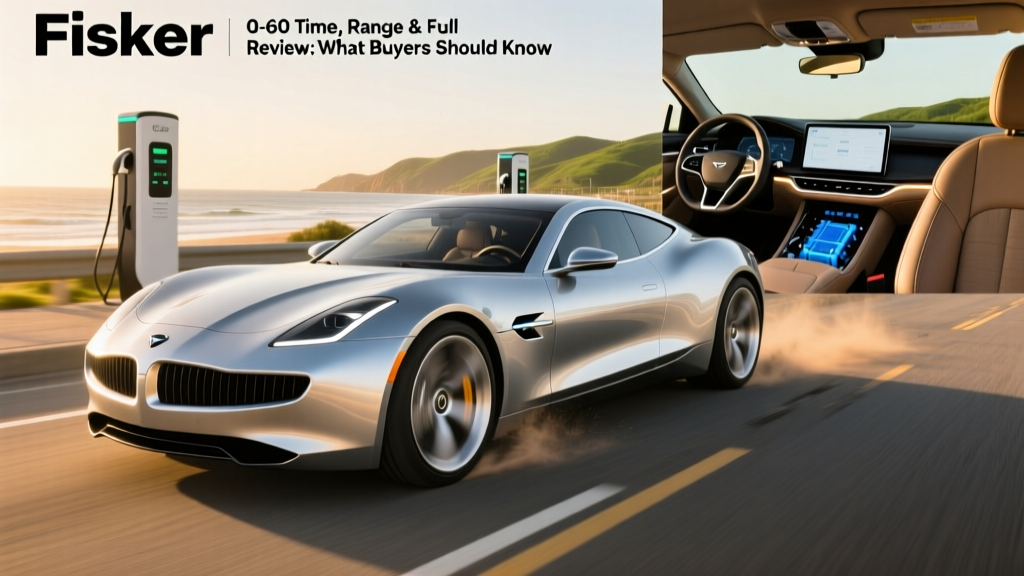
The Fisker Karma occupies a strange corner of the electrified-vehicle world. Originally launched in 2011 as a range-extended electric vehicle (EREV) — not a pure battery-electric car — it promised exotic looks with a gas generator to ease range anxiety. Fisker Automotive folded in 2013, and the platform was later revived by Wanxiang Group as the Karma Revero and subsequently the Karma GS-6 and Karma Gyesera. If you're searching for a Fisker Karma 0-60 time or trying to understand whether this car makes sense as a used or newly revived purchase, this profile breaks down every number that matters.
Because the original Fisker Karma and its successors share the same basic architecture but differ dramatically in specs, we'll cover the original Karma (2011–2012), the Karma Revero (2017–2020), and the latest Karma Gyesera (2025–2026 model years) so you know exactly what you're getting.
Fisker Karma 0-60, Horsepower & Drivetrain Specs
The original Fisker Karma was never a drag-strip car. Its dual rear-mounted electric motors produced a combined 403 hp and 959 lb-ft of torque in Sport mode, with the 2.0L turbocharged GM Ecotec engine acting solely as a generator (it never drives the wheels directly). Here's how the 0-60 mph times stack up across generations:
| Model | Years | Powertrain | Horsepower | Torque (lb-ft) | 0-60 mph | Top Speed |
|---|---|---|---|---|---|---|
| Fisker Karma (original) | 2011–2012 | EREV (dual rear motors + 2.0L generator) | 403 hp | 959 | 5.8 sec | 125 mph |
| Karma Revero | 2017–2020 | EREV (dual rear motors + 1.5L BMW generator) | 403 hp | 959 | 5.4 sec | 125 mph |
| Karma GS-6 | 2021–2023 | EREV (same architecture, updated battery) | 403 hp | 959 | 5.4 sec | 125 mph |
| Karma Gyesera | 2025–2026 | EREV (updated 1.5L gen + larger battery) | 536 hp | 1,100 (est.) | 4.9 sec | 140 mph |
The Fisker Karma 0-60 time of 5.8 seconds was respectable for a 5,300-pound luxury sedan in 2011, but it falls well behind modern EVs. A Tesla Model S Plaid hits 60 in under 2.0 seconds; even a base Tesla Model 3 RWD does it in 5.8 seconds at a fraction of the weight. The Gyesera's claimed 4.9-second sprint is an improvement, but still trails competitors in the $80,000+ electric performance-sedan segment.
All variants use rear-wheel drive via the twin electric motors on the rear axle. There is no AWD option, which matters if you live in a snowy climate — traction control and winter tires are essential.
Battery, Range & Real-World Efficiency
This is where Karma ownership gets complicated. The original Fisker Karma used a 20.1 kWh usable lithium-ion battery (A123 Systems, NMC chemistry), which delivered an EPA-rated 32 miles of electric-only range before the gas generator kicked in. Total range with the generator running was approximately 230 miles.
The EPA's 32-mile EV-only estimate for the original Karma was optimistic. In real-world driving — especially highway speeds above 65 mph or in cold weather (below 40°F) — expect 22–28 miles of pure electric range. The generator extends total range to roughly 200–230 miles, but you're burning premium gasoline at that point, at roughly 52 MPGe combined (electric + gas) per fueleconomy.gov. The Karma Gyesera's larger ~40 kWh pack is expected to deliver around 55–60 miles EV-only, but official EPA figures should be confirmed before purchase.
| Model | Battery (kWh usable) | Chemistry | EV-Only Range (EPA) | Total Range (EV+Gas) | MPGe / MPG |
|---|---|---|---|---|---|
| Fisker Karma (2012) | 20.1 kWh | NMC (A123) | 32 mi | ~230 mi | 52 MPGe / 20 MPG (gas) |
| Karma Revero (2020) | 21.4 kWh | NMC | 33 mi | ~240 mi | 54 MPGe / 21 MPG |
| Karma GS-6 (2022) | 28.0 kWh | NMC | 45 mi | ~280 mi | 60 MPGe / 22 MPG |
| Karma Gyesera (2025) | ~40 kWh (est.) | NMC | ~55 mi (est.) | ~350 mi (est.) | TBD |
For context, a 2026 Toyota Prius Prime PHEV delivers 44 miles of EV-only range from a smaller, lighter package and gets 52 MPG on gas alone. The Karma's value proposition here is design and exclusivity, not efficiency.
Charging Speed: DC Fast & Home Level 2
Charging has historically been one of the Karma platform's weakest points. The original Fisker Karma does not support DC fast charging at all. It charges exclusively via Level 1 (120V) or Level 2 (240V) AC charging.
| Model | DC Fast Charge | Level 2 (240V) Rate | Level 2: Full Charge Time | Level 1 (120V) |
|---|---|---|---|---|
| Fisker Karma (2012) | Not supported | 3.3 kW | ~6 hours (0–100%) | ~14 hours |
| Karma Revero (2020) | Not supported | 6.6 kW | ~3.5 hours | ~8 hours |
| Karma GS-6 (2022) | Not supported | 6.6 kW | ~4.5 hours | ~10 hours |
| Karma Gyesera (2025) | Not supported (est.) | 7.2 kW (est.) | ~5.5 hours | ~12 hours |
This is a critical limitation. Without DC fast charging, road-trip charging means relying exclusively on the gas generator — you cannot pull into an Electrify America or Tesla Supercharger station and add range in 20 minutes. For daily commuting within the EV-only range and overnight home charging, the Level 2 rate is adequate. But if your routine includes frequent longer trips, you'll be running the gasoline generator regularly, which defeats much of the efficiency benefit.
Home Level 2 installation typically costs $800–$2,500 for a 240V/40A circuit (equipment + electrician + permit), depending on your panel capacity and run distance. A licensed electrician should assess your panel before installation.
Pricing, Trims & Federal Tax Credit Eligibility
The original Fisker Karma launched with a base MSRP of approximately $102,000 in 2011–2012. Today, used examples trade for $25,000–$55,000 depending on condition, mileage, and whether the A123 battery was replaced under the original recall program.
The Karma Revero (2017–2020) launched around $130,000, and the GS-6 started near $83,000. The 2025–2026 Karma Gyesera starts at approximately $105,000 (estimated, subject to confirmation from Karma Automotive).
- New Karma Gyesera: At ~$105,000 MSRP, it exceeds the IRS §30D sedan cap of $55,000. It does NOT qualify for the new-vehicle federal credit. Income caps ($150K single / $300K joint) and battery-sourcing/critical-mineral requirements also apply per IRS guidelines.
- Used Karma/Revero/GS-6: The used clean vehicle credit offers up to $4,000 (30% of sale price, max $4,000) for vehicles priced at $25,000 or less, purchased from a dealer. Buyer income caps are $75K single / $150K joint. Most used Karmas above $25K won't qualify.
- State and local incentives may apply — check your state's EV incentive program and consult a tax professional.
Interior, Cargo & Daily Practicality
The Karma's interior is undeniably striking — diamond-stitched leather, reclaimed wood trim, and a low-slung roofline that screams grand tourer. But practicality takes a back seat.
| Spec | Fisker Karma / Revero | 2026 BMW i5 (comparison) |
|---|---|---|
| Front legroom | 42.3 in | 41.5 in |
| Rear legroom | 29.0 in | 36.6 in |
| Cargo volume | 7.0 cu ft (trunk) | 17.3 cu ft |
| Seating capacity | 4 passengers | 5 passengers |
| Curb weight | ~5,300 lbs | ~4,900 lbs |
The 7.0 cu ft trunk is tiny — roughly half the cargo space of a Honda Civic. The battery pack sits between the rear seats and the trunk, eliminating any fold-down capability. Rear legroom at 29 inches is tight for adults on anything beyond short trips. This is a two-person grand tourer in practice, not a family sedan.
The infotainment system in the original Karma is dated by 2026 standards — a small touchscreen with basic navigation and no wireless Apple CarPlay or Android Auto. The Revero and GS-6 updated this with a larger screen and smartphone integration, but the tech still trails mainstream offerings. Driver-assistance features are limited: expect basic stability control and parking sensors, but no adaptive cruise control, lane-keeping assist, or any SAE Level 2 driver-assist system comparable to Tesla Autopilot or GM Super Cruise.
Warranty, Reliability & Battery Replacement Cost
This is the single biggest risk factor for Karma buyers. Fisker Automotive's bankruptcy in 2013 left original Karma owners without factory support for years. Karma Automotive (the Wanxiang-owned successor) has provided limited support for Revero and GS-6 models, but the company's long-term stability remains uncertain.
| Model | Basic Warranty | Battery Warranty | Powertrain |
|---|---|---|---|
| Fisker Karma (2012) | Expired (was 4yr/50K mi) | Expired (was 5yr/60K mi) | Expired |
| Karma Revero (2020) | 4yr/50,000 mi | 8yr/100,000 mi (capacity ≥70%) | 4yr/50,000 mi |
| Karma GS-6 (2022) | 4yr/50,000 mi | 8yr/100,000 mi | 4yr/50,000 mi |
| Karma Gyesera (2025) | 4yr/50,000 mi (est.) | 8yr/100,000 mi (est.) | 4yr/50,000 mi (est.) |
Battery replacement cost is a serious concern. The original Karma's A123 battery pack replacement ran $8,000–$12,000 when available. For the Revero/GS-6, expect $12,000–$18,000 for a replacement pack, assuming parts availability. Given Karma Automotive's low production volumes and uncertain supply chain, sourcing a replacement battery could take weeks or months.
Reliability data is sparse due to low production numbers (fewer than 2,500 original Karmas were built). Common issues reported by owners include:
- A123 battery cell failures (many replaced under the 2012 recall)
- Generator/engine mount vibrations
- Electrical gremlins in the infotainment and HVAC systems
- Solar roof panel failures (the Karma's signature roof-mounted solar panel contributed minimal charge — ~200W — and is expensive to replace)
Pros & Cons: The Honest Verdict
✓ Pros
- Head-turning design — still one of the most distinctive sedans on the road
- Massive torque (959 lb-ft) delivers strong initial acceleration feel
- EREV architecture eliminates pure range anxiety (gas generator backup)
- Exclusivity — you will not see another one at the stoplight
- Solar roof panel (novelty, if not practically significant)
✗ Cons
- No DC fast charging — a dealbreaker for road-trip EV drivers
- Tiny 7 cu ft trunk and cramped rear seats
- Short EV-only range (32–45 mi) vs. modern PHEVs
- Manufacturer bankruptcy history raises parts/service risk
- Outdated infotainment and zero advanced driver assists
- Does NOT qualify for the $7,500 federal EV tax credit (MSRP cap)
- Heavy curb weight hurts efficiency and tire wear
Who Should Buy the Fisker Karma (And Who Shouldn't)
Decision Framework
Choose the Fisker Karma / Revero if:
- You want a design-first exotic sedan and accept the practicality trade-offs
- Your daily commute is under 30 miles and you can charge at home every night
- You view the car as a weekend/collector vehicle, not a primary daily driver
- You've verified battery health and service availability in your area
Choose a competitor (BMW i5, Porsche Taycan, Tesla Model S, Mercedes EQE) if:
- You need DC fast charging for road trips
- You carry rear-seat passengers regularly
- You want modern driver-assist technology (adaptive cruise, lane-keeping)
- You want a reliable warranty network and predictable service costs
- You need cargo space for luggage, groceries, or child seats
Frequently Asked Questions
What is the Fisker Karma's 0-60 mph time?
The original 2011–2012 Fisker Karma achieves 0-60 mph in 5.8 seconds in Sport mode. The Karma Revero improved slightly to 5.4 seconds, and the 2025 Karma Gyesera claims approximately 4.9 seconds. These times trail modern performance EVs significantly.
Is the Fisker Karma a fully electric car?
No. The Fisker Karma is a range-extended electric vehicle (EREV). It drives exclusively on its electric motors, but carries a gasoline engine (2.0L turbo in the original, 1.5L BMW-sourced in later models) that acts as a generator to recharge the battery when it depletes. It is not a plug-in hybrid in the traditional sense — the engine never drives the wheels.
Does the Fisker Karma qualify for the federal EV tax credit?
The original Fisker Karma is only available used, and most examples exceed the $25,000 price cap for the used clean vehicle credit ($4,000 max). The new Karma Gyesera's estimated ~$105,000 MSRP far exceeds the $55,000 sedan cap for the new-vehicle §30D credit. Always verify current IRS rules and consult a tax professional.
How much does it cost to replace the Fisker Karma battery?
Replacement battery packs for the original Karma ran $8,000–$12,000 when available. For the Revero and GS-6, expect $12,000–$18,000. Parts availability is a concern given Karma Automotive's low production volumes.
Can I DC fast-charge a Fisker Karma?
No. No generation of the Karma platform supports DC fast charging. Charging is limited to Level 1 (120V) and Level 2 (240V AC, up to 7.2 kW on the latest models). This is a major practical limitation for any driver who takes longer trips.
What's the real-world electric-only range?
The EPA rated the original Karma at 32 miles EV-only. In real-world conditions — highway speeds, cold weather, or aggressive acceleration — expect 22–28 miles. The GS-6's larger battery improved this to roughly 35–40 real-world miles, and the Gyesera targets 50+ miles, though official EPA data should be confirmed.