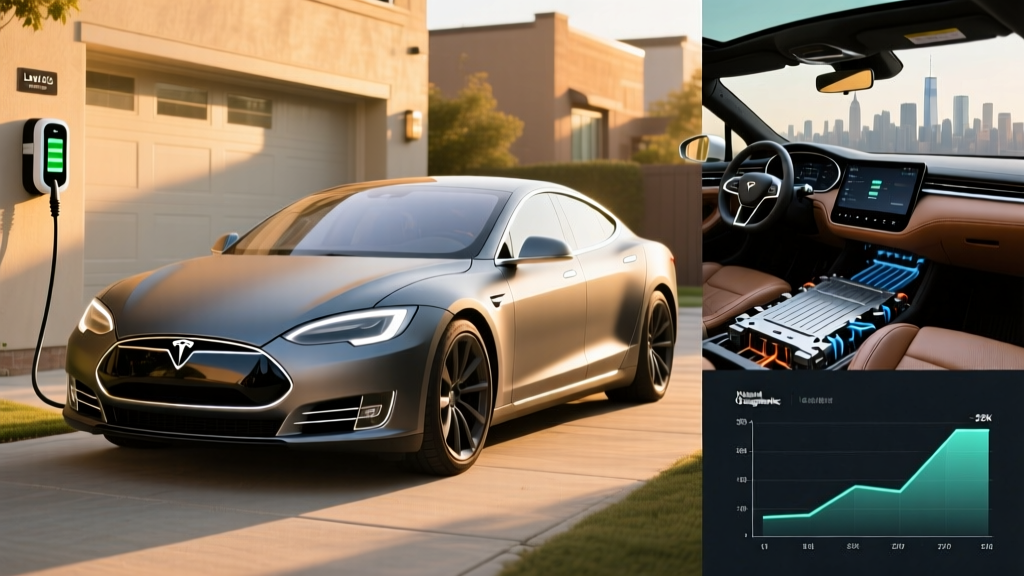
The first generation Tesla Model S — produced from 2012 through the major 2021 Palladium refresh — remains one of the most consequential electric vehicles ever built. It proved that a battery-electric sedan could compete with luxury flagships on performance, range, and technology. In 2026, these early Model S sedans are flooding the used-EV market at tempting prices, often between $15,000 and $35,000 depending on year, mileage, and battery health. But buying a decade-old EV is fundamentally different from buying a used gas car: the traction battery is the single most expensive component, and its state of health (SoH) determines whether you're getting a bargain or a liability.
This guide covers every critical data point a used-EV shopper needs: real-world range across the 60, 75, 85, 90, and 100 kWh variants, battery chemistry and degradation patterns, DC fast-charge and Level 2 speeds, maintenance realities, and whether the federal used-EV tax credit applies. If you're considering a first generation Tesla Model S in 2026, this is the spec-driven breakdown you need before signing a bill of sale.
First Generation Tesla Model S: Key Specifications at a Glance
The first generation Model S spanned nearly a decade of production with multiple battery packs, motor configurations, and software-locked variants. The table below consolidates the most common configurations you'll encounter on the used market in 2026. Note that Tesla frequently adjusted these figures via over-the-air updates and mid-year production changes.
| Variant | Battery (kWh Usable) | Chemistry | EPA Range (mi) | 0-60 mph (sec) | Horsepower | Drivetrain | MPGe (Combined) |
|---|---|---|---|---|---|---|---|
| Model S 60 (2014–2017) | ~60 (software-limited from 75) | NMC (Nickel Manganese Cobalt) | 208 (2014), 210 (2016–17) | 5.5–5.8 | 315–328 | RWD / AWD | 95–101 |
| Model S 75 (2016–2017) | ~72.5 usable (75 gross) | NMC | 249 | 4.3–4.5 | 328–362 | RWD / AWD | 101–104 |
| Model S 85 (2012–2016) | ~81 usable (85 gross) | NMC (Panasonic) | 265 (2012–14), 253 (2015–16) | 5.4–5.6 | 362–416 | RWD / AWD (Dual Motor) | 89–95 |
| Model S 90D (2015–2017) | ~83.5 usable (90 gross) | NMC (Panasonic) | 294 | 4.2 | 417–518 | AWD (Dual Motor) | 101–104 |
| Model S P100D (2016–2020) | ~98 usable (100 gross) | NMC (Panasonic) | 315–335 | 2.5 (Ludicrous) | 670–762 | AWD (Dual Motor) | 98–102 |
| Model S 100D (2017–2020) | ~98 usable (100 gross) | NMC (Panasonic) | 335 | 4.2 | 518–670 | AWD (Dual Motor) | 102 |
All first generation Model S variants use NMC (nickel manganese cobalt) lithium-ion cells supplied by Panasonic. Tesla did not introduce LFP (lithium iron phosphate) chemistry into the Model S lineup — LFP was reserved for the standard-range Model 3 and Model Y. This matters for degradation behavior, which we cover in detail below.
Real-World Range: What the EPA Sticker Doesn't Tell You
EPA estimates for the first generation Model S range from 208 miles (60 kWh) to 335 miles (100D). These figures were established under controlled laboratory testing on the fueleconomy.gov cycle.
Real-world expectations in 2026:
• Highway driving (70–80 mph): Expect 15–22% less than EPA. A P100D rated at 315 miles EPA will deliver approximately 245–265 miles at sustained highway speed.
• Cold weather (below 32°F / 0°C): Range loss of 25–40% is common. An 85 kWh Model S rated at 265 miles EPA may deliver only 160–195 miles in sub-freezing conditions due to cabin heating demands and reduced battery efficiency.
• Battery degradation factor: A 2015 Model S 85 with original battery and 120,000 miles may have lost 10–18% of original capacity, further reducing real-world range to 180–220 miles in mixed driving.
• Best-case city driving (mild weather, regenerative braking active): Some owners report matching or slightly exceeding EPA figures in stop-and-go traffic at moderate temperatures.
The first generation Model S lacks a heat pump (introduced with the 2021 Palladium refresh). Instead, it uses resistive cabin heating, which draws significant power from the traction battery in cold weather. This is the single largest contributor to winter range loss. If you live in a climate with extended sub-freezing temperatures, budget for at least 30% range reduction and plan charging stops accordingly.
Preconditioning the battery — warming it to optimal temperature before driving or fast-charging — is essential in cold weather. The Model S allows scheduled preconditioning via the Tesla app, and enabling this feature can recover 5–10% of range that would otherwise be lost to cold-soak inefficiency.
Charging Speeds: DC Fast, Level 2, and the Supercharger Network
Charging infrastructure was a major selling point for the first generation Model S, and Tesla's proprietary Supercharger network remains a significant ownership advantage in 2026. However, charging speeds on these older vehicles are substantially slower than current-generation EVs, and buyers need realistic expectations.
| Charging Level | Power (kW) | Rate (miles of range per hour) | Notes |
|---|---|---|---|
| Level 1 (120V household) | ~1.2–1.4 kW | 3–4 mi/hr | Emergency/trickle only; 85 kWh pack takes 60+ hours |
| Level 2 (240V, 40A onboard charger — early models) | ~10 kW | 29–31 mi/hr | 2012–2015 models with single onboard charger |
| Level 2 (240V, 48A — dual charger or later models) | ~11.5 kW | 34–37 mi/hr | Dual-charger option or 2016+ standard |
| Level 2 (240V, 72A — High Power Wall Connector, dual charger) | ~17.3 kW | 52–58 mi/hr | Requires optional dual onboard chargers; rare on used market |
| DC Fast Charge (Tesla Supercharger V1/V2) | Peak 120–150 kW | ~170–200 mi in 30 min | 10–80% in approximately 40–50 minutes; tapers significantly above 80% |
| DC Fast Charge (CCS adapter on Supercharger V3/V4) | Peak 150 kW (hardware-limited) | ~170–200 mi in 30 min | CCS adapter (~$250) required for non-Tesla DC networks; car cannot accept full 250–350 kW from V3/V4 stalls |
Understanding the charge curve: DC fast-charging speed is not constant. A first generation Model S at a Supercharger V2 stall will peak at approximately 120–150 kW when the battery is between 10–30% state of charge (SoC). As SoC climbs, the battery management system (BMS) reduces charge rate to protect cell health. By 60% SoC, you're typically seeing 60–80 kW. By 80%, it drops to 30–40 kW. Charging from 80% to 100% on DC fast charge can take as long as the first 80%. For road trips, plan to charge to 80% and move on — the time penalty for topping off is severe.
CCS adapter note: The first generation Model S uses Tesla's proprietary connector. In 2026, Tesla has opened many Supercharger stalls to non-Tesla EVs, but first generation Model S owners may need Tesla's CCS adapter (approximately $250 from Tesla) to access Electrify America, EVgo, and other CCS-based DC fast-charging networks. The car's hardware limits it to approximately 150 kW regardless of the charger's maximum output — you won't see 350 kW speeds even at a V4 stall.
Battery Health, Degradation, and Replacement Costs
The traction battery is the most critical — and most expensive — component in any used EV. The first generation Model S uses Panasonic-manufactured NMC cells in a liquid-cooled pack. Tesla's battery management system (BMS) actively monitors cell temperature and voltage, and the liquid cooling system was a significant advantage over early air-cooled competitors like the Nissan Leaf.
Observed degradation data: According to aggregated owner data and third-party analyses, first generation Model S batteries typically show the following degradation patterns:
- Years 1–2 (0–30,000 miles): 3–5% capacity loss (rapid initial degradation, typical of NMC chemistry)
- Years 3–5 (30,000–80,000 miles): Additional 3–5% loss, totaling 6–10% from new
- Years 6–10 (80,000–150,000 miles): Degradation slows; total loss of 10–18% is common
- High-mileage examples (150,000+ miles): 15–22% degradation observed; some packs remain functional at 80%+ SoH
Battery warranty: Tesla's original battery and drive unit warranty for the first generation Model S was 8 years with unlimited miles for the 85 kWh and larger packs, and 8 years / 125,000 miles for the 60 kWh pack. The warranty guarantees the battery will retain at least 70% of its original capacity. In 2026, most first generation Model S vehicles have exceeded their original battery warranty period unless they are 2018–2020 model years with low mileage.
Battery replacement cost: If the battery falls outside warranty coverage, replacement is a significant expense:
- Remanufactured 85 kWh pack: $12,000–$16,000 (parts and labor at a Tesla Service Center)
- Remanufactured 100 kWh pack: $15,000–$20,000
- Third-party replacement or refurbishment: $8,000–$14,000 through independent EV shops, though availability varies and may void remaining warranty coverage
Before purchasing, always: Request a battery health report from Tesla (available through the service menu in the car's touchscreen or via a pre-purchase inspection at a Tesla Service Center). Look for State of Health (SoH) above 85% on any vehicle you're seriously considering. A car at 78% SoH may still be functional, but it signals accelerated degradation and a potential replacement expense within 2–4 years.
Performance, Driving Dynamics, and Efficiency
The first generation Model S redefined performance expectations for electric sedans. Even the base 60 kWh variant delivers responsive, linear acceleration that outperforms most gasoline sedans in its class. The P100D with Ludicrous mode remains one of the quickest production sedans ever made, with a 2.5-second 0-60 mph time that rivals hypercars costing ten times as much.
Efficiency (MPGe and kWh/100mi): Efficiency varies by configuration. Per fueleconomy.gov, the Model S 100D achieves approximately 102 MPGe combined (33 kWh/100mi). The lighter 85 kWh RWD models achieve around 89–95 MPGe (36–38 kWh/100mi). These figures are competitive for a large luxury sedan but less efficient than smaller, lighter EVs like the Model 3 or Hyundai Ioniq 6. Real-world efficiency on the highway at 75+ mph typically rises to 38–42 kWh/100mi due to aerodynamic drag.
Suspension and ride quality: Early Model S vehicles (2012–2015) use a conventional coil-spring suspension. The optional adaptive air suspension, available from launch and standard on higher trims from 2016 onward, provides adjustable ride height and damping. Air suspension failures are a known issue on high-mileage examples — replacement air struts cost approximately $1,500–$2,500 per corner. Budget for this if the vehicle has 80,000+ miles and original air suspension.
Interior, Cargo, and Technology
The first generation Model S interior was polarizing at launch and has aged unevenly. The 17-inch portrait touchscreen was revolutionary in 2012 but early versions suffer from slow response times, yellowing, and delamination (a known issue on 2012–2015 models, often covered under an extended service campaign). The 2016 refresh introduced updated materials, a larger center console, and improved build quality.
Cargo capacity:
- Rear cargo (seats up): 26.3 cu ft
- Rear cargo (seats folded): 58.1 cu ft
- Front trunk (frunk): 5.3 cu ft
- Total cargo volume: 63.4 cu ft — competitive with midsize SUVs and far more than any conventional sedan
Seating: Standard seating for five. A rear-facing third-row jump seat was available on 2012–2015 models (seating for seven total), but it was extremely cramped and has been recalled for safety concerns. Avoid vehicles with the third-row seat or confirm it has been removed under the recall.
Driver assistance — Autopilot: The first generation Model S offers Tesla's Autopilot system, which is an SAE Level 2 driver-assistance feature. It includes adaptive cruise control, lane-keeping assist, and (on vehicles with Enhanced Autopilot or Full Self-Driving capability) automatic lane changes, Navigate on Autopilot, and Smart Summon.
Tesla's Autopilot and FSD (Supervised) on the first generation Model S are SAE Level 2 systems. The driver must remain fully attentive, keep hands on the steering wheel, and be prepared to take over at any moment. These systems do not make the vehicle autonomous. Only Level 4 services like Waymo operate without a human driver, and those are limited to specific geofenced areas. Never treat Autopilot or FSD as a substitute for active driving.
Infotainment and connectivity: Early Model S vehicles (2012–2015) run on older NVIDIA Tegra-based hardware that is noticeably slow by 2026 standards. Tesla offered a paid MCU (Media Control Unit) upgrade to the newer Intel Atom-based MCU2, which significantly improves responsiveness and enables newer software features. If the vehicle you're considering still has the original MCU1, factor in approximately $1,500–$2,500 for the upgrade, or accept the sluggish performance. Standard features include navigation, Bluetooth, Wi-Fi, and (on most examples) a premium audio system. Apple CarPlay and Android Auto are not supported natively, though third-party integration boxes are available.
Pricing, Tax Credits, and Total Cost of Ownership
The first generation Tesla Model S was never eligible for the new-vehicle federal tax credit under IRS §30D for most of its production run (the credit phased out for Tesla buyers in 2019). However, in 2026, a used-EV buyer may qualify for the Used Clean Vehicle Credit under IRS §25E, which provides up to $4,000 or 30% of the sale price (whichever is less) for qualifying pre-owned electric vehicles.
| Model Year / Variant | Typical Used Price Range | Max Used EV Credit (§25E) | Effective Price After Credit |
|---|---|---|---|
| 2012–2014 Model S 85 | $12,000–$18,000 | $3,600–$4,000 | $8,000–$14,400 |
| 2015–2016 Model S 90D | $18,000–$25,000 | $4,000 | $14,000–$21,000 |
| 2016–2017 Model S P100D | $28,000–$38,000 | $4,000 | $24,000–$34,000 |
| 2017–2020 Model S 100D | $25,000–$35,000 | $4,000 | $21,000–$31,000 |
| 2018–2020 Model S Long Range | $30,000–$42,000 | $4,000 | $26,000–$38,000 |
§25E Used EV Credit eligibility requirements (per IRS.gov):
- Sale price must be $25,000 or less to qualify for the full $4,000 credit (the credit is 30% of sale price, capped at $4,000)
- Buyer's adjusted gross income must not exceed: $75,000 (single), $112,500 (head of household), $150,000 (married filing jointly)
- Vehicle must be at least two model years old
- Vehicle must be purchased from a licensed dealer (private-party sales do not qualify)
- The credit can only be claimed once per vehicle (check the VIN's credit history)
- Buyer must not have claimed the used-EV credit in the prior three years
Important: Many first generation Model S vehicles sell above the $25,000 price cap, especially P100D and 100D variants. For a $35,000 P100D, the credit would be 30% of $25,000 = $4,000 (the cap applies to the sale price threshold, not the credit calculation). Consult a tax professional and verify current-year rules on irs.gov before relying on this credit, as eligibility rules and availability are subject to legislative change.
Total cost of ownership considerations:
- Insurance: Model S insurance premiums are above average for the EV segment. Expect $1,800–$2,800 annually depending on your location, driving record, and coverage level.
- Maintenance: No oil changes, spark plugs, or transmission fluid. Expect to budget for cabin air filters ($100–$200/yr), brake fluid flushes ($150–$200 every 2 years), wiper blades, and tires ($800–$1,500 for a set of four; the Model S's weight and torque wear tires faster than gas sedans).
- Known failure points: Drive unit (motor) replacement ($5,000–$8,000), air suspension struts ($1,500–$2,500 each), MCU screen delamination ($1,500–$2,500 for upgrade), 12V auxiliary battery ($300–$500), door handles ($400–$800 each — a notorious failure point on 2012–2016 models).
- Charging cost: At the 2026 national average of $0.16/kWh, charging a 100 kWh Model S from empty to full at home costs approximately $16. Supercharger pricing varies by location but averages $0.28–$0.36/kWh, making a full charge $28–$36.
Pros and Cons: The Honest Assessment
- Class-leading cargo space (63.4 cu ft) with frunk and fold-flat rear seats
- Access to Tesla Supercharger network — still the most reliable DC fast-charging ecosystem in North America
- Over-the-air software updates continue to add features to older vehicles
- P100D performance is extraordinary (2.5 sec 0-60) at a fraction of its original $140,000+ price
- Liquid-cooled battery with proven longevity; many packs exceed 150,000 miles at 80%+ SoH
- No gasoline, oil changes, or transmission maintenance
- Strong resale community and third-party parts/support ecosystem
- No heat pump — severe cold-weather range loss (25–40%)
- DC fast-charging limited to ~150 kW peak; slower than modern EVs at V3/V4 Superchargers
- Out-of-warranty battery replacement costs $12,000–$20,000
- Known reliability issues: door handles, air suspension, MCU screen, drive unit
- No Apple CarPlay or Android Auto; infotainment feels dated on MCU1 hardware
- Insurance premiums above average for the segment
- Build quality inconsistent on 2012–2015 models; panel gaps, rattles, and water leaks reported
- Autopilot hardware on 2012–2016 models (HW1) is obsolete and cannot run current FSD software
Who Should Buy a First Generation Tesla Model S?
Choose the first generation Model S if:
• You need a spacious electric sedan with SUV-level cargo capacity
• You primarily drive in mild-to-moderate climates (less cold-weather range penalty)
• You value Supercharger network access for road trips
• You're comfortable budgeting $2,000–$5,000/year for potential out-of-warranty repairs
• You want performance-sedan acceleration at a used-EV price
• You can charge at home with Level 2 (240V) and don't rely solely on public charging
Look elsewhere if:
• You live in a very cold climate and need maximum winter range (consider a newer EV with a heat pump)
• You want the latest infotainment, CarPlay/Android Auto, or current-generation ADAS hardware
• You need guaranteed low maintenance costs — a used Model S is a luxury car with luxury repair bills
• You want DC fast-charging speeds above 200 kW for frequent long-distance travel
• You're on a tight budget and can't absorb a $12,000–$20,000 battery replacement risk
Frequently Asked Questions
What is the real-world range of a first generation Tesla Model S?
Real-world range depends on the specific variant, battery health, driving conditions, and climate. A well-maintained Model S 100D with 90% battery health will deliver approximately 270–290 miles in mixed driving in moderate weather. Highway-only driving at 75 mph reduces this to 230–260 miles. In sub-freezing temperatures, expect 180–220 miles from the same vehicle. Always check the specific car's battery health report before purchase — a degraded battery significantly reduces all of these figures.
How fast does the first generation Model S charge?
On a Tesla Supercharger V2 (the most common type these cars were designed for), peak charge rate is approximately 120–150 kW, with a 10–80% charge taking about 40–50 minutes. On a Level 2 home charger at 48 amps (11.5 kW), you'll add approximately 34–37 miles of range per hour, with a full charge of an 85 kWh pack taking about 8–9 hours. The car's hardware limits it to approximately 150 kW DC fast charging regardless of the charger's maximum output.
Does a used first generation Model S qualify for any federal tax credit?
It may qualify for the Used Clean Vehicle Credit (§25E), which provides up to $4,000 (30% of the sale price, capped at $4,000) if the sale price is $25,000 or less and you meet income requirements ($75,000 single / $150,000 married filing jointly). The vehicle must be purchased from a licensed dealer, and you must not have claimed this credit in the prior three years. It does NOT qualify for the new-vehicle §30D credit. Always verify current rules on IRS.gov and consult a tax professional.
Is the first generation Model S worth buying vs. a newer used EV?
It depends on your priorities. The first generation Model S offers unmatched cargo space, Supercharger access, and (in P100D form) supercar-level performance at used prices starting around $15,000. However, it lacks a heat pump, charges slower than modern EVs, and carries significant out-of-warranty repair risk. A used 2019–2021 Model 3 Long Range may offer similar range, newer hardware, CarPlay support, and lower maintenance risk at a comparable price — but with far less cargo room. Test-drive both and weigh the trade-offs for your specific needs.
What are the most common problems with the first generation Model S?
The most frequently reported issues include: door handle mechanism failure ($400–$800 per handle), air suspension strut leaks ($1,500–$2,500 per corner), MCU1 touchscreen delamination and yellowing ($1,500–$2,500 for MCU2 upgrade), drive unit (motor) failure on high-mileage examples ($5,000–$8,000), and 12V auxiliary battery failure ($300–$500). Battery degradation is gradual and predictable, but a full pack replacement outside warranty costs $12,000–$20,000. A pre-purchase inspection at a Tesla Service Center is strongly recommended.
Can the first generation Model S use Tesla's latest Autopilot or FSD features?
It depends on the hardware generation. Vehicles built before October 2016 have Hardware 1 (HW1), which supports only basic Autopilot (adaptive cruise, lane keeping) and cannot run current FSD software. Vehicles built from October 2016 onward have HW2, HW2.5, or HW3, which support Enhanced Autopilot and FSD (Supervised) — though Tesla has offered hardware upgrades to HW3 or HW4 for some older vehicles. Even with the latest hardware and software, remember that Autopilot and FSD are SAE Level 2 driver-assist systems requiring full driver attention at all times.