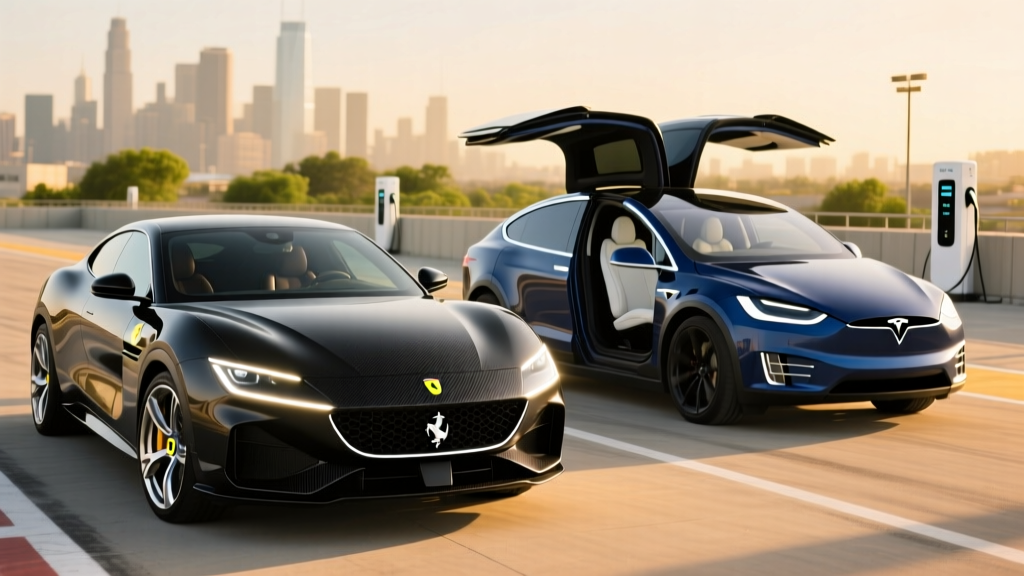
The phrase Ferrari Tesla has dominated EV forum debates for years — usually as a hypothetical. In 2026, it's finally a real comparison. Ferrari's first all-electric model (codenamed E137, widely referred to as the electric Purosangue successor or Ferrari EV GT) is expected to arrive as a 2027 model-year vehicle with preliminary specifications now circulating. Meanwhile, the Tesla Model X continues as the established luxury electric SUV benchmark. This guide breaks down what we know, what's confirmed, and where each stands for buyers cross-shopping ultra-luxury and tech-forward EVs.
Confirmed and Estimated Specifications at a Glance
| Specification | Ferrari EV (E137)* | Tesla Model X Plaid | Tesla Model X Long Range |
|---|---|---|---|
| EPA Range (est.) | ~310 mi (est.) | 326 mi (EPA) | 348 mi (EPA) |
| Battery Capacity | ~120 kWh usable (est., NMC) | 100 kWh usable (NMC/NCA) | 100 kWh usable (NMC/NCA) |
| Horsepower | ~1,000 hp (est., quad-motor) | 1,020 hp (tri-motor AWD) | 670 hp (dual-motor AWD) |
| 0–60 mph | ~2.5 sec (est.) | 2.5 sec | 3.8 sec |
| Max DC Fast Charge | ~270 kW (est., 800V arch.) | 250 kW (Supercharger) | 250 kW (Supercharger) |
| 10–80% DC Time | ~22 min (est.) | ~30 min | ~30 min |
| Level 2 Home Charge | ~22 kW (est.) | 11.5 kW / 48A | 11.5 kW / 48A |
| Drivetrain | Quad-motor AWD (est.) | Tri-motor AWD | Dual-motor AWD |
| Base MSRP | ~$500,000+ (est.) | $109,990 | $79,990 |
| EPA Efficiency (MPGe) | TBD | 102 MPGe combined | 104 MPGe combined |
| Battery Warranty | TBD (likely 8 yr/unlimited mi) | 8 yr / 150,000 mi | 8 yr / 150,000 mi |
| Federal Tax Credit (§30D) | Not eligible (MSRP cap) | Not eligible (MSRP cap) | Not eligible (MSRP cap) |
*Ferrari E137 figures are preliminary estimates based on industry reporting and Ferrari's confirmed 800V architecture investment. Final specs pending official unveiling.
Range: EPA Stickers vs. Real-World Driving
EPA Estimate: 348 miles
Real-World Highway (70 mph, 72°F): ~285–310 miles
Real-World Cold Weather (30°F, mixed driving): ~240–275 miles
Why the gap: The Model X's boxy SUV profile creates significant aerodynamic drag at highway speeds, reducing efficiency by 10–18% vs. city driving. Cold temperatures increase battery internal resistance and cabin heating demands, further cutting range.
The Tesla Model X Long Range achieves an EPA-estimated 348 miles on its 100 kWh (usable) battery pack, while the Plaid variant drops to 326 miles due to its performance-tuned tri-motor setup. According to fueleconomy.gov, the Long Range returns 104 MPGe combined.
For the Ferrari EV, the estimated ~310-mile range reflects a different priority: Ferrari has confirmed an 800-volt architecture and a battery developed in partnership with a major cell supplier (likely SK On or Samsung SDI). The focus is on sustained high-speed performance and charge rate rather than maximum distance. Expect real-world highway range closer to 250–280 miles given the performance-oriented powertrain and likely aggressive tire compound.
Charging Speed: Peak kW, Sustained Curves, and Home Setup
| Charging Level | Ferrari EV (E137, Est.) | Tesla Model X | Miles Added per Hour |
|---|---|---|---|
| Level 1 (120V / 12A) | ~1.4 kW | ~1.4 kW | ~3–4 mi/hr |
| Level 2 (240V / 48A) | ~22 kW (est.) | 11.5 kW | ~30–52 mi/hr |
| DC Fast Charge (Peak) | ~270 kW (est.) | 250 kW | N/A (see 10–80%) |
| 10–80% DCFC Time | ~22 min (est.) | ~30 min | N/A |
kW vs. kWh reminder: kW (kilowatts) measures charging power — how fast energy flows into the battery. kWh (kilowatt-hours) measures battery capacity — how much energy the battery stores. A 250 kW charger delivers energy faster than a 150 kW charger, but both fill the same kWh battery.
The Model X peaks at 250 kW on Tesla's V3 Superchargers, but like most EVs, it doesn't sustain peak rate for the entire session. The charge curve tapers significantly above 50% state of charge (SoC), and drops sharply past 80%. A typical 10–80% session takes approximately 30 minutes under optimal conditions (preconditioned battery, warm ambient temperature, V3 stall availability).
The Ferrari EV is expected to leverage its 800V architecture (similar to the Porsche Taycan and Hyundai Ioniq 5) to achieve faster sustained charging. An 800V system can accept higher power without excessive current, reducing heat buildup. If the estimated 270 kW peak holds, the 10–80% time of ~22 minutes would be competitive with the fastest-charging EVs on the market. However, real-world charge sessions depend heavily on battery preconditioning — arriving at a charger cold can double your charging time.
Performance: Where Ferrari's DNA Meets Electric Torque
The Tesla Model X Plaid remains one of the quickest production SUVs ever built. Its tri-motor powertrain produces 1,020 horsepower and rockets to 60 mph in 2.5 seconds. The Long Range dual-motor variant delivers 670 hp and a 3.8-second 0–60 — still brutally quick by any standard.
Ferrari's electric GT is expected to use a quad-motor layout (one motor per wheel) producing approximately 1,000 horsepower. Ferrari has confirmed active torque vectoring at each wheel, which should deliver cornering dynamics no Tesla can match. The estimated 0–60 time of ~2.5 seconds puts it in the same acceleration bracket, but Ferrari's development focus is on lap-time capability and high-speed stability, not just drag-strip numbers.
Where the Model X excels is daily usability: adaptive air suspension, a spacious cabin, and Tesla's continuously updated software. Where the Ferrari will excel is on a canyon road or track — areas where Tesla has never prioritized development.
Pricing, Trims, and Federal Tax Credit Reality
| Model | Base MSRP | As-Tested / Typical Config | §30D Federal Tax Credit |
|---|---|---|---|
| Tesla Model X Long Range | $79,990 | $85,000–$95,000 | Not eligible (exceeds $80,000 SUV MSRP cap) |
| Tesla Model X Plaid | $109,990 | $115,000–$130,000 | Not eligible (exceeds $80,000 SUV MSRP cap) |
| Ferrari EV (E137) | ~$500,000+ (est.) | $550,000–$700,000+ (est.) | Not eligible (exceeds $80,000 SUV MSRP cap) |
Neither vehicle qualifies for the $7,500 federal EV tax credit under IRS §30D rules. The law caps eligible SUVs at an $80,000 MSRP, and both vehicles far exceed that threshold. Additionally, §30D imposes buyer income limits ($300,000 joint / $150,000 single modified adjusted gross income) and battery critical-mineral sourcing requirements. For full details, consult the IRS clean vehicle credit page.
At this price tier, buyers are not making purchase decisions based on a $7,500 incentive. Total cost of ownership diverges sharply: the Model X benefits from Tesla's Supercharger network reliability, lower maintenance costs (no Ferrari dealer service premiums), and strong software support. The Ferrari will carry exotic-car insurance premiums, limited service center availability, and likely steep first-year depreciation typical of ultra-luxury vehicles.
Interior, Cargo, and Technology
The Model X offers genuine SUV utility: 92.3 cubic feet of total cargo space (with rear seats folded), seating for up to seven, and the signature front trunk (frunk) adding additional storage. Second-row legroom measures 41.1 inches. The 17-inch center touchscreen runs Tesla's latest software with native navigation, streaming, and over-the-air updates.
Driver assistance comes via Tesla Autopilot (standard) and Full Self-Driving Supervised ($8,000 option). Important: FSD is SAE Level 2, meaning the driver must remain fully engaged with hands on the wheel and eyes on the road at all times. It is not autonomous driving.
Ferrari's EV interior details remain under wraps, but the company has confirmed a focus on driver-centric design with minimal screen reliance — a contrast to Tesla's tablet-forward approach. Expect premium leather, carbon fiber trim, and Ferrari's traditional craftsmanship at a half-million-dollar price point. Cargo space will likely be limited (grand tourer proportions, not SUV utility), and rear seating will prioritize two passengers over family hauling.
Who Should Buy Which?
- You need daily-driver practicality with 5–7 seat capacity
- You road-trip frequently and want reliable Supercharger access
- You want OTA software updates and cutting-edge infotainment
- Your budget is $80,000–$130,000
- You value low running costs (home charging at ~$0.13/kWh ≈ $0.04/mile)
- You want an exotic grand tourer with EV performance
- Track capability and handling dynamics are top priorities
- Budget is not a constraint ($500,000+)
- You already own a practical daily driver and want a weekend car
- Exclusivity and brand prestige matter more than cargo space
Pros and Cons
- 348-mile EPA range (Long Range) reduces charging stops
- 250 kW Supercharger network with 50,000+ stalls globally
- Class-leading cargo and passenger space
- Continuous OTA updates improve the car over time
- Strong safety ratings from NHTSA
- Falcon-wing doors prone to sensor issues and leaks historically
- Build quality inconsistency (panel gaps, interior rattles)
- Highway range drops 15–18% vs. EPA at sustained 75+ mph
- No federal tax credit at current MSRP
- Insurance premiums above segment average
- Quad-motor torque vectoring for unmatched handling
- 800V architecture for faster sustained DC charging
- Ferrari brand prestige and exclusivity
- Expected ~1,000 hp with track-capable thermal management
- Bespoke interior craftsmanship
- $500,000+ price eliminates most buyers
- Limited cargo/passenger practicality
- Charging network access outside Tesla ecosystem (CCS/NACS adapters needed)
- Likely steep first-year depreciation
- Fewer service centers; exotic-car maintenance costs
Frequently Asked Questions
What is the real-world range of the Tesla Model X?
The EPA rates the Model X Long Range at 348 miles and the Plaid at 326 miles. In real-world highway driving at 70–75 mph, expect 285–310 miles (Long Range) and 265–290 miles (Plaid). Cold weather (below freezing) can reduce range by an additional 20–30% due to battery resistance and cabin heating load.
How fast does the Tesla Model X charge at home and on the road?
At home on a Level 2 (240V/48A) charger, the Model X adds approximately 30 miles of range per hour — a full overnight session (10 hours) restores roughly 300 miles. On a Tesla V3 Supercharger (250 kW DC), a 10–80% session takes about 30 minutes with a preconditioned battery. Charging slows considerably above 80% to protect battery longevity.
Does either vehicle qualify for the federal EV tax credit?
No. Under IRS §30D rules, SUVs must have an MSRP at or below $80,000 to qualify. The Model X starts at $79,990 for the Long Range but typical configurations exceed the cap, and the Plaid is well above it. The Ferrari EV, at an estimated $500,000+, is far beyond eligibility. Buyers should also note income caps and battery-sourcing requirements that further limit eligibility.
Is the Ferrari EV worth waiting for vs. buying a Model X now?
These serve entirely different buyers. If you need a practical, daily-drivable electric SUV with family seating and road-trip charging infrastructure, the Model X is available today and proven. If you're an exotic-car collector seeking Ferrari's first EV and budget is not a concern, the E137 is worth tracking — but it won't arrive until 2027 at the earliest, and final specs may differ from current estimates.
Can I charge a Ferrari EV at Tesla Superchargers?
This depends on the connector Ferrari adopts. If Ferrari equips the E137 with NACS (Tesla's connector, now widely adopted by Ford, GM, Rivian, and others), it will access Superchargers natively. If it ships with CCS1, a NACS adapter will be required. Ferrari has not confirmed the connector standard as of this writing.
What battery chemistry does the Model X use, and how long will it last?
The Model X uses NMC/NCA (nickel-manganese-cobalt / nickel-cobalt-aluminum) chemistry, optimized for energy density and performance. Tesla warranties the battery for 8 years or 150,000 miles, whichever comes first, with a minimum 70% capacity retention guarantee. Real-world data from high-mileage Tesla owners shows typical degradation of 10–15% over 150,000 miles when following recommended charging practices (daily limit of 80–90% SoC for NMC batteries).
Sources: fueleconomy.gov, Tesla Model X specifications, IRS §30D Clean Vehicle Credit.