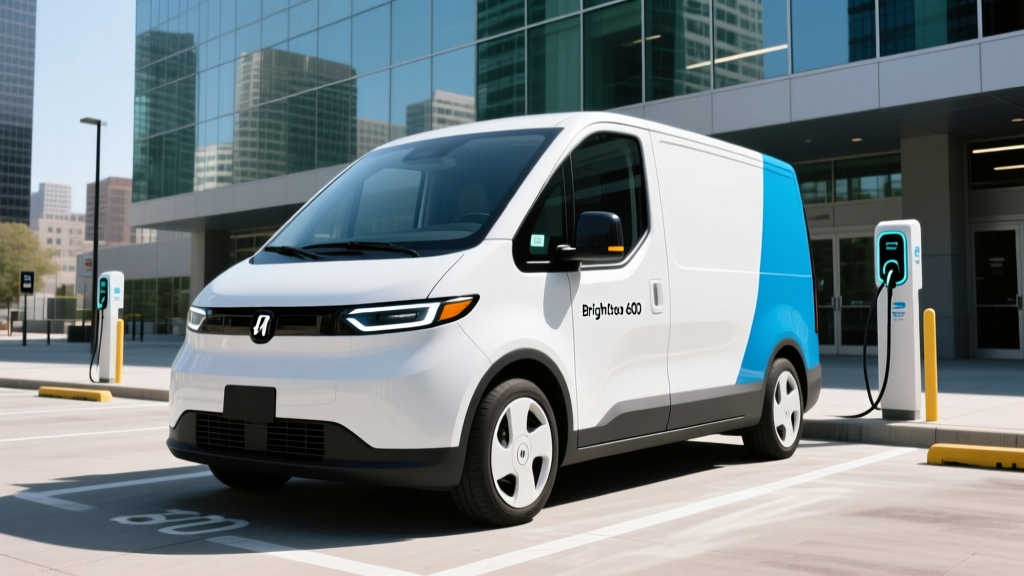
FedEx's electric van fleet is no longer a pilot — it's a deployment. As of 2026, FedEx operates thousands of BrightDrop Zevo 600 electric delivery vans across major U.S. metro areas, with plans to scale further as the last-mile delivery sector electrifies. These aren't concept vehicles; they're working assets logging daily routes, and their specs, costs, and limitations tell the real story of commercial EV adoption.
The Quick Answer
FedEx's primary electric delivery van is the BrightDrop Zevo 600, built by GM's commercial EV division. It offers an EPA-estimated 250 miles of range from a 110 kWh NMC lithium-ion battery, supports DC fast charging at up to 120 kW (10–80% in roughly 45 minutes), and costs approximately $100,000–$120,000 per unit before fleet incentives. FedEx has deployed these vans primarily in dense urban routes where daily mileage stays under 150 miles, making overnight depot charging practical and fuel savings substantial versus diesel Sprinter-class alternatives.
BrightDrop Zevo 600: The Van Behind the FedEx Electric Fleet
GM launched BrightDrop as a standalone commercial EV brand in 2021, and by 2023–2024 the Zevo 600 entered full production at the CAMI Assembly plant in Ontario. FedEx was an early and anchor customer, placing orders totaling thousands of units. The Zevo 600 sits in the Class 2b/3 segment — the same territory as the Mercedes-Benz Sprinter, Ford E-Transit, and Ram ProMaster EV — but it was designed from the ground up as a battery-electric platform rather than a converted ICE chassis.
| Spec | Value |
|---|---|
| EPA Range | ~250 miles (real-world loaded: 180–210 mi) |
| Battery Capacity | 110 kWh usable, NMC chemistry |
| DC Fast Charge (Peak) | 120 kW |
| 10–80% DC Charge Time | ~45 minutes |
| Level 2 AC Charge Rate | 11.5 kW (onboard charger) |
| Level 2 Full Charge Time | ~10 hours (0–100%) |
| Motor Output | ~266 hp / 320 lb-ft torque (front-wheel drive) |
| Cargo Volume | ~410 cu ft |
| Payload Capacity | ~2,500 lbs |
| Estimated Unit Price | $100,000–$120,000 (fleet pricing varies) |
| Battery/Powertrain Warranty | 8 years / 100,000 miles |
A few notes on those numbers. The 250-mile EPA estimate assumes moderate load and mild conditions. In real-world last-mile delivery — frequent stops, heavy cargo, HVAC running, and urban stop-and-go — expect 180 to 210 miles in temperate weather and 140 to 170 miles in sub-30°F winter conditions. Battery thermal management helps, but NMC chemistry loses 20–30% of usable capacity in deep cold. For FedEx's typical urban routes averaging 80–130 miles per day, this still provides comfortable margin.
How the FedEx Electric Van Compares to Diesel and Gas Alternatives
The Zevo 600 competes directly with the diesel Mercedes-Benz Sprinter 2500 and Ford Transit 350, which have dominated last-mile delivery for a decade. The comparison isn't just about range — it's about total cost of operation over a 5-year, 100,000-mile fleet lifecycle.
| Cost Category | BrightDrop Zevo 600 (EV) | Mercedes Sprinter 2500 (Diesel) |
|---|---|---|
| Purchase Price (per unit) | ~$110,000 | ~$55,000 |
| Federal Commercial EV Credit (§45W) | −$7,500 (up to GVWR threshold) | $0 |
| Fuel / Energy (100k mi) | ~$5,500 (at $0.13/kWh avg) | ~$18,750 (at $3.75/gal, 16 MPG) |
| Maintenance (5 yr) | ~$2,500 | ~$8,000 |
| Estimated Insurance (5 yr) | ~$14,000 | ~$11,000 |
| 5-Year Total Operating Cost | ~$124,500 | ~$92,750 |
| Cost Per Mile (operating) | ~$0.25/mi | ~$0.38/mi |
The upfront premium is real — roughly $55,000 more per van before incentives. But operating costs flip the equation over time. Electricity at commercial depot rates (often $0.08–$0.15/kWh depending on utility and time-of-use) costs a fraction of diesel per mile. Maintenance savings are significant: no oil changes, no diesel particulate filters, no transmission fluid, no exhaust system repairs. Regenerative braking extends brake pad life by 2–3× compared to ICE equivalents.
For a fleet operator like FedEx running vans 250+ days per year, the per-mile savings of $0.10–$0.13/mi compound quickly. Break-even typically arrives around year 4–5 depending on route density, local electricity rates, and diesel prices. FedEx has publicly stated that electrified routes show measurable cost advantages in dense metro areas, though long rural routes remain diesel territory.
Charging Infrastructure: What Depot Charging Looks Like
The FedEx electric van strategy hinges on depot-based charging, not public infrastructure. Vans return to a FedEx station at night, plug into Level 2 chargers, and are fully replenished by morning. This is fundamentally different from consumer EV ownership and eliminates range anxiety for planned routes.
| Level | Power (kW) | Miles Added per Hour | Use Case |
|---|---|---|---|
| Level 1 (120V) | ~1.4 kW | ~3–4 mi/hr | Not practical for fleet |
| Level 2 (240V, 48A) | 11.5 kW | ~28–32 mi/hr | Overnight depot charging |
| DC Fast Charge | 120 kW peak | ~180+ mi/hr (to 80%) | Mid-day top-up if needed |
At 11.5 kW on Level 2, a fully depleted 110 kWh battery recharges in roughly 10 hours — perfect for an overnight depot window. FedEx has invested heavily in depot charging infrastructure, working with utilities on electrical upgrades that can include 480V three-phase service, switchgear, and dozens of networked Level 2 pedestals at a single station. A depot with 50 vans might require a 1–2 MW electrical service upgrade, a capital investment that's significant but amortized over years of fuel savings.
The 120 kW DC fast-charge capability is useful for mid-day opportunity charging on longer routes, but it's not the primary strategy. Charging curves taper substantially above 80% state of charge, so fleet managers typically target 80–90% SoC for daily use to preserve battery longevity. Sustained fast charging to 100% accelerates NMC degradation.
Real-World Ownership: What Fleet Operators Actually Face
FedEx's electric van deployment reveals practical realities that apply to any commercial fleet considering electrification:
Route planning is non-negotiable. Unlike diesel vans that can refuel in 5 minutes anywhere, EVs require predictable routes within range limits. FedEx uses telematics and route-optimization software to ensure daily mileage stays within the Zevo 600's real-world envelope. Routes exceeding ~170 miles in winter or ~200 miles in summer are assigned to diesel vehicles.
Cold weather demands derating. In northern markets like Chicago, Minneapolis, and Boston, FedEx has reported winter range reductions of 25–35%. Battery preconditioning helps, but physics is physics — NMC cells lose efficiency below freezing, and cabin heating draws from the traction battery. FedEx mitigates this by assigning shorter routes to EVs in winter months or operating them in milder-climate metros.
Driver acceptance required change management. Early Zevo deployments revealed that drivers needed training on regenerative braking behavior, one-pedal driving techniques, and charge management. FedEx reported that after initial adjustment periods, drivers preferred the EVs — quieter operation, instant torque for merging, and no diesel exhaust in loading areas.
Charger uptime matters. A broken depot charger means a van doesn't run the next day. FedEx has invested in networked chargers with remote diagnostics and has contracted maintenance SLAs with charging hardware providers. Fleet operators report that 95%+ charger uptime is essential, which requires redundant capacity at each depot.
Common Misconceptions About FedEx's Electric Vans
| Myth | Fact |
|---|---|
| "EVs can't handle a full delivery day." | Most FedEx urban routes average 80–130 miles/day — well within the Zevo 600's real-world 180+ mile range in temperate conditions. |
| "Electric vans are slower and less capable." | The Zevo 600 delivers 320 lb-ft of instant torque — it accelerates faster unloaded than most diesel Sprinters and handles highway merging easily. |
| "Battery replacement will bankrupt the fleet." | The 8-year/100,000-mile warranty covers capacity below 70%. Most fleet vans reach end-of-vehicle life before battery replacement is needed. Replacement cost is estimated at $15,000–$22,000 if required out of warranty. |
| "FedEx is going all-electric everywhere." | FedEx deploys EVs on dense urban routes where economics favor them. Rural, long-distance, and cold-climate routes still rely on diesel. The fleet is mixed by design. |
| "The grid can't handle fleet charging." | Depot charging is scheduled overnight during off-peak hours. Utilities offer commercial EV rate schedules that make this manageable, though local grid upgrades are sometimes needed. |
Federal Tax Credits and Fleet Incentives for Commercial EVs
Commercial fleet buyers like FedEx don't qualify for the consumer §30D tax credit. Instead, they use the §45W Commercial Clean Vehicle Credit, which provides up to $7,500 for vehicles under 14,000 lbs GVWR and up to $40,000 for heavier vehicles. The Zevo 600, sitting in the Class 2b/3 range, typically qualifies for the $7,500 credit per unit. Per IRS guidelines, the vehicle must be acquired for use or lease by the business and meet battery component and critical mineral sourcing requirements.
Beyond federal credits, many states and utilities offer additional incentives:
- Utility make-ready programs that cover depot electrical upgrade costs (common in California, New York, and Massachusetts)
- State voucher programs like California's HVIP (Hybrid and Zero-Emission Truck and Bus Voucher Incentive Project) that can add $20,000–$45,000 per vehicle
- CARB Advanced Clean Fleets rule compliance, which in California and adopting states mandates zero-emission fleet transitions on specific timelines
These incentives can reduce effective per-unit cost by $30,000–$50,000 in favorable jurisdictions, dramatically accelerating the break-even timeline. FedEx's deployment has been concentrated in states with strong incentive environments.
Decision Framework: When Does an Electric Delivery Van Make Sense?
Is a Commercial Electric Van Right for Your Fleet?
Use this framework to evaluate whether EVs fit your operation:
Choose electric if:
- Daily routes are under 150 miles (temperate) or 110 miles (cold climate)
- Vehicles return to a central depot nightly
- Your depot has access to commercial electrical service (or can upgrade)
- You operate in a state with fleet EV incentives (CA, NY, MA, NJ, WA, OR)
- Annual mileage is high enough that fuel savings offset the purchase premium within 4–5 years
- Your routes are urban/suburban with frequent stops (regen braking maximizes efficiency)
Stick with diesel/gas if:
- Routes regularly exceed 200 miles per day
- Vehicles operate in extreme cold (<10°F) for extended seasons
- You lack depot charging access or grid capacity is prohibitively expensive to upgrade
- Annual mileage is low (under 15,000 mi/yr) — the fuel savings won't offset the premium
- Operations require heavy towing or payload near GVWR limits in hilly terrain
FedEx's own deployment pattern validates this framework: EVs in dense urban metros with predictable routes, diesel everywhere else. The company has stated publicly that its target is to electrify parcel pickup and delivery (PUD) routes first — exactly the use case where EVs shine economically.
Competitive Landscape: How the Zevo 600 Stacks Up
FedEx didn't choose BrightDrop in a vacuum. The commercial EV van market in 2026 includes several serious competitors, and fleet operators cross-shop them:
| Spec | BrightDrop Zevo 600 | Ford E-Transit (148" WB) | Mercedes eSprinter (2500) |
|---|---|---|---|
| EPA Range | ~250 mi | ~126 mi | ~200 mi |
| Battery | 110 kWh NMC | 68 kWh NMC | 113 kWh NMC |
| DC Fast Charge | 120 kW | 115 kW | 115 kW |
| Cargo Volume | ~410 cu ft | ~487 cu ft | ~533 cu ft |
| Payload | ~2,500 lbs | ~3,880 lbs | ~2,600 lbs |
| Est. Price | $100k–$120k | $55k–$65k | $75k–$90k |
The Ford E-Transit's lower range (126 miles EPA) makes it viable only for very short urban routes, but its lower price and familiar service network appeal to smaller fleets. The Mercedes eSprinter offers more cargo volume but at a higher price. The BrightDrop's advantage is range — 250 miles EPA gives fleet planners the most flexibility, which is likely why FedEx, operating at massive scale with varied route lengths, chose it as their primary platform.
Worth noting: fueleconomy.gov lists official EPA range and efficiency figures for these commercial vehicles, and fleet buyers should cross-reference manufacturer spec sheets for the latest model-year updates, as battery capacity and charging rates have seen incremental improvements year over year.
Frequently Asked Questions
Can individual consumers buy a BrightDrop Zevo 600?
Not easily. BrightDrop sells primarily to commercial fleets through direct sales agreements. There is no consumer retail channel comparable to buying a personal vehicle from a dealership. Small fleet operators (5+ vehicles) may qualify for purchase, but pricing and terms are negotiated B2B. Individuals looking for a personal electric cargo van are better served by the Ford E-Transit, which is sold through regular Ford commercial dealers.
How long does the BrightDrop Zevo 600 battery last?
NMC batteries in commercial service typically retain 80–85% capacity after 100,000 miles and 8 years, which aligns with the warranty threshold of 70% retention. Real-world fleet data from early deployments suggests degradation of roughly 2–3% per year under daily cycling. Most delivery vans are retired from frontline service at 200,000–300,000 miles, and the battery should last the vehicle's useful life in most cases.
Does FedEx use any other electric vehicles besides the BrightDrop?
Yes. FedEx has tested and deployed smaller electric vehicles for specific use cases, including electric cargo bikes for ultra-dense urban centers and smaller EVs from other manufacturers in limited markets. However, the BrightDrop Zevo 600 is the backbone of their full-size electric van fleet. FedEx Ground contractors (independent service providers) may also use other EV platforms based on their individual purchasing decisions.
What happens if a FedEx electric van runs out of charge on route?
Fleet management software monitors state of charge in real time, and dispatchers can reroute or send support if a van's projected range falls below its remaining route distance. In practice, route planning prevents this — vans are assigned routes well within their range envelope. If a van does deplete, it requires a flatbed tow back to the depot (you cannot tow an EV with its wheels down without drivetrain damage). FedEx reports these incidents are rare.
Are FedEx electric vans truly zero-emission?
At the tailpipe, yes — zero direct emissions. Upstream, the emissions profile depends on the local electricity grid. In regions with high renewable penetration (California, Pacific Northwest), the lifecycle emissions are dramatically lower than diesel. In coal-heavy grid regions, the advantage narrows but still exists because electric motors are 3–4× more efficient than internal combustion engines. As grids decarbonize, the EV advantage increases over time — a diesel van's emissions never improve.
FedEx's electric van investment is one of the largest commercial EV deployments in North America, and the BrightDrop Zevo 600 is proving that last-mile electrification works — within defined parameters. The economics favor dense urban routes, depot-based charging, and high annual mileage. For fleet operators evaluating their own transition, the Zevo 600's specs, costs, and real-world performance data from FedEx's deployment offer the most concrete evidence available about what commercial EV adoption actually looks like in 2026.