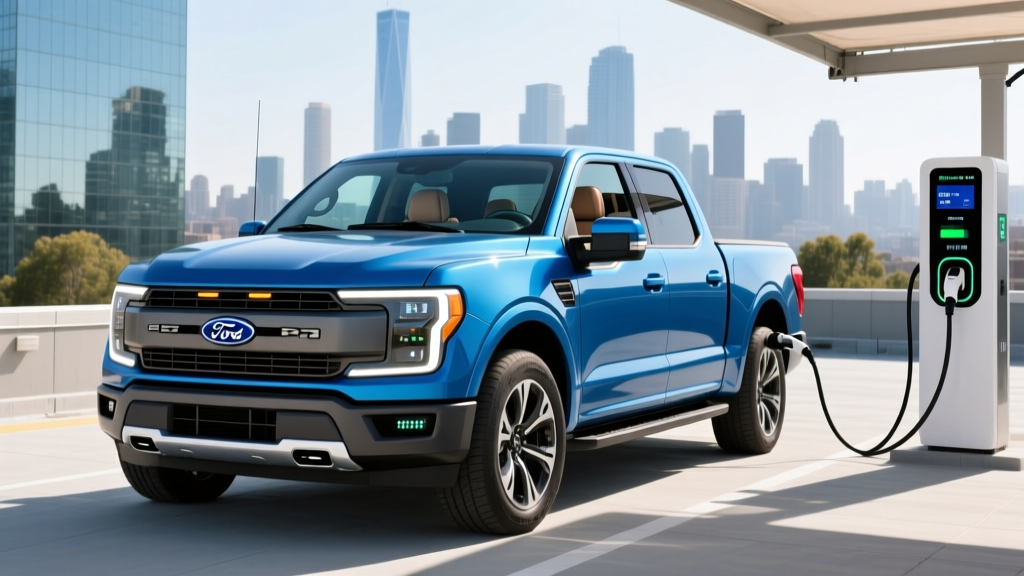
If you've been searching for an f150 bolt pattern 2014 reference while researching a truck upgrade, you're likely weighing whether your existing wheels, spacers, or accessories carry over to Ford's electric platform. The short answer: they don't. The 2014 F-150 used a 6×135 mm bolt pattern on a body-on-frame ICE chassis, while the 2026 F-150 Lightning rides on a dedicated EV skateboard with its own hub geometry, load ratings, and offset requirements. This review covers the Lightning as a complete vehicle — range, charging, pricing, tax credits — while addressing the wheel-compatibility question that brings many legacy F-150 owners here.
Quick Verdict: Who the 2026 Lightning Is For
The F-150 Lightning remains the default electric pickup for buyers who need a full-size truck first and an EV second. It tows, hauls, powers a job site via Pro Power Onboard, and fits in a standard garage. Where it trails rivals like the Rivian R1T or Chevrolet Silverado EV is in highway efficiency and maximum fast-charge speed. If your daily loop is under 250 miles and you charge at home, the Lightning's compromises are easy to live with. If you tow a 9,000-lb trailer cross-country every month, you'll feel the range penalty acutely.
EPA estimate: 230 mi (Standard Range, 98-kWh pack) to 320 mi (Extended Range, 131-kWh pack).
Real-world expectation: Count on ~185–205 mi highway at 70 mph in the Standard Range truck, and ~265–285 mi in the Extended Range. In sub-freezing weather, subtract another 15–25% due to cabin heating and battery thermal losses. Towing a 5,000-lb trailer cuts range roughly in half regardless of pack size.
Spec Table: 2026 Ford F-150 Lightning at a Glance
| Attribute | Standard Range | Extended Range |
|---|---|---|
| EPA Range | 230 mi | 320 mi |
| Battery Capacity (usable) | 98 kWh, NMC | 131 kWh, NMC |
| Drivetrain | Dual-motor AWD | Dual-motor AWD |
| Horsepower | 452 hp | 580 hp |
| Torque | 775 lb-ft | 775 lb-ft |
| 0–60 mph | ~3.8 sec | |
| Max DC Fast Charge | 150 kW | 150 kW |
| 10–80% DC Time | ~41 min | ~41 min |
| Level 2 Home Charge | 11.3 kW (~22 mi/hr) | 19.2 kW (~30 mi/hr)* |
| MPGe (combined) | 68 MPGe | 66 MPGe |
| Efficiency | 49 kWh/100 mi | 51 kWh/100 mi |
| Max Towing | 7,700 lb | 10,000 lb |
| Payload | ~2,235 lb | ~1,800 lb |
| Base MSRP (Pro trim) | $54,995 | $69,995 (XLT 312A) |
| Battery Warranty | 8 yr / 100,000 mi (≥70% retention) | |
*19.2-kW home charging requires the optional 80-amp Charge Station Pro and a 100-amp dedicated circuit. Most homes default to the 11.3-kW / 48-amp setup.
Charging: DC Fast, Level 2, and the Bolt-Pattern 2014 Question
The Lightning uses a NACS (Tesla-style) charge port on 2025-and-newer models after Ford's transition from CCS1. At a 150-kW DC fast charger, both packs peak near 150 kW but taper significantly above 80% State of Charge — that's why the 10–80% time is roughly 41 minutes for both batteries. The larger pack takes longer to fill from 80–100%, which matters on road trips when you top off while eating.
| Charging Level | Power | Miles Added per Hour | Typical Use |
|---|---|---|---|
| Level 1 (120V) | ~1.4 kW | ~2–3 mi/hr | Overnight trickle |
| Level 2 (240V, 48A) | 11.3 kW | ~22 mi/hr | Standard home |
| Level 2 (240V, 80A) | 19.2 kW | ~30 mi/hr | Upgraded home w/ 100A circuit |
| DC Fast (NACS) | 150 kW peak | ~150 mi in 20 min | Road trips |
About the 2014 bolt pattern: The 2014 F-150's 6×135 mm (6-lug, 135 mm bolt circle) pattern does not carry over to the Lightning. The 2026 Lightning uses a 6×139.7 mm (6×5.5 in) hub with different center-bore diameter, offset, and load rating calibrated for the truck's heavier curb weight (~6,500 lb). Wheels from a 2014 model will not bolt on safely, and adapters that alter offset can compromise handling, warranty, and regenerative-braking calibration. Source wheels from Ford's Lightning-specific accessory catalog or aftermarket manufacturers that list Lightning fitment explicitly.
Performance, Efficiency, and Daily Drivability
Dual motors and standard AWD are non-negotiable on the Lightning — there is no RWD variant. The Extended Range model's 3.8-second 0–60 time puts it in sports-sedan territory despite a curb weight over three tons. More relevant to truck buyers: the instant 775 lb-ft of torque means merging onto a highway with a loaded bed is effortless, with no downshift lag or turbo spool-up.
Efficiency is the Lightning's weakest spec-sheet number. At 49–51 kWh per 100 miles, it trails the Rivian R1T (roughly 43 kWh/100 mi) and significantly trails the Silverado EV's more aerodynamic profile. On a 300-mile highway trip at 75 mph, expect to consume roughly 150–160 kWh — a full Extended Range pack plus a charging stop. Cold weather pushes consumption higher because the truck uses resistive cabin heating on lower trims; the heat pump is standard only on Lariat and above for 2026.
Pricing, Trims, and Federal Tax Credit Eligibility
Ford restructured Lightning pricing for 2026 after several rounds of cuts. The Pro trim is the value entry point; Lariat and Platinum push past $80,000 once options are added.
| Trim | Base MSRP | As-Tested Typical | §30D Credit Eligibility |
|---|---|---|---|
| Pro (Std Range) | $54,995 | $57,500 | Up to $7,500 — subject to sourcing |
| XLT (Std Range) | $59,995 | $64,000 | Up to $7,500 |
| Lariat (Ext Range) | $76,995 | $82,500 | Up to $7,500 |
| Platinum (Ext Range) | $91,995 | $96,000 | Up to $7,500 |
The IRS §30D federal tax credit is not a flat $7,500 for every buyer. Eligibility hinges on three moving targets:
- MSRP cap: Pickup trucks must stay under $80,000 MSRP to qualify. The Platinum trim exceeds this; the Lariat with certain option packages may as well.
- Buyer income cap: $150,000 single / $225,000 head of household / $300,000 joint filers (modified AGI).
- Battery sourcing: A percentage of critical minerals and battery components must be sourced from the U.S. or free-trade-agreement partners. Ford has shifted some Lightning battery production domestically, but the exact credit amount ($3,750 or $7,500) varies by build month. Confirm the VIN on the IRS portal before signing.
Point-of-sale transfer is available — your dealer applies the credit as a down-payment reduction rather than a tax-year refund — but only if the dealer is registered with the IRS Energy Credits portal.
Cargo, Passenger Space, and the Mega Power Frunk
The Lightning retains the SuperCrew cab layout, meaning rear-seat legroom matches the gas F-150 at roughly 43.6 inches. The 5.5-foot bed is shorter than some competitors, but the payload floor is flat and the tailgate offers a work-surface mode.
The defining feature is the Mega Power Frunk — 14.1 cubic feet of lockable, drainable, front-trunk storage where an engine used to live. It has four 120V outlets, two USB-C ports, and LED lighting. On job sites, it doubles as a powered toolbox via the Pro Power Onboard system (2.0 kW standard, 9.6 kW available on Lariat and above), which can run a chop saw, air compressor, or tailgate PA system directly from the traction battery.
Tech, Driver Assists, and What's Missing
The 2026 Lightning ships with SYNC 4A on a 12-inch portrait touchscreen (15.5-inch on Lariat and above). Wireless Apple CarPlay and Android Auto are standard. Ford's BlueCruise hands-free driving system is available on mapped divided highways — currently over 130,000 miles of coverage — but it is a Level 2 SAE system, meaning the driver must remain attentive and the cabin camera enforces eye monitoring.
Despite "hands-free" branding, BlueCruise requires an alert driver behind the wheel at all times. It does not handle construction zones, unmapped roads, or severe weather autonomously. It is SAE Level 2, not Level 3 or 4.
Notable drawbacks: the Lightning's regenerative braking is mild compared to one-pedal-driving EVs like the Tesla Model Y; the rear suspension uses a solid axle with leaf springs (carried over from the gas F-150), so an empty bed rides firmer than the Rivian R1T's independent rear; and the infotainment system, while improved, still has occasional lag when navigating large menus.
Pros
- Class-leading frunk (14.1 cu ft) with integrated power
- Pro Power Onboard turns the truck into a mobile generator
- Comfortable SuperCrew cabin with full-size rear seat
- Strong value at the Pro trim after tax credit
- BlueCruise coverage is extensive for highway commuters
Cons
- Efficiency trails Rivian R1T and Silverado EV
- 150-kW peak DC charging is slow vs. 350-kW competitors
- Real-world highway range well below EPA sticker
- Towing slashes range dramatically (~50% loss)
- Platinum trim prices out of §30D credit eligibility
Lightning vs. Key Competitors
The Rivian R1T is more efficient, faster to charge (up to 220 kW peak), and has a more refined independent rear suspension — but it starts around $70,000 and lacks the Lightning's full-size bed and frunk. The Chevrolet Silverado EV (4WT and Trail Boss trims) offers up to 400 miles EPA on the Max Range pack and 350-kW peak charging, but its smaller crew cab and unconventional bed layout limit traditional truck utility. For fleet and work-site buyers who need a recognizable full-size truck with NACS Supercharger access (via Ford's 2025 adapter integration), the Lightning remains the default.
Who Should Buy the 2026 F-150 Lightning
Choose the Lightning if: You need a full-size 4-door truck for work, family, or towing under 7,000 lb on most trips; you can charge at home on Level 2; and you value Pro Power Onboard and the frunk.
Look elsewhere if: You tow heavy trailers long distances weekly (range penalty is brutal), you prioritize fast DC charging for road trips (Silverado EV is quicker), or you need the longest possible bed (Rivian and Silverado offer different configurations).
FAQ
What is the real-world range of the 2026 F-150 Lightning?
EPA stickers read 230 mi (Standard Range) and 320 mi (Extended Range). Real-world highway driving at 70 mph yields roughly 185–205 mi and 265–285 mi respectively. Cold weather and towing reduce these figures further — plan conservatively.
How fast does the Lightning charge at home and on the road?
At a 150-kW DC fast charger, 10–80% takes about 41 minutes. At home on a 48-amp Level 2 circuit, expect ~22 miles of range per hour; on an 80-amp circuit with the optional Charge Station Pro, that rises to ~30 miles per hour.
Does the 2026 Lightning qualify for the $7,500 federal tax credit?
Most trims do, but eligibility depends on MSRP staying under $80,000 (which excludes Platinum), buyer income caps, and battery mineral/component sourcing. Verify your VIN on the IRS portal before purchase. Per fueleconomy.gov, the credit can transfer at point of sale through registered dealers.
Will 2014 F-150 wheels fit the 2026 Lightning?
No. The 2014 F-150 uses a 6×135 mm bolt pattern; the Lightning uses 6×139.7 mm with a different center bore, offset, and load rating. Do not use adapters — they compromise safety, handling, and warranty. Buy wheels rated specifically for Lightning curb weight and EV torque.
Is it worth buying the Lightning over the Rivian R1T or Silverado EV?
If you want a traditional full-size truck experience with the best frunk and job-site power, yes. If efficiency and fast-charging speed are top priorities, the Silverado EV and Rivian R1T have measurable advantages. Test-drive all three with your typical payload before deciding.