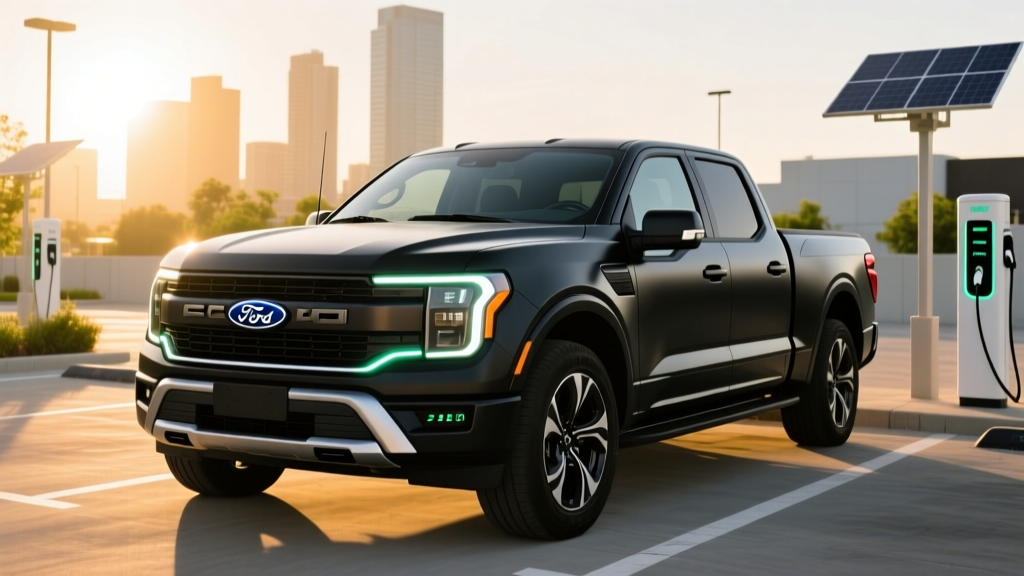
Ford Paused F-150 Lightning Production — Here's What Buyers Need to Know
In early 2026, Ford confirmed a temporary production halt of the F-150 Lightning at its Rouge Electric Vehicle Center in Dearborn, Michigan. The move comes as Ford recalibrates its EV truck strategy amid shifting demand, supply-chain adjustments for battery cell sourcing, and the ongoing ramp-up of its next-generation EV platform. For buyers who've had the Lightning on their shortlist, the headline is alarming — but the reality is more nuanced. Dealer lots still carry inventory, the order books are expected to reopen, and the 2025 model-year trucks already in the wild remain fully supported under Ford's warranty network.
This guide breaks down exactly what the F-150 Lightning production halt means for your purchase timeline, while delivering the full spec-by-spec review of the truck as it stands today — so you can decide whether to grab remaining dealer stock now or wait for the next production run.
F-150 Lightning Specs at a Glance
| Spec | Standard Range | Extended Range |
|---|---|---|
| EPA Range | 230 miles | 320 miles |
| Battery (usable) | 98 kWh (NMC) | 131 kWh (NMC) |
| Drivetrain | Dual-motor AWD | |
| Horsepower | 452 hp | 580 hp |
| Torque | 775 lb-ft | 775 lb-ft |
| 0-60 mph | ~3.8 sec | |
| Max DC Fast Charge | 150 kW | 150 kW |
| 10-80% DC Charge | ~36 min | ~41 min |
| Level 2 Home Charge | 11.3 kW / ~30 mi/hr (80A Charge Station Pro) | |
| MPGe (combined) | 78 MPGe | 66 MPGe |
| Efficiency | 43 kWh/100mi | 51 kWh/100mi |
| Max Towing | 7,700 lbs | 10,000 lbs |
| Max Payload | 2,235 lbs | 1,800 lbs |
| Base MSRP (2025) | $54,995 | $69,995 (Lariat) |
| Battery Warranty | 8 years / 100,000 miles | |
Real-World Range: What the EPA Sticker Doesn't Tell You
The Lightning's boxy aerodynamics (drag coefficient ~0.45) and 6,500+ lb curb weight are the primary range killers at highway speed. Unlike a sedan-shaped EV, the Lightning doesn't benefit much from regenerative braking on flat interstates — you're pushing a wall of air. In our experience, ambient temperatures below freezing reduce range 25-35% due to battery resistance and cabin heating demands, even with the truck's heat pump (standard on Extended Range, optional on some Standard Range trims).
If your daily commute is under 60 miles round-trip and you charge at home, the Standard Range is more than adequate. Road trippers and those who tow should strongly consider the Extended Range — or plan charging stops carefully using fueleconomy.gov efficiency data to calculate real energy needs.
Charging Speed: DC Fast and Home Level 2
| Charging Level | Power | Miles Added per Hour | Notes |
|---|---|---|---|
| Level 1 (120V) | 1.4 kW | ~2-3 mi/hr | Emergency/trickle only |
| Level 2 (240V, 32A) | 7.7 kW | ~18 mi/hr | Standard mobile cord |
| Level 2 (240V, 48A) | 11.5 kW | ~27 mi/hr | Wall connector / aftermarket |
| Level 2 (240V, 80A) | 19.2 kW | ~30 mi/hr | Ford Charge Station Pro (requires 100A circuit) |
| DC Fast (peak) | 150 kW | — | 10-80% in ~36-41 min |
The Lightning's 150 kW peak DC fast-charge rate is its most debated spec. Competitors like the Rivian R1T (with its newer max-charger update) and the Chevy Silverado EV push past 200 kW. The Lightning's charge curve peaks early (around 20% SoC) and tapers progressively — by 60% SoC, you're typically seeing 90-100 kW, and by 80% it drops below 50 kW. This means the 10-80% time is respectable but not class-leading.
On a 350 kW Electrify America or Tesla Supercharger (with NACS adapter, which Ford now provides for 2025+ models), the Lightning will only draw what its onboard system allows — 150 kW max. You won't benefit from higher-rated stations, but you will benefit from their availability: Ford's access to the Tesla Supercharger network (via the included NACS adapter) is arguably the biggest charging-infrastructure advantage the Lightning has over CCS-only rivals.
At home, the 80A Ford Charge Station Pro is the gold standard, adding roughly 30 miles of range per hour — enough to fully replenish the Extended Range pack overnight. However, it requires a dedicated 100-amp circuit, which means many homes will need a panel upgrade ($1,500-$3,000 from a licensed electrician) before installation.
Performance, Towing, and Everyday Driving
The F-150 Lightning Extended Range hits 60 mph in approximately 3.8 seconds — quicker than any factory F-150 before it and genuinely startling in a full-size pickup. The Standard Range's 5.0-second run is no slouch either. Dual-motor AWD is standard across all trims, giving confident traction in rain, snow, and loose surfaces.
Towing is where the Lightning both impresses and compromises. The 10,000-lb max tow rating (Extended Range, Max Trailer Tow Package) is legitimate, and the truck's integrated Pro Trailer Backup Assist and smart hitch features make hooking up and reversing a trailer genuinely easier than in any gas F-150. But towing any substantial load hammers range. Expect roughly 1.5-2.0 miles per kWh when towing a 5,000-7,000 lb trailer — that means the Extended Range's 131 kWh pack delivers maybe 160-200 miles before you need to stop. Plan accordingly.
The front trunk (frunk) is a standout: 14.1 cubic feet of lockable, weatherproof storage with a drain plug — perfect for job-site gear, tailgate coolers, or groceries. Combined with the 5.5-foot bed, total cargo flexibility exceeds any gas F-150.
Interior, Tech, and Driver Assistance
Inside, the Lightning mirrors the gas F-150's cabin, which means it's spacious, functional, and built to a work-truck standard on lower trims (Pro, XLT) while climbing toward near-luxury on Platinum and King Ranch. Rear-seat legroom is generous at 43.6 inches, and the cabin seats five comfortably (six with the front bench option on XLT).
The available 15.5-inch vertical touchscreen (SYNC 4A) dominates the dash on Lariat and above, running wireless Apple CarPlay and Android Auto, over-the-air updates, and Ford's cloud-connected navigation with real-time charger routing. The digital gauge cluster is standard across all trims.
Ford's BlueCruise hands-free driving system (SAE Level 2) is available on over 130,000 miles of pre-mapped divided highways. It works well for reducing fatigue on long hauls, but the driver must remain attentive — a driver-monitoring camera enforces eye-on-road engagement. This is not self-driving; it's an advanced lane-centering and adaptive cruise system. Competitors like GM's Super Cruise cover similar ground, and Tesla's Autopilot/FSD (Supervised) operates everywhere but with less predictable behavior.
Pro Power Onboard is the Lightning's party trick: up to 9.6 kW of exportable 120V/240V power (standard 2.4 kW on Pro trim) turns the truck into a mobile generator. It can run power tools at a job site, power a camper, or — with the right transfer switch setup — serve as emergency home backup power during an outage.
Pricing, Trims, and Federal Tax Credit Status
| Trim | Base MSRP | §30D Credit Eligible? | Est. After Credit |
|---|---|---|---|
| Pro (Standard Range) | $54,995 | Yes (if sourcing rules met) | ~$47,495 |
| XLT (Standard Range) | $59,995 | Yes | ~$52,495 |
| Lariat (Extended Range) | $69,995 | Yes (truck MSRP cap: $80,000) | ~$62,495 |
| Platinum (Extended Range) | $84,995 | No — exceeds $80K truck cap | $84,995 |
The F-150 Lightning qualifies as a light truck under IRS §30D rules, which sets the MSRP cap at $80,000. This means the Pro, XLT, and Lariat trims can qualify for the full $7,500 federal tax credit — provided the buyer meets income limits (adjusted gross income ≤$150,000 single / ≤$300,000 joint) and the vehicle meets battery critical-mineral and component sourcing requirements. Ford has worked to shift battery sourcing to comply, but eligibility can change as supply chains evolve. Always verify current eligibility at fueleconomy.gov and consult a tax professional before relying on the credit.
The credit can now be transferred to the dealer at point of sale, effectively reducing your purchase price by $7,500 on the spot — a significant change from prior years when you had to wait until tax filing. This makes the Lightning Pro at roughly $47,500 (after credit) one of the most affordable full-size electric trucks available.
As-tested pricing on a well-equipped Lariat Extended Range with the Max Trailer Tow Package and BlueCruise typically lands around $76,000-$78,000 before any incentives.
What the Production Halt Actually Means
Ford's Rouge Electric Vehicle Center pause is not a cancellation. Ford has confirmed the F-150 Lightning nameplate will continue, but the company is evaluating next-generation battery chemistry (potentially LFP for Standard Range models to reduce cost and reliance on nickel/cobalt) and manufacturing efficiency improvements. Industry analysts expect production to resume in late 2026 or early 2027, potentially with updated specs.
For buyers right now, this means:
- Dealer inventory exists — many Ford dealers have unallocated 2025 Lightnings on lots, often with dealer discounts of $3,000-$8,000 off MSRP.
- Warranty and parts support is unaffected — Ford's 8-year/100,000-mile battery warranty and dealer service network remain fully operational.
- Used/CPO market is viable — 2022-2024 Lightnings are available with similar specs, though earlier models had some software and build-quality quirks that were addressed in later production.
- New orders are paused — you cannot currently configure and order a new Lightning through Ford's website. This may change without much advance notice.
F-150 Lightning vs. Key Competitors
Why Choose the Lightning
- Best value in full-size electric trucks (Pro trim ~$47.5K after credit)
- Pro Power Onboard: up to 9.6 kW exportable power
- Massive 14.1 cu ft frunk with drain plug
- Tesla Supercharger network access via NACS adapter
- Familiar F-150 driving dynamics, controls, and service network
- BlueCruise hands-free highway driving
Where It Falls Short
- 150 kW DC peak charge rate is below Rivian R1T and Silverado EV
- Production halt creates uncertainty on new orders and future updates
- Heavy curb weight (6,500+ lbs) hurts efficiency vs. lighter EV trucks
- Towing range remains a significant compromise (~160-200 mi loaded)
- Platinum trim exceeds $80K tax credit cap
- Standard Range cold-weather/highway range can dip below 150 miles
Against the Rivian R1T, the Lightning is larger, more affordable, and has a bigger bed — but the R1T charges faster, offers a quad-motor option, and has a more adventure-oriented design. The Chevy Silverado EV (2025+ 4WT and RST) offers up to 400 miles of EPA range on its max pack and faster DC charging, but at significantly higher pricing and limited availability. For buyers who need a traditional full-size truck experience with EV benefits, the Lightning still occupies a unique middle ground — if you can find one.
Frequently Asked Questions
What is the real-world range of the F-150 Lightning?
The Extended Range achieves 320 miles EPA but expect 250-270 highway and 190-220 in freezing cold. The Standard Range's 230 EPA miles drops to 175-190 highway and 140-160 in cold weather. Towing reduces range by roughly 40-50%.
How fast does the F-150 Lightning charge?
DC fast charging peaks at 150 kW, achieving 10-80% in approximately 36 minutes (Standard Range) or 41 minutes (Extended Range). At home on a Level 2 charger, expect 18-30 miles of range added per hour depending on amperage (32A to 80A).
Does the F-150 Lightning qualify for the federal EV tax credit?
The Pro, XLT, and Lariat trims qualify for the $7,500 §30D credit if the buyer meets income caps ($150K single / $300K joint AGI) and the vehicle meets battery sourcing requirements. The Platinum trim exceeds the $80,000 truck MSRP cap and does not qualify. Always verify at irs.gov.
Is the F-150 Lightning still worth buying with the production halt?
If you find dealer stock at a competitive price, yes — the truck's specs, warranty support, and Supercharger access remain strong. The production pause creates uncertainty about future model-year updates and long-term platform investment, but it doesn't affect the ownership experience of current vehicles.
How does the Lightning compare to the Rivian R1T?
The Lightning is a full-size truck (larger bed, more cabin space, lower starting price, Pro Power Onboard). The R1T is mid-size, charges faster (up to 200+ kW), offers more off-road capability, and has a more premium interior — but starts around $70,000 and doesn't qualify for the same tax credit on higher trims.
What battery chemistry does the Lightning use?
Both the Standard Range (98 kWh) and Extended Range (131 kWh) packs use NMC (nickel-manganese-cobalt) lithium-ion cells supplied by SK On. Ford has signaled potential LFP adoption for future Standard Range models, which would improve cycle life and reduce cost but slightly lower energy density.
Bottom Line: Buy Now From Dealer Stock or Wait?
The F-150 Lightning production halt is a strategic pause, not a death sentence. For buyers who need an electric full-size truck today — especially for job-site power, daily commuting under 100 miles, or family hauling — remaining dealer inventory represents a strong value, particularly the Pro and XLT trims with the $7,500 federal credit applied at point of sale.
If you're flexible on timing and want the next-generation improvements Ford is likely baking into the resumed production run (potentially LFP chemistry, faster charging, updated infotainment), waiting 6-12 months is reasonable. Just know that pricing may creep upward, and introductory incentives may shrink as production normalizes.
Either way, verify tax credit eligibility before signing, confirm the dealer's remaining inventory hasn't been sitting long enough to affect the 12V battery or tire condition, and negotiate hard — production halts create motivated sellers.