The Ford F-150 Lightning remains the electric truck to beat for buyers who need genuine utility without the complexity of a dedicated EV platform. For the 2026 model year, Ford has streamlined the lineup, improved thermal management on the extended-range pack, and kept the starting price competitive against the Rivian R1T and Chevrolet Silverado EV. Whether you're eyeing a purchase or an F-150 Lightning lease, this review covers every number that matters — from real-world highway range to DC fast-charge taper, tax-credit eligibility under IRS §30D, and total cost of ownership.
Quick Verdict: Who Should Lease or Buy the F-150 Lightning?
The Lightning is a full-size, body-on-frame electric pickup that does not pretend to be a car. It's heavy, it's tall, and it can tow. That makes it ideal for:
- Homeowners with a garage who can install a Level 2 charger and wake up to a full battery every morning.
- Fleet operators and tradespeople who need a frunk for tools, a bed for materials, and V2L capability to power job-site equipment.
- Commuters with occasional towing needs — provided daily driving stays under ~200 miles round-trip.
It is not the best choice if you apartment-dwell without charging access, regularly drive 400+ miles between stops in cold weather, or prioritize sporty handling over payload. For those use cases, the Rivian R1T (lighter, faster, tri-motor option) or a plug-in hybrid F-150 PowerBoost may serve you better.
2026 F-150 Lightning Specs at a Glance
| Specification | Standard Range | Extended Range |
|---|---|---|
| EPA Range | 240 miles | 320 miles |
| Battery (usable) | 98 kWh | 131 kWh |
| Battery Chemistry | NMC (Nickel Manganese Cobalt) | NMC |
| Drivetrain | Dual-motor AWD | Dual-motor AWD |
| Horsepower | 563 hp | 580 hp |
| Torque | 775 lb-ft | 775 lb-ft |
| 0-60 mph | ~4.0 sec | ~3.8 sec |
| Max DC Fast Charge | 150 kW | 150 kW |
| 10-80% DCFC Time | ~36 min | ~41 min |
| Level 2 Home Charge Rate | 11.3 kW (30 mi/hr) | 11.3 kW (30 mi/hr) |
| MPGe (combined) | 68 MPGe | 66 MPGe |
| Efficiency | 49 kWh/100 mi | 51 kWh/100 mi |
| Max Towing | 7,700 lbs | 10,000 lbs |
| Max Payload | 2,235 lbs | 1,800 lbs |
| Battery Warranty | 8 years / 100,000 miles (≥70% capacity retention) | |
| Base MSRP (Pro trim) | $54,995 | $69,995 |
Source: EPA Fuel Economy, Ford Motor Company. Specs reflect 2026 model year; verify with your dealer for final pricing.
Real-World Range: What the EPA Sticker Doesn't Tell You
EPA Extended Range: 320 miles
Real-World Highway (70 mph, 75°F): ~255-275 miles
Real-World Cold Weather (30°F, mixed driving): ~210-240 miles
Towing a 5,000-lb trailer (flat terrain): ~140-160 miles
The F-150 Lightning Extended Range carries a 320-mile EPA estimate, but that figure assumes a mix of city and highway driving at moderate temperatures. On a pure 70-mph highway run — the scenario that matters most for road trips — expect roughly 255 to 275 miles before you're hunting for a charger. The Lightning's boxy aerodynamics (drag coefficient around 0.44) and 6,500+ lb curb weight punish highway efficiency far more than stop-and-go city driving, where regenerative braking recovers energy.
Cold weather compounds the problem. At 30°F, lithium-ion cells experience higher internal resistance, and the cabin heater draws significant energy (the Lightning uses a resistive heater on most trims, not a heat pump). Expect a 20-30% range reduction in winter conditions, bringing the Extended Range down to roughly 210-240 miles. The Standard Range pack drops to approximately 160-185 miles in the cold — tight for any commute over 70 miles one-way.
Towing is the Lightning's Achilles' heel. Pulling a 5,000-lb travel trailer on flat ground at 65 mph cuts range nearly in half, yielding 140-160 miles. Hilly terrain or headwinds reduce that further. If you tow frequently over long distances, plan charging stops every 120 miles or consider the PowerBoost hybrid F-150 instead.
Charging Speed: DC Fast Charge and Home Level 2
| Charging Level | Power / Voltage | Miles Added per Hour | Notes |
|---|---|---|---|
| Level 1 (120V outlet) | 1.4 kW | ~3 mi/hr | Emergency/trickle only; full charge in 4+ days |
| Level 2 (240V, 48A) | 11.3 kW | ~30 mi/hr | Full charge in ~10-13 hours; ideal overnight |
| DC Fast Charge (CCS) | Peak 150 kW | Up to ~190 mi in 30 min | Tapers significantly above 80% SoC |
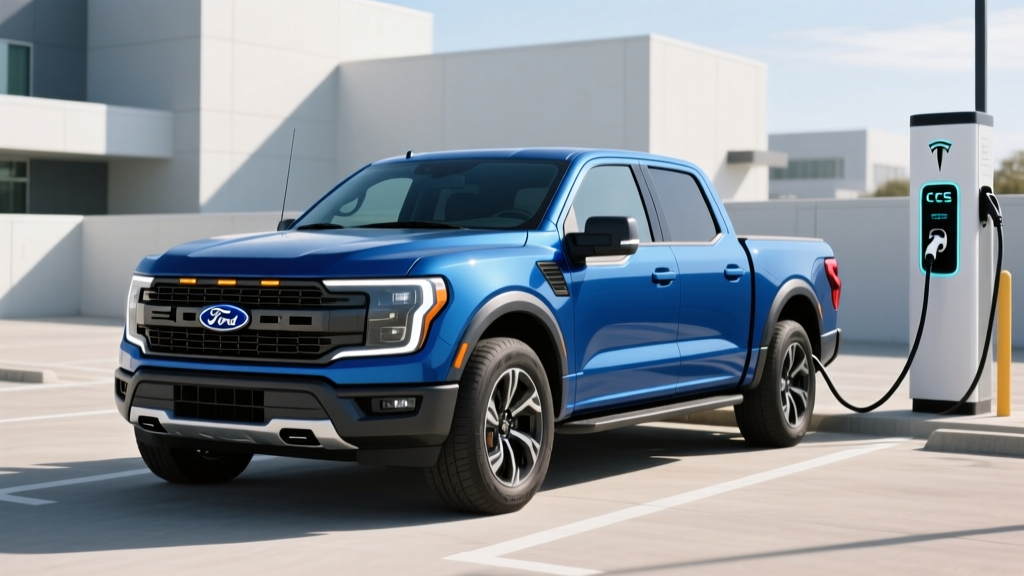
The Lightning charges at a peak rate of 150 kW on DC fast chargers using the CCS1 connector (Ford has confirmed NACS adapter compatibility for Tesla Supercharger access). That 150 kW peak is not sustained — the charge curve ramps quickly from 10% to about 40% SoC, holds near peak through ~60%, then tapers to roughly 80-90 kW through 80%, and drops below 40 kW above 90%. A 10-80% session takes approximately 36 minutes on the Standard Range pack and 41 minutes on the Extended Range pack at a capable 150+ kW station.
For home charging, the onboard 11.3 kW charger is adequate but not class-leading. A full overnight charge on a 48-amp Level 2 circuit adds roughly 30 miles per hour of charging, meaning the Extended Range pack refills in about 13 hours from near-empty. Most owners who plug in nightly after a 40-60 mile commute will never notice — the truck tops off while you sleep. But if you need a quick mid-day top-up before a road trip, plan accordingly.
Preconditioning matters. Use the FordPass app to precondition the battery while still plugged in before a DC fast-charge stop. This warms the cells to optimal temperature and can shave 5-10 minutes off your 10-80% session, especially in cold weather. Skipping preconditioning in winter can reduce peak charge rate to under 80 kW.
Performance and Drivetrain
Every 2026 F-150 Lightning comes with dual electric motors and all-wheel drive. The Standard Range produces 563 horsepower and 775 lb-ft of torque; the Extended Range bumps output to 580 hp with the same torque figure. Ford quotes 0-60 mph in approximately 3.8 seconds for the Extended Range — genuinely quick for a truck that weighs over three tons.
The instant torque delivery makes the Lightning feel even faster than the numbers suggest, particularly when merging onto highways or pulling away from stoplights. However, the truck's weight is evident in corners and during hard braking. This is a straight-line performer that rewards smooth inputs, not a canyon carver.
The low center of gravity (battery pack mounted under the floor) gives the Lightning better body control than a gas F-150, and the independent rear suspension improves ride quality over the live axle found on most gas variants. Off-road, the Lightning manages fire roads and light trails competently, but ground clearance (8.9 inches) and approach/departure angles are not designed for serious rock crawling.
Pricing, Lease Deals, and Federal Tax Credit
| Trim | Battery | MSRP | Est. Lease (36 mo / 10.5k mi) |
|---|---|---|---|
| Pro | Standard Range (98 kWh) | $54,995 | $550-$650/mo |
| XLT | Standard Range | $62,995 | $620-$750/mo |
| XLT | Extended Range (131 kWh) | $72,995 | $750-$880/mo |
| Lariat | Extended Range | $79,995 | $820-$950/mo |
| Platinum | Extended Range | $91,995 | $950-$1,100/mo |
Lease estimates are approximate and vary by region, dealer, credit tier, and current incentives. Always negotiate the capitalized cost and money factor.
Federal EV Tax Credit (§30D) Eligibility
- MSRP Cap: Trucks/vans/SUVs must have an MSRP ≤ $80,000. The Pro, XLT, and Lariat trims qualify; the Platinum ($91,995) does not.
- Buyer Income Cap: Modified AGI ≤ $150,000 (single), $225,000 (head of household), $300,000 (joint).
- Battery Sourcing: The Lightning's NMC pack must meet critical-mineral and battery-component requirements, which phase in progressively. Ford sources from SK On (South Korea). Verify current-year compliance on IRS.gov before purchasing.
- Point-of-Sale Transfer: As of 2024, buyers can transfer the credit to the dealer at purchase, reducing the upfront price by up to $7,500. This also applies to many lease structures (the leasing company claims the credit and may pass savings through as a capitalized-cost reduction).
- Final Assembly: Must occur in North America. The Lightning is assembled at Ford's Rouge Electric Vehicle Center in Dearborn, Michigan — this requirement is met.
Credit Amount: Up to $7,500 if all battery-sourcing thresholds are met. Consult a tax professional and check the IRS clean vehicle credit list for the specific VIN eligibility.
Lease vs. Buy Consideration: When you lease an F-150 Lightning, the §30D credit technically goes to the leasing company (the legal owner). However, most major lessors (Ford Credit, Ally, etc.) factor the credit into the lease as a cap-cost reduction, effectively passing the $7,500 savings to you as lower monthly payments. This can make leasing attractive even for buyers whose income exceeds the §30D cap — because leased vehicles may qualify under the separate commercial clean vehicle credit (§45W) that the lessor claims. Confirm with your dealer's finance department exactly how the credit is applied before signing.
Cargo, Passenger Space, and the Mega Power Frunk
The Lightning retains the F-150 SuperCrew cab dimensions, offering generous interior space:
- Front legroom: 43.9 inches
- Rear legroom: 43.6 inches
- Bed length: 5.5 feet (67.1 inches)
- Bed volume: 52.8 cu ft
- Frunk (front trunk): 14.1 cu ft, lockable, with 400 lbs payload capacity
The Mega Power Frunk is the Lightning's party trick. It replaces the engine bay with a sealed, lockable compartment featuring a drain plug (it doubles as a cooler), four 120V outlets, two USB-C ports, and LED lighting. It's genuinely useful for secure tool storage, groceries that you don't want rolling around the bed, or tailgate supplies.
The 5.5-foot bed is shorter than the 6.5-foot option available on gas F-150s — a trade-off for the independent rear suspension and battery packaging. If you regularly haul 8-foot lumber, you'll need to use the bed extender or a trailer. Payload capacity ranges from 1,800 lbs (Extended Range, due to heavier battery) to 2,235 lbs (Standard Range).
Technology, Driver Assists, and Standout Features
The 2026 Lightning features Ford's SYNC 4A infotainment system on a standard 12-inch or available 15.5-inch vertical touchscreen. Wireless Apple CarPlay and Android Auto are included. The interface is responsive and logically laid out, though the heavy reliance on touchscreen controls for climate and seat functions can frustrate glove-wearing users.
Standard driver-assist features include Ford Co-Pilot360 2.0:
- Pre-Collision Assist with Automatic Emergency Braking
- Blind Spot Information System (BLIS) with trailer coverage
- Lane-Keeping System
- Rear View Camera with dynamic hitch assist
Available BlueCruise (Ford's hands-free highway driving system) operates on pre-mapped divided highways. This is an SAE Level 2 system — the driver must remain attentive and keep eyes on the road, monitored by an interior camera. BlueCruise is genuinely useful on long interstate hauls and reduces fatigue, but it does not handle construction zones, unmapped roads, or complex interchanges autonomously.
BlueCruise, like Tesla Autopilot and GM Super Cruise, is an SAE Level 2 driver-assistance system. The driver is responsible for all vehicle operation and must supervise at all times. Full self-driving (SAE Level 4) is currently limited to geofenced robotaxi services like Waymo.
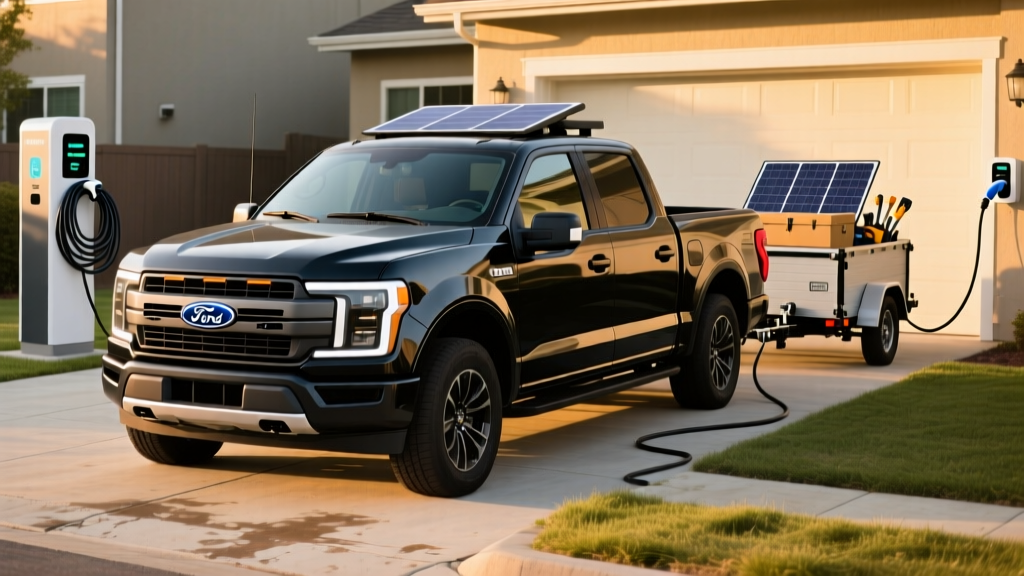
Pro Power Onboard is the Lightning's V2L (vehicle-to-load) system, offering up to 9.6 kW of exportable power through bed-mounted and frunk outlets. This can run power tools at a job site, keep appliances running during a home outage (with a proper transfer switch installed by a licensed electrician), or power a campsite. At 9.6 kW, it can run a refrigerator, microwave, and several lights simultaneously for hours.
Notable Drawbacks:
- No heat pump on most trims — cabin heating relies on resistive elements, hurting cold-weather range.
- 150 kW peak DC charging is slower than rivals (Rivian R1T: ~200 kW; Silverado EV: ~350 kW on 400V architecture).
- The 5.5-foot bed limits utility for long materials without accessories.
- SYNC 4A can be sluggish on startup and occasionally drops wireless CarPlay connections.
Pros and Cons
Pros
- Genuine truck capability — 10,000-lb towing, real payload
- Massive, lockable frunk with integrated power outlets
- Pro Power Onboard V2L (up to 9.6 kW) is best-in-class
- Comfortable ride quality thanks to independent rear suspension
- Strong acceleration (0-60 in ~3.8 sec) for a full-size truck
- Assembled in Michigan; qualifies for §30D credit on most trims
- Spacious SuperCrew cabin with adult-friendly rear seats
Cons
- Real-world highway range significantly below EPA (320 → ~260 mi)
- Towing cuts range roughly in half
- 150 kW DC charging is slower than newer competitors
- No heat pump on most trims — cold-weather range suffers
- 5.5-foot bed is shorter than many gas F-150 configurations
- Heavy curb weight (~6,500-6,800 lbs) hurts efficiency
- Platinum trim exceeds $80K MSRP cap for tax credit
F-150 Lightning vs. Key Competitors
| Spec | F-150 Lightning Ext. Range | Rivian R1T Dual-Motor (Max Pack) | Silverado EV 4WT (Extended Range) |
|---|---|---|---|
| EPA Range | 320 mi | 410 mi | 460 mi |
| Battery (usable) | 131 kWh (NMC) | 149 kWh (NMC) | ~200 kWh (NMC) |
| 0-60 mph | ~3.8 sec | ~3.5 sec | ~4.5 sec |
| Peak DC Charge | 150 kW | ~200 kW | ~350 kW |
| Max Towing | 10,000 lbs | 11,000 lbs | 12,500 lbs |
| Bed Length | 5.5 ft | 4.5 ft (+ Gear Tunnel) | 5.9 ft (w/ Multi-Flex midgate) |
| Base MSRP (comparable trim) | ~$69,995 | ~$83,000 | ~$75,000 |
| Tax Credit (§30D) | Yes (most trims) | Yes (MSRP ≤$80K dependent on config) | Yes (most trims ≤$80K) |
Choose the F-150 Lightning if: You want a traditional truck experience, the best V2L system for job-site power, Ford dealer service network familiarity, and a frunk that's actually useful. It's also the most affordable path into a full-size electric truck with genuine towing capacity.
Choose the Rivian R1T if: Range and charging speed are higher priorities, you want a tri-motor or quad-motor option for performance, and you value adventure-oriented features like the Gear Tunnel and built-in air compressor. The trade-off is a higher price, smaller bed, and fewer service centers.
Choose the Silverado EV if: Maximum range (up to 460 miles EPA) and fastest DC charging (~350 kW) are dealbreakers, and you need a longer bed with the Multi-Flex midgate. The Silverado EV is newer to market with less long-term reliability data, and its size makes it even heavier than the Lightning.
Frequently Asked Questions
What is the real-world range of the F-150 Lightning?
The Extended Range is EPA-rated at 320 miles, but expect roughly 255-275 miles on the highway at 70 mph, 210-240 miles in freezing temperatures, and only 140-160 miles when towing a 5,000-lb trailer. The Standard Range (240 EPA) drops to approximately 185-200 highway, 160-185 cold, and 110-130 towing.
How fast does the F-150 Lightning charge?
On a DC fast charger, it peaks at 150 kW and charges from 10-80% in approximately 36-41 minutes depending on the battery pack. At home on a 48-amp Level 2 charger (11.3 kW), it adds about 30 miles of range per hour, fully recharging overnight in 10-13 hours.
Does the F-150 Lightning qualify for the federal EV tax credit?
Most trims qualify for up to $7,500 under IRS §30D, provided the buyer's modified AGI is within limits ($300K joint / $150K single), the MSRP is ≤$80,000 (excluding the Platinum trim), and battery-sourcing requirements are met. The credit can be transferred to the dealer at point of sale. Always verify VIN eligibility on IRS.gov before finalizing your purchase or lease.
Is leasing the F-150 Lightning a better deal than buying?
Leasing can be advantageous if you want to hedge against EV depreciation and battery degradation concerns. The $7,500 federal credit is typically passed through as a cap-cost reduction in the lease. However, you won't build equity, you'll face mileage restrictions (typically 10,500-15,000 mi/year), and disposition fees apply at lease-end. If you drive under 12,000 miles/year and plan to upgrade in 3 years, leasing is compelling. High-mileage drivers and long-term keepers are usually better off buying.
Can the F-150 Lightning power my house during an outage?
Yes, with Ford's available Pro Power Onboard and a professionally installed home transfer switch (Ford Intelligent Power integration with Sunrun or similar). The Extended Range pack holds 131 kWh of usable energy — enough to power an average home's essential circuits (refrigerator, lights, HVAC fan, internet) for 3-7 days depending on consumption. This requires a bidirectional charger or transfer switch installed by a licensed electrician; it is not a simple plug-and-play setup.
How does the F-150 Lightning handle in snow and off-road?
The dual-motor AWD system provides excellent traction in snow, and the low center of gravity from the under-floor battery pack improves stability. Ground clearance is 8.9 inches, which handles snow drifts and moderate trails. However, the Lightning's 6,500+ lb weight means longer braking distances on icy roads — use winter tires and allow extra stopping room. It is not designed for serious rock crawling or deep mud.