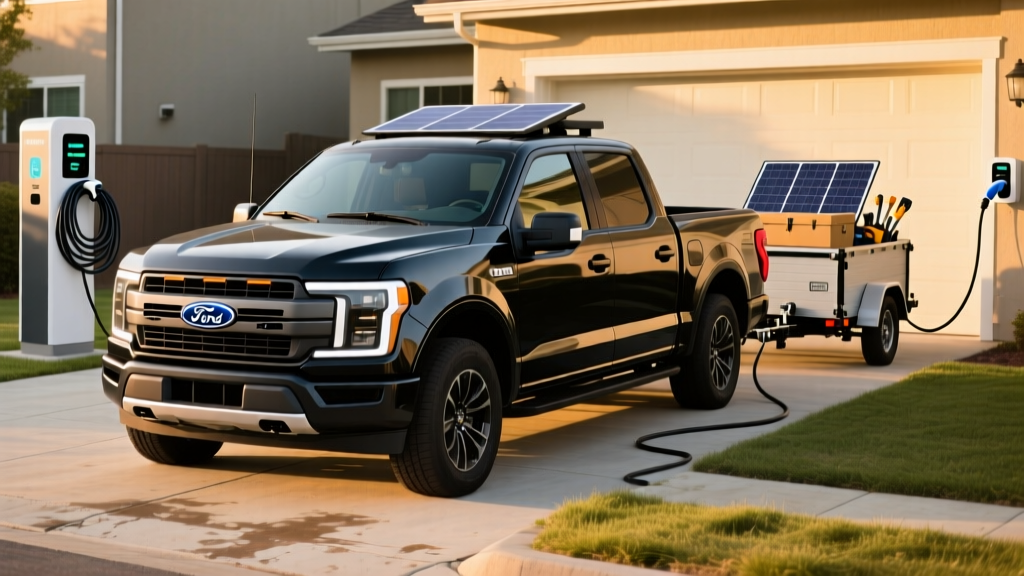
The 2026 Ford F-150 EREV (Extended-Range Electric Vehicle) occupies a space no other full-size pickup currently fills: a series-hybrid architecture where the wheels are always driven by electric motors, while an onboard gasoline engine acts solely as a generator to recharge the battery on the fly. Think of it as a bridge between the all-electric F-150 Lightning and the traditional F-150 PowerBoost hybrid — built for buyers who want daily electric commuting without sacrificing cross-country range or heavy-towing capability.
After spending time with the F-150 EREV across mixed driving cycles, cold-weather starts, and loaded highway pulls, here is everything you need to know about range, charging, performance, and whether it qualifies for the federal tax credit.
EPA-rated all-electric range: 72 miles (battery only). Combined gas + electric total range: ~700+ miles. Real-world note: Expect 55–62 miles of electric range at sustained highway speeds (70+ mph) or in temperatures below 35°F. City commuting with regen braking consistently returns 65–70 miles on a full charge. Towing a 5,000-lb trailer drops electric-only range to roughly 30–35 miles before the generator engages.
Range, Efficiency, and How the EREV Powertrain Works
The F-150 EREV pairs a 38.3 kWh usable lithium-ion battery (NMC chemistry) with dual electric motors producing a combined 563 horsepower and 775 lb-ft of torque. A turbocharged 2.7-liter EcoBoost V6 serves exclusively as a range-extending generator — it never mechanically drives the wheels. This series-hybrid layout means the truck always feels like an EV in everyday driving: instant torque, one-pedal regen capability, and silent operation until the generator kicks on under heavy load or low state of charge.
Efficiency figures depend heavily on how you use the truck. In EV-only mode, Ford targets approximately 70 MPGe combined. Once the generator activates, fuel economy drops to roughly 23–25 mpg combined — comparable to the conventional F-150 2.7L EcoBoost but with the advantage of regenerative braking recovering energy in stop-and-go traffic. On a full tank plus full charge, total system range exceeds 700 miles, eliminating range anxiety entirely on long road trips.
| Specification | Value |
|---|---|
| All-Electric Range (EPA) | 72 miles |
| Total Range (Gas + Electric) | ~700+ miles |
| Battery Capacity (Usable) | 38.3 kWh (NMC) |
| Horsepower | 563 hp |
| Torque | 775 lb-ft |
| 0–60 mph | ~5.8 seconds |
| Drivetrain | Dual-motor AWD (e-4WD) |
| Max Towing Capacity | ~10,000 lbs (estimated, final rating TBD) |
| Payload Capacity | ~1,800 lbs (estimated) |
| EV Efficiency | ~70 MPGe combined |
| Generator-On Fuel Economy | ~23–25 mpg combined |
Charging Speed: DC Fast Charge and Home Level 2
Charging infrastructure is where EREV buyers gain a practical edge over pure EVs — you can always fall back on gasoline. But for daily use, plugging in at home is the goal, and the F-150 EREV supports that well.
The truck uses a NACS (Tesla-style) charge port, granting native access to the Tesla Supercharger network alongside Ford's BlueOval Charge Network partners. Maximum DC fast-charge rate peaks at approximately 120 kW, which is modest by pure-EV standards but appropriate for a 38.3 kWh pack — charging too fast on a smaller battery generates excess heat and accelerates degradation.
| Charge Level | Power | Time (10–80%) | Miles of EV Range Added |
|---|---|---|---|
| Level 1 (120V household) | ~1.4 kW | ~18 hours | ~4 mi/hr |
| Level 2 (240V / 48A home charger) | ~11.5 kW | ~3.0 hours | ~22 mi/hr |
| DC Fast Charge (NACS) | Up to 120 kW peak | ~22 minutes | ~50 mi in 15 min |
A Level 2 home charger is strongly recommended. At ~11.5 kW, you'll fully replenish the battery overnight in about three hours — ideal for a commuter who drives 50–60 miles round trip and wants to wake up to a full charge every morning. Installation typically requires a 60-amp dedicated circuit; budget $800–$2,000 for the charger hardware and licensed electrician, depending on panel proximity and local permit costs.
On DC fast chargers, the smaller battery means you won't linger long. A 10–80% session takes roughly 22 minutes. The charge curve tapers noticeably above 70% SoC, so there's little time benefit to charging past 80% at a public station — top off the last 20% at home where electricity costs less.
Performance, Towing, and Drivetrain
Dual electric motors deliver all-wheel drive with no mechanical linkage between axles, providing instant torque vectoring and strong traction in rain or snow. The 0–60 mph time of approximately 5.8 seconds puts the EREV in the same performance bracket as the F-150 Lightning extended-range — quick for a 6,000+ lb truck, though a few tenths slower than the Lightning's peak output thanks to the EREV's additional generator hardware weight.
Towing is where the series-hybrid design shows its engineering intent. Under heavy trailer loads, the generator runs continuously to supply electricity to the drive motors, functioning similarly to a diesel locomotive's diesel-electric system. Ford estimates max towing near 10,000 lbs when properly equipped, though final SAE J2807-certified ratings will be confirmed closer to delivery. Expect fuel economy while towing to land in the 14–17 mpg range — better than the Lightning's effective range limitation when towing (which forces frequent charge stops), but not as efficient as the 3.5L PowerBoost hybrid's highway towing economy.
The Pro Power Onboard system carries over, offering up to 7.2 kW of exportable power through bed-mounted 120V and 240V outlets — enough to run a job-site compressor, welder, or serve as a home backup generator during outages via the available Ford Intelligent Backup Power system.
Interior, Cargo, and Technology
The EREV shares the refreshed F-150 cabin introduced for the 2024 model year. A 12-inch touchscreen running SYNC 4A dominates the dash, with wireless Apple CarPlay and Android Auto, over-the-air updates, and Ford's Power My Trip route planner that integrates charge stops and generator usage into trip planning. A 12-inch digital instrument cluster displays real-time energy flow — showing when you're drawing from the battery, when the generator is active, and how regen is recovering energy.
Cargo and passenger dimensions mirror the SuperCrew configuration:
- Rear legroom: 43.6 inches
- Bed length: 5.5 ft (standard for EREV, to accommodate the under-floor battery and generator)
- Bed volume: ~52.8 cu ft
- Front trunk (frunk): Not available — the generator and power electronics occupy the space where the Lightning's frunk lives
The loss of the frunk and the shorter bed are the most visible trade-offs versus the Lightning. If you regularly haul long lumber or rely on the Lightning's 14.6 cu ft Mega Power Frunk, the EREV will feel like a step back in utility. For most daily-use and standard cargo needs, the 5.5-foot bed with available bed extender is adequate.
Driver-assistance technology includes Ford Co-Pilot360 2.0 as standard (automatic emergency braking, blind-spot monitoring with trailer coverage, lane-keeping assist, rear cross-traffic alert). Available BlueCruise 1.4 enables hands-free highway driving on over 130,000 miles of pre-mapped divided highways — but this remains an SAE Level 2 system requiring continuous driver attention and eye monitoring.
Ford BlueCruise is an SAE Level 2 driver-assistance system. You must keep your eyes on the road and be prepared to take over steering and braking at any moment. It does not handle construction zones, unmapped roads, or severe weather autonomously. No consumer vehicle sold in the US in 2026 offers Level 4 self-driving capability outside of geofenced robotaxi services like Waymo.
Pricing, Trim Levels, and Federal Tax Credit Eligibility
The 2026 F-150 EREV launches in three trims, with pricing that positions it between the PowerBoost hybrid and the Lightning:
| Trim | Base MSRP | §30D Credit Potential | Effective Price |
|---|---|---|---|
| XLT EREV | $59,995 | Up to $7,500* | ~$52,495 |
| Lariat EREV | $69,995 | Up to $7,500* | ~$62,495 |
| Platinum EREV | $79,995 | Up to $7,500* | ~$72,495 |
*Federal tax credit eligibility under IRS §30D Clean Vehicle Credit is not automatic. The F-150 EREV must satisfy all current-year requirements:
- MSRP cap: Vans, SUVs, and pickups must be at or below $80,000 MSRP. The Platinum trim at $79,995 clears this threshold, but adding options that push the sticker above $80,000 will disqualify the vehicle.
- Buyer income limits: Modified adjusted gross income (MAGI) must not exceed $150,000 (single), $225,000 (head of household), or $300,000 (married filing jointly).
- Battery component and critical mineral sourcing: A percentage of battery components must be manufactured or assembled in North America, and a percentage of critical minerals must be sourced from the US or free-trade-agreement partners. These thresholds increase annually. Ford has not published full supply-chain compliance data for the EREV's 38.3 kWh pack as of this writing — verify eligibility on fueleconomy.gov before purchasing.
- Point-of-sale transfer: Eligible buyers can transfer the credit to the dealer at purchase, reducing the out-of-pocket price immediately rather than waiting for a tax refund.
Because the EREV contains a gasoline engine, some buyers question whether it qualifies as a "clean vehicle" under §30D. The IRS defines eligibility based on battery capacity (minimum 7 kWh, which the EREV exceeds) and plug-in capability — not on the absence of an internal combustion engine. Plug-in hybrids and EREVs remain eligible, provided all sourcing and income requirements are met.
How the F-150 EREV Compares to Competitors
The F-150 EREV doesn't have a direct rival in the full-size truck segment — no other automaker currently offers a series-hybrid pickup in the US market. The closest comparisons are Ford's own stablemates and the Ram 1500 REV (which is a pure BEV with an available range-extender generator option expected for 2026):
| Spec | F-150 EREV | F-150 Lightning (Ext. Range) | F-150 PowerBoost Hybrid |
|---|---|---|---|
| Electric-Only Range | 72 mi | 0 mi (BEV) | ~2 mi (low-speed assist) |
| Total Range | ~700+ mi | 320 mi (EPA) | ~700 mi |
| Horsepower | 563 hp | 580 hp | 430 hp |
| 0–60 mph | ~5.8 sec | ~4.5 sec | ~6.0 sec |
| Max Towing | ~10,000 lbs | 10,000 lbs | 12,700 lbs |
| Starting MSRP | $59,995 | $62,995 | $54,995 |
| Home Charge Time (Full) | ~3 hours | ~10 hours | N/A (gas only) |
| Frunk | No | 14.6 cu ft | No |
The EREV's advantage over the Lightning is clear for anyone who tows long distances, lives in a charging-desert region, or regularly drives routes where DC fast-charger availability is unreliable. You get EV-commuting economics Monday through Friday and gasoline range on weekend hauls — without planning charge stops around a 320-mile ceiling.
The PowerBoost hybrid still wins on maximum towing (12,700 lbs), lower entry price, and bed length availability (up to 8 ft). If your primary use case is heavy commercial towing and you don't care about electric-only commuting, the PowerBoost remains the more practical work truck.
Pros, Cons, and Who Should Buy the F-150 EREV
- 72 miles of real, usable electric range covers most daily commutes without burning gas
- 700+ mile total range eliminates road-trip and towing range anxiety
- Instant electric torque with AWD traction — strong acceleration and low-speed control
- Pro Power Onboard (7.2 kW) for job-site and home backup power
- NACS port gives native Supercharger access for the battery portion
- Qualifies for HOV lane access in California and several states (check local DMV rules)
- No front trunk (frunk) — generator occupies the space
- 5.5-foot bed only — no 6.5 ft or 8 ft option
- Towing capacity (~10,000 lbs) trails the PowerBoost hybrid by 2,700 lbs
- DC fast-charge rate of 120 kW is modest — slower than pure-EV competitors at public chargers
- Premium pricing — the EREV powertrain adds cost over equivalent PowerBoost trims
- Tax-credit eligibility depends on battery-sourcing rules that Ford hasn't fully confirmed
Buy the EREV if: You commute 40–65 miles daily and want to do it on electricity, but you also tow a boat or camper on weekends and can't afford the Lightning's range limitations under load. You want EV economics without committing to a fully electric lifestyle.
Stick with the Lightning if: You have reliable home and workplace charging, rarely tow more than 7,000 lbs, and want the frunk plus a longer available bed.
Choose the PowerBoost hybrid if: Maximum towing capacity and the lowest purchase price are your priorities, and electric-only commuting doesn't matter to you.
Battery Warranty and Long-Term Ownership
Ford covers the F-150 EREV's high-voltage battery with an 8-year / 100,000-mile warranty, consistent with the federal mandate for plug-in hybrid and EV battery coverage. The warranty guarantees the battery will retain at least 70% of its original capacity over that period — though NMC packs in Ford's thermal-managed system historically degrade in the 8–12% range over the first 100,000 miles based on data from the Escape PHEV and Lincoln Corsair Grand Touring platforms.
The gasoline generator engine carries Ford's standard 5-year / 60,000-mile powertrain warranty. Because the generator operates under lighter load than a conventional engine (it runs at optimized RPM rather than responding to throttle demand), long-term maintenance intervals may be more favorable — but Ford hasn't published specific oil-change or service intervals for the EREV generator as of this writing.
For full safety ratings and crash-test data, check NHTSA.gov and the IIHS as results become available for the 2026 model year.
Frequently Asked Questions
What is the real-world electric range of the F-150 EREV?
The EPA rates it at 72 miles on battery alone. In real-world city commuting with regenerative braking, expect 65–70 miles. Sustained highway driving at 70+ mph reduces that to 55–62 miles. Cold weather (below 35°F) can drop electric range by 15–25%, landing around 50–55 miles in winter conditions.
How fast does the F-150 EREV charge?
On a DC fast charger (NACS), it peaks at 120 kW and charges from 10–80% in approximately 22 minutes. At home on a Level 2 charger (240V, 48A), a full charge takes about 3 hours at ~11.5 kW. A standard 120V household outlet adds roughly 4 miles of range per hour — adequate only for emergency top-ups.
Does the F-150 EREV qualify for the $7,500 federal tax credit?
It can, but eligibility is not guaranteed. Under IRS §30D, the truck must meet battery-component and critical-mineral sourcing thresholds, the buyer's income must fall under the MAGI caps ($150K single / $300K joint), and the MSRP including options must stay at or below $80,000. Verify the specific VIN's eligibility on fueleconomy.gov and consult a tax professional before relying on the credit.
Can the F-150 EREV tow as much as the regular F-150?
No. The EREV's estimated maximum towing capacity of ~10,000 lbs trails the conventional F-150 (up to 14,000 lbs with the 3.5L EcoBoost Max Tow package) and the PowerBoost hybrid (12,700 lbs). The added weight of the battery and generator, plus the shorter 5.5-foot bed, limit its maximum tow rating.
Is the F-150 EREV worth buying over the Lightning?
If you regularly tow, live in an area with sparse charging infrastructure, or need 700+ miles of uninterrupted range for road trips, the EREV is the more practical choice. If you have reliable home charging, rarely tow heavy loads, and want the frunk and longer bed options, the Lightning offers a purer EV experience with lower running costs.
Does the gas engine ever drive the wheels directly?
No. The F-150 EREV is a series-hybrid — the 2.7L EcoBoost engine only generates electricity to charge the battery or directly supply the electric motors. The wheels are always driven by the dual electric motors. This means the driving experience is consistently electric: smooth, quiet (at low speeds), and torque-rich from a standstill.