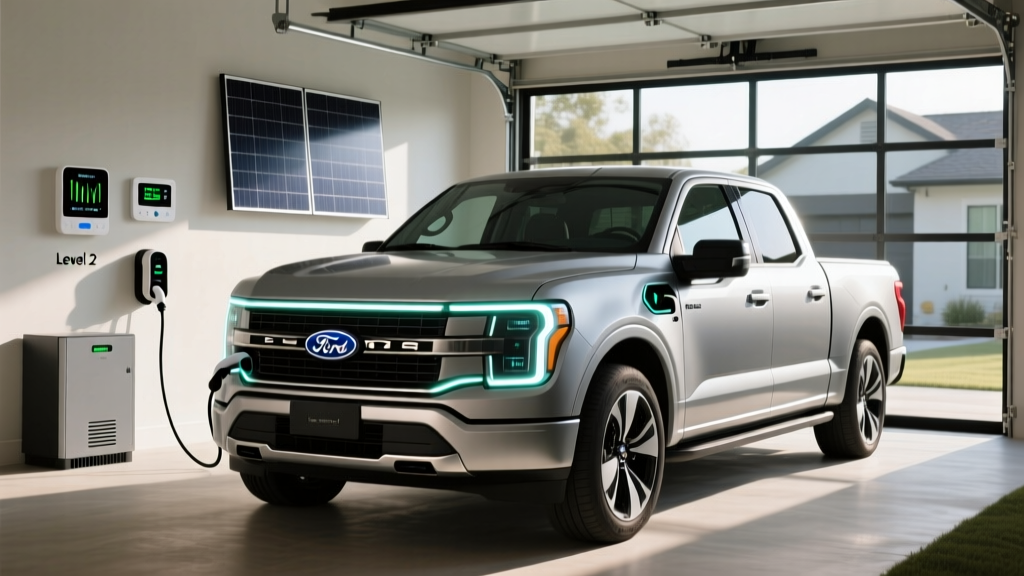
The Ford F-150 Lightning is more than an electric pickup — it's a rolling 131 kWh power station. Through Ford's Intelligent Backup Power system, enabled by the Charge Station Pro and Home Integration System, the truck can supply up to 9.6 kW of continuous power to your home during an outage. That's enough to run essential circuits — or even the entire house — for days. This review examines the F-150 Lightning as both a daily-driver EV and a home backup solution, with exact range, charging, pricing, and tax-credit data for the current model year.
Spec Table: 2026 Ford F-150 Lightning at a Glance
| Spec | Standard Range | Extended Range |
|---|---|---|
| EPA Range | 240 miles | 320 miles |
| Battery Usable Capacity | 98 kWh (NMC) | 131 kWh (NMC) |
| Horsepower | 580 hp | 580 hp |
| Torque | 775 lb-ft | 775 lb-ft |
| 0–60 mph | ~3.8 sec | |
| Drivetrain | Dual-motor AWD | |
| Max DC Fast Charge | 150 kW | 150 kW |
| 10–80% DC Charge | ~36 min | ~41 min |
| Level 2 Home Rate | 19.2 kW (80A) / ~30 mi/hr | |
| Pro Power Onboard | 9.6 kW (V2L/V2H capable) | |
| Max Tow Capacity | 7,700 lbs | 10,000 lbs |
| MPGe (Combined) | 76 MPGe | 70 MPGe |
| Efficiency | 44 kWh/100 mi | 48 kWh/100 mi |
| Battery Warranty | 8 yr / 100,000 mi (≥70% retention) | |
Real-World Range vs. EPA Estimates
Real-World Expectation: Highway driving at 70+ mph drops range ~12–15%. Expect ~200–210 mi (Standard) or ~270–280 mi (Extended) on sustained interstate runs. In cold weather (below 32°F), plan for 20–30% loss due to battery thermal demands and cabin heating — potentially as low as ~170 mi (Standard) or ~225 mi (Extended). City and suburban driving with regenerative braking recovers closer to EPA numbers.
The Extended Range battery's 131 kWh usable capacity is among the largest in any production consumer EV. That enormous energy reserve is precisely what makes the Home Integration System viable for multi-day backup. According to fueleconomy.gov, the Extended Range model consumes roughly 48 kWh per 100 miles — heavy, but expected for a 6,500-lb truck.
Charging: DC Fast, Home Level 2, and Backup Power
| Charging Level | Power | Speed / Notes |
|---|---|---|
| Level 1 (120V) | ~1.4 kW | ~2–3 mi/hr — emergency trickle only |
| Level 2 (240V, 80A) | 19.2 kW | ~30 mi/hr; full charge in ~7 hr (Ext.) |
| Level 2 (240V, 48A) | 11.5 kW | ~18 mi/hr; more common home setup |
| DC Fast Charge | Peak 150 kW | 10–80% in ~36–41 min; tapers sharply above 80% |
| Pro Power Onboard (V2L) | 9.6 kW | Bed outlets power tools, appliances directly |
| Intelligent Backup Power (V2H) | 9.6 kW | Whole-home transfer via Charge Station Pro |
The F-150 Lightning's 150 kW peak DC charge rate is moderate by 2026 standards — many newer EVs hit 250–350 kW. The charge curve sustains roughly 140–150 kW up to about 50% SoC, then steps down progressively. On a road trip, plan your stops around 25–30 minutes each to stay efficient.
For home integration, the Charge Station Pro (an 80A bi-directional wall unit) is the critical hardware piece. It's included with the Extended Range model and optional on Standard Range trims. When paired with the Home Integration System — a transfer switch and inverter setup installed by a licensed electrician and Sunrun (Ford's partner) — the truck automatically powers your home the moment the grid drops.
How the Home Integration System Actually Works
Ford's Intelligent Backup Power system operates through three components:
- Charge Station Pro — an 80A bi-directional Level 2 charger mounted in your garage or exterior wall.
- Home Integration System — a wall-mounted unit containing an inverter and automatic transfer switch, wired into your home's electrical panel.
- F-150 Lightning — plugged in and set to backup mode via the FordPass app.
When the grid fails, the system detects the outage within seconds and begins feeding up to 9.6 kW from the truck's battery back through the Charge Station Pro, into the Home Integration System, and onto your home's circuits. With 131 kWh in the Extended Range battery, and an average U.S. home consuming roughly 30 kWh per day, you could theoretically power your home for up to three days — or significantly longer if you run only essential loads (refrigerator, lights, HVAC fan, well pump, Wi-Fi).
Ford estimates the Extended Range Lightning can provide up to three days of whole-home power at average consumption, or up to 10 days on rationed essential circuits. The system supports both full-panel backup (every circuit) and critical-loads-only configurations, decided during installation.
Installation cost reality: The Home Integration System hardware runs approximately $3,800–$5,000 depending on your electrical setup. Professional installation by a certified electrician (typically coordinated through Sunrun) adds $2,500–$5,000+, especially if your panel needs upgrading to 200A service. Total installed cost typically lands between $7,000 and $12,000 before any local incentives. Always get a site-specific quote — older homes with 100A panels may face significant upgrade costs.
Pricing, Trims, and Federal Tax Credit Eligibility
| Trim | Battery | Base MSRP | Est. After §30D Credit |
|---|---|---|---|
| Pro (Standard Range) | 98 kWh | ~$55,000 | ~$47,500* |
| XLT (Standard Range) | 98 kWh | ~$60,000 | ~$52,500* |
| Lariat (Extended Range) | 131 kWh | ~$75,000 | ~$67,500* |
| Platinum (Extended Range) | 131 kWh | ~$87,000 | ~$79,500* |
*Tax credit estimates assume full $7,500 eligibility. Actual credit depends on IRS §30D requirements.
The F-150 Lightning qualifies as a truck under the IRS §30D clean vehicle credit, which carries an $80,000 MSRP cap for vans, SUVs, and pickup trucks. Most trims fall under this threshold, though a fully loaded Platinum with options can push close to or above it. Key eligibility requirements include:
- Buyer income caps: Modified AGI ≤ $300,000 (joint), $225,000 (head of household), $150,000 (single)
- MSRP cap: ≤ $80,000 for trucks/SUVs
- Battery sourcing: Critical minerals and battery component requirements phase in annually — confirm current-year compliance with your dealer
- Point-of-sale transfer: The credit can be applied at purchase to reduce your out-of-pocket cost directly
Tax credit eligibility changes frequently as battery-sourcing rules tighten. Consult a tax professional and verify on irs.gov before finalizing a purchase.
Performance, Cargo, and Daily Usability
The dual-motor AWD powertrain delivers 580 hp and 775 lb-ft of torque across all trims. The Extended Range model hits 60 mph in approximately 3.8 seconds — sports-car territory in a full-size truck. Towing capacity peaks at 10,000 lbs (Extended Range) and 7,700 lbs (Standard Range), though real-world towing range drops dramatically — expect a 40–50% range reduction when pulling heavy trailers at highway speed.
Cargo dimensions:
- Bed length: 5.5 ft (67.1 in) with 52.8 cu ft volume
- Mega Power Frunk: 14.1 cu ft, 400-lb payload capacity, drainable and lockable
- Rear-seat legroom: 43.6 in (SuperCrew cab)
- Max payload: ~2,000 lbs (varies by trim and battery)
The frunk is a standout practical feature — it replaces the engine bay with weatherproof, lockable storage that's ideal for groceries, tools, or charging cables. The 14.1 cu ft volume exceeds the trunk space of many sedans.
Tech and driver assists: The Lightning features SYNC 4A with a 15.5-inch portrait touchscreen (12-inch on Pro trim), wireless Apple CarPlay/Android Auto, and available BlueCruise — Ford's SAE Level 2 hands-free highway driving system. BlueCruise operates on pre-mapped divided highways and requires the driver to remain attentive; it is not autonomous driving. The truck also offers a 360-degree camera, trailer reverse assist, and over-the-air updates.
Pros
- 9.6 kW V2H/V2L powers an entire home during outages
- 131 kWh Extended Range battery offers up to 3 days backup
- 19.2 kW Level 2 charging is among the fastest for home setups
- Massive frunk and practical bed with onboard power outlets
- Strong 0–60 performance; excellent AWD traction
- Generous battery warranty (8 yr / 100,000 mi)
Cons
- 150 kW DC fast charging trails competitors (Rivian, Silverado EV)
- Highway and cold-weather range loss is significant (~20–30%)
- Home Integration System installation adds $7,000–$12,000
- Efficiency is low (~44–48 kWh/100 mi) — costly to charge on utility rates
- Towing drastically cuts range; not ideal for long-distance hauling
- Requires Sunrun partnership for integrated install — limited provider choice
Who the F-150 Lightning Home Integration System Suits Best
Buy it if: You live in an area with frequent or prolonged power outages (storm-prone coastal regions, wildfire-shutoff zones in California, Texas grid instability). The Lightning's V2H capability replaces or supplements a standby generator without fuel costs, maintenance, or noise. It's also ideal if you need a daily-driver truck with genuine work capability — the 9.6 kW Pro Power Onboard turns the bed into a mobile job-site power source.
Consider alternatives if: You primarily need long-distance towing range (a diesel truck or the upcoming Silverado EV with 400+ mi range may suit better). If home backup is your only goal and you don't need a truck, a purpose-built home battery like a Tesla Powerwall (~$12,000–$15,000 installed, 13.5 kWh) might be more cost-effective — though it won't drive you to work.
Warranty and Long-Term Battery Outlook
Ford covers the Lightning's battery and electric powertrain for 8 years or 100,000 miles, whichever comes first, with a capacity retention threshold of 70%. This means if the battery degrades below 70% of its original capacity within the warranty period, Ford will repair or replace it.
The NMC (nickel manganese cobalt) chemistry in both battery packs offers high energy density but is more sensitive to sustained high-SoC storage and extreme heat than LFP chemistries. For owners using the truck for home backup, frequent deep discharges below 20% SoC will accelerate degradation over time. Ford's system includes buffer management to protect the battery, but we recommend setting backup discharge limits (via FordPass) to preserve long-term battery health. Real-world data from early 2022–2023 Lightning owners shows degradation in the low single digits after 30,000–50,000 miles — encouraging, but long-term V2H cycling data is still limited.
Frequently Asked Questions
What is the real-world range of the F-150 Lightning?
The EPA rates the Extended Range at 320 miles and Standard Range at 240 miles. In real-world highway driving at 70+ mph, expect roughly 270–280 mi (Extended) or 200–210 mi (Standard). In cold weather below freezing, plan for 20–30% less — roughly 225 mi (Extended) or 170 mi (Standard).
How fast does the F-150 Lightning charge at home and on the road?
On a DC fast charger, the Lightning peaks at 150 kW and charges from 10–80% in approximately 36–41 minutes. At home with the 80A Charge Station Pro (19.2 kW), you gain roughly 30 miles of range per hour — enough to fully recharge the Extended Range battery overnight in about 7 hours. On a standard 48A Level 2 charger (11.5 kW), expect ~18 mi/hr.
How much does the F-150 Lightning cost after tax credits?
Base MSRPs range from roughly $55,000 (Pro Standard Range) to $87,000 (Platinum Extended Range). If you qualify for the full $7,500 federal §30D credit — subject to income caps, MSRP limits, and battery-sourcing rules — effective prices drop to approximately $47,500–$79,500. The credit can be transferred at point of sale. Add $7,000–$12,000 for Home Integration System installation.
Does the F-150 Lightning qualify for the federal EV tax credit?
Most trims qualify for up to $7,500 under IRS §30D, as the Lightning is classified as a truck (MSRP cap: $80,000). However, eligibility depends on your modified adjusted gross income (≤$300K joint / ≤$150K single), the specific vehicle's battery component and critical-mineral sourcing compliance for the current tax year, and the final MSRP of your configured trim. Verify on irs.gov and with your dealer before purchase.
Is the F-150 Lightning worth buying vs. the Rivian R1T or Chevy Silverado EV?
The Lightning wins on home backup capability — neither the R1T nor Silverado EV currently offers a factory-integrated V2H system at this scale. The R1T is more compact and off-road capable but costs more and lacks V2H. The Silverado EV offers longer range (up to 440 mi EPA on top trims) and faster DC charging, but its V2H ecosystem is less mature. If whole-home backup is your priority, the Lightning with the Home Integration System remains the most complete package available.
Can I install the Home Integration System myself?
No. The system requires a licensed electrician to install the transfer switch, inverter, and Charge Station Pro, and to wire them into your home's main electrical panel. Ford coordinates installations through Sunrun, though you may use your own licensed electrician if they are certified on the system. A 200A electrical panel is typically required; older homes may need a panel upgrade ($1,500–$3,000+).