Why the F-150 Lightning 1995 Restomod Is Trending in 2026
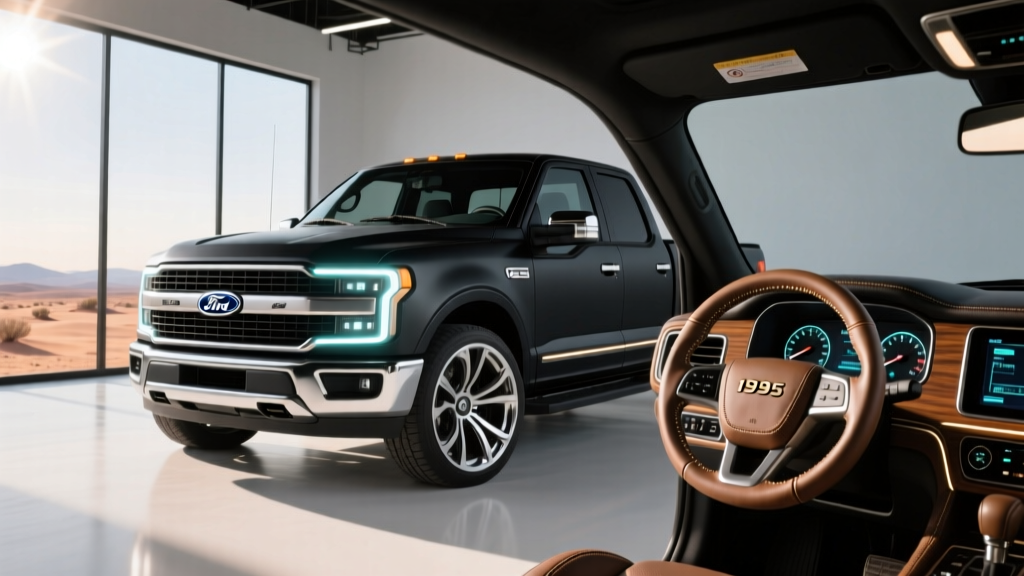
Search interest in "F-150 Lightning 1995" has surged among EV enthusiasts and classic truck fans alike — and for good reason. The ninth-generation Ford F-150 (1992–1996) is one of the most iconic square-body trucks on American roads. Now, a growing restomod movement is dropping modern electric powertrains — including salvaged Ford F-150 Lightning dual-motor setups — into 1995 F-150 chassis. The result: a vintage truck with 580 horsepower, instant torque, and zero tailpipe emissions.
But converting a 30-year-old truck to electric propulsion isn't a plug-and-play project. This guide breaks down the real specs, costs, charging realities, and practical trade-offs of building or buying an F-150 Lightning 1995-style EV restomod in 2026 — whether you're sourcing a donor Lightning drivetrain or working with a conversion shop.
Powertrain Specs: Lightning Drivetrain Meets '95 Body
Most F-150 Lightning 1995 restomods use a salvaged or crate drivetrain from a 2022–2025 Ford F-150 Lightning. Here's what that powertrain delivers when installed in a lighter, shorter-wheelbase 1995 regular-cab or extended-cab F-150:
| Spec | Value |
|---|---|
| Drivetrain | Dual-motor AWD |
| Horsepower | 580 hp (combined) |
| Torque | 775 lb-ft |
| 0–60 mph | ~3.8 seconds (in lighter '95 chassis) |
| Battery Usable Capacity | 131 kWh (Extended Range pack) |
| Battery Chemistry | NMC (Nickel Manganese Cobalt) |
| Max DC Fast Charge Rate | ~150 kW peak |
| 10–80% DC Charge Time | ~41 minutes (stock Lightning) |
| Level 2 Home Charge Rate | 19.2 kW (80A Ford Charge Station Pro) / ~30 mi/hr |
| EPA Range (stock 2024 Lightning Ext. Range) | 320 miles |
| Efficiency (stock Lightning) | 70 MPGe / 48 kWh/100 mi |
Important caveat: When this drivetrain is transplanted into a 1995 F-150, efficiency changes. The '95 body is less aerodynamic (boxier profile, no active grille shutters, no underbody panels), and the suspension/weight distribution differs. Expect real-world efficiency to drop to roughly 52–58 kWh/100 mi depending on bed configuration, tire choice, and lift height.
Real-World Range Expectations: Restomod vs. Stock Lightning
Stock 2024 F-150 Lightning Extended Range EPA estimate: 320 miles.
Estimated restomod range (1995 body, same 131 kWh pack): 240–280 miles in mixed driving. Highway driving at 75 mph may yield 210–240 miles due to the '95 truck's higher drag coefficient (~0.45 vs. the modern Lightning's ~0.38). In cold weather (below 32°F), expect an additional 15–25% range reduction — bringing winter highway range down to roughly 170–200 miles without preconditioning.
Sources: fueleconomy.gov, Ford Motor Company specifications.
Charging Reality: What to Expect at Home and on the Road
Charging a restomod F-150 Lightning 1995 build depends heavily on whether the conversion retains the stock Lightning's onboard charger and CCS charge port, or if a third-party system (like a CCS adapter or J1772 setup) is used. Most professional conversions keep the OEM charge port and BMS (Battery Management System) intact.
| Charging Level | Power (kW) | Miles Added per Hour | Notes |
|---|---|---|---|
| Level 1 (120V household) | ~1.4 kW | ~2–3 mi/hr | Emergency only; full charge takes days |
| Level 2 (240V, 32A mobile cord) | 7.7 kW | ~13 mi/hr | Standard outlet; overnight adds ~100 mi |
| Level 2 (240V, 48A wall connector) | 11.5 kW | ~19 mi/hr | Full charge in ~11 hours |
| Level 2 (240V, 80A Ford Charge Station Pro) | 19.2 kW | ~30 mi/hr | Requires 100A dedicated circuit; full charge in ~7 hrs |
| DC Fast Charge (public CCS) | Up to 150 kW peak | ~150 mi in 30 min (10–80%) | Tapers significantly above 80%; 41 min for 10–80% |
Charging curve reality: The Lightning's NMC pack peaks near 150 kW only between roughly 15–40% State of Charge (SoC). Above 60%, the rate drops to ~80 kW, and above 80%, it falls below 40 kW to protect cell longevity. This is standard NMC behavior — plan road-trip stops around the 10–80% window and avoid routinely charging to 100% unless you need the full range for a trip.
Home charging installation: Running the 80A Ford Charge Station Pro requires a 100A dedicated circuit. Many older homes (especially those with 100A or 150A main panels) will need a panel upgrade to 200A, which typically costs $1,500–$3,500 from a licensed electrician. The charger unit itself runs ~$1,200–$1,500. Budget $3,000–$5,000 total for a full Level 2 installation on an older panel. Always consult a licensed electrician for final specifications.
Conversion Costs and What You'll Actually Spend
Building an F-150 Lightning 1995 restomod is not cheap. Here's a realistic cost breakdown based on 2025–2026 conversion shop pricing and donor-part availability:
| Component | Estimated Cost |
|---|---|
| 1995 F-150 donor truck (running condition) | $3,000–$8,000 |
| Salvaged Lightning drivetrain (motors, inverter, battery pack, BMS) | $18,000–$28,000 |
| Custom motor mounts, subframe, and driveshaft adapters | $4,000–$8,000 |
| Battery enclosure fabrication and structural reinforcement | $5,000–$12,000 |
| Wiring harness, contactors, DC-DC converter, thermal management | $3,000–$6,000 |
| Instrumentation / digital dash integration | $2,000–$5,000 |
| Body restoration, paint, and interior refresh | $5,000–$15,000 |
| Shop labor (if not DIY — 300–500 hours typical) | $30,000–$60,000 |
| Total (professional build) | $70,000–$142,000 |
| Total (DIY-heavy, owner-fabricated) | $35,000–$65,000 |
For context, a new 2026 F-150 Lightning XLT Extended Range starts around $69,995 MSRP (before any incentives). A professionally built restomod will typically cost as much or more than a new Lightning — the value proposition is uniqueness, not savings.
Federal Tax Credit: Does a Conversion Qualify?
This is where the news gets sobering for restomod builders. Under current IRS §30D rules, the federal clean vehicle tax credit applies only to new, factory-produced vehicles purchased from a licensed dealer. An EV conversion or restomod built from salvaged components does not qualify for the §30D credit — regardless of the battery's origin or the vehicle's zero-emission status.
- §30D credit amount: Up to $7,500 for qualifying new EVs ($3,750 if only battery-sourcing or critical-minerals requirement is met)
- MSRP cap: Trucks/SUVs must be under $80,000 MSRP; sedans under $55,000
- Buyer income cap: AGI ≤ $150,000 (single), $225,000 (head of household), $300,000 (joint)
- Battery sourcing: Critical minerals and battery components must meet phased domestic-content thresholds
- Point-of-sale transfer: Eligible buyers can transfer the credit to the dealer at purchase for an immediate price reduction
- Conversion/restomod eligibility: NOT eligible — §30D requires a new vehicle from an OEM with a valid VIN and manufacturer certification
Bottom line: If you're building a 1995 F-150 Lightning restomod, budget the full cost without expecting any federal tax credit. Some states offer separate incentives for EV conversions (California's CC4A program, for example, has occasionally included conversion provisions), but these vary by jurisdiction — check your state's energy or environmental agency for current programs.
Who Should Consider an F-150 Lightning 1995 EV Restomod?
Choose This Build If:
- You want a one-of-a-kind classic truck with modern EV performance
- You have access to a qualified EV conversion shop or advanced DIY fabrication skills
- You plan to use it as a weekend/show vehicle with 200–250 miles of usable range
- You value the '95 F-150's simpler, lighter chassis for a more engaging drive
- Budget is secondary to the project's uniqueness and craftsmanship
Choose a Stock F-150 Lightning Instead If:
- You need a daily-driver work truck with warranty coverage and dealer support
- You want to qualify for the §30D federal tax credit
- You need Pro Power Onboard, BlueCruise, or a factory-integrated towing system
- You want predictable 320-mile EPA range with OTA updates and a service network
- Your budget is under $70,000 and you need financing options
Pros and Cons at a Glance
Pros
- 580 hp / 775 lb-ft in a ~4,200-lb classic chassis = thrilling performance
- Unique show-stopper — no two builds are alike
- Lower center of gravity with under-floor battery pack improves '95 handling
- Zero tailpipe emissions; silent cruising in a vintage truck
- Simpler '95 body means easier fabrication access vs. modern unibody trucks
- Salvaged Lightning drivetrains are becoming more available as fleet vehicles retire
Cons
- $70K–$140K+ for a professional build — more than a new Lightning
- No federal tax credit eligibility under §30D
- No factory warranty on the conversion; battery/motor warranty voided by salvage
- Reduced range vs. stock Lightning (240–280 mi est.) due to worse aero
- Insurance can be difficult — specialty/agreed-value policies required
- No ADAS features (no BlueCruise, no automatic emergency braking in '95 chassis)
- Resale market is niche — longer to sell, value is subjective
Warranty, Safety, and Insurance Considerations
Warranty: Ford's factory battery and powertrain warranty (8 years / 100,000 miles on the Lightning's high-voltage components) is voided the moment the drivetrain is removed from its original vehicle and installed in a different chassis. Restomod owners are entirely responsible for component longevity. NMC batteries typically retain 80–85% of original capacity after 150,000–200,000 miles of normal use, but without active thermal management calibration (which depends on the OEM BMS being properly re-integrated), degradation may accelerate.
Safety: The 1995 F-150 was never crash-tested by NHTSA under modern protocols, and adding a 1,800-lb battery pack changes crash dynamics significantly. Professional conversions include reinforced battery enclosures, inertia cutoff switches, and high-voltage disconnect systems — but this is not equivalent to a modern crumple-zone design. Airbags were optional and rudimentary in '95. Treat this as a fair-weather, low-speed-environment vehicle from a safety perspective.
Insurance: Expect to work with specialty insurers (Hagerty, Grundy, or similar agreed-value classic-car carriers). Annual premiums for a $100K+ restomod EV typically run $1,500–$3,500 depending on mileage limits, storage conditions, and driver history. Standard carriers often won't underwrite a home-built EV conversion.
Frequently Asked Questions
What is the real-world range of an F-150 Lightning 1995 restomod?
With the Lightning's 131 kWh Extended Range pack in a 1995 F-150 body, expect roughly 240–280 miles in mixed driving. Highway-only range at 75 mph drops to around 210–240 miles due to the '95 truck's boxier aerodynamics. Cold weather (below 32°F) can reduce range an additional 15–25%, so winter highway range may be 170–200 miles. The stock 2024 Lightning achieves an EPA-estimated 320 miles (fueleconomy.gov).
How fast does the restomod charge at home and on DC fast chargers?
If the OEM Lightning charge system is retained: DC fast charging peaks at ~150 kW (CCS connector), with 10–80% in approximately 41 minutes. At home on a 240V/80A Ford Charge Station Pro, you'll add ~30 miles per hour of charging. A standard 240V/32A outlet adds ~13 miles per hour. Level 1 (120V) is impractical for a 131 kWh pack — it adds only 2–3 miles per hour.
Does an F-150 Lightning 1995 EV conversion qualify for the federal tax credit?
No. The IRS §30D clean vehicle credit applies only to new vehicles purchased from licensed dealers with manufacturer certification. An EV conversion or restomod does not qualify, regardless of the battery's origin. Check your state's energy agency for any local conversion incentives, which vary by jurisdiction. Consult a tax professional for personal eligibility guidance.
Is it worth building a 1995 Lightning restomod vs. buying a new F-150 Lightning?
Financially, no — a professional build costs $70K–$140K+ with no tax credit, no warranty, and less range than a stock Lightning. Emotionally and as a collector piece, it depends on your priorities. If you want a guaranteed daily driver with 320 miles of range, BlueCruise, Pro Power Onboard, and dealer support, buy the new truck. If you want a unique classic that turns heads at every Cars & Coffee and delivers 3.8-second 0–60 times, the restomod is unmatched.
Can I do the conversion myself?
Advanced DIYers with high-voltage electrical training, fabrication skills, and EV system integration experience have completed similar projects. However, working with a 131 kWh NMC battery pack involves lethal voltages (350–400V nominal). If you lack formal EV safety training, work with a professional conversion shop. Budget at least 300–500 hours for a complete build.
What happens to the Lightning's regenerative braking in a '95 chassis?
Regenerative braking can be retained if the OEM motor controllers and BMS are properly integrated. Most conversions use the Lightning's drive unit controllers, which manage regen mapping. However, the '95 F-150's original hydraulic brake system must also be retained as a backup and for low-speed stops. Some builders add a vacuum pump to replicate power-brake assist, since there's no engine-driven vacuum source.