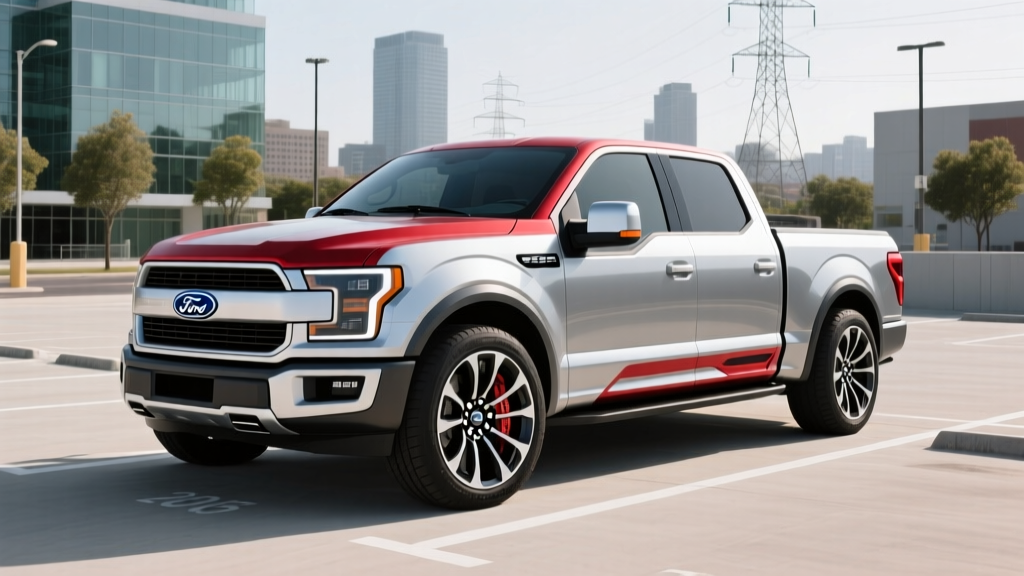
If you've searched for F-150 bolt pattern 2015, you're likely swapping wheels — either on a 2015-era gasoline F-150 or cross-referencing fitment for the current Ford F-150 Lightning. Wheel compatibility between these generations is more nuanced than a simple lug count, especially when an electric powertrain adds 1,500+ pounds of battery mass to the equation. This guide covers the exact bolt pattern, center bore, offset ranges, and the EV-specific considerations that affect range, efficiency, and safety.
F-150 Bolt Pattern 2015: The Core 6x135mm Specification
The 2015 Ford F-150 — the first model year of Ford's aluminum-body 13th generation — uses a 6x135mm bolt pattern (also written as 6x5.31 inches). This means six lug nuts arranged on a 135-millimeter bolt circle diameter. Ford has maintained this pattern across the F-150 lineup continuously from 2004 through the current 2026 model year, including the F-150 Lightning EV.
| Bolt Pattern | 6x135mm (6x5.31") |
| Center Bore | 87.1mm |
| Lug Nut Thread | M14 x 1.5 |
| Stock Offset Range | +40mm to +44mm (varies by trim/wheel) |
| Lug Torque Spec | 150 lb-ft (2015 gas); 165 lb-ft (Lightning) |
The 87.1mm center bore is critical: wheels with a smaller bore won't physically mount, while aftermarket wheels with a larger bore require hub-centric rings to prevent vibration at highway speeds. Never rely on lug-centric fitment on a truck — the center bore carries the load, not the studs.
Does the 2015 Bolt Pattern Fit the F-150 Lightning?
Yes — the F-150 Lightning (2022–2026) shares the identical 6x135mm bolt pattern and 87.1mm center bore as the 2015 F-150. However, physical bolt-on compatibility does not mean the wheel is safe or optimal for the Lightning. Three factors separate Lightning-appropriate wheels from gas-truck wheels:
- Load Rating: The Lightning's curb weight ranges from 6,171 lbs (base Pro, standard-range battery) to approximately 6,840 lbs (Platinum, extended-range). Each wheel must support at minimum 1,650 lbs per corner to provide adequate margin. Many 2015-era aftermarket wheels are rated for only 1,300–1,400 lbs per corner — sufficient for a 4,700-lb gas F-150, but structurally inadequate for the Lightning.
- Offset and Brake Clearance: The Lightning's larger front brake calipers (necessary for the heavier vehicle) require specific spoke profiles. A wheel that clears a 2015 F-150's caliper may contact the Lightning's caliper at the pad or barrel.
- TPMS Compatibility: The Lightning uses Ford's current-generation tire pressure monitoring sensors. Older 2015-era TPMS sensors operate on a different frequency and won't pair with the Lightning's receiver without a module adapter.
If you're mounting 2015-spec wheels on a Lightning, verify the stamp on the wheel's back — it must show a load rating of 750 kg (1,653 lbs) or higher per wheel.
EV Wheel Choice and Real-World Range Impact
Wheel and tire selection has an outsized effect on electric-vehicle efficiency. Unlike a gas truck where a wheel swap might cost you 0.5 MPG, the same change on an EV directly reduces available range from a fixed 98 kWh (standard-range) or 131 kWh (extended-range) battery pack.
EPA estimated range: 320 miles (Platinum/Lariat 20" wheels). Expect approximately 260–285 miles at sustained highway speeds (70–75 mph) and as low as 220–240 miles in sub-30°F cold weather without preconditioning. Switching to aggressive all-terrain tires on aftermarket wheels can reduce range by an additional 8–12%.
Ford's own EPA data shows the difference: the Lightning XLT with 18" all-season tires achieves 230 miles on the standard-range battery, while the same truck with optional 20" wheels drops to 217 miles — a 13-mile loss from wheel diameter and tire compound alone. Per fueleconomy.gov, the extended-range Lightning with 20" wheels achieves 70 MPGe combined (2.1 kWh/mile), while 18" configurations reach 78 MPGe combined.
For aftermarket wheel buyers: prioritize low rolling-resistance tires and avoid increasing overall tire diameter beyond 2% of stock. Every 1% increase in rolling circumference forces the motors to work harder, reducing regenerative braking efficiency and increasing consumption.
2026 F-150 Lightning: Current Specs at a Glance
| Spec | Standard-Range | Extended-Range |
|---|---|---|
| Battery (usable) | 98 kWh (NMC) | 131 kWh (NMC) |
| EPA Range | 230 mi (18" wheels) | 320 mi (18" wheels) |
| Horsepower | 452 hp (dual-motor) | 580 hp (dual-motor) |
| Torque | 775 lb-ft | 775 lb-ft |
| 0–60 mph | ~4.5 sec | ~3.8 sec |
| Max DC Fast Charge | 150 kW | 150 kW |
| 10–80% DCFC Time | ~44 min | ~41 min |
| Level 2 Home Rate | 11.5 kW (~30 mi/hr) | 19.2 kW (~50 mi/hr, 80A charger req.) |
| Max Towing | 7,700 lbs | 10,000 lbs |
| Bolt Pattern | 6x135mm | 6x135mm |
The Lightning uses NMC (nickel-manganese-cobalt) pouch cells supplied by SK On. Ford's battery warranty covers 8 years or 100,000 miles against capacity loss below 70% of original — a standard among mainstream EV manufacturers.
Wheel Offset, Spacers, and the Lightning's Wider Track
The 2015 F-150 and the Lightning share a bolt pattern, but their track widths differ. The 2015 F-150 front track measures approximately 67.6 inches, while the Lightning's front track is approximately 68.1 inches. This half-inch difference per side means:
- Stock Lightning wheels have a slightly different offset than equivalent 2015 gas wheels
- Mounting 2015 gas wheels on a Lightning may push the wheel inward, increasing the risk of inner-barrel contact with suspension components
- Wheel spacers (5–10mm) can correct offset mismatches but must be hub-centric and rated for the Lightning's load — never use generic spacers rated for passenger cars
For the safest fitment, target a wheel offset between +35mm and +44mm with a minimum width of 8 inches. Anything outside this range risks bearing wear, steering pull, or fender rubbing at full lock.
Pricing and Federal Tax Credit Eligibility
| Trim | Base MSRP | Est. After §30D Credit |
|---|---|---|
| Pro (Std Range) | $54,995 | $47,495* |
| XLT (Std Range) | $59,995 | $52,495* |
| Lariat (Ext Range) | $71,995 | $64,495* |
| Platinum (Ext Range) | $86,995 | $79,495* |
*Credit eligibility depends on meeting all IRS §30D requirements, including buyer income caps ($150K single / $300K joint MAGI), MSRP cap of $80,000 for trucks, and battery critical-mineral and component sourcing thresholds. Point-of-sale transfer is available at participating dealers. Verify eligibility with a tax professional before purchase — rules are subject to legislative change.
Note that the Platinum trim's MSRP of $86,995 exceeds the §30D truck cap of $80,000, making it ineligible for the federal credit. The Lariat extended-range at $71,995 qualifies on MSRP but must still satisfy sourcing and income requirements.
Pros and Cons: F-150 Lightning Ownership
- 6x135mm bolt pattern shared with 2004–2026 F-150s — vast aftermarket wheel selection
- 580 hp / 775 lb-ft from dual motors; 3.8-sec 0–60 (extended-range)
- Pro Power Onboard (up to 9.6 kW) turns the truck into a mobile generator
- Frunk (400L / 14.1 cu ft) with drain plug — useful cooler or secure storage
- BlueCruise hands-free driving on 130,000+ miles of divided highway (SAE Level 2)
- Low operating cost: ~$0.06/mi on home electricity vs. ~$0.18/mi gas equivalent
- Heavy: 6,840-lb curb weight means rapid tire wear — expect 25,000–35,000 mi on stock rubber
- Range drops 30–40% when towing at highway speeds (real-world: ~175 mi at 65 mph with 7,000-lb trailer)
- 150 kW peak DCFC is slower than the Rivian R1T's ~220 kW or Silverado EV's ~350 kW
- Platinum trim exceeds $80K MSRP cap — no federal tax credit
- Aftermarket wheels MUST be load-rated for EV weight — many 2015-era wheels are not
- Insurance premiums run 15–25% higher than equivalent gas F-150 trims
Who Should Buy the F-150 Lightning?
Best for: Homeowners with Level 2 charging who need a full-size truck for daily commuting, light-to-moderate towing (<7,000 lbs typical), job-site power via Pro Power Onboard, and weekend hauling. The extended-range battery makes 250-mile day trips feasible without en-route charging.
Think twice if: You regularly tow over 7,000 lbs on highway routes longer than 150 miles, lack reliable home charging access, or live in a region with sparse DCFC infrastructure. For heavy towing, a diesel F-250 or a PHEV alternative remains more practical for range-consistent work duty.
Frequently Asked Questions
What is the bolt pattern on a 2015 Ford F-150?
The 2015 F-150 uses a 6x135mm (6x5.31") bolt pattern with an 87.1mm center bore and M14 x 1.5 lug nuts. This pattern is shared across all F-150 model years from 2004 through the current 2026 F-150 and F-150 Lightning.
Can I put 2015 F-150 wheels on a 2026 F-150 Lightning?
The bolt pattern and center bore match, but you must verify three things: (1) each wheel's load rating supports at least 1,650 lbs, (2) the wheel clears the Lightning's larger brake calipers, and (3) you have compatible TPMS sensors. Many 2015-era aftermarket wheels are not load-rated for the Lightning's 6,100–6,800 lb curb weight.
What is the real-world range of the F-150 Lightning?
The extended-range Lightning carries an EPA rating of 320 miles. In real-world highway driving at 70–75 mph, expect 260–285 miles. In sub-freezing temperatures without battery preconditioning, range can drop to 220–240 miles. Towing a 5,000+ lb trailer at highway speeds reduces range to approximately 150–180 miles.
How fast does the Lightning charge at home and on the road?
On DC fast charging, the Lightning peaks at 150 kW, reaching 10–80% in approximately 41–44 minutes depending on battery size. At home, the extended-range model charges at up to 19.2 kW on a dedicated 80-amp Level 2 circuit, adding roughly 50 miles of range per hour. The standard-range model charges at 11.5 kW on a standard 48-amp Level 2, adding about 30 miles per hour.
Does the F-150 Lightning qualify for the $7,500 federal tax credit?
Most trims qualify, but eligibility depends on IRS §30D rules: buyer modified adjusted gross income must not exceed $150,000 (single) or $300,000 (joint), the truck's MSRP must be at or below $80,000, and the battery must meet critical-mineral and component sourcing thresholds. The Platinum trim ($86,995 MSRP) does not qualify due to the price cap. Always verify current rules at irs.gov and consult a tax professional.
What size wheels fit the F-150 Lightning from the factory?
Ford offers 18-inch (Pro, XLT), 20-inch (Lariat, XLT optional), and 22-inch (Platinum) wheels on the Lightning. All use the 6x135mm pattern. For best range, stick with 18-inch wheels and low-rolling-resistance all-season tires. Aftermarket 20-inch wheels are the most popular upgrade but expect a 5–8% range reduction versus 18-inch stock.