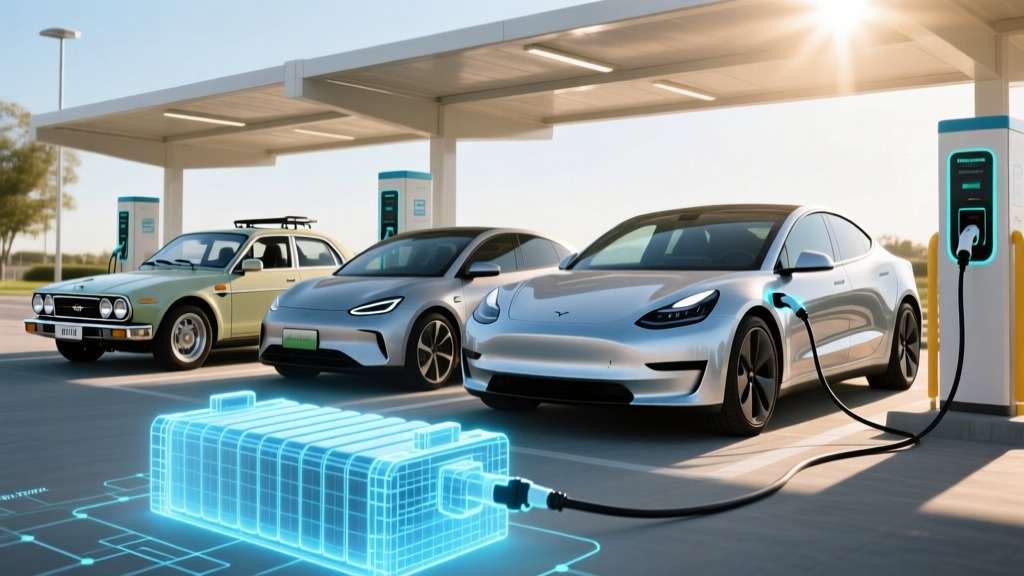
The evolution of electric cars has transformed them from short-range curiosities into mainstream vehicles that compete directly with gas cars on cost, performance, and practicality. In 2011, the Nissan Leaf offered 73 miles of EPA range and took 21 hours to charge on a standard outlet. Today, vehicles like the Hyundai Ioniq 5 (318 miles EPA, 10–80% DC fast charge in ~18 minutes) and the Tesla Model 3 Long Range (363 miles EPA) make cross-country EV travel routine. But the real question for buyers isn't history—it's whether today's EVs make financial and practical sense for your driving patterns, charging access, and budget.
Quick Answer: Is a Modern EV Worth It in 2026?
For most drivers with home charging access and daily commutes under 100 miles, a modern EV delivers lower total cost of ownership than a comparable gas car over 5 years—especially when factoring in the federal §30D tax credit (up to $7,500 for qualifying models), reduced maintenance, and lower per-mile energy costs. The tipping point comes at roughly 10,000 miles/year if you're paying residential electricity rates under $0.18/kWh. If you lack home charging or regularly drive 400+ miles in cold climates, a plug-in hybrid (PHEV) may be the smarter bridge.
The Timeline: How EVs Went From Niche to Normal
The modern EV era began in earnest around 2010–2012, when the U.S. Department of Energy and EPA started tracking electric vehicles as a distinct category. Here's what changed across three distinct generations:
- First Generation (2011–2016): Battery capacities of 16–30 kWh, EPA ranges of 73–107 miles, Level 2 charging at 3.3–6.6 kW, and DC fast charging (where available) capped at 50 kW via CHAdeMO. Representative models: Nissan Leaf, Chevy Spark EV, BMW i3.
- Second Generation (2017–2022): Battery capacities grew to 60–82 kWh, EPA ranges hit 200–300+ miles, 150–250 kW DC fast charging became common on CCS and Tesla Supercharger networks. Representative models: Chevy Bolt (259 mi), Tesla Model 3 Long Range (353 mi), Hyundai Kona Electric (258 mi).
- Third Generation (2023–2026): 800-volt architectures enable 250–350 kW peak DC charging, LFP chemistry cuts battery costs, NACS connector adoption expands Supercharger access to non-Tesla EVs, and EPA ranges of 300–400+ miles are routine. Representative models: Hyundai Ioniq 5 (318 mi, 800V), Tesla Model 3 Long Range (363 mi), Chevrolet Equinox EV (315 mi), Lucid Air Grand Touring (516 mi).
The single biggest shift isn't range—it's charging speed. A 2012 Leaf added roughly 15 miles of range in a 30-minute DC fast charge session. A 2026 Ioniq 5 on a 350 kW charger adds roughly 150 miles in the same timeframe. That's what made road-trip EV ownership viable.
EV vs Gas vs Hybrid: The 2026 Cost Comparison
The evolution of electric cars only matters if the economics work. Let's compare three realistic 2026 options across a 5-year, 75,000-mile ownership period, assuming $3.50/gallon gas, $0.15/kWh home electricity, and 15,000 miles/year:
| Cost Factor | Hyundai Ioniq 5 SE (EV) | Toyota RAV4 LE (Gas) | Toyota RAV4 Prime (PHEV) |
|---|---|---|---|
| Base MSRP | $42,400 | $30,425 | $44,590 |
| Federal Tax Credit (§30D) | Up to $7,500* | $0 | Up to $7,500* |
| Effective Purchase Price | ~$34,900 | $30,425 | ~$37,090 |
| 5-Year Fuel/Energy Cost | ~$3,375 (home charging) | ~$8,750 (30 MPG combined) | ~$4,800 (blended) |
| 5-Year Maintenance | ~$1,200 | ~$3,500 | ~$2,800 |
| 5-Year Insurance (est.) | ~$9,500 | ~$7,800 | ~$8,600 |
| 5-Year Total Cost of Ownership | ~$48,975 | ~$50,475 | ~$53,290 |
*Federal §30D tax credit eligibility depends on MSRP caps ($55,000 sedans, $80,000 SUVs/trucks), buyer income limits ($150K single / $300K joint for new vehicles), and battery critical-mineral and component sourcing requirements. Credit can now be transferred to the dealer at point of sale as an upfront discount. Always verify current eligibility at IRS.gov and consult a tax professional.
The data reveals a pattern: EVs cost more upfront (before credits) but claw back the difference through fuel and maintenance savings. Insurance remains the EV's weak spot—premiums run 15–25% higher on average due to repair costs and battery replacement risk.
What the Evolution of Electric Cars Means for Range and Charging in 2026
Today's EV buyers benefit from three converging improvements that didn't exist five years ago:
1. Larger, cheaper batteries. The average new EV battery in 2026 holds 75–100 kWh of usable energy, compared to 30–60 kWh in 2018. LFP (lithium iron phosphate) chemistry, now used in standard-range Tesla Model 3/Y and several other models, trades some energy density for lower cost, longer cycle life, and reduced fire risk. NMC (nickel manganese cobalt) remains the choice for maximum range in Long Range and Performance trims.
2. Faster charging architectures. 800-volt platforms (Hyundai/Kia E-GMP, Porsche Taycan, Lucid Air) sustain higher charge rates longer. Where a 400V vehicle might peak at 150 kW and taper sharply above 60% SoC, an 800V vehicle can sustain 200+ kW through 80% SoC, cutting real-world 10–80% times to 18–22 minutes.
3. NACS connector unification. Tesla's North American Charging Standard (NACS) has been adopted by Ford, GM, Rivian, Hyundai, and most major automakers for 2025–2026 models. This means non-Tesla EVs now access the Supercharger network (17,000+ stalls in North America) with a native port or adapter, dramatically reducing public charging friction.
Real-World Range Reality Check
EPA range estimates are tested under controlled conditions. In real-world driving, expect:
- Highway driving (75+ mph): 10–20% below EPA (aerodynamic drag hits EVs harder than gas cars)
- Cold weather (below 30°F): 20–40% range reduction due to battery chemistry and cabin heating load (heat pumps, now standard on many 2026 models, cut this penalty roughly in half)
- Mixed suburban driving (35–55 mph): Typically within 5% of EPA, often slightly above thanks to regenerative braking
A 318-mile EPA Ioniq 5 might deliver 260–280 miles on a 70°F highway trip, but only 190–220 miles on a 15°F winter highway drive. Plan charging stops accordingly.
Common EV Myths vs. 2026 Facts
The evolution of electric cars has outpaced public perception. Here's where misconceptions still linger:
| Myth | 2026 Fact |
|---|---|
| "EV batteries need replacing every few years" | Federal law mandates 8-year/100,000-mile battery warranties (10 years in CARB states). Real-world degradation data shows most EVs retain 85–92% capacity after 100,000 miles. Full replacement costs $5,000–$20,000 depending on the model, but is rarely needed within the warranty period. |
| "The grid can't handle mass EV adoption" | Most EV charging happens overnight at home when grid demand is lowest. A 2026 EV drawing 7.2 kW on Level 2 uses roughly the same power as a central AC unit. Smart charging and time-of-use rates further reduce strain. |
| "EVs are worse for the environment because of battery mining" | Lifecycle analyses from Argonne National Laboratory and the ICCT consistently show EVs produce 50–70% fewer lifetime CO₂ emissions than comparable gas cars, even on coal-heavy grids. The breakeven point vs. a 30 MPG gas car is typically 15,000–25,000 miles of driving. |
| "Public charging is unreliable" | This varies by network. Tesla Superchargers maintain ~99.5% uptime. Electrify America and EVgo have improved to ~90–95% uptime in 2025–2026, but rural corridors and older 50 kW CHAdeMO stations remain pain points. Always have a backup charging plan on road trips. |
| "You can't take road trips in an EV" | With 300+ mile ranges and 18–25 minute 10–80% DC fast charges, a 500-mile trip requires one 25-minute stop—comparable to a gas car's lunch break. Apps like A Better Routeplanner and PlugShare make trip planning routine. |
Real-World Ownership: What First-Time EV Buyers Must Know
The evolution of electric cars has made ownership simpler, but it hasn't eliminated all friction points. Here's what actually matters day-to-day:
Home charging is the single biggest ownership advantage. Roughly 80% of EV charging happens at home. A Level 2 home charger (240V, 32–48 amps, 7.7–11.5 kW) adds 25–44 miles of range per hour—enough to fully replenish any EV overnight. Installation costs range from $500–$2,500 if your electrical panel has capacity, or $2,000–$5,000+ if you need a panel upgrade (common in older homes with 100-amp service). Without home charging, EV ownership means relying on public DC fast charging ($0.30–$0.50/kWh) or workplace charging, which erodes the cost advantage and adds daily friction.
Understand kW vs. kWh. This is the most common point of confusion. kW (kilowatts) measures power—how fast energy flows, like water pressure in a hose. kWh (kilowatt-hours) measures energy—how much the battery holds, like gallons in a tank. A 75 kWh battery charged at 7.2 kW takes roughly 10.4 hours from empty to full. A 250 kW DC fast charger can add 50 kWh (roughly 180–200 miles) in 12–15 minutes. Never confuse the two.
Charging curves matter more than peak kW. Automakers advertise peak charge rates (e.g., "up to 350 kW"), but no EV sustains peak rate for the entire session. Lithium-ion batteries accept charge fastest between 10–50% SoC, then taper progressively. A vehicle that peaks at 250 kW may average only 150 kW over a 10–80% session. Look for published 10–80% charge times, not just peak kW, when comparing models.
Preconditioning saves charging time. Most modern EVs can warm or cool the battery before you arrive at a DC fast charger (triggered automatically when you navigate to the station). A preconditioned battery charges 20–40% faster, especially in cold weather. Skipping preconditioning in winter can double your charge time.
Tax credits aren't guaranteed. The §30D credit has strict rules that change periodically. As of 2026, qualifying vehicles must meet MSRP caps, buyer income limits, and increasingly stringent battery-sourcing requirements (critical minerals and components from U.S. or free-trade-agreement countries). Some popular models lose eligibility mid-year when sourcing rules tighten. Always check the fueleconomy.gov tax credit page before purchasing.
Decision Framework: Which Electrified Vehicle Fits Your Situation?
If-This-Then-That: Find Your EV Match
- If you have home charging (garage or driveway with 240V access) and your daily driving is under 100 miles → Choose a battery EV (BEV). Models like the Chevy Equinox EV ($33,000 base, 315 mi EPA), Tesla Model 3 ($38,990 base, 363 mi Long Range), or Hyundai Ioniq 5 ($42,400, 318 mi) offer the lowest operating costs and simplest maintenance.
- If you lack home charging but have workplace Level 2 charging → A BEV is still viable, but prioritize 300+ mile range and reliable public DC fast charging near your routes. Tesla's Supercharger network remains the gold standard for reliability.
- If you lack all reliable charging access (apartment, street parking) → Choose a PHEV like the Toyota RAV4 Prime (42 mi electric-only, 38 MPG gas) or a conventional hybrid. You'll get electric commuting on good days and gas fallback without charging dependency.
- If you regularly drive 400+ miles in sub-freezing climates → PHEV or hybrid is the pragmatic choice until charging infrastructure and cold-weather battery tech improve further. Range loss of 30–40% in extreme cold turns a 300-mile EV into a 190-mile EV.
- If you tow frequently (boats, campers, trailers) → Most current EVs lose 40–60% range while towing. A PHEV truck (e.g., Ford F-150 PowerBoost hybrid) or a diesel remains more practical until dedicated EV towing platforms mature.
- If you want the lowest possible monthly payment → Consider a used EV. The §25E used-EV credit offers up to $4,000 (30% of sale price, capped) on vehicles priced under $25,000, making a 3-year-old Chevy Bolt or Nissan Leaf remarkably affordable.
Where the Evolution of Electric Cars Goes Next
Looking ahead to 2027–2030, three developments will reshape EV ownership again:
Solid-state batteries (announced by Toyota, Samsung SDI, and others) promise 30–50% more energy density, faster charging, and improved safety. Production is expected to begin in limited volumes around 2027–2028, likely debuting in premium models before reaching mainstream pricing.
Vehicle-to-home (V2H) and vehicle-to-grid (V2G) capabilities, already available on the Ford F-150 Lightning and Hyundai Ioniq 5, will let EVs serve as home backup power during outages and sell energy back to the grid during peak demand. This transforms the EV from a transportation expense into a home energy asset.
$25,000–$30,000 mainstream EVs are arriving now (Chevy Equinox EV, next-gen Tesla Model 2 expected 2026–2027), eliminating the upfront price gap with gas cars even before tax credits. When a 300-mile EV costs the same as a comparable gas crossover at purchase, the ownership math becomes overwhelmingly favorable for anyone with home charging.
The evolution of electric cars over the past 15 years has been one of the most dramatic technology shifts in automotive history. The question is no longer whether EVs are viable—it's whether your specific situation (charging access, climate, driving patterns, budget) makes one the right choice today. For a growing majority of American drivers, the answer is yes.
Frequently Asked Questions
How long do EV batteries actually last?
Based on data from Recurrent Auto and NHTSA-tracked warranty claims, most modern EV batteries retain 85–92% of original capacity after 100,000 miles and 8–10 years. Federal law requires manufacturers to warrant the battery for at least 8 years/100,000 miles against dropping below ~70% capacity. Many owners report batteries lasting 150,000–200,000+ miles before meaningful degradation affects daily usability.
Is charging an EV really cheaper than buying gas?
At the U.S. average residential electricity rate of ~$0.16/kWh and a typical EV efficiency of 3–4 miles/kWh, your cost per mile is roughly $0.04–$0.05. At $3.50/gallon gas and 30 MPG combined, a gas car costs ~$0.12/mile. Over 15,000 miles/year, that's $600 in electricity vs. $1,750 in gas—a $1,150 annual savings. Public DC fast charging at $0.35–$0.50/kWh narrows the gap, so home charging is where the economics shine brightest.
What happens if I run out of charge on the road?
Unlike a gas car that can be refueled from a jerry can, a depleted EV requires a tow to the nearest charger (or a mobile charging service, available in some metro areas). Modern EVs give aggressive low-battery warnings and will reroute navigation to the nearest charger automatically. With 300+ mile ranges and apps like PlugShare and A Better Routeplanner, running out of charge is almost always a planning failure, not a technology failure.
Do EVs qualify for the $7,500 federal tax credit?
Some do, but eligibility is narrow and changes frequently. The §30D credit requires the vehicle to meet MSRP caps ($55,000 for sedans, $80,000 for SUVs/trucks/vans), the buyer to fall under income limits ($150,000 single / $300,000 joint AGI), and the battery to meet critical-mineral and component sourcing thresholds that tighten annually. As of 2026, qualifying models include certain trims of the Tesla Model Y, Ford F-150 Lightning, Chevy Equinox EV, and others—but always verify on IRS.gov before purchasing, as eligibility can change mid-year.
Should I wait for solid-state batteries before buying an EV?
Solid-state batteries are expected in limited production around 2027–2028, likely in premium vehicles ($70,000+) first. Mainstream adoption at affordable prices is unlikely before 2030. If you need a vehicle now, today's NMC and LFP batteries are proven, well-warrantied, and deliver 300+ miles of range. Waiting 4–5 years for next-gen tech means 4–5 more years of higher gas and maintenance costs in a conventional car.