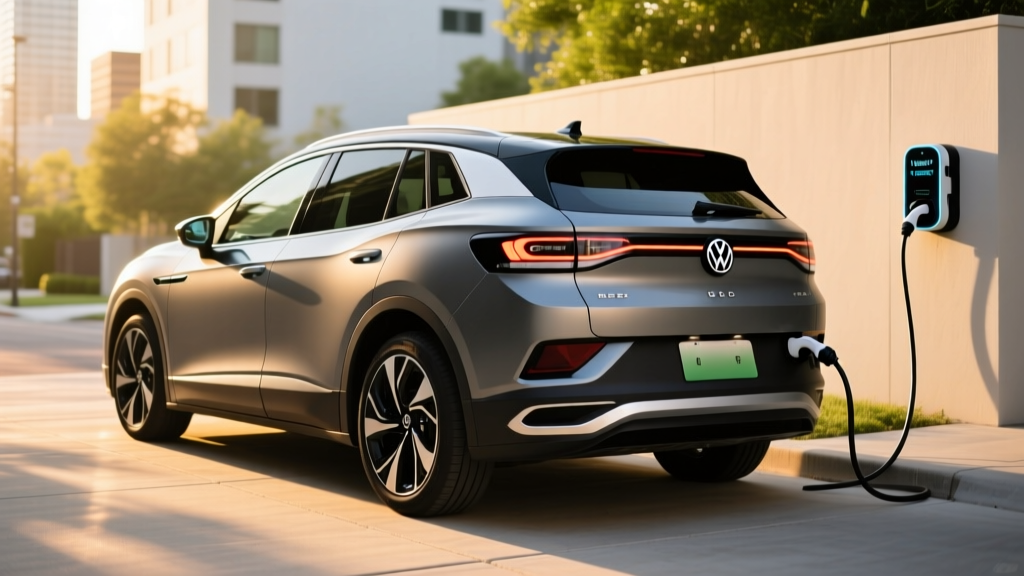
The 2026 Volkswagen ID.4 arrives at a pivotal moment for VW's electric strategy. After a turbulent rollout in the early 2020s marked by infotainment complaints and range skepticism, the ID.4 has quietly matured into one of the most practical compact electric SUVs on the market. With a competitive base price, usable EPA range, and improving software, it warrants a serious look — particularly if you're evaluating a Volkswagen ID.4 lease versus a purchase.
This review covers the 2026 ID.4's real-world efficiency, charging behavior, interior practicality, and how the federal EV tax credit applies. We'll also compare it against key rivals and help you decide whether leasing or buying makes more financial sense.
2026 ID.4 at a Glance: Key Specifications
| Attribute | Standard Range (62 kWh) | Pro / Pro S (82 kWh) | Pro S AWD |
|---|---|---|---|
| EPA Range | ~206 mi | ~291 mi | ~275 mi |
| Battery (Usable) | 62 kWh (NMC) | 82 kWh (NMC) | 82 kWh (NMC) |
| Horsepower | 201 hp | 282 hp | 335 hp |
| 0–60 mph | ~7.3 sec | ~6.7 sec | ~5.4 sec |
| Drivetrain | RWD | RWD | AWD (Dual-Motor) |
| Max DC Fast Charge | 125 kW | 175 kW | 175 kW |
| 10–80% DCFC Time | ~29 min | ~30 min | ~30 min |
| Level 2 Charge Rate | 11 kW | 11 kW | 11 kW |
| MPGe (Combined) | ~104 MPGe | ~104 MPGe | ~95 MPGe |
| Base MSRP | ~$39,735 | ~$43,735 | ~$49,935 |
Sources: EPA / fueleconomy.gov, VW manufacturer specifications. Prices include destination. Actual specs may vary by trim and options.
Range & Efficiency: EPA vs. Real-World Driving
The 82 kWh Pro trim is the volume seller, and its EPA-estimated 291 miles of range is competitive within the compact electric SUV segment. But as with any EV, the sticker number doesn't tell the full story.
- EPA Estimate: 291 miles
- Mixed city/highway (65–75°F): ~255–275 miles
- Highway-only at 75 mph: ~240–255 miles
- Cold weather (20–30°F, cabin heat): ~195–230 miles
The ID.4 Pro's efficiency hovers around 30–33 kWh/100 mi in mixed driving, which is respectable for its class. The available heat pump (standard on Pro S and above in 2026) helps preserve range in winter by reducing the resistive heating load on the battery pack. Expect a 15–25% range reduction in sustained cold-weather highway driving — this is typical for NMC chemistry packs in this segment.
The 62 kWh Standard Range trim's ~206-mile EPA rating is best suited for urban commuters who charge at home nightly. Highway road trips in this trim require more planning, and cold weather pushes it below 160 miles of practical range.
Charging Speed: DC Fast Charging & Home Level 2
Charging speed is one of the ID.4's stronger attributes in this segment. The 82 kWh models accept up to 175 kW on DC fast chargers via the CCS1 connector (with NACS adapter compatibility for Tesla Supercharger network access).
| Charging Level | Power / Rate | Speed (Miles Added) | Notes |
|---|---|---|---|
| Level 1 (120V) | ~1.4 kW | ~3–4 mi/hr | Emergency/top-up only |
| Level 2 (240V, 48A) | 11 kW | ~28–30 mi/hr | Full charge in ~8–9 hrs (82 kWh) |
| DC Fast (175 kW peak) | 175 kW (tapers above 80%) | ~200+ mi in 30 min (10–80%) | Peak rate sustained to ~55% SoC |
A critical detail for road-trip planning: the ID.4's charge curve holds near peak power through roughly 55% state of charge, then tapers progressively. The published 10–80% time of approximately 30 minutes is accurate under ideal thermal conditions — meaning the battery is preconditioned. In colder weather without adequate preconditioning, add 5–10 minutes to that figure.
The 11 kW onboard AC charger is a strong point. Many competitors (including the Hyundai Ioniq 5's 10.9 kW) offer similar rates, but the ID.4's 11 kW means a full overnight charge on a 48-amp Level 2 home station takes roughly 8 hours for the 82 kWh pack. Most owners will arrive home at 20–30% and wake up fully charged.
Performance & Driving Dynamics
The 2026 ID.4 offers two distinct driving personalities depending on your trim choice.
RWD models (201–282 hp): The base 201 hp motor delivers adequate acceleration for daily commuting. The 282 hp upgrade in the 82 kWh Pro is noticeably more responsive, achieving 0–60 mph in roughly 6.7 seconds. Rear-wheel drive gives the ID.4 a relatively tight 31.5-foot turning circle, making it surprisingly nimble in urban environments.
AWD Pro S (335 hp, dual-motor): The dual-motor variant cuts the 0–60 time to approximately 5.4 seconds and adds genuine all-weather capability. The trade-off is roughly 16 miles of EPA range and a higher starting price. For buyers in snow-belt states, the traction advantage justifies the range penalty.
Ride quality leans toward the comfort end of the spectrum. The ID.4 absorbs highway imperfections well, though it doesn't match the sportiness of a Ford Mustang Mach-E or the refinement of a Hyundai Ioniq 5. Regenerative braking offers multiple levels via steering-wheel paddles, but the ID.4 still lacks true one-pedal driving to a full stop — a persistent criticism that VW has not addressed for 2026.
Interior Space, Cargo & Technology
The ID.4's cabin is where it earns its family-SUV credentials. Interior volume is generous, with 99.9 cubic feet of passenger space and a flat floor that maximizes rear-seat comfort.
- Cargo volume (behind rear seats): 30.3 cu ft
- Cargo volume (rear seats folded): 64.2 cu ft
- Rear legroom: 37.6 inches
- Front legroom: 41.1 inches
These numbers put the ID.4 squarely between the Ioniq 5 and the Mach-E in practicality, and ahead of the Toyota bZ4X. The square roofline and upright rear hatch make loading bulky items straightforward.
The 2026 model continues with VW's 12.9-inch infotainment display (10.25-inch digital instrument cluster). Software performance has improved significantly over earlier model years, with faster response times and a more logical menu structure. However, capacitive touch sliders for volume and climate remain a pain point for some owners who prefer physical controls. Wireless Apple CarPlay and Android Auto are standard across all trims.
Driver assistance: The ID.4 includes VW's IQ.DRIVE suite as standard — adaptive cruise control, lane-keeping assist, automatic emergency braking, and blind-spot monitoring. This is SAE Level 2 driver assistance, meaning the driver must remain fully engaged with hands on the wheel. It is not autonomous driving. The system is competent on highways but not class-leading compared to GM's Super Cruise or Ford's BlueCruise in hands-free zones.
Pricing, Trims & Federal Tax Credit Eligibility
The 2026 Volkswagen ID.4 is available in five primary trims. Pricing below includes destination charges:
| Trim | Drivetrain | MSRP | Est. Price After §30D Credit* |
|---|---|---|---|
| Standard | RWD | ~$39,735 | ~$32,235 |
| Pro | RWD | ~$43,735 | ~$36,235 |
| Pro S | RWD | ~$47,735 | ~$40,235 |
| Pro S Plus | RWD | ~$50,735 | ~$43,235 |
| Pro S AWD | AWD | ~$49,935 | ~$42,435 |
*Federal Tax Credit (§30D) — Key Rules for 2026:
- Credit amount: Up to $7,500, split between critical minerals ($3,750) and battery components ($3,750) requirements.
- MSRP cap: SUVs must be priced at or below $80,000 — all ID.4 trims qualify.
- Buyer income caps: $300,000 joint / $225,000 head of household / $150,000 individual (modified AGI).
- Battery sourcing: Increasing percentages of critical minerals and battery components must be sourced from the U.S. or free-trade-agreement partners. VW's North American battery supply chain has expanded, but eligibility can change mid-year. Always verify current status on fueleconomy.gov before purchasing.
- Point-of-sale transfer: As of 2024, the credit can be transferred to the dealer at purchase, reducing your out-of-pocket cost immediately. This applies to purchases — lease structures may differ (see below).
For complete and current eligibility details, consult the IRS §30D guidance. Eligibility can shift based on battery sourcing compliance, so confirm before signing.
Lease vs. Buy: The Volkswagen ID.4 Lease Question
If you're researching a Volkswagen ID.4 lease, there's an important tax-credit distinction. Under current IRS rules, the $7,500 credit applies to purchased vehicles meeting all §30D requirements. However, leases are technically structured as commercial purchases by the leasing company — and under §45W, the leasing entity may claim a commercial clean vehicle credit. Whether this savings is passed to you as a lower monthly payment depends entirely on the lessor's policies.
Typical 2026 ID.4 lease terms (36 months, 10,000–12,000 miles/year) may land in the $299–$449/month range depending on trim, down payment, and whether the lessor applies any credit pass-through. Always ask the dealer explicitly: "Is the commercial EV credit being passed through as a capitalized cost reduction?" — this single question can save you thousands over the lease term.
Leasing also insulates you from battery degradation concerns and EV resale-value uncertainty, which is meaningful given how rapidly the segment is evolving. If you plan to upgrade every three years, a lease may be the lower-risk path.
How the ID.4 Compares to Key Competitors
| Spec | 2026 VW ID.4 Pro | 2026 Hyundai Ioniq 5 SEL | 2026 Ford Mach-E Select | 2026 Toyota bZ4X XLE |
|---|---|---|---|---|
| EPA Range | 291 mi | 303 mi | 250 mi | 252 mi |
| Battery (kWh) | 82 (NMC) | 77.4 (NMC) | 75.7 (NMC) | 71.4 (NMC) |
| Max DCFC (kW) | 175 | 235 | 150 | 150 |
| 10–80% Time | ~30 min | ~18 min | ~35 min | ~30 min |
| HP | 282 | 225 | 266 | 201 |
| Cargo (cu ft) | 30.3 | 27.2 | 29.7 | 27.7 |
| Base MSRP | ~$43,735 | ~$46,650 | ~$42,995 | ~$43,070 |
The Ioniq 5's 800-volt architecture gives it a decisive charging-speed advantage on road trips. The ID.4 counters with superior cargo volume, a slightly lower starting price, and VW's extensive dealer network for service accessibility. The Mach-E offers sportier handling dynamics, while the bZ4X trails on most metrics.
Pros, Cons & Who the ID.4 Suits Best
- Spacious cabin with class-leading cargo room
- Competitive EPA range on 82 kWh trims
- Comfortable ride quality for daily commuting
- All trims fall under the $80K MSRP cap for §30D credit
- Strong Level 2 home charging rate (11 kW)
- Wide VW dealer network for service and support
- No true one-pedal driving to a full stop
- Capacitive touch controls frustrate some drivers
- DCFC speed lags behind 800V competitors (Ioniq 5, EV6)
- Infotainment learning curve for new EV adopters
- AWD trim commands a significant price premium
- Lease tax-credit pass-through is not guaranteed
- Choose the ID.4 if: You need maximum cargo space in a compact EV, prioritize ride comfort over sporty handling, have access to home Level 2 charging, and want a mainstream dealer network for service.
- Look at the Ioniq 5 instead if: Road-trip charging speed is your top priority and you value 800V architecture for 18-minute fast charges.
- Look at the Mach-E instead if: You want sportier handling dynamics and don't mind slightly less cargo room.
- Consider the Standard Range ID.4 if: You're a city commuter who charges at home nightly, rarely drives more than 150 miles in a day, and want the lowest entry price after tax credits.
Warranty Coverage
Volkswagen provides solid EV warranty coverage for the 2026 ID.4:
- Battery warranty: 8 years / 100,000 miles (whichever comes first), covering capacity loss below 70% of original state of health.
- Powertrain warranty: 8 years / 100,000 miles
- Bumper-to-bumper: 4 years / 50,000 miles
- Corrosion perforation: 7 years / 100,000 miles
The 70% capacity retention threshold is industry-standard, matching most competitors. Long-term degradation data for VW's MEB-platform batteries shows approximately 8–12% capacity loss over 100,000 miles under normal use, well within the warranty floor.
Frequently Asked Questions
What is the real-world range of the 2026 Volkswagen ID.4?
The 82 kWh Pro trim delivers an EPA-estimated 291 miles. In real-world mixed driving at moderate temperatures, expect 255–275 miles. Highway-only driving at 75 mph reduces this to roughly 240–255 miles, and cold weather (20–30°F) can drop practical range to 195–230 miles. The Standard Range 62 kWh trim is best limited to ~160 miles in cold conditions.
How fast does the ID.4 charge at home and on DC fast chargers?
On a 48-amp Level 2 home charger, the ID.4 charges at 11 kW, adding roughly 28–30 miles of range per hour. A full charge of the 82 kWh pack takes about 8 hours. On DC fast chargers, the 82 kWh models peak at 175 kW and can charge from 10–80% in approximately 30 minutes under ideal conditions. The 62 kWh model peaks at 125 kW with a similar 10–80% time of about 29 minutes.
Does the 2026 Volkswagen ID.4 qualify for the federal EV tax credit?
All ID.4 trims fall under the $80,000 MSRP cap for SUVs. However, full $7,500 credit eligibility depends on battery-sourcing requirements (critical minerals and component sourcing from the U.S. or FTA partners), which can change throughout the year. Buyer income caps also apply ($150K individual / $300K joint). Always verify current eligibility on fueleconomy.gov before purchasing.
Is leasing the ID.4 better than buying?
Leasing protects you from depreciation risk and battery degradation concerns, and monthly payments may benefit from the lessor's commercial EV credit pass-through (ask your dealer explicitly). However, purchasing with the §30D point-of-sale credit transfer can significantly reduce your upfront cost if you plan to keep the vehicle 5+ years. If you drive more than 12,000 miles annually, lease mileage penalties may make buying the better choice.
Is the ID.4 worth buying over the Hyundai Ioniq 5 or Ford Mach-E?
The ID.4 wins on cargo space, ride comfort, and value pricing. The Ioniq 5 is the clear choice if fast charging and range are your priorities (235 kW DCFC, 303 mi EPA). The Mach-E offers sportier handling. All three qualify for the federal credit (subject to sourcing rules), so your decision should hinge on which trade-off — comfort vs. charging speed vs. handling — matters most to you.
Does the ID.4 support Tesla Supercharger access?
Yes. The 2026 ID.4 is compatible with the Tesla Supercharger network via a NACS adapter (included or available depending on trim). This significantly expands your public charging options, particularly for road trips through areas where Electrify America or other CCS networks have limited coverage.
What are the biggest drawbacks of the ID.4?
The most common owner complaints center on the lack of one-pedal driving to a full stop, capacitive touch controls that are difficult to use while driving, and DCFC speeds that trail 800V competitors. The infotainment system, while improved, still has a steeper learning curve than systems from Hyundai or Tesla.