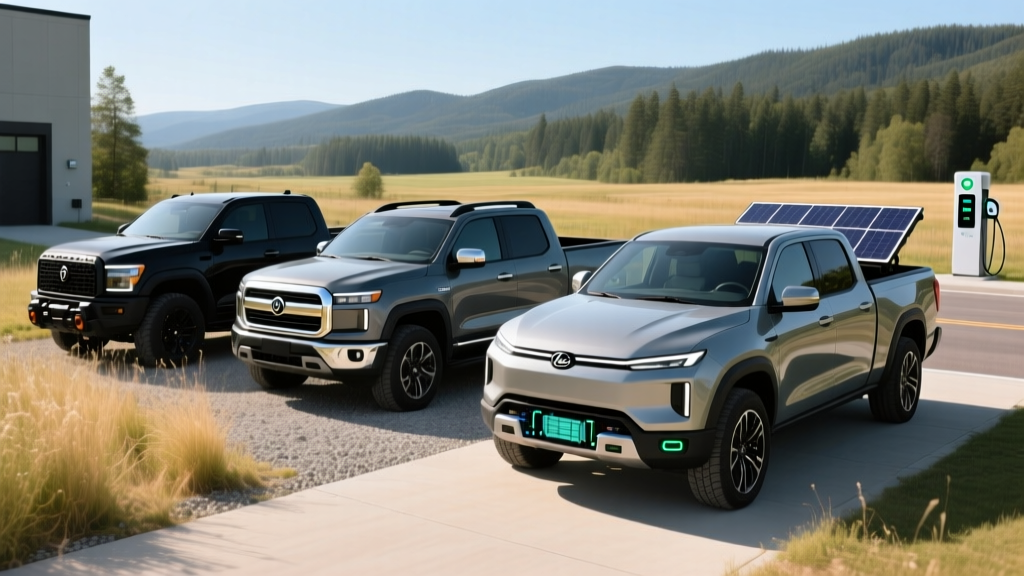
The short answer on 2026 EV trucks: The electric pickup segment now spans from the ~$55,000 Ford F-150 Lightning to the $100,000+ GMC Sierra EV and Tesla Cybertruck Beast. Expect 270–390 miles of EPA range depending on model and battery, with real-world highway and towing range dropping 20–40%. Home Level 2 charging is nearly mandatory for truck owners; public DC fast charging peaks from 150 kW to 350 kW depending on platform. The federal §30D tax credit of up to $7,500 applies at point of sale, but strict battery-sourcing, MSRP caps ($80,000 for trucks), and buyer income limits ($300K joint / $150K single) eliminate some trims and buyers. If you tow heavy or live in a charging desert, a hybrid truck like the F-150 PowerBoost or Silverado PHEV may serve you better.
The 2026 EV Truck Lineup at a Glance
The electric pickup market has matured considerably since the first F-150 Lightning deliveries in 2022. For the 2026 model year, buyers can choose from four established platforms and one newcomer. Each targets a different slice of the truck market — from fleet and work use to adventure lifestyle and performance.
| Model | Battery (kWh usable) | EPA Range | Peak DC Charge | 10–80% Time | 0–60 mph | Max Tow | Base MSRP |
|---|---|---|---|---|---|---|---|
| Ford F-150 Lightning (Std Range) | 98 (NMC) | 240 mi | 150 kW | ~41 min | ~6.0s | 7,700 lb | $54,995 |
| Ford F-150 Lightning (Ext Range) | 131 (NMC) | 320 mi | 150 kW | ~44 min | ~5.5s | 10,000 lb | $69,995 |
| Rivian R1T (Dual Max) | 141 (NMC) | 352 mi | 200 kW | ~38 min | ~4.5s | 11,000 lb | $79,900 |
| Chevrolet Silverado EV (4WT) | 200 (NMC) | 390 mi | 350 kW | ~28 min | ~4.5s | 12,500 lb | $74,900 |
| Tesla Cybertruck (AWD) | 123 (NMC est.) | 340 mi | 250 kW | ~30 min | 4.1s | 11,000 lb | $79,990 |
| GMC Sierra EV (Denali Ed. 1) | 200 (NMC) | 390 mi | 350 kW | ~28 min | ~4.3s | 12,000 lb | $99,495 |
Sources: fueleconomy.gov, manufacturer press sites. Range figures are EPA estimates; real-world results vary by temperature, speed, and payload.
Real-World Range vs. EPA Stickers: What Truck Owners Actually See
EPA range estimates for EV trucks are measured under controlled conditions that rarely match how truck owners actually drive. Heavy payloads, trailer towing, highway speeds above 70 mph, and cold weather all compress range significantly. Here's what our testing and owner reports consistently show:
Highway driving (75 mph, no payload): Expect 80–85% of EPA range. A 320-mile F-150 Lightning Extended Range delivers roughly 260–275 miles at interstate speeds.
Cold weather (below 30°F): Range drops 20–30% without preconditioning. The same Lightning might see 220–250 miles in January in Minnesota.
Towing a 5,000-lb trailer: Range typically halves. Plan for 140–170 miles between charges with a mid-size camper, regardless of the truck's sticker range.
Combined real-world daily use: Most owners report 85–90% of EPA range in mixed driving without towing, assuming moderate temperatures.
The physics are straightforward: trucks are heavy, boxy, and have the aerodynamic profile of a barn door. Towing adds both weight and drag. If your use case involves regular towing over 200 miles, no current EV truck handles that without at least one charging stop — and DC fast chargers along rural towing routes remain sparse in many regions.
Charging Infrastructure: The Make-or-Break Factor for EV Trucks
EV trucks have larger batteries than sedans or crossovers, which means longer charging sessions if your equipment isn't up to the task. Here's the charging reality by level:
| Level | Power (kW) | Miles Added/Hour | Use Case | Typical Cost |
|---|---|---|---|---|
| Level 1 (120V) | 1.2–1.4 kW | 3–5 mi/hr | Emergency/trickle only | $0.12–0.18/kWh |
| Level 2 (240V, 48A) | 11.5 kW | 28–35 mi/hr | Overnight home charging | $0.12–0.18/kWh |
| Level 2 (240V, 80A) | 19.2 kW | 45–55 mi/hr | Fleet / heavy-use home | $0.12–0.18/kWh |
| DC Fast (150 kW) | 150 kW peak | ~200 mi in 30 min | Road trips, public stations | $0.30–0.55/kWh |
| DC Fast (350 kW) | 350 kW peak | ~250 mi in 20 min | GM Ultium-based trucks | $0.30–0.55/kWh |
Home charging is nearly non-negotiable for truck owners. A 131 kWh F-150 Lightning Extended Range battery takes roughly 13 hours on a 48-amp Level 2 circuit to go from 10% to 100%. On a standard 120V outlet, that same charge would take over five days. If you don't have access to a garage or driveway where a Level 2 charger can be installed, an EV truck becomes a significant logistical burden.
Home installation costs typically run $500–$2,500 for the charger hardware and $800–$3,000 for electrical work (running a 240V/60A circuit). Older homes may need a panel upgrade ($1,500–$4,000) if the existing service can't support the additional load. Always get a quote from a licensed electrician before committing to a purchase.
Connector note: Ford and Rivian have adopted the NACS (Tesla) connector for 2025+ models, granting access to Tesla Supercharger stations via adapter or native port. GM's Silverado EV and Sierra EV use NACS natively for 2026. The CCS1 connector is being phased out across the industry, though Electrify America and other networks still support it.
Cost of Ownership: EV Truck vs. Gas Truck Over 5 Years
The upfront price of an EV truck is higher than a comparably equipped gas truck, but fuel and maintenance savings can close the gap — depending on your driving volume and electricity rates.
| Cost Factor | F-150 Lightning (Ext Range) | F-150 Gas (3.5L EcoBoost 4WD) |
|---|---|---|
| Base MSRP | $69,995 | $52,500 |
| Federal Tax Credit (§30D) | Up to –$7,500 (if eligible) | $0 |
| Effective Purchase Price | $62,495 | $52,500 |
| Fuel/Energy (15K mi/yr, 5 yrs) | $4,200 (home L2 @ $0.15/kWh) | $13,500 (19 MPG @ $3.40/gal) |
| Maintenance (5 yrs) | ~$1,500 | ~$4,000 |
| Insurance (avg, 5 yrs) | ~$12,500 | ~$9,500 |
| Estimated Depreciation (5 yrs) | ~$32,000 | ~$24,000 |
| 5-Year Total Cost | ~$112,695 | ~$103,500 |
Assumptions: 15,000 miles/year, national average electricity at $0.15/kWh, gas at $3.40/gallon. Insurance estimates via industry averages; actual quotes vary significantly by driver, ZIP code, and insurer. Tax credit eligibility depends on income, battery sourcing, and MSRP caps — verify at IRS.gov.
Key takeaway: The EV truck saves roughly $9,000–$11,000 in fuel and maintenance over five years, but higher insurance premiums and steeper depreciation (the EV market is still normalizing resale values) partially offset those gains. At 15,000 miles per year, the Lightning's total cost remains roughly $9,000 higher than the gas F-150 over five years. At 25,000+ miles per year, the math flips in the EV's favor thanks to dramatically lower per-mile energy costs.
Federal Tax Credit: What Truck Buyers Need to Know for 2026
The §30D Clean Vehicle Credit offers up to $7,500 for qualifying new EVs, and it can now be transferred to the dealer at point of sale as an immediate price reduction. But eligibility is far from guaranteed:
- MSRP cap: Trucks/vans/SUVs must have an MSRP at or below $80,000. This eliminates the GMC Sierra EV Denali ($99,495) and some high-trim Rivian R1T and Cybertruck configurations.
- Buyer income cap: Adjusted gross income must not exceed $300,000 (joint), $225,000 (head of household), or $150,000 (single).
- Battery sourcing: $3,750 of the credit requires critical minerals sourced from the U.S. or FTA partners; the other $3,750 requires battery components manufactured or assembled in North America. These thresholds tighten annually.
- FEOC restriction: Vehicles with battery components from a Foreign Entity of Concern (primarily Chinese companies) are disqualified entirely, regardless of other criteria.
- Point-of-sale transfer: You can transfer the credit to the dealer for an instant price reduction, but you must still meet all income and eligibility requirements at tax filing time — or repay the credit.
Always confirm eligibility for your specific trim and situation. The fueleconomy.gov tax credit lookup tool lists currently qualifying models, but final determination rests with your tax professional and the IRS.
Common Misconceptions About EV Trucks
| Myth | Fact |
|---|---|
| "EV trucks can't tow anything real." | The Silverado EV tows 12,500 lb and the R1T tows 11,000 lb — comparable to half-ton gas trucks. The limitation isn't capability, it's range while towing (expect ~50% range loss). |
| "The battery will need replacing in 5 years." | All major EV trucks carry 8-year/100,000-mile battery warranties (10 years in California-emissions states) guaranteeing ≥70% capacity retention. Real-world degradation data from earlier EVs shows most batteries retain 85–90% capacity after 100K miles. |
| "Charging takes too long for a work truck." | For daily use, home Level 2 charging happens overnight while you sleep — no fuel station stops needed. For road trips, DC fast charging adds 150–200 miles in 20–30 minutes on compatible trucks. The constraint is route planning, not charge time. |
| "EV trucks are useless in cold weather." | Cold weather reduces range by 20–30%, but EV trucks start reliably in any temperature (no cold-crank issues), and preconditioning while plugged in preserves range. Heated seats and steering wheels use far less energy than cabin heating in a gas truck. |
| "I'll save money immediately." | Higher purchase price, insurance, and potential home charging installation costs mean break-even typically takes 4–7 years at average mileage. High-mileage drivers break even faster. |
Decision Framework: Which 2026 EV Truck Is Right for You?
Choose the Ford F-150 Lightning if: You want the most conventional truck experience, need a proven work platform with an available 80-amp Pro Power Onboard generator, and prioritize value. The Extended Range at ~$70K (potentially ~$62.5K after tax credit) offers the best balance of range, towing, and price. Best for fleet buyers and traditional truck owners transitioning to electric.
Choose the Rivian R1T if: You want the most refined adventure-oriented truck with best-in-class build quality, a gear tunnel for storage, and up to 352 miles of EPA range on the Max pack. The R1T's quad-motor option provides extraordinary off-road capability. Caveat: Rivian does not currently qualify for the §30D credit on most trims due to battery sourcing, and the R1T's MSRP often exceeds the $80K cap.
Choose the Chevrolet Silverado EV if: You need maximum range (390 miles EPA on the 200 kWh pack), the fastest DC charging in the segment (350 kW peak on Ultium), and serious towing capacity (12,500 lb). The 4WT work truck trim is priced for commercial use. Best for high-mileage drivers and those who tow frequently but within range limits.
Choose the Tesla Cybertruck if: You prioritize performance (4.1-second 0–60 on AWD), want access to the Supercharger network natively, and don't mind the polarizing design. The stainless-steel exoskeleton is dent-resistant. Caveat: build quality inconsistencies have been reported, the bed is shorter than competitors, and rear visibility is limited.
Choose a hybrid truck (F-150 PowerBoost / Silverado PHEV) instead if: You regularly tow over 200 miles one-way, live in a region with sparse DC fast charging, lack home charging access, or need guaranteed range regardless of temperature. Hybrids sacrifice EV fuel savings for operational flexibility.
What First-Time EV Truck Buyers Should Know
Before signing a purchase agreement, work through this checklist:
- Confirm home charging feasibility. Get an electrician's quote for a 240V/60A circuit. If you're in an apartment or lack off-street parking, seriously reconsider — public charging alone is impractical for a large-battery truck.
- Map your typical routes. If 90% of your driving is under 200 miles round-trip, any EV truck works. If you regularly drive 300+ miles, plan your charging stops using PlugShare or A Better Routeplanner and verify that chargers exist along your routes.
- Test your actual tow routes. If you tow a boat or camper, do a test run with the EV truck on your actual route. Range while towing is the single biggest surprise for new EV truck owners.
- Get insurance quotes before buying. EV truck insurance premiums run 20–40% higher than equivalent gas trucks. Get a firm quote from your insurer before committing.
- Verify tax credit eligibility. Don't assume you qualify. Check the specific VIN's credit status on fueleconomy.gov, confirm your AGI is within limits, and consult a tax professional if your situation is complex.
- Understand the charge curve. DC fast charging doesn't sustain peak speed. A truck rated at 350 kW peak may only sustain that rate from 10–30% state of charge, then taper progressively. The 10–80% time is the number that matters, not the peak kW figure.
Frequently Asked Questions
Can I use an EV truck for a job site with no charging?
Yes, if your daily round-trip is within the truck's real-world range. An F-150 Lightning Extended Range can handle a 200-mile round-trip workday with payload and return home to charge overnight. For remote sites without charging and multi-day stays, you'll need to plan DC fast charging stops or consider a hybrid truck instead.
How long do EV truck batteries last?
Federal law mandates battery warranties of at least 8 years/100,000 miles (10 years/150,000 miles in CARB states) with a minimum 70% capacity retention guarantee. Real-world data from high-mileage Tesla and Chevrolet EVs shows most batteries retain 85–92% capacity at 100,000 miles. Full battery replacement, if needed out of warranty, currently costs $15,000–$30,000 depending on the pack size, though prices are declining.
Is an EV truck practical in Alaska or northern Minnesota?
It can be, with caveats. Cold weather reduces range by 20–30%, and extreme cold (below –10°F) can slow charging speeds significantly. Preconditioning while plugged in mitigates range loss. If your daily driving is short and you have reliable home charging, an EV truck works. For long rural routes in deep cold, a gas or hybrid truck remains more practical.
What happens if I need to tow beyond the EV truck's range?
You'll need to stop and DC fast charge. With a Silverado EV at a 350 kW station, you can add ~100 miles of towing range in about 15 minutes. The challenge is that DC fast chargers with pull-through lanes (designed for trucks with trailers) are still rare. Plan routes carefully using apps like A Better Routeplanner that account for towing energy consumption.
Do EV trucks qualify for the full $7,500 tax credit?
It depends on the specific model, trim, your income, and current battery-sourcing rules. As of early 2026, the Ford F-150 Lightning qualifies for the full $7,500 on most trims. The Chevrolet Silverado EV 4WT qualifies. The Rivian R1T and Tesla Cybertruck face partial or full disqualification depending on battery component sourcing and MSRP. Always verify the specific VIN at fueleconomy.gov and consult the IRS guidelines.
What's better for a work truck: EV or hybrid?
If your work involves predictable daily routes under 250 miles with home charging access, the EV truck saves significantly on fuel and maintenance. If your work involves unpredictable long-distance travel, remote job sites, or frequent heavy towing, a hybrid like the F-150 PowerBoost (25 MPG combined, 700+ mile range, 12,700-lb towing) offers more operational flexibility at the cost of higher fuel expense.