The Short Answer on EV Towing Capacity
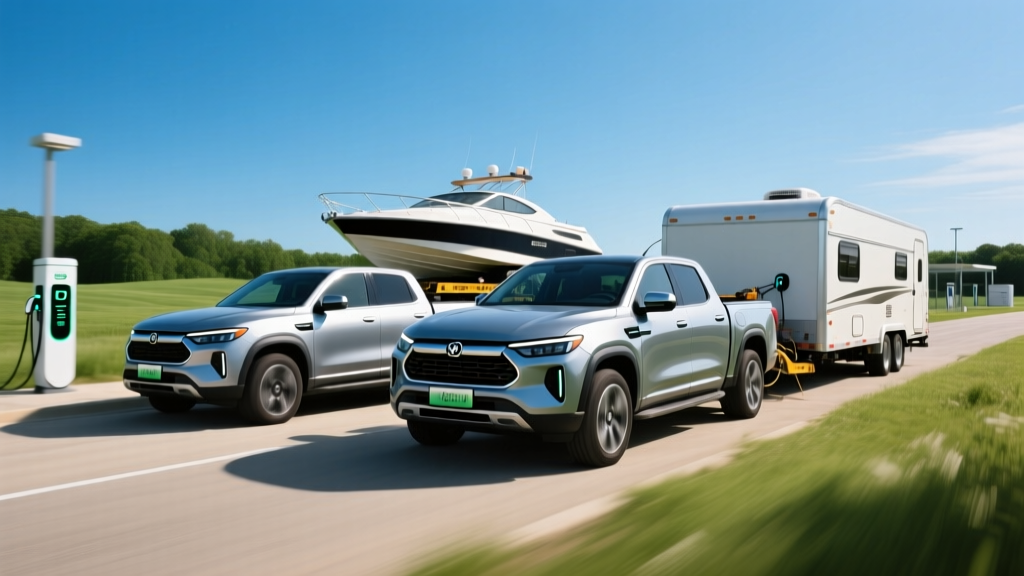
Most mainstream electric trucks and SUVs can tow between 5,000 and 11,000 pounds, matching or exceeding their gas counterparts on paper. The Ford F-150 Lightning leads at 10,000 lbs (Extended Range), the Rivian R1T hits 11,000 lbs, and the Chevrolet Silverado EV tops out at 10,000 lbs. However, towing cuts real-world EV range by 40–60% compared to EPA estimates. A truck rated for 320 miles of range may deliver only 140–180 miles while pulling a 5,000-lb trailer at highway speeds. The limiting factor isn't torque — EVs produce maximum torque at 0 RPM — it's energy consumption under extreme aerodynamic and rolling loads.
Why EV Towing Capacity Is Stronger Than You Think
Electric motors deliver peak torque instantly from a standstill, eliminating the low-end power gap that forces gas trucks to downshift on inclines. A dual-motor EV truck sends torque to all four wheels with millisecond precision, and the heavy battery pack (typically 1,800–2,400 lbs in trucks) sits low in the chassis, improving stability versus a gas truck's high-mounted engine and transmission. The Ford F-150 Lightning produces 563 hp and 775 lb-ft of torque in its Extended Range configuration, while the Rivian R1T dual-motor generates 533 hp and 610 lb-ft.
But towing isn't a spec-sheet exercise. It's an energy problem. A 6,000-lb enclosed trailer at 65 mph can require 50–70 kW of continuous power to maintain speed on flat ground. That's roughly double the energy draw of an unloaded truck cruising at the same speed. The result: your 131 kWh battery pack (F-150 Lightning Extended Range) depletes roughly twice as fast while towing.
EV Towing Capacity by Model: 2026 Specs
| Vehicle | Max Tow Rating | Battery (kWh) | EPA Range | Est. Range Towing* | Peak DC Charge | Base MSRP |
|---|---|---|---|---|---|---|
| Rivian R1T Dual-Motor | 11,000 lbs | 149 (Max Pack) | 410 mi | 180–240 mi | 220 kW | $81,900 |
| Ford F-150 Lightning Ext. Range | 10,000 lbs | 131 (NMC) | 320 mi | 140–180 mi | 150 kW | $62,995 |
| Chevrolet Silverado EV 4WT | 10,000 lbs | 200 (NMC) | 440 mi | 200–260 mi | 350 kW | $59,900 |
| Tesla Cybertruck AWD | 11,000 lbs | 123 (est.) | 340 mi | 150–190 mi | 250 kW | $79,990 |
| Hyundai Ioniq 5 (w/ tow pkg) | 3,500 lbs | 84 (NMC) | 305 mi | 150–180 mi | 240 kW | $47,600 |
| Kia EV9 GT-Line AWD | 5,000 lbs | 100 (NMC) | 270 mi | 130–160 mi | 210 kW | $63,900 |
| BMW iX xDrive50 | 3,500 lbs | 111.5 (NMC) | 324 mi | 160–195 mi | 200 kW | $87,100 |
*Estimated towing range assumes a 5,000–7,000 lb trailer at 65 mph on flat terrain, 70°F. Cold weather, hills, and heavier loads reduce range further. Sources: fueleconomy.gov, manufacturer specifications.
The Range Reality Check: What Happens When You Hook Up a Trailer
This is the single most important factor that spec sheets bury. Towing range loss isn't linear — it compounds with speed, trailer aerodynamics, and elevation.
Real-World Towing Range Expectations
EPA sticker says 320 miles (F-150 Lightning Ext. Range)? Here's what to expect:
- Unloaded, mixed driving: 280–310 miles (5–12% below EPA)
- Towing 3,000-lb pop-up camper at 55 mph: 190–220 miles (~35% loss)
- Towing 5,500-lb travel trailer at 65 mph: 140–175 miles (~50% loss)
- Towing 7,000-lb boat uphill in 35°F: 100–130 miles (~60%+ loss)
The aerodynamic penalty dominates at highway speed. A boxy travel trailer is far worse than a low-profile utility trailer at the same weight.
For context, a gas F-150 with the 3.5L EcoBoost V6 towing the same 5,500-lb trailer sees fuel economy drop from ~20 MPG combined to roughly 10–12 MPG — a 40–50% reduction. The percentage loss is similar, but the gas truck can refuel in 5 minutes at any station, while a DC fast charge from 10–80% takes 25–45 minutes depending on the truck and charger.
EV vs. Gas Truck Towing: Cost and Efficiency Head-to-Head
| Factor | Ford F-150 Lightning (Ext. Range) | Ford F-150 Gas (3.5L EcoBoost) |
|---|---|---|
| Max Tow Rating | 10,000 lbs | 14,000 lbs |
| Torque | 775 lb-ft @ 0 RPM | 500 lb-ft @ 3,100 RPM |
| Energy/Fuel Cost Towing (per 100 mi) | $18–$28 (home/public blend) | $45–$60 (at 10 MPG, $4.50–$6.00/gal) |
| Refuel/Recharge Time (towing) | 30–45 min (DC fast, 10–80%) | 5–8 min (gas station) |
| Range Towing 5,500 lbs | ~155 miles | ~240 miles (26-gal tank) |
| Maintenance (100k mi) | ~$1,200 (tires, cabin filter, fluid) | ~$4,500 (oil, trans fluid, spark plugs, belts) |
| Base MSRP | $62,995 | $52,500 (XLT SuperCrew 4x4) |
The EV truck wins on energy cost per mile and maintenance, but the gas truck wins on maximum towing capacity, towing range, and refueling speed. For a weekend warrior towing a boat 80 miles to the lake and back, the EV is practical and cheaper. For a contractor towing 9,000 lbs across three states daily, the gas or diesel truck still makes more sense in 2026.
The Real Cost of EV Towing: Purchase, Charging, and Ownership
| Cost Category | EV Truck (5-Year Ownership) | Gas Truck (5-Year Ownership) |
|---|---|---|
| Purchase Price (after incentives) | $55,500–$62,995 | $52,500 |
| Fuel/Energy (75,000 mi, 30% towing) | $4,800–$7,200 | $11,250–$15,000 |
| Maintenance | $1,500–$2,000 | $4,000–$5,500 |
| Insurance (avg annual × 5) | $12,500–$15,000 | $9,000–$11,500 |
| Depreciation (est. 5-yr) | 45–55% | 35–45% |
| Total 5-Year Cost (est.) | $74,300–$102,200 | $76,750–$104,500 |
EV insurance premiums run 15–30% higher than gas equivalents, driven by higher repair costs and battery replacement risk. Depreciation on EV trucks has been steeper than gas trucks, though this gap is narrowing as the used EV market matures. The federal §30D tax credit can reduce upfront cost by up to $7,500 if the vehicle meets battery sourcing, MSRP cap ($80,000 for trucks), and buyer income limits ($300k joint / $150k single). Point-of-sale transfer is available, meaning the dealer applies the credit at purchase rather than waiting until tax filing.
Common EV Towing Misconceptions
| Myth | Fact |
|---|---|
| "EVs can't tow heavy loads." | Multiple EV trucks are rated for 10,000–11,000 lbs. The limitation is range, not capability. |
| "Towing will destroy the battery." | Towing increases cycle count but modern thermal management keeps cells within safe temps. Warranty covers 8 years / 100,000 miles minimum to 70% capacity. |
| "You can't tow and fast-charge." | You can, but the battery is already hot from towing, which may cause the charge curve to taper earlier. Expect 10–80% in 35–45 minutes instead of the advertised 20–25. |
| "EVs lose all regenerative braking while towing." | Most EV trucks reduce regen while towing to prevent trailer sway. Ford's Pro Power Onboard and integrated trailer brake controller manage this automatically. |
| "All EVs have the same tow rating regardless of trim." | Tow ratings vary by battery pack and motor config. The F-150 Lightning Standard Range tows 7,700 lbs; Extended Range tows 10,000 lbs. |
First-Time EV Truck Buyer: What You Need to Know Before Towing
1. Install a Level 2 home charger before your first tow trip. Towing depletes the battery fast. A 240V / 48A Level 2 charger (11.5 kW) adds roughly 25–30 miles of range per hour to a truck. An overnight charge from 20% to 80% takes 6–8 hours — essential for daily towing routines. Budget $800–$2,000 for a quality Level 2 unit (ChargePoint Home Flex, Emporia Vue) plus $500–$2,500 for electrician installation depending on panel capacity and conduit runs. A 200-amp panel upgrade may be needed in older homes ($1,500–$3,000).
2. Plan charging stops for any tow trip over 100 miles. Use apps like A Better Routeplanner (ABRP) with your trailer weight and profile entered. Not all DC fast chargers are easy to navigate with a trailer — pull-through stations are still rare. Electrify America and Tesla Superchargers are adding more pull-through stalls, but as of 2026, many require unhitching or backing in.
3. Precondition the battery before fast-charging. Most EV trucks precondition the battery when you navigate to a DC fast charger. This warms or cools the cells to the optimal temperature, enabling faster charge acceptance. Skipping preconditioning in cold weather can cut peak charge rates by 30–50%.
4. Understand your trailer brake controller setup. EV trucks like the F-150 Lightning and Silverado EV come with integrated trailer brake controllers. Aftermarket controllers may not communicate properly with the EV's regen system, causing jerky braking. Stick with the OEM-integrated solution.
5. Check your hitch rating, not just the truck's tow rating. Your actual towing limit is the lowest number among: the truck's tow rating, the hitch receiver rating, the Gross Combined Weight Rating (GCWR), and the tire load rating. A 10,000-lb tow rating means nothing if your hitch is rated for 7,500 lbs.
Decision Framework: Should You Tow with an EV?
Choose an EV Truck for Towing If:
- Your typical tow trips are under 150 miles round-trip (or you can charge at the destination)
- You tow 3–6 times per month, not daily for commercial work
- You have reliable Level 2 home charging (or can install it)
- Your trailer weight falls within 5,000–8,000 lbs (the efficiency sweet spot)
- You value low per-mile energy cost and minimal maintenance
- You want instant torque for boat launches and steep driveways
Stick with Gas or Diesel for Towing If:
- You regularly tow over 200 miles between stops (highway construction, cross-state hauling)
- Your trailer exceeds 9,000 lbs frequently (heavy equipment, large horse trailers)
- You tow commercially and downtime for charging cuts into revenue
- You lack home charging access and depend entirely on public infrastructure
- You operate in extreme cold (below 10°F) where range loss compounds past 60%
The Bottom Line on EV Towing in 2026
EV towing capacity is no longer a question of "can it?" — it's a question of "how far, and at what cost?" Electric trucks match or beat gas trucks on torque, stability, and per-mile operating cost. The trade-off is real-world towing range (expect 40–60% reduction) and longer refueling stops. For the majority of recreational towing — boats, campers, utility trailers within a 100-mile radius — a modern EV truck is practical, cheaper to operate, and more pleasant to drive. For long-haul and heavy commercial towing, diesel and gas still hold the edge. Know your routes, install home charging, and plan your stops. The capability is there; the logistics just require more forethought.
FAQ
Does towing void an EV battery warranty?
No. Towing within the manufacturer's rated capacity does not void the battery warranty. Federal law mandates that EV battery warranties cover at least 8 years / 100,000 miles for capacity retention (typically 70% threshold). Towing increases energy throughput and cycle count, which accelerates degradation marginally, but stays well within warranty parameters.
Can I tow with a Tesla Cybertruck?
Yes. The Cybertruck AWD and Cyberbeast are rated for 11,000 lbs of towing. However, its stainless-steel exoskeleton and angular shape create unique trailer-matching considerations, and its 48V architecture requires compatible trailer wiring adapters. Real-world towing range with a 5,000-lb trailer is estimated at 150–190 miles.
How much does it cost to charge an EV truck while towing on a road trip?
DC fast charging costs $0.30–$0.50 per kWh at public stations in 2026. Towing a 5,500-lb trailer, an F-150 Lightning consumes roughly 60–70 kWh per 100 miles. That translates to $18–$35 per 100 miles on public DC fast chargers — still cheaper than gas at $45–$60 per 100 miles towing, but the gap narrows compared to home charging ($6–$12 per 100 miles at $0.12–$0.18/kWh).
Do I need a weight-distribution hitch for EV truck towing?
For trailers over 5,000 lbs, a weight-distribution hitch is strongly recommended regardless of whether the tow vehicle is electric or gas. EV trucks have heavy rear-axle loads from the battery pack, and a weight-distribution hitch ensures proper tongue weight balance, reducing sway and improving braking stability.
What's the best EV for towing a small camper trailer?
For campers under 3,500 lbs (teardrop, pop-up), the Hyundai Ioniq 5, Kia EV9, or BMW iX all offer adequate tow ratings with manageable range loss. For campers between 4,000–7,000 lbs, the F-150 Lightning Extended Range or Chevrolet Silverado EV offer the best combination of tow rating, battery capacity, and DC fast-charge speed to make campground trips practical.