The short answer: "EV technologies" covers three core systems that determine your ownership experience: battery chemistry (LFP vs. NMC — affects range, longevity, and charging habits), charging standards (NACS vs. CCS — determines where and how fast you charge), and driver-assist platforms (Level 2 systems like Autopilot or BlueCruise — not self-driving, but impactful on long trips). In 2026, most new EVs use NACS connectors, offer 250-350 miles of EPA range, and qualify for up to $7,500 in federal tax credits if you meet IRS §30D income, MSRP, and battery-sourcing requirements. Your best technology choice depends on whether you prioritize maximum range (NMC), battery longevity (LFP), or charging-network access (NACS).
Battery Chemistry: LFP vs. NMC and What It Means for You
The single most consequential EV technology decision you'll make is battery chemistry. Two dominant types power nearly every 2026 EV sold in the U.S., and they behave very differently in real ownership.
| Attribute | LFP (Lithium Iron Phosphate) | NMC (Nickel Manganese Cobalt) |
|---|---|---|
| Energy Density | Lower (~160 Wh/kg cell-level) | Higher (~250-300 Wh/kg cell-level) |
| Typical EPA Range | 240-290 mi (smaller packs) | 290-380 mi (larger packs) |
| Charge to 100% Daily? | Yes — recommended for longevity | No — 80% daily, 100% for trips |
| Cycle Life | 3,000-5,000+ cycles to 80% SoH | 1,500-2,500 cycles to 80% SoH |
| Cold-Weather Loss | Greater (~35-40% at 20°F) | Moderate (~25-30% at 20°F) |
| Cost to Manufacturer | ~15-20% cheaper per kWh | Higher due to cobalt/nickel |
| Common In (2026) | Tesla Model 3 RWD, Ford Mustang Mach-E Select, Rivian Standard | Tesla Model Y LR, Hyundai Ioniq 5, Chevy Equinox EV RS |
Real-world implication: If you drive a 2026 Tesla Model 3 RWD with a ~60 kWh LFP pack (EPA 272 mi), you can charge to 100% every night without accelerated degradation — effectively giving you the full 272 miles daily. An NMC-equipped Model Y Long Range (EPA 330 mi, ~82 kWh usable) should be charged to 80% daily (~264 mi usable) and reserved at 100% only for road trips. Both deliver similar daily range, but the LFP pack will likely outlast the vehicle itself, while the NMC pack may show 8-12% degradation over 150,000 miles.
According to fueleconomy.gov, LFP adoption in U.S.-market EVs grew substantially through 2025-2026 as manufacturers sought lower-cost packs without cobalt supply-chain exposure.
Charging Standards: NACS Dominance and Connector Compatibility
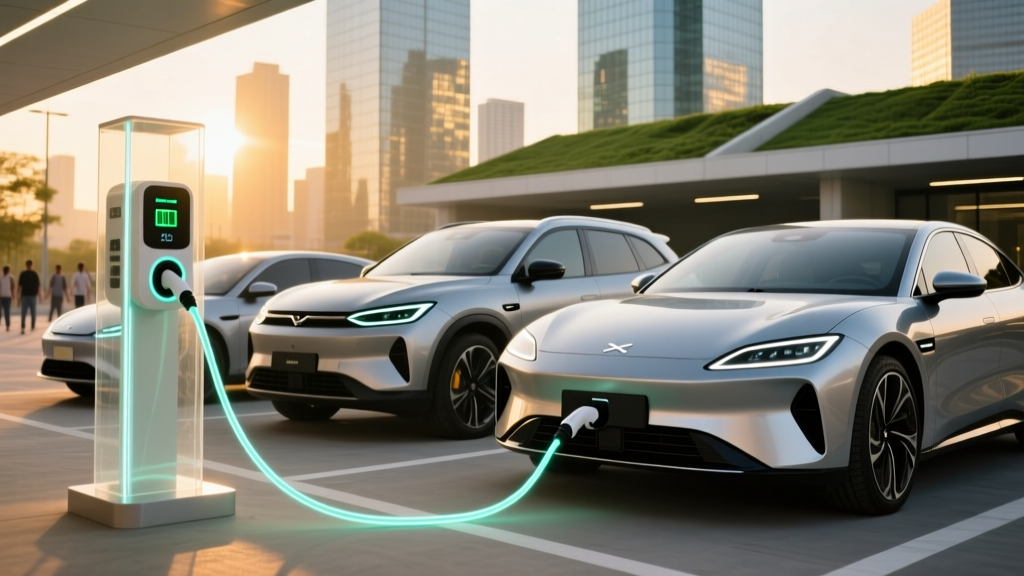
The charging landscape shifted dramatically between 2023 and 2026. Tesla's North American Charging Standard (NACS) is now the dominant connector, adopted by Ford, GM, Rivian, Hyundai, Kia, and most major automakers for their 2025+ models. CCS1 (Combined Charging System) remains on some legacy and European-market vehicles, while CHAdeMO is effectively discontinued for new U.S. passenger EVs.
| Connector | Peak DC Rate (Typical) | Network Access | 2026 Vehicles Using It |
|---|---|---|---|
| NACS (native) | 150-350 kW | Tesla Supercharger (20,000+ stalls), growing third-party | Tesla all models, Ford F-150 Lightning, GM Ultium models, Rivian R1T/R1S |
| CCS1 | 150-350 kW | Electrify America, EVgo, ChargePoint | Hyundai Ioniq 5/6 (2024-earlier), VW ID.4, some BMW iX |
| NACS (via adapter) | 150-250 kW (adapter-limited) | Tesla Supercharger (with OEM adapter) | Ford/GM/Rivian CCS vehicles using Ford/GM-provided adapters |
Why this matters practically: The Tesla Supercharger network consistently delivers higher uptime (95%+ stall availability) compared to Electrify America or EVgo, based on user-reported reliability data. If your 2026 EV has a native NACS port, you get seamless plug-and-charge access to the largest DC fast-charging network in North America. If you own a CCS vehicle, you can access Superchargers via an OEM-provided adapter, but expect slightly slower peak rates due to adapter thermal limits and cable-length constraints at some stalls.
For home Level 2 charging, the connector matters less — all EVs use a J1772 inlet (or NACS, which includes J1772 signaling) and any Level 2 home charger (typically 7.7-11.5 kW on a 240V circuit) will work with any EV.
Driver-Assist Technologies: What Level 2 Actually Means
SAE Automation Level 2 — NOT self-driving. Systems like Tesla Autopilot, Ford BlueCruise, GM Super Cruise, and Hyundai Highway Driving Assist are Level 2 driver-assist features. They combine adaptive cruise control and lane-centering, but you must remain attentive, hands on or near the wheel, and ready to take over instantly. Only Waymo and Zoox robotaxi services operate at Level 4 (no driver required) in geofenced urban areas. No consumer vehicle sold in 2026 is self-driving.
That distinction doesn't mean these systems aren't valuable. On a 400-mile highway trip, GM's Super Cruise (available on 2026 Cadillac Lyriq and Chevy Silverado EV) handles steering, braking, and acceleration on 750,000+ miles of pre-mapped divided highways, using a driver-monitoring camera to confirm your eyes are on the road. Tesla's Autopilot (standard on all 2026 models) works on any road but requires torque on the steering wheel. Ford's BlueCruise (available on the Mustang Mach-E and F-150 Lightning) covers 130,000+ miles of approved highways with hands-off driving and eye tracking.
The practical difference: Super Cruise is the most confident hands-off system on mapped interstates, but does nothing on unmapped surface streets. Autopilot is ubiquitous but requires more active supervision. BlueCruise sits between them. None replaces you as the driver, and all carry monthly or upfront costs ($2,100 for GM's three-year Super Cruise plan, $200/month for Ford BlueCruise 1.0, or included on certain trims).
What Level 2 systems do NOT do: Navigate unmapped construction zones, respond to emergency vehicles consistently, handle severe weather (heavy rain, snow, fog), make ethical decisions, or function if lane markings are faded or obscured. You are legally and physically responsible for the vehicle at all times. Per NHTSA guidance, misuse of Level 2 systems has contributed to documented collisions — always maintain situational awareness.
EV vs. Gas vs. Hybrid: The Real Cost Comparison
EV technologies don't exist in a vacuum — buyers are choosing between battery-electric (BEV), plug-in hybrid (PHEV), conventional hybrid (HEV), and gasoline vehicles. Here's how the numbers stack up for a typical midsize crossover in 2026.
| Factor | BEV (e.g., 2026 Tesla Model Y LR) | PHEV (e.g., 2026 Toyota RAV4 Prime) | HEV (e.g., 2026 RAV4 Hybrid) | Gas (e.g., 2026 RAV4 LE) |
|---|---|---|---|---|
| Base MSRP | $44,990 | $43,690 | $33,550 | $30,250 |
| Federal Tax Credit | Up to $7,500 (§30D, if eligible) | Up to $7,500 (§30D, if eligible) | $0 | $0 |
| Effective Price (after credit) | ~$37,490 | ~$36,190 | $33,550 | $30,250 |
| EPA Efficiency | 111 MPGe / 28 kWh/100mi | 94 MPGe (EV) / 38 MPG (gas) | 39 MPG combined | 28 MPG combined |
| Annual Fuel/Energy Cost | ~$540 (12k mi, $0.15/kWh home) | ~$750 (mixed EV/gas) | ~$1,230 ($3.50/gal) | ~$1,715 ($3.50/gal) |
| Annual Maintenance | ~$300 (tire rotation, cabin filter) | ~$600 (oil, filters, brakes) | ~$550 (oil, filters, brakes) | ~$650 (oil, filters, brakes) |
| 5-Year Fuel + Maint. Total | ~$4,200 | ~$6,750 | ~$8,900 | ~$11,825 |
The math: A BEV saves roughly $7,600 in fuel and maintenance over five years compared to a gas vehicle, and about $4,700 compared to a hybrid. Even without the federal tax credit, the BEV breaks even against a gas vehicle within 3-4 years at 12,000 miles/year. With the credit, the effective purchase price drops below the PHEV.
However, this assumes reliable home charging. If you rely entirely on public DC fast charging at $0.35-$0.50/kWh, your annual energy cost jumps to $1,260-$1,800 — eliminating much of the BEV's operating-cost advantage. This is why home charging access remains the single biggest determinant of EV satisfaction.
Real-World Ownership: What the Sticker Doesn't Tell You
EV technologies perform differently once you leave the showroom. Here's what data-driven owners learn in year one:
Range Reality Check
A 2026 Hyundai Ioniq 5 with an 84 kWh NMC pack carries an EPA range of 305 miles. In real-world highway driving at 70-75 mph in moderate temperatures, expect 260-280 miles. In winter conditions (20-30°F) with cabin heating, that drops to 200-230 miles — a 25-35% loss. If you regularly drive in sub-freezing climates, budget for this reduction and consider a vehicle with a heat pump (standard on the Ioniq 5, Tesla Model Y, and most 2026 EVs), which recovers 10-15% of cold-weather range compared to resistive heating.
Charging Curve Honesty
When a manufacturer advertises "peak 250 kW" DC fast charging, that rate is sustained only between roughly 10-40% state of charge. Above 60%, the rate tapers significantly — often to 80-100 kW, and below 30 kW past 85%. A 2026 Model Y Long Range (peak 250 kW) will charge 10-80% in approximately 25 minutes at a V3 Supercharger, but 80-100% adds another 20-25 minutes. Plan road-trip stops around the 10-80% window and skip topping off unless you need the extra miles to reach your next charger.
Home Charging Installation Costs
If you don't already have a 240V outlet near your parking spot, budget $800-$2,500 for a professional Level 2 installation (50-amp circuit, NEMA 14-50 or hardwired wall connector). Older homes with 100-amp electrical panels may need a panel upgrade ($1,500-$3,500 additional). Per the IRS §30D guidelines, some home charging equipment qualifies for a separate residential energy credit (up to $1,000 under §30C, subject to income and census-tract eligibility).
Insurance Premiums
EVs typically cost 15-25% more to insure than comparable gas vehicles due to higher repair costs (battery damage, aluminum body panels, recalibration of ADAS sensors after collision). A 2026 Model Y might carry an annual premium of $2,200-$2,800 depending on your state, driving record, and coverage level — compared to $1,600-$2,000 for a gas RAV4. Always get quotes before purchasing.
Common EV Technology Misconceptions — Fact-Checked
| Myth | Fact (with data) |
|---|---|
| "EV batteries need replacing every 5 years" | Federal law mandates battery warranties of at least 8 years/100,000 miles (10/150,000 in CARB states). Real-world data from Tesla's 2025 Impact Report shows Model 3/Y batteries retain ~88% capacity at 150,000 miles. Full replacement costs $10,000-$18,000 but is rarely needed within the vehicle's useful life. |
| "Public charging is always broken" | Tesla Superchargers maintain 95%+ uptime. Electrify America reported 92% session success rates in late 2025. The problem is concentrated in older CHAdeMO and early CCS stations. NACS adoption is improving reliability as networks standardize. |
| "EVs are worse for the environment because of electricity generation" | Per Argonne National Laboratory's GREET model, even on a coal-heavy U.S. grid, a BEV produces 50-60% fewer lifetime greenhouse gas emissions than a comparable gas vehicle. On the increasingly renewable U.S. grid (40%+ clean energy in 2026), that gap widens to 65-75%. |
| "All EVs qualify for the $7,500 tax credit" | As of 2026, §30D eligibility requires: buyer AGI under $150K (single)/$300K (joint), vehicle MSRP under $55K (sedans)/$80K (SUVs/trucks), and battery components meeting critical-mineral and sourcing thresholds. Many EVs qualify for partial credits ($3,750) or none at all. Always verify at irs.gov before purchasing. |
| "You can't take an EV on a road trip" | A 2026 Model Y LR (EPA 330 mi) can cover Los Angeles to Las Vegas (270 mi) on a single charge. For longer trips like LA to San Francisco (380 mi), one 20-minute Supercharger stop adds 200+ miles. The national DC fast-charging network now exceeds 50,000 stalls, though rural corridors in the Mountain West remain sparse. |
Your EV Technology Decision Framework
Choose an LFP-battery EV if: You want maximum battery longevity, mostly drive under 250 miles/day, charge at home nightly, live in a moderate climate, and prefer a lower purchase price (e.g., Tesla Model 3 RWD at ~$38,990 before credit).
Choose an NMC-battery EV if: You need 300+ miles of real-world range, regularly drive in cold weather, take frequent road trips, and are comfortable managing daily charge limits to 80% (e.g., Hyundai Ioniq 5 at ~$42,900 before credit).
Choose a NACS-equipped EV if: You want the most reliable public fast-charging experience with the widest network coverage. In 2026, this includes Tesla, Ford, GM, Rivian, and Hyundai/Kia new models.
Choose a CCS-equipped EV if: You're buying a 2024-2025 model year at a discount, have reliable access to Electrify America or EVgo stations, and are comfortable using a NACS adapter for Supercharger access.
Choose a PHEV instead of a BEV if: You lack home charging access, regularly drive 400+ miles in rural areas with sparse charging infrastructure, or want electric-only commuting (30-42 mi) without range anxiety on longer trips.
Choose a conventional HEV if: You have no charging access at all, your budget is under $35,000, and you want meaningful fuel savings (35-45 MPG) without the complexity or cost of a plug-in vehicle.
Frequently Asked Questions
What EV technology has the biggest impact on daily ownership?
Home Level 2 charging. A 240V, 48-amp home charger delivers roughly 35-44 miles of range per hour of charging, meaning any EV with 250+ miles of range is fully replenished overnight. Without home charging, EV ownership becomes significantly more expensive and time-consuming, as public DC fast charging costs 2-4x more per kWh and requires dedicated trips.
Do I need a heat pump in my EV?
If you live where temperatures regularly drop below 40°F, yes. A heat pump (standard on Tesla, Hyundai, Kia, and most 2026 EVs) uses 30-50% less energy for cabin heating than resistive heating, directly preserving range in cold weather. In climates that rarely dip below 50°F, it's a nice-to-have but not critical.
How do I verify if a specific EV qualifies for the federal tax credit?
Check the IRS clean vehicle credit page at irs.gov for the current list of eligible vehicles. Eligibility depends on the vehicle's battery sourcing, your adjusted gross income, and the vehicle's MSRP. Point-of-sale transfers (where the dealer applies the credit as a discount at purchase) are available, but you must still meet all requirements when you file taxes — if you don't, you owe the credit back.
Is regenerative braking hard to get used to?
Most drivers adapt within 1-2 weeks. Regenerative braking recovers kinetic energy when you lift off the accelerator, slowing the vehicle and feeding energy back to the battery. In strong-regen modes (often called one-pedal driving), you can handle 80-90% of daily driving without touching the brake pedal. This also reduces brake wear — many EV owners report original brake pads lasting 100,000+ miles.
What happens to EV batteries when they degrade?
Degradation is gradual and nonlinear. Most EVs lose 5-8% capacity in the first year, then stabilize at roughly 1-2% per year. A 2026 EV with a 300-mile EPA range will likely deliver 260-275 miles after 10 years and 120,000 miles. If capacity drops below the warranty threshold (typically 70% of original), the manufacturer replaces or refurbishes the pack at no cost. Out-of-warranty replacement costs $10,000-$18,000 depending on pack size, but full replacements remain uncommon within 15 years of typical ownership.