The Real Question: Does Your Income Disqualify You From the EV Tax Credit?
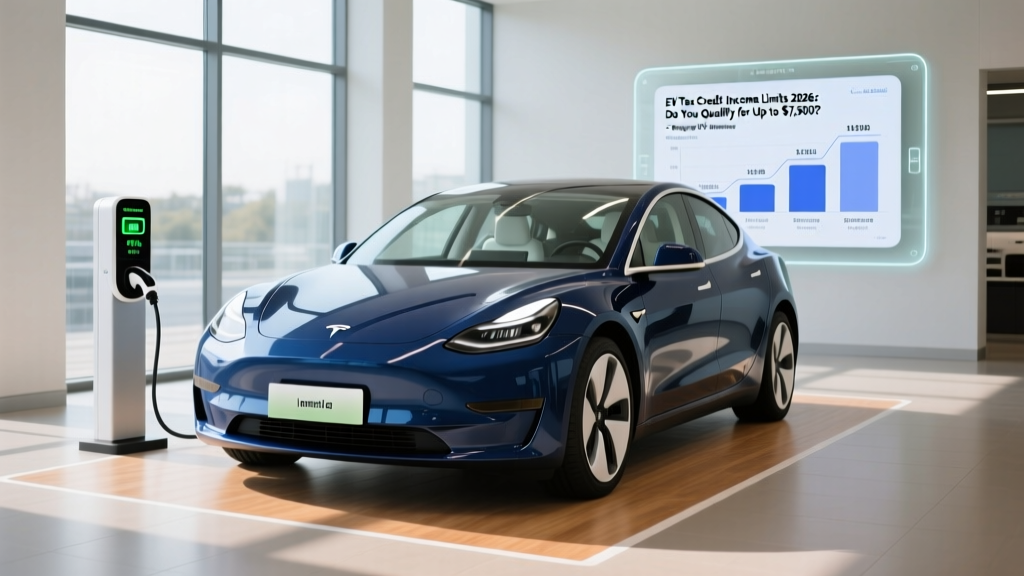
The federal EV tax credit under IRS §30D can knock up to $7,500 off the price of a new electric vehicle — or up to $4,000 on a qualifying used EV. But before you configure that Tesla Model Y or Hyundai Ioniq 5, the hard truth: EV tax credit income limits are one of the three gates you must clear, alongside MSRP caps and battery-sourcing requirements. Miss any one, and the credit drops to zero.
This guide walks through the exact 2026 thresholds, the point-of-sale transfer mechanics, and then zooms out to the bigger picture — what an EV actually costs to own over five years compared to a comparable gas car, including the line items most buyers underestimate (insurance, depreciation) and the ones they overestimate (maintenance, fuel).
Federal EV Tax Credit: Income Limits, MSRP Caps, and Sourcing Rules
The §30D Clean Vehicle Credit is not a blanket $7,500 for every EV buyer. It is a composite of two sub-credits — $3,750 for meeting critical-mineral sourcing requirements and $3,750 for meeting battery-component sourcing requirements — and your eligibility depends on three tests: your adjusted gross income (AGI), the vehicle's MSRP, and where the battery materials come from.
2026 §30D Eligibility Checklist
- Income caps (modified AGI): $150,000 single / $225,000 head of household / $300,000 married filing jointly. The lower of the current tax year or prior year AGI is used.
- MSRP caps: $55,000 for sedans, wagons, and hatchbacks; $80,000 for SUVs, vans, and pickup trucks. MSRP includes destination but excludes dealer-installed accessories and options added after the window sticker is printed.
- Critical-minerals requirement ($3,750): A percentage of the battery's critical minerals must be extracted or processed in the U.S. or a country with a U.S. free-trade agreement, or recycled in North America. The threshold has ratcheted up annually since 2023.
- Battery-component requirement ($3,750): Battery components must be manufactured or assembled in North America. Vehicles with battery components from a "foreign entity of concern" (FEOC) are disqualified entirely.
- Point-of-sale transfer: As of 2024, you can transfer the credit to the dealer at purchase, reducing your out-of-pocket cost immediately — even if you have no federal tax liability that year (the transferred credit is treated as a payment, not a refundable credit, but the dealer advance is not recaptured from you).
- One credit per vehicle, one used-EV credit per 3-year period, new-EV credit limited to one per taxpayer per year.
Because the critical-minerals and FEOC lists are updated regularly, a vehicle that qualifies in January may not qualify in July. Always verify a specific VIN on the official fueleconomy.gov credit lookup before signing a purchase agreement, and cross-reference IRS.gov §30D guidance for current-year rule changes.
Used EV Credit (§25E)
If you're buying a used EV, the credit is 30% of the sale price up to $4,000. Income caps are halved: $75,000 single / $112,500 head of household / $150,000 joint. The vehicle must be at least two model years old, sell for $25,000 or less, and be purchased from a licensed dealer. The same once-per-three-years-per-buyer limit applies.
Total Cost of Ownership: 5-Year EV vs. Gas Car
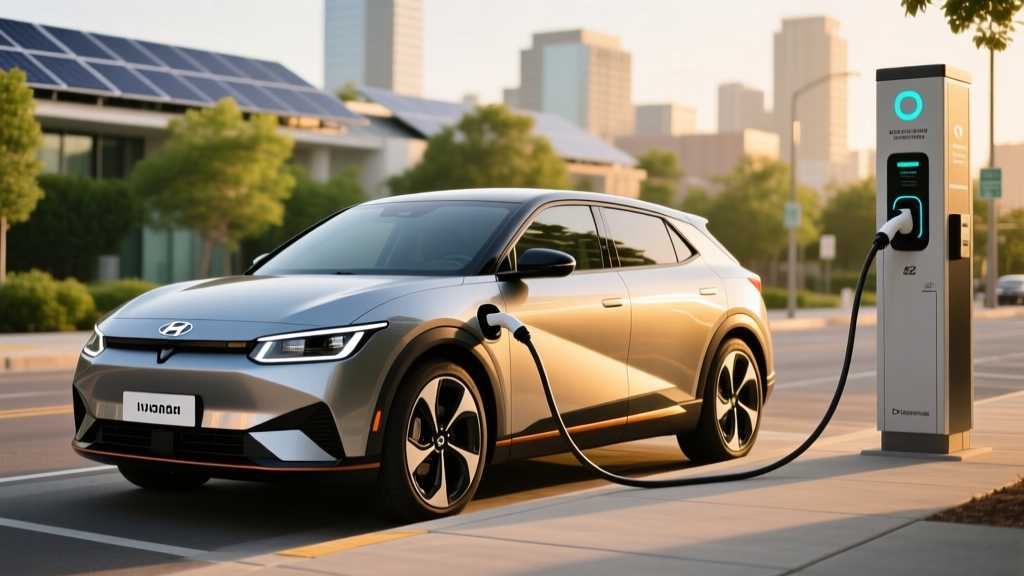
The tax credit lowers the purchase price, but the ownership equation runs deeper. Below is a 5-year / 75,000-mile comparison between a representative EV (2026 Hyundai Ioniq 5 SEL AWD, ~$50,000 MSRP before credit) and a comparably equipped gas crossover (2026 Toyota RAV4 AWD, ~$36,000 MSRP). Assumptions: 15,000 miles/year, $0.16/kWh home charging, $3.60/gallon regular, and 85% home / 15% DC fast-charge mix at $0.45/kWh for the EV.
| Line Item | Hyundai Ioniq 5 AWD | Toyota RAV4 AWD (Gas) |
|---|---|---|
| Purchase price (after $7,500 credit) | $42,500 | $36,000 |
| Energy / fuel | $2,400 | $9,000 |
| Maintenance | $1,500 | $4,200 |
| Insurance (5-year total) | $12,500 | $9,500 |
| Depreciation (est.) | $18,000 | $12,500 |
| 5-Year Total | $76,900 | $71,200 |
| Cost per mile (all-in) | $1.03 | $0.95 |
The EV's operating costs (fuel + maintenance) are dramatically lower — roughly $9,300 cheaper over 5 years. But higher insurance premiums and steeper depreciation partially offset those savings. The Ioniq 5 only wins the total-cost race if you keep it past year five (when depreciation curves flatten) or if gas prices climb above $4.00/gallon in your region.
Charging vs. Gas: Cost Per Mile With Real Numbers
The single biggest variable in EV economics is where you charge. A driver with a Level 2 home charger on a $0.12/kWh utility rate pays a fraction of what an apartment dweller relying on Electrify America at $0.48/kWh pays.
| Scenario | Rate | Efficiency | $/Mile |
|---|---|---|---|
| Home Level 2 (national avg.) | $0.16/kWh | 3.0 mi/kWh | $0.053 |
| Home Level 2 (low-cost utility) | $0.10/kWh | 3.0 mi/kWh | $0.033 |
| Public DC fast charging | $0.45/kWh | 3.0 mi/kWh | $0.150 |
| Gas car, 28 MPG combined | $3.60/gal | 28 MPG | $0.129 |
| Gas car, 22 MPG combined | $3.60/gal | 22 MPG | $0.164 |
At the national average electricity rate, home-charged EVs cost roughly $0.05/mile — less than half the cost of a 28-MPG gas car. But if you rely exclusively on public DC fast chargers, you're paying more per mile than most gas cars. Home charging access is the single most important variable in EV economics, more impactful than the tax credit itself over a 5-year horizon.
Maintenance Savings: Where EVs Quietly Win
EVs have roughly 20 moving parts in their drivetrain versus 2,000+ in an internal-combustion engine. That translates to fewer scheduled services and fewer things that break.
| Service | EV | Gas Car |
|---|---|---|
| Oil changes | $0 | $600–$1,000 |
| Transmission fluid | $0 (single-speed) | $200–$400 |
| Brake pads (regen extends life) | $0–$300 | $600–$1,200 |
| Coolant, spark plugs, belts | $0 | $400–$800 |
| Cabin air filter, wipers, tires | $800–$1,200 | $800–$1,200 |
| Total (5 yr / 75k mi) | $800–$1,500 | $2,600–$4,600 |
One caveat: EVs are heavier (the Ioniq 5 AWD weighs ~4,600 lbs vs. the RAV4 at ~3,800 lbs) and deliver instant torque, which accelerates tire wear. Budget for a tire rotation every 5,000–7,500 miles and expect to replace tires 10,000–15,000 miles sooner than on an equivalent gas car.
Insurance: The Line Item That Catches Buyers Off Guard
EV insurance premiums are typically 15–30% higher than equivalent gas vehicles. Three factors drive this:
- Higher repair costs: EV-specific collision repair requires high-voltage-certified technicians, and battery-pack damage can total a vehicle that would be repairable if it had a gas tank.
- Higher vehicle values: Comprehensive and collision premiums scale with replacement cost. A $50,000 EV costs more to insure than a $36,000 gas crossover.
- Specialized parts: Headlights, sensors, and body panels on EVs often carry premium pricing due to lower parts volumes and ADAS calibration requirements.
Shop quotes from at least three carriers — some insurers (Geico, Progressive, State Farm) now offer EV-specific policies with bundling discounts. If you qualify for the tax credit, that $7,500 reduction in purchase price effectively pre-funds roughly 2–3 years of the insurance premium gap.
Depreciation and Resale Value: The EV Market Is Still Normalizing
EV depreciation has been volatile. In 2023–2024, aggressive Tesla price cuts cascaded through the used market, pushing 3-year depreciation on many EVs to 45–55% — well above the gas-car average of ~35%. By 2026, the market has stabilized somewhat, but structural headwinds remain:
- Battery health uncertainty: Used buyers discount EVs for fear of expensive battery replacement, even though most packs retain 85–92% capacity at 100,000 miles.
- Rapid tech improvement: Newer models with 350+ mile range and NACS charging make 3-year-old 250-mile EVs feel dated.
- Tax-credit pressure: Every $7,500 point-of-sale credit on a new EV effectively resets the baseline used buyers compare against.
Brands with strong reputations for battery longevity (Hyundai/Kia with their 10-year/100,000-mile battery warranty, Tesla with large installed data samples) tend to hold value better. If resale value is a top concern, consider leasing — you capture the tax credit via the lessor's pass-through and offload depreciation risk entirely.
State, Local, and Utility Incentives: The Bonus Layer
Important: State and local incentives vary enormously by jurisdiction and change frequently. The examples below are illustrative — verify current programs through your state energy office and utility provider.
- State rebates: California's CVRP (up to $7,000 for income-qualified buyers), Colorado's $5,000 state credit, New York's $2,000 rebate — all stack on top of the federal credit.
- Utility rebates: Many utilities offer $500–$1,500 rebates for Level 2 home charger purchase and installation, plus time-of-use rate plans that drop charging costs to $0.06–$0.08/kWh overnight.
- HOV lane access: States including California, Colorado, and Virginia grant single-occupant HOV access to qualifying EVs — a benefit worth thousands in commute time if applicable.
- Registration fees: Offset these against incentives — many states charge EVs higher annual registration fees ($100–$225) to compensate for lost gas-tax revenue.
Combined, a buyer in Colorado with a qualifying utility could stack the $7,500 federal credit, $5,000 state credit, and $1,000 utility charger rebate for $13,500 in total incentives — fundamentally changing the purchase equation.
Frequently Asked Questions
How much does it really cost to own an EV over 5 years?
For a mid-range EV like the Ioniq 5 AWD, expect roughly $75,000–$80,000 all-in over 5 years and 75,000 miles — comparable to or slightly above a gas equivalent. The EV wins on operating costs (fuel + maintenance savings of ~$9,000) but loses on insurance (+$3,000) and depreciation (+$5,000). The break-even point typically arrives in year 6 or 7, or sooner if gas prices rise above $4/gallon.
Do I qualify for the federal EV tax credit?
You qualify for up to $7,500 if your modified AGI is at or below $150,000 (single), $225,000 (head of household), or $300,000 (joint), the vehicle MSRP is under $55,000 (cars) or $80,000 (SUVs/trucks), and the battery meets critical-mineral and component sourcing thresholds. Check your specific VIN on fueleconomy.gov before purchasing — the qualifying list changes as battery supply chains shift.
How much do I save on fuel and maintenance?
Typical savings are $0.07–$0.10 per mile on fuel (home charging vs. gas) and $1,800–$3,100 over 5 years on maintenance. Combined, that's roughly $7,000–$10,500 in operating-cost savings over 75,000 miles — but only if you can charge at home. Exclusive reliance on public DC fast charging erases the fuel savings.
Are EVs more expensive to insure?
Yes, typically 15–30% more than comparable gas vehicles due to higher repair costs, specialized technician requirements, and elevated vehicle values. The gap varies by carrier and model — always get quotes before purchasing. Some insurers offer EV-specific discounts that narrow the gap to 5–10%.
How well do EVs hold their value?
EV depreciation has been steeper than gas cars, averaging 45–55% over 3 years vs. ~35% for gas. The gap is narrowing as the market matures, but rapid technology improvement and new-model price pressure continue to weigh on resale. Leasing is the most effective strategy to manage depreciation risk if you plan to trade in within 3–4 years.
Can I transfer the tax credit to the dealer at point of sale?
Yes. Since 2024, you can elect to transfer the full §30D credit to the dealer, who applies it as a down-payment reduction or cash discount at closing. You do not need to itemize or have sufficient tax liability to benefit from the transfer. The dealer must be IRS-registered, and you must attest to your income eligibility at the time of sale.