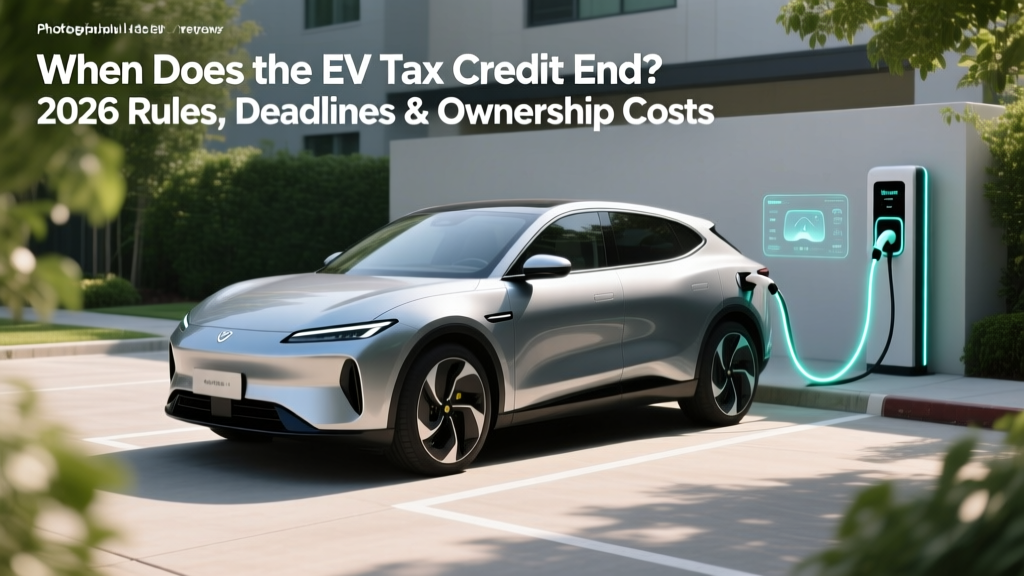
The federal electric vehicle tax credit has been a decisive factor for millions of EV buyers, but the rules governing it are shifting rapidly. If you're asking when does the EV tax credit end, the short answer is that the §30D new clean vehicle credit is currently authorized through December 31, 2032 — but the practical eligibility requirements have narrowed significantly since the Inflation Reduction Act reshaped the program. Many popular models no longer qualify due to battery-sourcing mandates, and buyer income caps exclude a growing number of households.
Beyond the credit itself, the real question buyers need answered is whether an EV makes financial sense over a full ownership cycle. Below, we break down the current §30D rules, the true 5-year cost of EV ownership, and where the savings — and the hidden costs — actually land.
When Does the Federal EV Tax Credit Expire?
Under the Inflation Reduction Act, the §30D new clean vehicle credit is authorized for vehicles placed in service through December 31, 2032. However, this is not a guaranteed countdown. Congress can amend, extend, or repeal tax provisions at any time, and the battery-sourcing and critical-mineral requirements have already tightened annually since 2023, effectively removing dozens of models from eligibility before any expiration date arrives.
The used EV credit (§25E) — up to $4,000 or 30% of the sale price, whichever is lower — is also authorized through 2032 under current law. State-level incentives operate on entirely separate timelines and funding pools, many of which run out on a first-come, first-served basis well before any federal deadline.
The practical takeaway: if you're eligible for the credit on a vehicle that meets sourcing requirements today, waiting risks losing eligibility not because the program expires, but because the rules tighten or the funding runs dry at the state level.
Do You Qualify? The 2026 §30D Eligibility Checklist
The federal EV tax credit is not a universal $7,500 rebate. It's a complex, multi-layered incentive with strict caps on buyer income, vehicle price, and battery component sourcing. Here's what the IRS requires as of the 2026 tax year:
- Adjusted Gross Income Caps: $300,000 for married filing jointly, $225,000 for head of household, $150,000 for single filers. Based on the tax year the vehicle is delivered or the prior year — whichever is lower.
- MSRP Caps: $80,000 for vans, SUVs, and pickup trucks; $55,000 for sedans and all other body styles. The MSRP includes the base price plus all factory-installed options and destination charges — before dealer add-ons.
- Vehicle Assembly: Final assembly must occur in North America. Verify using the VIN decoder at NHTSA.gov.
- Battery Component Sourcing (2026): An increasing percentage of battery components must be manufactured or assembled in North America. The threshold rises annually — vehicles that qualified in 2024 may not qualify in 2026.
- Critical Minerals Sourcing (2026): A growing percentage of critical minerals (lithium, cobalt, nickel, manganese) must be extracted or processed in the U.S. or a free-trade-agreement partner nation, or recycled in North America.
- Foreign Entity of Concern (FEOC) Restriction: Vehicles with battery components from a FEOC (primarily Chinese-linked entities) are disqualified. This rule has eliminated several previously eligible models.
- Point-of-Sale Transfer: As of 2024, buyers can transfer the credit to the dealer at purchase, receiving it as an immediate price reduction rather than waiting to claim it on their tax return. The dealer must be IRS-registered.
- Tax Liability Requirement: §30D is a non-refundable credit. You must owe at least the credit amount in federal income tax to benefit — though the point-of-sale transfer option changes the practical dynamics of this requirement.
Always verify current eligibility on the official IRS §30D page and the DOE's fueleconomy.gov tax credit tracker, which lists qualifying vehicles and their specific credit amounts. These lists update frequently as manufacturers adjust supply chains.
The Real 5-Year Cost of EV Ownership
The tax credit is only one variable in a much larger equation. To determine whether an EV actually saves money, you need to model the full ownership cycle. Below is a representative 5-year / 60,000-mile total cost of ownership (TCO) comparison between a mainstream EV (modeled on a 2026 Hyundai Ioniq 5 SEL, ~$47,000 MSRP) and a comparable gas-powered crossover (modeled on a 2026 Toyota RAV4 XLE AWD, ~$33,000 MSRP).
| Cost Category | EV (Ioniq 5 SEL) | Gas (RAV4 XLE AWD) | Difference |
|---|---|---|---|
| Purchase Price (MSRP) | $47,000 | $33,000 | +$14,000 EV |
| Federal Tax Credit (§30D) | −$7,500 | $0 | −$7,500 EV |
| State Incentive (avg.) | −$2,000 | $0 | −$2,000 EV |
| Net Purchase Cost | $37,500 | $33,000 | +$4,500 EV |
| Fuel / Charging (5 yrs) | $4,320 | $8,100 | −$3,780 EV |
| Maintenance (5 yrs) | $1,800 | $3,600 | −$1,800 EV |
| Insurance (5 yrs) | $10,200 | $7,800 | +$2,400 EV |
| Depreciation (5 yrs) | $18,750 | $11,550 | +$7,200 EV |
| Total 5-Year Cost | $72,570 | $64,050 | +$8,520 EV |
Assumptions: 12,000 miles/year; $0.15/kWh home charging (80% of miles), $0.40/kWh public DCFC (20%); gas at $3.50/gallon at 30 MPG combined; insurance based on national EV average premium; depreciation based on 2024–2025 Kelley Blue Book and Recurrent data trends. Actual costs vary significantly by region, driving habits, utility rates, and specific model.
This model reveals a critical insight: the EV costs more over 5 years in this scenario, primarily because of higher depreciation and insurance premiums that overwhelm the fuel and maintenance savings. However, this equation flips dramatically in states with higher gas prices, lower electricity rates, stronger state incentives, or for buyers who can charge almost entirely at home on off-peak utility rates. It also changes substantially at the 10-year mark, where fuel savings compound and EV maintenance costs remain flat while gas vehicles require major service (transmission, timing chain, exhaust).
Charging vs. Gas: The Per-Mile Math
The fuel savings argument for EVs is real, but the exact number depends heavily on how and where you charge. Here's the breakdown:
| Scenario | Rate / Price | Efficiency | Cost Per Mile |
|---|---|---|---|
| Home Level 2 (off-peak) | $0.12/kWh | 3.5 mi/kWh (120 MPGe) | $0.034 |
| Home Level 2 (standard) | $0.16/kWh | 3.5 mi/kWh | $0.046 |
| Public DC Fast Charger | $0.40/kWh | 3.2 mi/kWh (highway) | $0.125 |
| Tesla Supercharger (avg.) | $0.30/kWh | 3.5 mi/kWh | $0.086 |
| Gas vehicle (30 MPG) | $3.50/gallon | 30 MPG | $0.117 |
| Gas vehicle (25 MPG city) | $3.50/gallon | 25 MPG | $0.140 |
At home on standard rates, an EV costs roughly $0.04–$0.05 per mile to fuel — about one-third the cost of a 30 MPG gas vehicle. But if you rely primarily on public DC fast charging at $0.40/kWh, your per-mile cost actually exceeds gasoline. This is why home charging access is the single largest determinant of EV operating economics. If you can't install a Level 2 charger at home or at your workplace, the fuel-cost advantage shrinks considerably.
For a driver covering 12,000 miles annually with 80% home charging at $0.15/kWh and 20% public charging at $0.40/kWh, annual fuel cost is approximately $864 — compared to $1,400 for a 30 MPG gas car at $3.50/gallon. That's a $536 annual savings, or about $2,680 over five years.
Maintenance Savings: Where EVs Quietly Win
EVs have roughly 20 moving parts in their drivetrain versus 2,000+ in an internal combustion engine. This translates to real, measurable maintenance savings — though not as dramatic as some marketing materials suggest.
| Service Item | EV Cost (5 yrs) | Gas Vehicle Cost (5 yrs) |
|---|---|---|
| Oil changes | $0 | $600 (5 changes × $120 synthetic) |
| Brake pads & rotors | $200 (regen reduces wear 60–80%) | $800 |
| Coolant service | $150 (battery thermal mgmt) | $200 |
| Cabin air filter | $200 | $200 |
| Tire rotation & replacement | $1,000 (EVs wear tires ~20% faster due to weight & torque) | $800 |
| Transmission fluid | $0 (single-speed reducer) | $200 |
| Wipers, misc. | $250 | $250 |
| Total | $1,800 | $3,050 |
The net savings of roughly $1,250 over 5 years is meaningful but not transformative. The biggest caveat: EV tires. The combination of heavier curb weight (an Ioniq 5 weighs ~4,500 lbs vs. a RAV4 at ~3,600 lbs) and instant torque means EV tires wear 15–25% faster. Budget for a tire replacement around 30,000–40,000 miles rather than the 50,000–60,000 miles typical for gas vehicles.
At the 10-year mark, EV maintenance savings widen considerably as gas vehicles face timing chain replacements, exhaust system repairs, catalytic converter issues, and transmission overhauls — all of which are eliminated in a battery-electric drivetrain.
The Insurance Reality: Expect to Pay More
EV insurance premiums are typically 15–30% higher than comparable gas vehicles, and this is one of the most under-discussed costs in EV ownership analysis. The reasons are structural:
- Higher repair costs: EV battery packs, power electronics, and specialized structural components are expensive to replace after collision damage. A minor rear-end collision that would cost $2,000 to repair on a gas car can total an EV if the battery enclosure is compromised.
- Limited repair network: Fewer body shops have the high-voltage certification required to work on EVs, leading to longer repair times and higher labor rates.
- Higher vehicle values: Comprehensive and collision coverage scales with vehicle price, and EVs still carry a purchase-price premium.
- Actuarial uncertainty: Insurers are still building data models on EV claim frequency and severity, and they're pricing conservatively.
For our Ioniq 5 vs. RAV4 comparison, expect annual premiums around $2,040 for the EV versus $1,560 for the gas vehicle — a $480/year or $2,400/5-year gap. However, this varies enormously by state, insurer, driving record, and specific model. Tesla vehicles, for example, often carry even higher premiums due to repair complexity, while some insurers now offer EV-specific policies with battery-coverage endorsements that can actually reduce total cost. Always get quotes from at least three insurers before purchase.
Depreciation and Resale Value: The Moving Target
EV depreciation has been the most volatile variable in ownership economics over the past three years. After Tesla's aggressive price cuts in 2023–2024 rippled through the used market, EV resale values dropped significantly — in some cases 40–50% over two years for early-adopter models.
As of 2026, the depreciation picture is stabilizing but remains less favorable than gas vehicles on average:
- Average EV 5-year depreciation: 45–55% of purchase price (vs. 35–40% for comparable gas crossovers)
- Primary drivers: Rapid price competition from new models, battery health uncertainty in the used market, and faster technology obsolescence (charging speed, range, and software features improve year-over-year)
- Bright spots: High-demand models with limited supply (e.g., Rivian R1T, certain Porsche Taycan trims) retain value better; vehicles with transferable warranties and documented battery health reports depreciate less
- Leasing advantage: Given depreciation uncertainty, leasing an EV can be financially advantageous — you capture the tax credit (passed through as a lease incentive) while transferring resale risk to the lessor
If you plan to own your EV for 8–10+ years, depreciation matters less because you'll extract maximum utility from the vehicle and the residual value converges toward scrap-and-parts value for any vehicle that old. Depreciation pain is concentrated in the 3–5 year ownership window.
State, Local, and Utility Incentives: The Hidden Variable
Important: State and local incentives vary enormously by jurisdiction and change frequently. The figures below are representative examples, not a comprehensive list. Always check your state energy office, local air quality district, and utility provider for current programs. Many utility rebates for home charger installation are available on a first-come, first-served basis and can run out mid-year.
Beyond the federal §30D credit, a patchwork of state and utility incentives can dramatically alter EV economics:
- State purchase rebates: California's Clean Fuel Reward (up to $1,000 at point of sale for eligible buyers), Colorado's Innovative Motor Vehicle Credit (up to $5,000 for EVs under $80,000), Massachusetts MOR-EV (up to $3,500), New York Drive Clean (up to $2,000). Many states have income caps and MSRP limits mirroring federal rules.
- Utility charger rebates: Many utilities offer $300–$1,500 rebates for Level 2 home charger purchase and installation. Some (e.g., PG&E, ConEdison) offer additional rebates for electrical panel upgrades required to support 240V/48A circuits.
- HOV lane access: States including California, Colorado, Virginia, and Maryland offer free or discounted HOV/carpool lane access for EVs — a non-monetary incentive worth significant commute time.
- Registration fee offsets: Some states charge EVs higher annual registration fees (to replace lost gas tax revenue), which can partially offset incentives. These range from $50 to $225/year depending on the state.
- Time-of-use (TOU) rates: Most utilities offer off-peak electricity rates (often $0.08–$0.12/kWh overnight) specifically designed for EV charging. Enrolling in a TOU plan can cut home charging costs by 30–50% compared to standard residential rates.
A buyer in Colorado with access to the full federal credit ($7,500), the state credit ($5,000), a utility charger rebate ($500), and TOU rates could reduce the effective purchase price of a $47,000 EV to under $34,000 — fundamentally changing the TCO equation.
Frequently Asked Questions
When does the EV tax credit end for new vehicles?
Under current law, the §30D new clean vehicle credit is authorized through December 31, 2032. However, eligibility for specific vehicles changes frequently as battery-sourcing requirements tighten annually. A vehicle that qualifies today may not qualify next year, and Congress could amend the program at any time. The practical deadline is whenever your specific vehicle and income situation no longer meet the requirements — not necessarily 2032.
How much does it really cost to own an EV over 5 years?
Based on our TCO analysis, a mainstream EV like the Hyundai Ioniq 5 SEL costs approximately $72,570 over 5 years and 60,000 miles including purchase price (after incentives), charging, maintenance, insurance, and depreciation. A comparable gas crossover costs about $64,050. The EV's higher purchase price, insurance, and depreciation typically outweigh fuel and maintenance savings in the 5-year window. However, at 10 years, in high-gas-price states, or with strong state incentives, the EV can reach cost parity or come out ahead.
Do I qualify for the $7,500 federal EV tax credit?
Eligibility requires meeting all of these criteria: income below $150,000 (single) / $300,000 (joint), vehicle MSRP below $55,000 (sedans) or $80,000 (SUVs/trucks/vans), North American final assembly, and battery components and critical minerals meeting 2026 sourcing thresholds. Additionally, the vehicle cannot contain battery components from a Foreign Entity of Concern. Check the specific vehicle on fueleconomy.gov and verify your income against IRS limits.
How much do I save on fuel and maintenance with an EV?
With 80% home charging at $0.15/kWh and 20% public charging, expect to save approximately $536/year on fuel compared to a 30 MPG gas vehicle at $3.50/gallon. Maintenance savings average about $250/year, primarily from eliminated oil changes and reduced brake wear. Combined, that's roughly $786/year or $3,930 over five years. These savings grow with higher gas prices, lower electricity rates, and longer ownership periods.
Are EVs more expensive to insure?
Yes, typically 15–30% more expensive than comparable gas vehicles. Higher repair costs after collisions, a smaller certified repair network, and higher vehicle values all contribute. For a mid-range EV, expect to pay $400–$600 more per year in insurance premiums. However, rates vary significantly by insurer, state, and model — always compare quotes before purchasing.
How well do EVs hold their value?
Average EV depreciation over 5 years is currently 45–55%, compared to 35–40% for gas vehicles. Rapid technology improvements, aggressive new-model pricing, and used-market uncertainty about battery health drive the gap. Leasing can mitigate this risk, and long-term ownership (8+ years) reduces the impact of depreciation on your total cost.
Can I get the EV tax credit as a point-of-sale discount?
Yes. Since January 1, 2024, buyers can transfer the §30D credit to an IRS-registered dealer at the time of purchase, receiving it as an immediate reduction in the vehicle's purchase price rather than as a credit on your tax return. This is available regardless of your tax liability, making the credit accessible to buyers who might not owe enough in federal taxes to claim it traditionally. The dealer handles the IRS paperwork.
The EV tax credit isn't disappearing overnight — but the window to claim it on a specific vehicle narrows as sourcing rules tighten and model eligibility shifts. Run your own numbers using the TCO framework above, get insurance quotes before you commit, and verify credit eligibility on IRS and DOE sources the week you plan to buy. The rules are moving targets, and the only way to lock in savings is to understand them precisely.