Quick Answer: Is an EV Semi Truck Worth It in 2026?
An EV semi truck makes financial sense today for fleets operating predictable, hub-based routes under 300 miles round-trip with access to depot megawatt charging. The Tesla Semi delivers an EPA-estimated 500-mile range with a ~900 kWh battery at roughly $250,000 base, while the Freightliner eCascadia targets regional hauls at 150–250 miles of range from ~$300,000. Diesel still wins on long-haul flexibility, but for drayage, port operations, and regional distribution, an electric Class 8 truck can cut per-mile energy costs by 50–60% and eliminate diesel exhaust fluid, particulate filter, and transmission maintenance. Federal commercial clean vehicle credits (§45W) up to $40,000 and state voucher programs (California's HVIP, for example) can reduce net acquisition cost dramatically.
The EV Semi Truck Landscape: What's Available Now
The Class 8 electric truck market has matured past early-adopter pilot programs into genuine commercial production. As of 2026, three platforms dominate real-world fleet orders, each targeting different duty cycles. Understanding which fits your operation requires looking past press-release range figures and into battery chemistry, sustained charge rates, and payload penalties.
| Specification | Tesla Semi (2026) | Freightliner eCascadia | Volvo VNR Electric |
|---|---|---|---|
| EPA-Est. Range (loaded) | ~500 mi (300 kWh/100 mi variant) | ~230 mi (438 kWh usable) | ~275 mi (565 kWh usable) |
| Battery Chemistry | NMC (estimated) | NMC | NMC |
| Battery Capacity (usable) | ~900 kWh (long-range) | ~438 kWh | ~565 kWh |
| Peak DC Charge Rate | ~1.2 MW (MCS connector) | ~350 kW (CCS2) | ~250 kW (CCS2) |
| 10–80% Charge Time | ~35–45 min (est.) | ~90 min | ~70–90 min |
| GVWR | 82,000 lbs | 82,000 lbs | 82,000 lbs |
| Payload Penalty vs. Diesel | ~8,000–10,000 lbs | ~5,000–7,000 lbs | ~5,500–7,500 lbs |
| Base MSRP (approx.) | $250,000 (300 mi) / $290,000 (500 mi) | $290,000–$350,000 | $270,000–$330,000 |
| Warranty (battery) | 8 yr / 1,000,000 mi (est.) | 5 yr / 600,000 mi | 5 yr / 600,000 mi |
The Tesla Semi commands attention with its range and megawatt-class charging, but production volume remains limited and the Megacharger network is still sparse outside key freight corridors in California and Nevada. The Freightliner eCascadia, built on Daimler Truck's proven Cascadia platform, offers established dealer service networks and parts availability that fleets already running diesel Cascadias find reassuring. The Volvo VNR Electric, now in its third generation, has the most documented real-world fleet miles and targets regional and drayage routes where its 275-mile range covers the daily duty cycle with margin.
EV Semi Truck vs. Diesel: The Real Cost Breakdown
The purchase price of an electric Class 8 truck is roughly 2–3× that of a comparable diesel rig ($150,000–$180,000 for a new diesel sleeper). The economic case rests entirely on total cost of ownership (TCO) over a 5–7 year operating life, driven by energy savings and maintenance reduction.
| Cost Factor (Annual, 80,000 mi/yr) | Diesel Class 8 | EV Class 8 (Depot Charged) |
|---|---|---|
| Fuel / Energy | $52,000–$64,000 (6.5 MPG, $4.00–$5.00/gal diesel) | $16,000–$24,000 (2 kWh/mi, $0.10–$0.15/kWh commercial) |
| Maintenance | $15,000–$22,000 (oil, DEF, DPF, transmission, brakes) | $4,000–$8,000 (no oil/DEF/DPF/transmission; regen saves brakes) |
| Insurance | $8,000–$12,000 | $10,000–$15,000 (higher replacement-cost premiums) |
| Charging Infrastructure (amortized) | $0 | $8,000–$15,000 (depot charger install, utility upgrades) |
| Estimated Annual Total | $75,000–$98,000 | $38,000–$62,000 |
The per-mile energy cost gap is the single largest TCO driver. A diesel semi at 6.5 MPG burning $4.50/gallon diesel spends roughly $0.69/mile on fuel. An electric semi consuming 2.0 kWh/mile at $0.12/kWh (a realistic blended commercial rate with time-of-use optimization) spends roughly $0.24/mile on energy. That's a $0.45/mile savings — at 80,000 miles/year, that's $36,000 annually in energy savings alone.
Maintenance compounds the advantage. Electric drivetrains eliminate engine oil changes ($2,000–$3,000/yr), diesel exhaust fluid ($1,500–$2,500/yr), diesel particulate filter replacements ($5,000–$8,000 every 200,000–400,000 miles), and transmission service. Regenerative braking dramatically extends friction brake life, often pushing pad replacements past 300,000 miles.
However, the higher upfront acquisition cost ($100,000–$170,000 more than diesel) and depot charging infrastructure investment ($50,000–$150,000+ per charger depending on utility service upgrades) mean break-even typically arrives in year 3–5 depending on route mileage and electricity rates. Fleets running fewer than 40,000 miles/year may never recover the premium.
Charging Infrastructure: The Hidden Hurdle
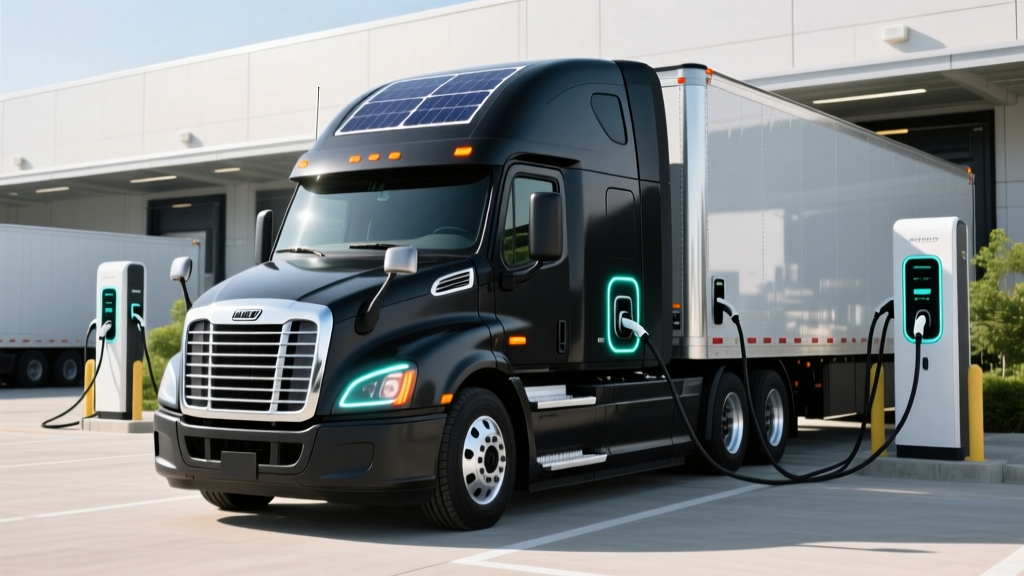
Unlike passenger EVs that can rely on public charging networks, an EV semi truck requires dedicated depot or corridor charging infrastructure rated at 150 kW to 1.2 MW per stall. This is where most fleet electrification plans stall — not because the trucks can't work, but because the electrical infrastructure takes 12–24 months to plan, permit, and energize.
Charging Levels for Class 8 Trucks
| Level | Power (kW) | Connector | Miles Added/Hour | Typical Use Case |
|---|---|---|---|---|
| Depot AC (Level 2) | 19.2–40 kW | J1772 / CCS1 | ~8–18 mi/hr | Overnight top-off, weekend charging |
| Depot DC Fast | 60–150 kW | CCS1 / CCS2 | ~30–70 mi/hr | Shift-change top-up, regional depot |
| Corridor DC Fast | 180–350 kW | CCS1 / CCS2 | ~80–160 mi/hr | Mid-route charging, public truck stops |
| Megawatt Charging | 600–1,200 kW | MCS (Megawatt Charging System) | ~280–550 mi/hr | Hub-to-hub, Tesla Megacharger |
For a depot running 10 electric semis overnight, plan for a 1–2 MW utility service upgrade. Most commercial districts have 480V three-phase service available, but transformer upgrades and switchgear can push electrical contractor costs to $200,000–$500,000 for a multi-stall depot. Utility demand charges — the per-kW peak fee on commercial electric bills — can add $0.05–$0.15/kWh to effective charging cost if not managed with smart scheduling and battery buffering.
The Megawatt Charging System (MCS) connector, standardized by CharIN, is emerging as the North American standard for heavy-duty DC fast charging above 350 kW. Tesla's proprietary Megacharger uses a custom connector but Tesla has signaled future MCS compatibility. Fleets investing in depot infrastructure today should spec CCS2/MCS-ready equipment to avoid obsolescence.
Real-World Range: What the EPA Sticker Doesn't Tell You
Electric semi truck range is profoundly sensitive to payload weight, terrain, ambient temperature, and speed — even more so than passenger EVs because of the massive energy consumption baseline. A truck consuming 2.0 kWh/mile at 65 mph on flat terrain may consume 3.0+ kWh/mile at 70 mph through mountain grades, cutting effective range by 30–40%.
Real-World Range Expectations (Loaded, 80,000 lbs GCW)
Tesla Semi (500-mi EPA): Expect ~400–440 mi at 65 mph on mixed terrain; ~320–360 mi at 70 mph sustained highway; ~300–350 mi in sub-30°F winter conditions.
Freightliner eCascadia (230-mi EPA): Expect ~180–210 mi real-world regional; ~140–170 mi in cold weather or hilly terrain.
Volvo VNR Electric (275-mi EPA): Expect ~220–250 mi real-world; ~170–200 mi in winter/highway conditions.
Cold weather hits Class 8 batteries especially hard. Battery internal resistance increases below 32°F, reducing usable capacity by 15–25% and slowing charge acceptance. Unlike passenger EVs, most electric semis do not yet feature heat-pump-based battery thermal management optimized for extreme cold — resistive heating of a 900 kWh pack is energy-prohibitive. Fleets operating in Minnesota, Montana, or New England winters must derange their range planning by at least 25% from November through March.
The charging curve also matters. A Tesla Semi peaking at 1.2 MW will not sustain that rate from 10% to 80%. Expect peak rates between 10–40% SoC, tapering to ~600–800 kW through 40–60%, and further tapering above 60%. The "10–80% in ~35–45 minutes" figure assumes preconditioned batteries and functional Megacharger availability — real-world stops with cold-soaked batteries or shared charger queuing can extend to 60–90 minutes.
Incentives, Tax Credits, and the Acquisition Math
The federal Commercial Clean Vehicle Credit (§45W) provides up to $40,000 for qualified commercial electric trucks (the credit equals the lesser of 15% of the vehicle's basis or the incremental cost over a comparable diesel, up to $40,000 for vehicles over 14,000 lbs GVWR). Unlike the §30D consumer credit, §45W has no MSRP cap and no buyer income limit — but the vehicle must be used predominantly in the U.S. and meet prevailing-wage requirements for vehicles placed in service after 2024.
- §45W Credit: Up to $40,000 per vehicle; requires commercial use, U.S. deployment
- State Vouchers: California HVIP offers $60,000–$120,000+ per Class 8 EV truck (funding varies by year); similar programs in New York, New Jersey, Colorado
- IRA §179 Deduction: Full expensing of qualifying commercial EV equipment, including charging infrastructure
- Utility Rebates: Many investor-owned utilities offer $10,000–$50,000 per depot charger installed
- Charging Infrastructure Credit (§30C): Up to $100,000 per item of charging property placed in service (subject to prevailing wage and apprenticeship requirements, located in eligible census tracts)
Stacked together, a fleet in California purchasing a $300,000 electric semi could see: $40,000 federal §45W credit + $90,000 HVIP voucher + $30,000 utility charger rebate = $160,000 in incentives, bringing the effective acquisition cost to roughly $140,000 — near parity with a diesel truck. This is the scenario where EV semis become economically irresistible. But incentive availability is jurisdiction-specific, time-limited, and subject to funding exhaustion. Always verify current program status with your state energy office and consult a tax professional for credit eligibility.
Decision Framework: Should Your Fleet Go Electric?
Choose an EV Semi Truck If:
- Your routes are predictable and under 250 miles round-trip (regional haul, drayage, port operations)
- You have depot space with access to 480V three-phase utility service (or can fund an upgrade)
- Your trucks return to base nightly for 8–10 hour dwell windows (overnight charging)
- You operate in a state with strong voucher programs (CA, NY, NJ, CO, WA)
- Annual mileage exceeds 50,000 miles/year (to recover the acquisition premium through fuel savings)
- You face regulatory pressure (California's Advanced Clean Fleets rule, port clean-air mandates)
Stick With Diesel (or Wait) If:
- Your routes exceed 400 miles one-way or require multi-day over-the-road runs
- You operate in regions with no public MCS/corridor truck charging infrastructure
- Your fleet runs fewer than 30,000 miles/year per truck (insufficient TCO payback)
- Payload is weight-critical and you consistently max out at 80,000 lbs GCW (the 5,000–10,000 lb battery penalty cuts into revenue)
- Your depot lacks utility service capacity and a transformer upgrade would cost $500,000+
- You operate in extreme cold climates (<0°F regularly) without heated depot facilities
Common Misconceptions About EV Semi Trucks
| Myth | Fact |
|---|---|
| "Electric semis can't pull heavy loads" | All current Class 8 EVs are rated at 82,000 lbs GCW. Tesla Semi has demonstrated 80,000+ lb hauls over the Sierra Nevada. Torque delivery is instant and superior to diesel for grade climbing. |
| "Batteries will need replacing in 5 years" | NMC packs in commercial trucks are engineered for 1 million+ mile lifespans with <20% degradation. Freightliner and Volvo warranty batteries for 5 yr/600,000 mi with guaranteed capacity retention thresholds (~70–80%). |
| "Charging takes too long for freight" | For depot-based operations with overnight dwell, charging time is irrelevant — the truck charges while the driver sleeps. For corridor runs, MCS charging adds ~300 miles in under an hour, aligning with mandatory 30-minute driver rest breaks (though full HOS compliance requires careful scheduling). |
| "The grid can't handle electric trucks" | A single 350 kW charger draws roughly the same peak power as a small grocery store. Ten-truck depots at 1–2 MW require utility coordination but are routinely installed. Smart charging software staggers sessions to manage demand charges. |
| "EV semis are zero-emission everywhere" | Tailpipe emissions are zero, but upstream electricity generation matters. In coal-heavy grids, well-to-wheel CO₂ reduction vs. diesel may be 30–40%. In renewable-heavy grids (CA, WA, NY), reduction exceeds 70–80%. |
What First-Time Electric Fleet Buyers Should Know
Transitioning from diesel to electric Class 8 trucks is as much an infrastructure and operations project as a vehicle purchase. Here's what experienced fleet operators wish they'd known before their first EV semi order:
- Start utility engagement 18–24 months before truck delivery. A 1 MW service upgrade requires utility planning studies, easement negotiations, transformer procurement (lead times of 12–18 months post-2023), and permitting. This is the longest lead-time item — longer than the truck build queue.
- Spec your chargers for the future, not today's trucks. If your current trucks charge at 150 kW but your next generation will accept 350 kW or MCS, install conduit and switchgear rated for the higher capacity now. Trenching twice is the most expensive mistake in depot electrification.
- Train drivers on regen braking and energy management. One-pedal driving techniques and strategic regen use can improve efficiency by 10–15% — the difference between completing a route and running short. Drivers accustomed to diesel coasting habits waste significant energy.
- Budget for software and telematics. Fleet management platforms that integrate SoC monitoring, route optimization, and charge scheduling (Electriphi/ChargePoint, Ampup, TeraWatt) are essential. Expect $50–$150/month per vehicle for fleet EV management software.
- Insurance premiums will be higher initially. Insurers price EV semis based on higher replacement values and limited claims history. Budget 20–40% higher premiums than diesel equivalents for the first 2–3 years of operation; expect normalization as claims data matures.
- Plan for battery end-of-life in year 8–12. While most packs will outlast the truck's first ownership cycle, second-life applications (stationary storage) and recycling pathways (Redwood Materials, Li-Cycle) are developing. Factor in potential residual value or disposal cost in your long-term TCO model.
Frequently Asked Questions
How long does an EV semi truck battery last before replacement?
Current NMC battery packs in Class 8 trucks are engineered for 1 million to 1.5 million miles with less than 20% capacity loss. At typical fleet utilization of 80,000–120,000 miles/year, that translates to 10–15 years of service before meaningful range degradation. Full pack replacement, if needed, currently costs $100,000–$200,000 depending on capacity, but prices are declining ~10–15% annually and are expected to fall below $80,000 for a 500 kWh pack by 2028–2029.
Can an EV semi truck operate in extreme cold?
Yes, but with significant range penalty. Below 20°F, expect 20–30% range reduction due to increased battery internal resistance and cabin/battery heating loads. Fleets in Minnesota and Canada report successful winter operations by derating planned routes by 25%, preheating batteries while plugged in, and using depot heating to maintain pack temperature above 40°F during charging. No current production EV semi offers the cold-weather range consistency of a diesel in sub-zero conditions.
What's the payload penalty for going electric?
Battery weight is the primary trade-off. A Tesla Semi with the 500-mile (~900 kWh) pack carries roughly 8,000–10,000 lbs of battery mass beyond what a diesel's fuel tank and drivetrain weigh. This means a fully loaded EV semi may carry 8,000–10,000 lbs less freight than a diesel at the same 82,000 lb GCW. For weight-out freight (dense goods like beverages, steel, aggregate), this can mean 5–10% fewer revenue tons per trip. For cube-out freight (light, bulky goods), the penalty is negligible. Some states offer weight exemptions for EV trucks (up to 2,000 additional lbs), but federal Interstate limits remain at 80,000 lbs without special permit.
Do EV semi trucks qualify for the $7,500 consumer tax credit?
No. The §30D consumer clean vehicle credit applies only to light-duty vehicles under 14,000 lbs GVWR. Electric semi trucks qualify instead for the §45W Commercial Clean Vehicle Credit, which offers up to $40,000 per vehicle for commercial use. Consult a tax professional to confirm eligibility based on your business structure and vehicle deployment.
What happens if a truck runs out of charge on a route?
Towing a dead Class 8 EV requires a heavy-duty wrecker and careful handling — the electric motors can generate back-EMF if the wheels turn while the system is faulted, so flatbed recovery or driveshaft disconnection may be required. Most fleets mitigate this risk through conservative route planning (targeting 80% of max range), telematics-based SoC monitoring, and identifying mid-route charging options. AAA and commercial roadside providers are developing EV-specific heavy-duty response protocols, but coverage remains limited outside major freight corridors.