The Quick Answer: What Does an EV Road Charge Actually Cost?
An EV road charge at a public DC fast-charging station typically costs between $0.30 and $0.60 per kWh depending on the network, location, and time of day. For a mid-size electric SUV with a 75 kWh battery charging from 10% to 80%, expect to pay roughly $22–$42 per session, adding approximately 200–240 miles of range in 18–30 minutes. That translates to $0.09–$0.17 per mile on the road — competitive with a 30 MPG gas car at $3.50/gallon ($0.12/mile), though home charging remains dramatically cheaper at $0.04–$0.06 per mile.
How Public EV Road Charging Works in 2026
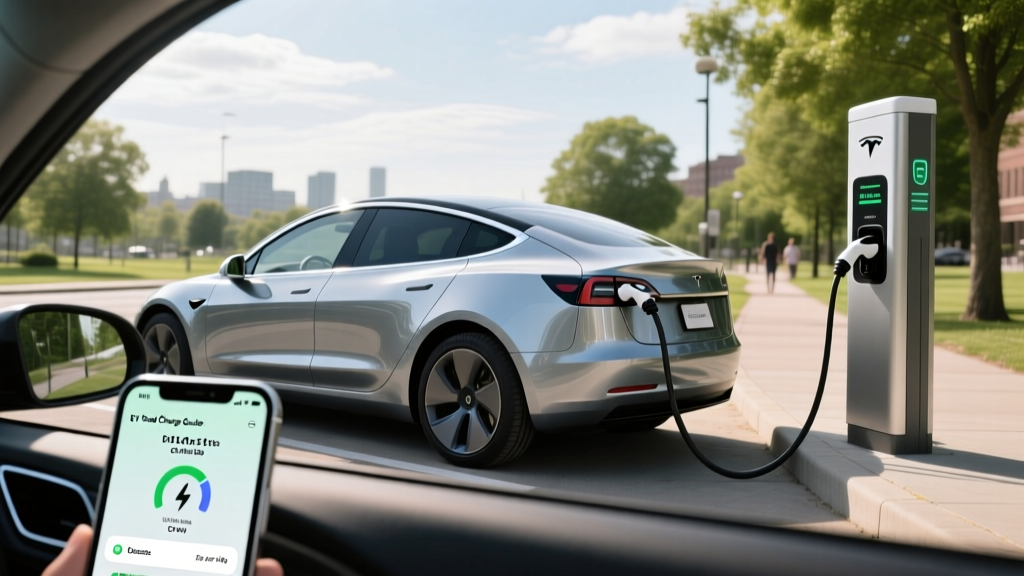
Public DC fast charging has matured considerably. The North American Charging Standard (NACS) connector — originally developed by Tesla — is now the dominant plug across nearly all new EVs sold in the US, with former CCS1 vehicles using adapters. Networks like Tesla Supercharger, Electrify America, EVgo, and ChargePoint operate stations ranging from 50 kW legacy units to 350 kW+ ultra-fast chargers.
Here's how charging levels break down when you're on the road:
| Charging Type | Power (kW) | Miles Added per Hour | Typical Use Case |
|---|---|---|---|
| Level 1 (120V outlet) | 1.2–1.9 kW | 3–5 mi/hr | Emergency overnight top-up |
| Level 2 (240V public) | 7.2–19.2 kW | 25–60 mi/hr | Destination charging (hotels, malls) |
| DC Fast Charge (typical) | 50–150 kW | 150–400 mi/hr | Highway road-trip stops |
| DC Ultra-Fast | 250–350 kW | 500–900 mi/hr | Quick 10-80% highway sessions |
Critical distinction: kW (kilowatts) measures charging power — how fast energy flows into the battery. kWh (kilowatt-hours) measures battery capacity — how much energy it stores. A 350 kW charger doesn't deliver 350 kWh; it delivers energy at a rate of 350 kW that tapers as the battery fills.
Real-World EV Road Charge Costs vs. Gas
The economics of road-trip charging depend heavily on the network you use and whether your EV came with free charging credits. Here's a concrete comparison using a 300-mile highway trip scenario:
| Metric | EV (Hyundai Ioniq 5 Long Range) | Gas Car (Toyota Camry LE) |
|---|---|---|
| EPA Efficiency | 3.46 kWh/mi (114 MPGe combined) | 32 MPG combined |
| Energy needed for 300 mi | ~82 kWh (highway adjusted) | ~9.4 gallons |
| Cost at $0.48/kWh avg DCFC | $39.36 | — |
| Cost at $3.50/gal gasoline | — | $32.90 |
| Cost per mile | $0.13/mi | $0.11/mi |
| Time to refuel/recharge | ~25 min (two 10-80% stops) | ~10 min (one stop) |
On the road, EVs are slightly more expensive to fuel than efficient gas cars at current public charging rates. The savings advantage of an EV comes overwhelmingly from home charging, where electricity at $0.14/kWh national average drops the per-mile cost to roughly $0.05 — about half the cost of gasoline.
The real-world range you'll use on a road trip also differs from the EPA sticker. The Ioniq 5's EPA-estimated 303-mile range typically yields 240–270 miles at sustained 70 MPH highway speeds, and potentially 200–230 miles in cold weather (below 32°F) due to battery chemistry limitations and cabin heating demand. Plan your route around 180–200 mile segments to maintain a comfortable buffer.
Charging Speed Reality: The Charge Curve Matters
Manufacturer claims of "10-80% in 18 minutes" assume ideal conditions: a preconditioned battery, a charger capable of the vehicle's peak rate, and moderate ambient temperatures. Here's what actually happens during a DC fast-charge session:
Peak rate (10-30% SoC): The battery accepts maximum power. A vehicle rated at 240 kW peak might actually sustain 220-240 kW in this window.
Mid-range (30-60% SoC): Power begins tapering. Expect 150-180 kW for that same vehicle.
Upper range (60-80% SoC): Significant taper to protect battery health. Rates may drop to 80-120 kW.
Above 80% SoC: Charging slows dramatically to 30-50 kW. This is why road-trippers charge to 80% and move on — the last 20% can take as long as the first 70%.
Vehicles with LFP (lithium iron phosphate) batteries — such as the base Tesla Model 3 Rear-Wheel Drive — can often charge at high rates to a higher SoC than NMC (nickel manganese cobalt) batteries, partially offsetting their lower energy density. However, LFP cells are heavier and offer less total range per kWh.
Network Reliability: What EV Owners Actually Experience
Not all charging networks are equal. Based on industry reliability surveys and owner reports through 2025-2026:
- Tesla Supercharger: ~97% uptime, consistent speeds, seamless plug-and-charge payment. Now open to NACS-equipped non-Tesla vehicles at most locations.
- Electrify America: ~85-90% uptime. Speeds can vary; some stations have charger-specific quirks. App-based payment.
- EVgo: ~88-92% uptime. Strong urban coverage; some older 50 kW stations being upgraded.
- ChargePoint: Varies widely by site host. Excellent for Level 2 destination charging; DC fast stations less consistent.
First-time EV buyers should download multiple network apps before their first road trip and keep an RFID card or credit card handy — not all stations support tap-to-pay universally.
Total Ownership Cost: EV vs. Gas Over 5 Years
The road charge cost is just one piece. Here's a 5-year/75,000-mile ownership comparison assuming 80% home charging and 20% public DC fast charging for the EV:
| Cost Category | EV (2026 Hyundai Ioniq 5 SEL, $45,900 MSRP) | Gas (2026 Toyota Camry SE, $31,400 MSRP) |
|---|---|---|
| Purchase price (after §30D credit*) | $38,400 (est.) | $31,400 |
| Fuel/energy (5 yrs) | $4,200 (home + road) | $7,350 |
| Maintenance (5 yrs) | $1,800 | $4,500 |
| Insurance (5 yrs, avg) | $9,500 | $7,200 |
| Estimated depreciation | $18,500 | $12,800 |
| 5-Year Total Cost | $72,400 | $63,250 |
| Cost per mile (all-in) | $0.97/mi | $0.84/mi |
*The federal §30D clean vehicle credit offers up to $7,500, but eligibility depends on MSRP caps ($55,000 for sedans, $80,000 for SUVs/trucks), buyer income limits ($150K single / $300K joint AGI), battery critical-mineral sourcing requirements, and final assembly in North America. Always verify current-year rules on IRS.gov and consult a tax professional. The credit can now be transferred to the dealer at point of sale as an upfront discount.
The EV's higher insurance premiums (typically 15-25% more due to repair costs and battery replacement risk) and steeper early depreciation partially offset fuel and maintenance savings. Buyers who drive fewer than 10,000 miles per year may not recoup the price premium within five years.
Common Misconceptions About EV Road Charging
| Myth | Fact |
|---|---|
| "Public charging is always cheaper than gas" | DC fast charging on the road often costs more per mile than an efficient gas car. The savings come from home charging. |
| "You'll be stranded without a charger" | With route-planning apps (A Better Routeplanner, PlugShare), you can identify chargers every 80-150 miles along major US corridors. Rural gaps still exist in parts of the Mountain West and Great Plains. |
| "All chargers are the same speed" | A 50 kW CHAdeMO station adds ~150 miles/hour; a 350 kW NACS station can add 800+. Your vehicle's max charge rate also caps the speed. |
| "Cold weather doesn't affect charging" | Below freezing, batteries charge slower until they warm up. Preconditioning (heating the battery en route to a charger) can reduce a 40-minute session to 20 minutes. |
| "Fast charging ruins the battery" | Modern thermal management systems limit degradation. Studies show 8-15% capacity loss over 100,000 miles is typical even with regular DCFC use. |
Decision Framework: Is an EV Right for Your Road Trips?
Choose a Battery EV (BEV) If:
- You have reliable home Level 2 charging (240V, 32-48A circuit) — this covers 80%+ of your charging needs
- Your typical road trips are under 400 miles and follow major interstate corridors
- You drive more than 12,000 miles/year, maximizing fuel savings
- You qualify for the §30D tax credit, narrowing the upfront price gap
- You value low maintenance (no oil changes, fewer brake replacements due to regen braking)
Choose a Plug-In Hybrid (PHEV) If:
- You lack home charging access or live in an apartment without EV infrastructure
- You frequently drive 400+ miles through rural areas with sparse charging
- You want electric-only commuting (25-45 miles) without any range limitation on road trips
- You live in extreme cold climates (below 0°F regularly) where EV range loss exceeds 30%
Stick With a Gas Car or HEV Hybrid If:
- You cannot install home charging and public infrastructure in your area is limited
- Your budget is under $30,000 and you need the lowest upfront cost
- You tow heavy loads (5,000+ lbs) regularly — EV range drops 40-50% under heavy towing
First-Time EV Buyer: What to Know Before Your First Road Charge
- Precondition your battery. Set your navigation to the charging station 15-30 minutes before arrival. This warms the battery to optimal temperature, dramatically improving charge speed in cool or cold weather.
- Charge to 80%, then move on. The charge curve means 80-100% takes disproportionately long. On road trips, two 10-80% stops are faster than one 10-100% stop.
- Know your vehicle's peak charge rate. A 2026 Ioniq 5 peaks at ~240 kW on a 350 kW charger (10-80% in ~18 min ideal). A Chevy Equinox EV peaks at ~150 kW (10-80% in ~30 min). Plan stop durations accordingly.
- Carry a NACS-to-J1772 adapter if your vehicle uses a NACS port, so you can use Level 2 destination chargers at hotels and restaurants.
- Download PlugShare and A Better Routeplanner before departure. Filter by connector type and check recent user reviews for station reliability.
- Budget $0.40-$0.55/kWh for DC fast charging on major highways. Tesla Superchargers tend to be on the lower end ($0.30-$0.45); Electrify America and EVgo often run $0.48-$0.60 at peak rates.
How long does a typical EV road charge take?
For a modern EV with 200+ kW peak charging capability, a 10-80% session at a compatible DC fast charger takes 18-25 minutes under ideal conditions. Add 5-10 minutes in cold weather without preconditioning. Vehicles with lower peak rates (100-150 kW) typically need 30-45 minutes for the same session.
Is it cheaper to charge an EV on the road or fill a gas tank?
On the road at DC fast-charging rates of $0.40-$0.55/kWh, an EV costs roughly $0.12-$0.17 per mile — comparable to or slightly more than a 30 MPG gas car at $3.50/gallon ($0.12/mile). The EV's cost advantage comes from home charging at $0.04-$0.06/mile, not road charging.
Can I road-trip an EV cross-country in 2026?
Yes, along major interstates (I-5, I-10, I-40, I-70, I-80, I-90). The Supercharger network and third-party DCFC stations cover these corridors with chargers every 100-180 miles. Rural routes in parts of Montana, the Dakotas, and West Texas still have gaps — plan carefully using A Better Routeplanner.
Does frequent DC fast charging damage the battery?
Modern battery thermal management systems significantly limit degradation from DCFC. Data from high-mileage EVs shows 8-15% capacity loss over 100,000 miles with regular fast charging. Most manufacturers warranty the battery for 8 years/100,000 miles with a 70% capacity retention threshold. Occasional Level 2 charging and avoiding consistent 100% SoC storage extend longevity.
What if I can't charge at home?
Without home charging, EV ownership becomes significantly more expensive and inconvenient. You'll rely entirely on public charging at $0.30-$0.60/kWh (vs. $0.14/kWh residential average). Consider whether your workplace offers Level 2 charging, or whether a PHEV — with its gas backup — better fits your situation.