What Are EV Repowering Solutions?
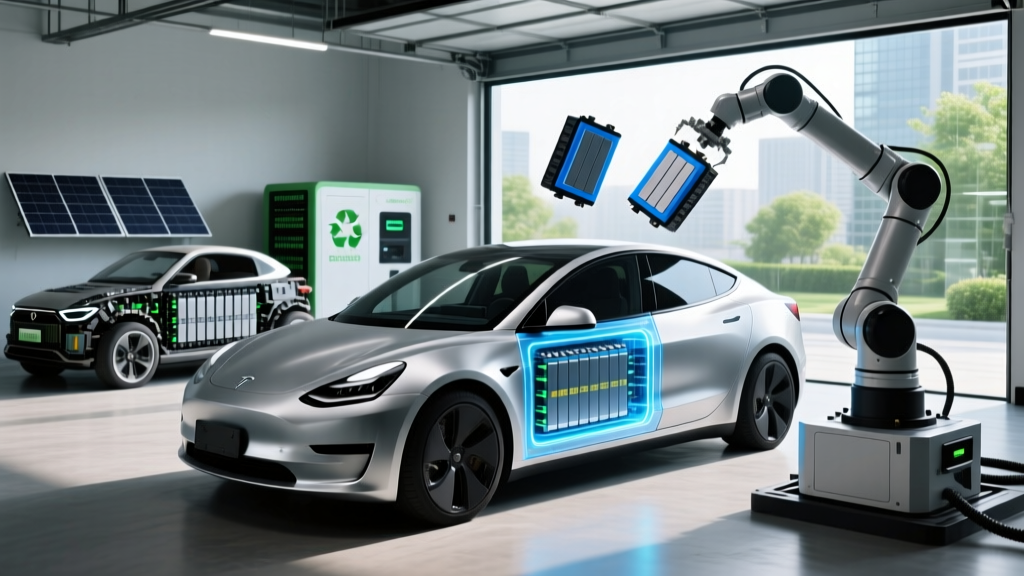
EV repowering solutions encompass battery module replacements, full pack swaps, drivetrain retrofits (converting ICE vehicles to electric), and second-life battery deployments. For most owners of aging EVs, repowering means replacing degraded battery modules or the entire pack to restore range — typically costing $5,000–$22,000 depending on chemistry, capacity, and labor. For fleet operators and conversion enthusiasts, repowering can mean dropping a salvaged EV drivetrain into a classic or commercial chassis. In 2026, factory battery replacements remain the most reliable path, while third-party module-level repairs and aftermarket retrofit kits are expanding rapidly.
Why EV Owners Are Exploring Repowering in 2026
The first generation of mass-market EVs — the 2013–2019 Nissan Leaf, BMW i3, early Chevrolet Spark EV, and first-gen Tesla Model S — are now 7 to 13 years old. Many have accumulated 80,000–150,000 miles, and their lithium-ion packs have degraded 15–35% from original capacity. A 2017 Leaf that originally delivered 107 EPA miles may now manage only 70–80 miles on a full charge.
Meanwhile, modern EVs like the 2026 Hyundai Ioniq 6 (361 EPA miles, 77.4 kWh NMC pack) or the Tesla Model 3 Long Range (363 EPA miles, ~75 kWh LFP/NMC) have reset expectations. Owners of older EVs face a choice: trade in at diminished resale value, or repower to extend the vehicle's useful life by another 5–8 years.
The economics have shifted in favor of repowering in specific scenarios:
- New EV prices remain elevated: The average transaction price for a new EV in early 2026 hovers around $48,000 (source: Kelley Blue Book), even after incentives.
- Battery costs have fallen: Pack-level pricing has dropped to roughly $120–$140/kWh at the cell level (BloombergNEF 2025 survey), translating to more affordable replacement pricing.
- Module-level repair is maturing: Specialist shops can now replace individual bad modules in packs like the Leaf's laminated cells or the Bolt's LG pouch cells for a fraction of a full-pack swap.
Types of EV Repowering Solutions
1. Factory Battery Pack Replacement
The most straightforward option. Dealerships or manufacturer-authorized service centers replace the entire high-voltage battery pack with a new or factory-refurbished unit.
| Vehicle | Pack Size | Approx. Replacement Cost (2026) | Warranty on New Pack |
|---|---|---|---|
| Nissan Leaf (40 kWh) | 40 kWh NMC | $8,500–$11,000 | 8 yr / 100,000 mi |
| Chevrolet Bolt EV | 65 kWh NMC | $14,000–$16,500 | 8 yr / 100,000 mi |
| Tesla Model S (90D era) | 90 kWh NCA | $16,000–$22,000 | 8 yr / 150,000 mi |
| BMW i3 (42.2 kWh) | 42.2 kWh NMC | $10,000–$14,000 | 8 yr / 80,000 mi |
Real-world caveat: These costs often include 2–4 hours of high-voltage labor at $150–$200/hour. Some older packs are being replaced with higher-capacity units (e.g., Nissan offering the 62 kWh "Plus" pack as a Leaf upgrade where compatible), effectively giving the car more range than when new.
2. Third-Party Module-Level Repair
Specialist EV shops (such as Electrified Garage, ReJoule-certified technicians, and regional high-voltage repair centers) diagnose individual weak or failed modules within a pack and replace only those cells. This is most viable for packs with accessible, discrete modules:
- Nissan Leaf: Laminated cell modules can be swapped individually. A 4–6 module repair runs $2,500–$5,000.
- Chevrolet Bolt: Post-recall, GM's replacement packs have well-documented module architecture. Individual module replacement: $3,000–$6,000.
- Tesla Model S/X (pre-2020): The pack is composed of 16 modules. Individual module replacement: $1,500–$3,000 per module, but labor-intensive access.
Limitation: Module-level repair works best when the rest of the pack is healthy. If overall degradation is uniform (all modules at ~75% State of Health), replacing a few won't restore meaningful range.
3. EV Retrofit Conversions (ICE-to-EV Repowering)
This involves removing an internal combustion engine, fuel tank, and exhaust system from a conventional vehicle and installing an electric motor, inverter, and battery pack. Companies like Electric GT, EV West, and Zero EV offer turnkey kits or components.
| Conversion Type | Typical Cost | Resulting Range | Best Candidates |
|---|---|---|---|
| Light-duty kit (DIY-oriented) | $12,000–$20,000 | 60–100 mi | VW Beetle, Porsche 914, lightweight classics |
| Professional full conversion | $30,000–$75,000+ | 120–200+ mi | Classic trucks, muscle cars, fleet vehicles |
| Commercial/fleet repower | $40,000–$90,000 | 100–180 mi | Step vans, delivery trucks, school buses |
Most retrofit kits in 2026 use salvaged Tesla Large Drive Units or NetGain Hyper9 motors paired with 30–70 kWh of repurposed or new LFP modules. Charging is typically limited to Level 2 (6.6–11 kW onboard) unless the builder integrates a DC fast-charge controller — which adds $3,000–$8,000 to the build.
4. Second-Life Battery Deployments
Packs retired from automotive service (typically at 70–80% State of Health) still hold enormous energy for stationary storage or lower-demand mobility applications. Companies like Redwood Materials, Cirba Solutions, and B2U Storage Solutions repurpose these packs for:
- Home energy storage (competing with Tesla Powerwall at lower per-kWh cost)
- Grid-scale frequency regulation
- Low-speed fleet vehicles and campus shuttles
For individual EV owners, second-life packs are occasionally available through salvage channels at 30–50% below new-pack pricing — but come with unknown cycle history and no factory warranty.
EV Repowering vs. Buying New: A Cost Comparison
| Factor | Repower Existing EV | Buy New 2026 EV |
|---|---|---|
| Upfront cost | $5,000–$22,000 (battery) or $15,000–$75,000 (retrofit) | $30,000–$65,000+ MSRP |
| Federal tax credit (§30D) | Not applicable to battery replacement; $4,000 cap on used EVs | Up to $7,500 if income/MSRP/sourcing rules met (see IRS §30D) |
| Remaining vehicle life | 5–10 more years (if chassis/body sound) | 15+ years expected |
| Warranty coverage | 1–8 years on new pack; none on rest of car | Full bumper-to-bumper + 8 yr battery |
| Tech/safety features | No upgrade (same ADAS, infotainment) | Latest SAE Level 2 systems, updated crash structures |
| Insurance impact | Minimal change | May increase (higher vehicle value) |
| Charging speed | Limited by original onboard charger/inverter | Modern 150–350 kW DC capability |
Real-World Ownership Considerations Before Repowering
Repowering isn't the right call for every aging EV owner. These factors determine whether it's a sound investment:
Home Charging Access
If you have reliable Level 2 home charging (a 240V/40A circuit delivering ~9.6 kW), a repowered EV with 100+ miles of restored range covers most daily driving without ever visiting a public charger. Without home charging, the calculus shifts — you'll rely on public DC fast charging, and older EV architectures (like the Leaf's CHAdeMO or early CCS1 implementations) charge painfully slowly by 2026 standards. A Leaf peaks at ~50 kW (10–80% in ~60 minutes), while a 2026 Ioniq 5 hits 240 kW (10–80% in ~18 minutes).
Climate and Degradation Trajectory
Hot climates (Arizona, Texas, Southern California) accelerated degradation in early passively-cooled packs like the Leaf's. If you live in these regions and repower with a new NMC pack, expect similar thermal stress unless the replacement includes active liquid cooling. LFP replacement packs (where available) tolerate heat better and can be charged to 100% daily without the same degradation penalty — a practical advantage for hot-climate repowers.
Driving Patterns
If your daily round trip is under 60 miles and you charge at home, even a moderately degraded pack (70% SoH on a 150-mile original range = ~105 miles) may still serve you adequately. Repowering makes the most financial sense when:
- Degradation has pushed range below your daily needs
- The vehicle is otherwise in excellent mechanical/structural condition
- You plan to keep the vehicle 4+ more years to amortize the repower cost
EV Repowering vs. Gas Car Replacement: The Economics
| Metric | Repowered 2017 Leaf (40 kWh restored) | 2026 Toyota Corolla LE (Gas) | 2026 Chevrolet Equinox EV LT |
|---|---|---|---|
| Acquisition/repair cost | ~$9,500 (battery swap on owned car) | ~$24,500 MSRP | ~$34,900 MSRP |
| Fuel/energy cost per mile | $0.04–$0.06 (home L2 at $0.14/kWh) | $0.12–$0.15 (at 32 MPG, $3.80/gal) | $0.04–$0.06 |
| Annual maintenance | $300–$500 | $800–$1,200 | $300–$500 |
| Annual fuel/energy (12,000 mi) | $480–$720 | $1,440–$1,800 | $480–$720 |
| 5-year operating cost (fuel + maint.) | $3,900–$6,100 | $11,200–$15,000 | $3,900–$6,100 |
| EPA range / MPG | ~107 mi (restored) | 35 MPG combined | 319 mi EPA |
Source: Efficiency figures from fueleconomy.gov; electricity at national average $0.16/kWh.
The repowered Leaf wins on pure cost-per-mile if the rest of the car holds up. But the Equinox EV delivers 3x the range, modern safety tech, DC fast charging at 150+ kW, and a full warranty — for a higher upfront outlay partially offset by the §30D credit.
Common Misconceptions About EV Repowering
| Myth | Fact |
|---|---|
| "EV batteries all die at 100,000 miles and cost $30,000 to replace." | Most modern liquid-cooled NMC and LFP packs retain 80–90% capacity at 150,000 miles. Replacement costs for common packs range $8,500–$22,000 in 2026 — high, but not catastrophic. |
| "You can't replace just part of an EV battery." | Module-level repair is well-established for Leaf, Bolt, and Tesla Model S/X packs. Individual module swaps cost $1,500–$6,000 depending on accessibility. |
| "Any mechanic can do an EV battery swap." | High-voltage work (400V–800V systems) requires specific training, insulated tools, and safety protocols. Only certified EV technicians should perform pack work. Improper handling risks arc flash and lethal shock. |
| "A repowered EV will charge faster." | Charging speed is limited by the vehicle's onboard charger (AC) and BMS/charge controller (DC). A new battery restores capacity, not charge rate — unless the repower includes upgraded power electronics. |
| "EV retrofits are plug-and-play." | ICE-to-EV conversions require custom fabrication, high-voltage safety integration, DOT compliance considerations, and often result in vehicles that cannot be crash-certified to modern standards. |
Decision Framework: Should You Repower, Replace, or Keep Driving?
Choose to repower (battery replacement) if:
- Your EV's body, suspension, and interior are in good condition
- You have home Level 2 charging
- Your daily driving is under 80 miles round-trip
- The repower cost is under 40% of a comparable new EV's after-incentive price
- You plan to keep the car 4+ more years
Choose to buy new if:
- Your current EV lacks modern safety features (AEB, lane-keep, blind-spot) you now consider essential
- You need 250+ miles of range for road trips or longer commutes
- You want DC fast charging above 100 kW for practical road-trip use
- Your current EV's motor, suspension, or body are also showing age
- You qualify for the full $7,500 §30D credit, narrowing the price gap
Choose to keep driving (no repower yet) if:
- Your degraded range still covers your daily needs with a 20% buffer
- You're within the 8-year/100,000-mile battery warranty window and can claim a warranty replacement
- You plan to sell or trade within 18 months
Tax Credits, Incentives, and Warranty Notes for 2026
Under current IRS §30D rules, battery replacements on existing EVs do not qualify for the new clean vehicle credit. However:
- If you purchase a used EV (including one that's been repowered by a dealer), the §25E used clean vehicle credit may apply — up to $4,000 or 30% of the sale price (whichever is lower), subject to income caps ($75K single / $150K joint) and a vehicle price cap of $25,000.
- Some states (California's CVRP, Colorado's innovative motor vehicle credits, New York's Drive Clean Rebate) offer additional rebates that may partially apply to battery replacements — check your state energy office for current programs.
- Federally mandated battery warranty remains 8 years / 100,000 miles (10 years / 150,000 miles in California and states adopting CARB standards) with a minimum 70% capacity retention threshold. If your pack drops below this within the warranty window, replacement is covered at no cost.
Frequently Asked Questions
How long does an EV battery replacement take?
Most factory pack swaps take 3–6 hours of shop time. However, parts availability can add 1–4 weeks of waiting, especially for older models where new packs must be special-ordered. Third-party module repairs may be completed in 1–2 days if modules are in stock.
Can I upgrade to a larger battery when repowering?
In some cases, yes. Nissan Leaf owners have successfully upgraded from 24 kWh to 40 kWh or even 62 kWh packs using compatible BMS configurations. Tesla owners have swapped older 85 kWh packs for 100 kWh units. However, compatibility depends on physical dimensions, BMS software, cooling system capacity, and high-voltage contactor ratings. Always confirm with the installer that the upgrade path is validated for your specific model year.
Is an EV retrofit conversion street-legal?
Yes, in most states, provided the conversion meets your state's DMV inspection requirements for modified vehicles. Some states (California notably) require a BAR (Bureau of Automotive Repair) inspection for converted vehicles to receive a smog-exempt designation. Insurance can be more challenging — specialty insurers like Hagerty or American Modern are more accommodating of converted vehicles than standard carriers.
What happens to the old battery pack?
Responsible shops and dealerships route removed packs to recycling or second-life programs. Redwood Materials and Li-Cycle recover 90%+ of critical minerals (lithium, cobalt, nickel) from spent packs. If you're doing a private repower, expect a $200–$500 core charge refund when returning the old pack, or arrange recycling through a certified handler. Under no circumstances should a high-voltage pack go to a standard landfill.
Does repowering affect my EV's resale value?
A documented battery replacement with a transferable warranty generally improves resale value compared to selling with a degraded pack. Buyers of older EVs specifically look for battery State of Health data. A fresh pack with a 5+ year warranty can add $3,000–$7,000 to resale value versus an equivalent vehicle with an original degraded pack. Keep all service records and request a post-replacement SoH report.
Can I use an LFP battery to repower my older NMC-based EV?
Technically possible in some retrofit scenarios, but challenging as a drop-in replacement. LFP cells have different voltage curves (3.2V nominal vs. NMC's 3.7V), requiring different BMS calibration, charge profiles, and potentially different contactors and fusing. Some third-party shops are developing LFP replacement packs for popular models like the Leaf, but as of 2026 these remain limited in availability. The advantage — LFP tolerates 100% daily charging and offers 3,000+ cycle life — is compelling for high-mileage drivers.
Where to Find Qualified EV Repower Services
Not all shops are equipped for high-voltage work. When seeking repower services, look for:
- OEM-authorized service centers for factory pack replacements (Nissan, GM, Tesla, BMW dealers with EV-certified technicians)
- Independent EV specialists with documented high-voltage safety certifications (ASE xEV High Voltage Safety, or manufacturer-specific training)
- Retrofit shops with a portfolio of completed, street-registered conversions — ask for references and insurance documentation
- Community resources: Forums like SpeakEV, InsideEVs Forum, and model-specific owner groups (Tesla Motors Club, My Nissan Leaf) maintain vetted lists of repower-capable shops by region
Always request a written diagnostic report (including individual module voltage spread, isolation resistance test, and State of Health percentage) before committing to any repower work. A reputable shop will provide this for a $150–$300 diagnostic fee, which is typically credited toward the repair if you proceed.