The Short Answer: California's EV Registration Fee
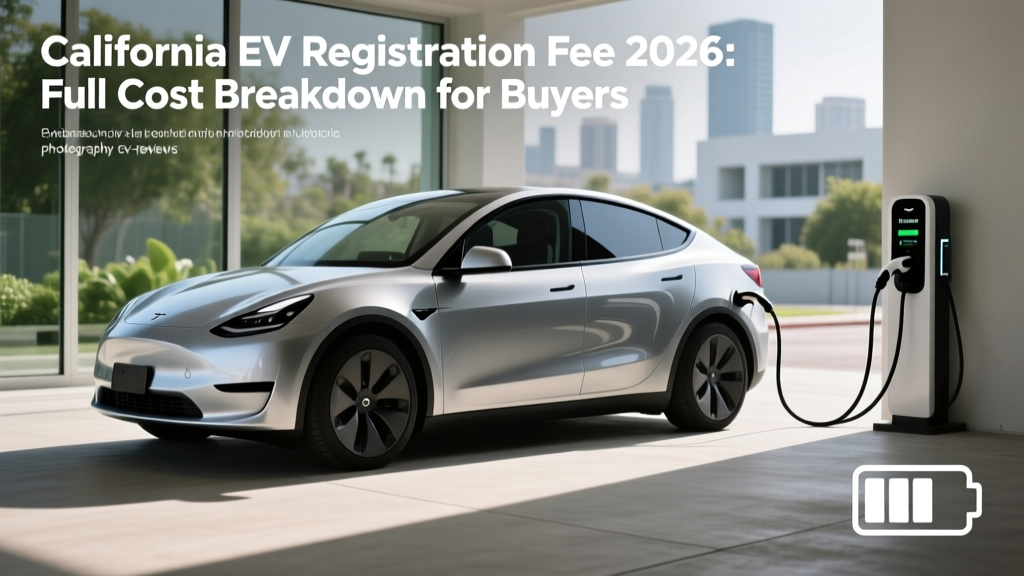
Starting with your initial registration and every renewal after, California charges battery-electric vehicle (BEV) owners an additional $100 annual EV registration fee on top of standard DMV charges. This fee was established under the Road Repair and Accountability Act of 2017 (SB 1) to offset the gas-tax revenue that EVs don't contribute. For a typical new EV like the 2026 Tesla Model Y or Hyundai Ioniq 5, expect your total first-year DMV registration to land between $400 and $700 depending on vehicle value, weight, and county. Plug-in hybrids (PHEVs) pay a reduced additional fee based on their electric-only range.
If you're shopping for an electric vehicle in California, the sticker price and federal tax credit get most of the attention. But registration costs, insurance premiums, and the state's evolving fee structure can shift your total cost of ownership in ways that aren't obvious at the dealership. This guide breaks down exactly what California EV owners pay at the DMV, how those costs compare to registering a gas car, and whether the math still favors going electric when every fee is on the table.
Breaking Down California EV Registration Costs
California's DMV registration isn't a single line item — it's a stack of fees that apply differently depending on whether your car runs on electrons or gasoline. Here's what a BEV owner in California actually pays:
| Fee Component | Battery EV (e.g., 2026 Tesla Model Y, $46,630 MSRP) | Comparable Gas Car (e.g., 2026 Toyota RAV4, $31,000 MSRP) |
|---|---|---|
| Registration fee (base) | $60 | $60 |
| Vehicle License Fee (VLF, ~0.65% of value) | ~$303 | ~$202 |
| Weight fee | $40–$80 (EVs are heavier) | $26–$50 |
| County/district fees | $10–$35 | $10–$35 |
| Additional EV fee (SB 1) | $100 | $0 |
| Smog/inspection | $0 (exempt) | $30–$70 (if required) |
| Estimated total annual | $513–$658 | $328–$417 |
The Vehicle License Fee (VLF) is where EV owners feel the biggest sting. California assesses VLF at 0.65% of the vehicle's depreciated value. Because EVs still command higher MSRPs on average, the VLF hits harder. A $46,630 Tesla Model Y generates roughly $303 in VLF in its first year, while a $31,000 RAV4 generates about $202. That $100 gap — plus the dedicated EV fee — means you'll pay roughly $150–$250 more per year to register an EV than a comparably sized gas car.
California's DMV provides a fee calculator so you can plug in your exact vehicle details before purchase.
Why California Charges EVs Extra
California funds road maintenance primarily through the gasoline excise tax — currently about 57.5 cents per gallon (including state and federal portions). Every time a gas car fills up, it contributes to highway repair. EVs skip that entirely.
The Road Repair and Accountability Act of 2017 (SB 1) introduced the $100 annual EV fee specifically to close this gap. The logic: an average gas car burning 500 gallons per year at ~18 cents state excise contributes roughly $90 in fuel taxes. The $100 EV fee is designed to approximate that contribution.
For plug-in hybrids, the calculation is more nuanced. PHEVs still burn gas part of the time, so they pay a reduced additional registration fee that scales with their electric-only range. A 2026 Toyota RAV4 Prime with 42 miles of EV range, for instance, pays a smaller surcharge than a pure BEV because it still generates some gas-tax revenue.
Total Cost of Ownership: EV vs. Gas in California
Registration is one line item. The bigger question is whether the EV's higher registration cost gets overwhelmed by savings elsewhere. Let's run a 5-year comparison using a 2026 Tesla Model Y Long Range (AWD, 310 miles EPA, $46,630 base MSRP) against a 2026 Toyota RAV4 AWD (30 MPG combined, $31,000 base MSRP), driven 12,000 miles per year in the Los Angeles area.
| Category | Tesla Model Y LR (BEV) | Toyota RAV4 AWD (Gas) |
|---|---|---|
| Purchase price (MSRP) | $46,630 | $31,000 |
| Federal §30D tax credit (if eligible) | –$7,500 | $0 |
| Effective purchase price | $39,130 | $31,000 |
| 5-year registration (est.) | $2,800 | $1,850 |
| 5-year fuel/energy (CA avg. $0.28/kWh home, $4.40/gal gas) | $4,700 | $8,800 |
| 5-year maintenance (est.) | $1,500 | $3,200 |
| 5-year insurance (est. avg.) | $9,500 | $7,200 |
| 5-year total (excl. depreciation) | $57,630 | $52,050 |
| Estimated 5-year depreciation | $18,000 | $14,000 |
| 5-year total cost of ownership | ~$75,630 | ~$66,050 |
A few realities emerge from this comparison:
- Energy savings are massive: The Model Y saves roughly $4,100 over five years on fuel alone, assuming predominantly home Level 2 charging at California's average residential rate of ~$0.28/kWh. Public DC fast charging at $0.40–$0.55/kWh narrows that gap.
- Maintenance favors EVs: No oil changes, no transmission fluid, no spark plugs, and regenerative braking extends pad life. Expect to spend roughly half on maintenance over five years.
- Insurance costs more for EVs: Higher repair costs, specialized parts, and battery replacement risk push EV insurance premiums 15–30% above gas equivalents. Shop quotes before buying.
- Registration is a modest gap: The ~$950 five-year registration premium for the EV is real but gets swallowed by fuel savings in year two.
California EV Registration Myths vs. Facts
There's persistent confusion about what California charges EV owners and why. Let's clear up the most common misconceptions:
| Myth | Fact |
|---|---|
| "California charges EVs a special $1,000 registration fee." | The additional EV fee is $100 per year, not $1,000. Total registration typically runs $400–$700 for a new EV. |
| "The EV fee applies to hybrids too." | Standard hybrids (HEVs like the Prius) pay no additional EV fee. Only BEVs and PHEVs do, and PHEVs pay a reduced amount. |
| "I won't pay the EV fee if I get the $7,500 federal credit." | Federal tax credits and state DMV fees are entirely separate. You still owe the $100 EV fee regardless of §30D eligibility. |
| "EVs pay more registration because they're heavier." | Weight fees do cost slightly more (EVs are 500–1,000 lbs heavier on average), but the $100 EV fee is a separate legislative charge, not weight-based. |
| "I can avoid the EV fee by registering out of state." | California requires you to register where you reside. Out-of-state registration while living in CA is illegal and risks penalties. |
Federal Tax Credit and California Incentives: What Offsets Registration
While the $100 EV fee adds cost, California remains one of the best states to buy electric thanks to layered incentives:
- Federal §30D Clean Vehicle Credit: Up to $7,500 for qualifying new EVs, subject to MSRP caps ($55,000 for sedans, $80,000 for SUVs/trucks), buyer income limits ($150K single / $300K joint), and battery critical-mineral sourcing requirements. As of 2026, the credit can be transferred to the dealer at point of sale, reducing your purchase price directly. Always verify current eligibility on IRS.gov — sourcing rules tighten annually.
- Clean Air Rebate (CVRP): California's Clean Vehicle Rebate Project has evolved into the California Energy Commission's point-of-sale programs, offering up to $7,000 for income-qualified buyers in disadvantaged communities. Check current availability before relying on it.
- CARP and utility rebates: Many California utilities (PG&E, SCE, SDG&E) offer $500–$1,500 rebates for home Level 2 charger installation, plus time-of-use rate plans that can cut charging costs by 30–50%.
- HOV lane access: California's Clean Air Vehicle decals grant solo carpool-lane access for qualifying EVs — a significant commute-time benefit in metro areas. Decals have income and vehicle-price caps and expire after a set period.
Combined, these incentives can erase the purchase-price gap between an EV and a gas car — and the fuel savings continue compounding every year you own the vehicle.
Real-World Ownership: What First-Time California EV Buyers Should Know
Registration fees are predictable. The variables that actually determine whether an EV works in your life are more personal:
Home Charging Access
If you can install a Level 2 charger (240V, 32–48 amps) at home, you'll do 85–95% of your charging there at roughly $0.20–$0.35/kWh depending on your utility's time-of-use plan. A typical home install runs $800–$2,500 including the charger and electrician labor, with a possible panel upgrade adding $1,500–$3,000 if you're on a 100-amp service. Renters and apartment dwellers face a harder calculus — public DC fast charging at $0.40–$0.55/kWh significantly narrows the fuel-cost advantage over gas.
Driving Patterns and Range Reality
EPA range ratings assume moderate temperatures and mixed driving. In real-world California conditions:
- Highway driving at 75+ mph: Expect 10–15% range reduction vs. EPA. A 310-mile Model Y delivers roughly 265–280 miles at sustained freeway speeds.
- Mountain passes (I-5 Grapevine, Hwy 395): Elevation gain consumes energy aggressively, but regen on descents recovers 30–50% of that.
- Cold weather (Lake Tahoe, Mammoth): Battery chemistry loses 15–30% range below freezing. If you ski regularly, spec for 20% more range than you think you need.
- Urban commuting (LA, SF): Stop-and-go traffic actually helps EV range thanks to regenerative braking. Expect near-EPA or even better figures.
Charging Infrastructure
California leads the nation in public charging stations, with the Tesla Supercharger network (now open to NACS-equipped non-Tesla EVs) and growing Electrify America, EVgo, and ChargePoint networks using CCS or NACS connectors. For road trips along I-5, US-101, or I-10, DC fast chargers are plentiful. Rural routes (Hwy 395, parts of the Eastern Sierras) still have gaps — plan accordingly.
Decision Framework: Should the Registration Fee Influence Your EV Purchase?
Choose an EV if:
- You have home charging access (garage, driveway, or landlord-approved outlet)
- Your daily commute is under 80 miles round-trip (covers 90%+ of California drivers)
- You drive 10,000+ miles per year (fuel savings compound faster, offsetting registration and insurance premiums)
- You qualify for the §30D credit (income under $150K single / $300K joint, vehicle under MSRP cap)
- You value HOV lane access and reduced maintenance
Choose a PHEV (plug-in hybrid) if:
- You can charge at home but regularly drive 200+ miles in a day (road trips, mountain cabins)
- You want EV commuting with gas-car range flexibility
- Your budget is under $40,000 and you want lower registration and insurance costs
- Example: 2026 Toyota RAV4 Prime — 42 miles EV range, 38 MPG combined after battery depletes, ~$45,000 MSRP
Stick with a gas car or standard hybrid if:
- You have no viable home or workplace charging option
- You drive fewer than 6,000 miles per year (fuel savings won't offset the purchase premium)
- Your budget is tight and the EV price premium after incentives still exceeds $8,000
The $100 annual EV registration fee is a real cost, but in context it's roughly $8.33 per month — less than a single gallon of premium gasoline. For most California drivers, the fuel and maintenance savings from going electric dwarf this fee within the first year of ownership. The bigger financial variables to model are your insurance quote, your home charging installation cost, and whether you actually qualify for the federal tax credit under current sourcing rules.
Frequently Asked Questions
Do I pay the $100 EV fee if I buy a used electric vehicle in California?
Yes. The $100 additional EV registration fee applies to all battery-electric vehicles registered in California, new or used. It's assessed at initial registration and at every annual renewal.
Are Tesla vehicles exempt from the California EV registration fee?
No. All BEVs — Tesla, Ford, Hyundai, Rivian, or otherwise — pay the same $100 annual EV fee. The fee is based on powertrain type, not brand.
How much does a PHEV pay in additional EV fees in California?
PHEV fees are lower than BEV fees and scale with the vehicle's electric-only range. The exact amount varies; check the DMV's fee calculator for your specific model. A high-range PHEV like the RAV4 Prime (42 mi EV) will pay more than a short-range PHEV.
Will California's EV registration fee increase in the future?
Legislation has been proposed periodically to adjust the EV fee upward as more EVs hit the road and gas-tax revenue declines further. As of 2026, the fee remains $100 for BEVs, but this is a line item to watch in future state budget sessions.
Can I deduct the EV registration fee on my taxes?
The Vehicle License Fee portion of your California registration (not the $100 EV fee specifically) may be deductible as a personal property tax on your federal Schedule A if you itemize. Consult a tax professional for your specific situation.
Does the EV fee apply to electric motorcycles or e-bikes?
No. The $100 SB 1 fee applies to four-wheeled zero-emission vehicles required to register with the DMV as passenger or commercial vehicles. Electric motorcycles have their own fee structure, and e-bikes don't require DMV registration.