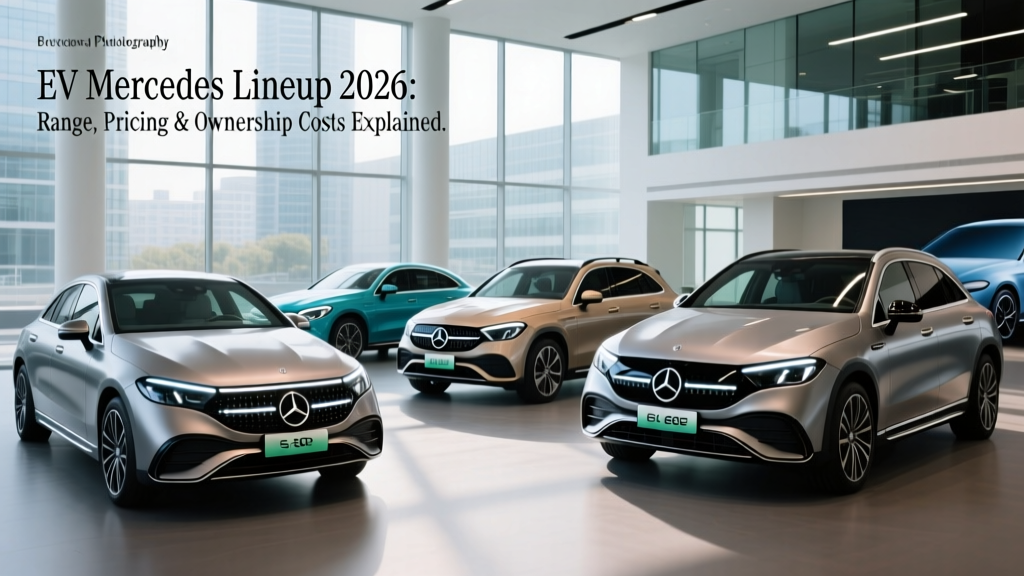
Quick Answer: The 2026 Mercedes-Benz EV lineup spans three core models: the EQB (compact SUV, 245 mi EPA, ~$54,000), the EQE Sedan/SUV (midsize, 287–303 mi EPA, ~$75,000–$87,000), and the EQS Sedan/SUV (flagship, 330–390 mi EPA, ~$105,000–$128,000). None currently qualify for the full $7,500 federal §30D tax credit due to battery-sourcing rules, though point-of-sale lease credits may apply. Expect real-world highway range 15–25% below EPA stickers and DC fast-charging peaks of 170–200 kW (10–80% in 28–32 minutes). Total 5-year ownership can undercut equivalent gas Mercedes models by $8,000–$15,000 if you charge primarily at home.
The 2026 Mercedes-Benz EV Lineup at a Glance
Mercedes-Benz has consolidated its electric portfolio around the dedicated EVA platform (EQE, EQS) and the adapted MFA2 platform (EQB). The earlier EQC has been discontinued in the U.S. market, and the upcoming MMA-based CLA EV remains in pre-production. Here is what you can actually buy today.
| Model | Battery (kWh usable) | EPA Range | Peak DC Charge | 10–80% Time | 0–60 mph | Base MSRP |
|---|---|---|---|---|---|---|
| EQB 300 4MATIC | 66.5 (NMC) | 245 mi | 100 kW | ~32 min | 7.7 sec | $54,200 |
| EQE 350+ Sedan | 90.6 (NMC) | 303 mi | 170 kW | ~32 min | 6.2 sec | $75,050 |
| EQE 350 4MATIC SUV | 90.6 (NMC) | 279 mi | 170 kW | ~32 min | 6.4 sec | $78,050 |
| EQS 450+ Sedan | 118.0 (NMC) | 390 mi | 200 kW | ~31 min | 5.9 sec | $105,550 |
| EQS 450 4MATIC SUV | 118.0 (NMC) | 330 mi | 200 kW | ~31 min | 5.7 sec | $108,550 |
Sources: fueleconomy.gov, Mercedes-Benz USA press specifications. MSRP excludes $1,150 destination. All figures for 2025/2026 model years as currently listed.
Real-World Range: What the EPA Sticker Doesn't Tell You
EPA vs. Reality: The EQS 450+ Sedan's 390-mile EPA rating is class-leading, but real-world highway driving at 70–75 mph typically yields 300–330 miles in mild weather. In cold conditions (below 32°F), expect a further 20–30% reduction, dropping effective range to 230–270 miles before needing a charge. The EQE Sedan's 303-mile EPA figure translates to roughly 240–260 miles on the highway in temperate weather.
Mercedes uses NMC (nickel manganese cobalt) chemistry across the lineup, which offers high energy density but is more temperature-sensitive than LFP. The EQS and EQE feature standard heat pumps, which recover waste heat from the drivetrain to warm the cabin — this reduces cold-weather range loss compared to resistive heating, but does not eliminate it.
The EQB, built on a modified ICE platform, lacks a heat pump in U.S.-spec models. Owners in northern climates report 30–35% range loss in sustained sub-freezing driving, making its 245-mile EPA range feel closer to 160–180 miles in January conditions. If you live in Minnesota or Maine, the EQB requires careful trip planning; the EQS and EQE handle cold far more gracefully.
Charging Speed and the Curve Reality
Mercedes quotes peak DC fast-charge rates, but sustained speed is what matters on a road trip. Here is what actually happens at the charger:
| Charging Level | Power (kW) | EQB Miles/Hr | EQE Miles/Hr | EQS Miles/Hr |
|---|---|---|---|---|
| Level 1 (120V household) | ~1.4 kW | ~4 mi/hr | ~5 mi/hr | ~6 mi/hr |
| Level 2 (240V, 48A home) | 11.5 kW | ~33 mi/hr | ~40 mi/hr | ~48 mi/hr |
| DC Fast (peak) | 100–200 kW | ~200 mi/hr* | ~340 mi/hr* | ~400 mi/hr* |
*Peak rate, sustained for roughly 10–20% of the session. Average rate across a 10–80% session is typically 60–75% of peak due to charge-curve taper above 50% SoC.
The EQS and EQE accept up to 200 kW and 170 kW respectively on CCS1 connectors. At a 350 kW Electrify America station, the EQS will ramp to ~195 kW between 10–30% SoC, then step down progressively: ~140 kW by 50%, ~90 kW by 70%, and ~50 kW by 85%. This means the advertised 31-minute 10–80% time holds only at stations capable of delivering sustained high power. On older 150 kW chargers, expect 38–45 minutes.
The EQB's 100 kW peak is a clear limitation for road trips. A 10–80% session takes roughly 32 minutes at a capable station, but the smaller battery means you stop more often. On a 500-mile trip, EQB drivers typically need two charging stops versus one in an EQS.
Connector note: All current U.S. Mercedes EVs use the CCS1 (J1772 Combo) connector. Mercedes has announced NACS adoption for future models, but 2026 vehicles ship with CCS. Tesla Supercharger access requires a CCS-to-NACS adapter (included with some models; ~$200 aftermarket).
EV Mercedes vs. Gas Equivalent: 5-Year Cost Breakdown
Luxury EV buyers often assume electric means more expensive. The math tells a different story — if you can charge at home. Here is a five-year comparison between the EQE 350+ Sedan and its closest gas counterpart, the E 350 Sedan (255 hp, 25 mpg combined).
| Cost Category | EQE 350+ Sedan (EV) | E 350 Sedan (Gas) | 5-Year Difference |
|---|---|---|---|
| Purchase Price (MSRP) | $75,050 | $62,550 | +$12,500 (EV) |
| Federal Tax Credit (§30D) | $0–$7,500* | $0 | Up to −$7,500 (EV) |
| Fuel/Energy (15,000 mi/yr) | $3,375 ($0.13/kWh home) | $10,500 ($3.50/gal, 25 mpg) | −$7,125/yr (EV) |
| Maintenance (5 yr) | ~$1,800 | ~$4,500 | −$2,700 (EV) |
| Insurance (5 yr avg) | ~$14,500 | ~$12,000 | +$2,500 (EV) |
| Total 5-Year Cost | ~$94,725 | ~$89,550 | +$5,175 (EV) |
*The EQE does not currently qualify for the $7,500 §30D purchase credit due to battery critical-mineral sourcing requirements (IRS §30D rules). However, leasing through Mercedes-Benz Financial may pass through the $7,500 commercial clean-vehicle credit (§45W) as a capitalized-cost reduction — ask the dealer specifically about lease credit pass-through.
The EV breaks even around year 4–5 when home charging dominates. If you rely on public DC fast charging at $0.40–$0.55/kWh, energy costs roughly double to ~$6,750 over five years, and the gas car retains a cost advantage. This is the single biggest variable in EV ownership economics.
Tax Credits, Incentives, and the Fine Print
The federal §30D new clean vehicle credit offers up to $7,500, split between a $3,750 critical-minerals component and a $3,750 battery-components component. For 2026, the rules require:
- MSRP cap: Vans/SUVs/pickups ≤ $80,000; sedans/other ≤ $55,000 (the EQS Sedan exceeds this; EQE Sedan exceeds this; EQB SUV meets the cap)
- Buyer income cap: AGI ≤ $300,000 (joint), $225,000 (head of household), $150,000 (single)
- Battery sourcing: Critical minerals and battery components must meet escalating domestic/free-trade-partner thresholds — most Mercedes EVs currently fail one or both tests
- Point-of-sale transfer: Eligible buyers can apply the credit as an immediate down-payment reduction at the dealership
As of early 2026, the EQB 300 4MATIC (MSRP $54,200, SUV cap $80,000) has the best shot at partial credit eligibility, but battery-sourcing compliance remains uncertain. Always verify current eligibility on fueleconomy.gov's tax credit page before purchasing, as the IRS updates the qualified-vehicle list periodically.
State incentives can fill the gap: California's CVRP offers up to $7,000 for income-qualified buyers, Colorado offers a $5,000 state credit, and several states have utility rebates of $500–$1,500 for home charger installation. Check your state and utility directly — these programs change annually.
Home Charging: The Make-or-Break Factor
Mercedes EV owners who charge at home report 85–90% lower "fuel" costs and minimal public-charging hassle. But home charging requires infrastructure:
| Item | Cost Range | Notes |
|---|---|---|
| Level 2 charger (Mercedes Wallbox or ChargePoint Home Flex) | $500–$750 | 48A, NEMA 14-50 or hardwired |
| Electrician: 240V/50A circuit run | $800–$2,500 | Depends on panel proximity |
| Electrical panel upgrade (if needed) | $1,500–$3,500 | Required if panel is ≤150A and heavily loaded |
| Permit and inspection | $100–$300 | Varies by municipality |
| Total typical install | $1,400–$3,500 | Without panel upgrade; $3,000–$7,000 with |
The EQS's 118 kWh battery fills from 20–80% overnight on a 48A Level 2 charger in roughly 7 hours — perfect for an 8-hour sleep cycle. The EQE takes about 5.5 hours. The EQB takes about 4 hours. All three can be fully replenished overnight for daily commuting.
If you cannot charge at home (apartment, street parking, condo restrictions), an EV Mercedes is still viable but more expensive and less convenient. You will rely on public Level 2 and DC fast charging, paying 3–5× the per-kWh cost of home electricity. Factor in 20–40 minutes of weekly charging time. Many urban Mercedes buyers in this situation opt for the EQS's larger battery to minimize stop frequency.
Common Misconceptions About Mercedes EVs
| Myth | Fact |
|---|---|
| "Mercedes EVs get full $7,500 tax credit" | Most do not qualify for the purchase credit due to battery-sourcing rules. Lease structures may pass through a commercial credit. |
| "The EQS charges at 350 kW" | The EQS peaks at 200 kW. It can plug into a 350 kW station but will not draw more than its onboard limit. |
| "EV batteries need replacement at 100,000 miles" | Mercedes warranties the traction battery for 10 years/155,000 miles at ≥70% capacity. Real-world NMC degradation data shows ~10–12% loss at 100,000 miles with proper charging habits. |
| "Driving assist means self-driving" | Mercedes Drive Pilot is SAE Level 2 on U.S. roads — you must remain engaged, hands near the wheel. Only limited Level 3 approval exists in Nevada for specific highway conditions below 40 mph. |
| "All Mercedes EVs are the same platform" | The EQB uses a modified ICE platform (MFA2) with packaging compromises; the EQE and EQS use the dedicated EVA platform with flat floor, better efficiency, and faster charging. |
Decision Framework: Which Mercedes EV Fits Your Situation?
Choose the EQB if: You want a compact luxury EV SUV under $60K, drive under 200 miles/day, have home charging, and live in a mild climate. Best for: urban couples, second-car duty, budget-conscious luxury buyers.
Choose the EQE Sedan/SUV if: You want the core Mercedes EV experience — 280+ real-world miles, fast Level 2 charging, premium interior, and midsize practicality. Best for: daily commuters with 40–80 mile round trips, families needing rear-seat space, road-trippers willing to plan one charging stop per 250 miles.
Choose the EQS Sedan if: Maximum range is your top priority, you regularly drive 300+ miles between charges, and budget is flexible. The 390-mile EPA rating is the highest of any Mercedes EV. Best for: long-distance commuters, executive use, cold-climate buyers who need buffer.
Choose the EQS SUV if: You need three-row seating (optional), cargo space, and all-weather capability with 330 miles of range. Best for: families of 5–7, ski-trip duty, buyers who want flagship tech in a practical package.
Consider a gas or hybrid Mercedes instead if: You lack reliable home charging, regularly tow over 3,500 lbs, or drive routes with sparse charging infrastructure (rural West, remote mountain corridors). The E 350 or GLE 450h PHEV may serve you better until infrastructure catches up.
What First-Time Mercedes EV Buyers Should Know
Before signing, verify these five items:
- Home charging feasibility: Confirm your electrical panel can support a 50A/240V circuit. Get a quote from a licensed electrician before purchase — not after.
- Lease vs. buy credit structure: Ask the dealer whether the $7,500 commercial credit (§45W) is being passed through as a cap-cost reduction on leases. This is often the only way to capture federal incentive value on a Mercedes EV.
- Realistic range for your commute: Take your one-way commute distance, double it, add 30% for detours/climate, and confirm the model covers it with 50+ miles of buffer. If your round trip is 160 miles, you need at least 210 miles of real-world range — the EQB barely qualifies in winter; the EQE and EQS handle it easily.
- Insurance quotes: EV Mercedes models carry 10–25% higher insurance premiums than gas equivalents due to repair costs and battery replacement exposure. Get a quote before committing.
- Charging network access: Download the Mercedes me app and test the built-in route planner on your most common long trip. Confirm that CCS chargers exist at reasonable intervals along your route.
Frequently Asked Questions
Does any Mercedes EV qualify for the $7,500 federal tax credit in 2026?
As of early 2026, most Mercedes EVs do not qualify for the §30D purchase credit due to battery-critical-mineral and component-sourcing requirements. The EQB (MSRP under the $80,000 SUV cap) has the best theoretical eligibility, but sourcing compliance must be verified on fueleconomy.gov at the time of purchase. Leasing may unlock the commercial credit (§45W) passed through by Mercedes-Benz Financial.
How long does it take to charge a Mercedes EQS at home?
From 20% to 80% on a 48A Level 2 home charger (11.5 kW), the EQS takes approximately 7 hours. A full 0–100% charge takes roughly 11 hours. Most owners charge between 20–80% to preserve long-term battery health, which aligns well with an overnight charging window.
What is the real-world highway range of the EQE 350+ Sedan?
The EQE 350+ has a 303-mile EPA rating. In real-world highway driving at 70–75 mph in 60–80°F weather, expect approximately 240–260 miles. In cold weather (below 32°F), expect 200–220 miles. Preconditioning the battery while plugged in recovers some efficiency.
Is the Mercedes EQB a dedicated EV platform?
No. The EQB is built on Mercedes' MFA2 platform, which is shared with the GLB gas model. This means the battery is packaged in a modified floor rather than a dedicated skateboard, resulting in slightly less interior space efficiency, a higher floor, and slower peak charging (100 kW vs. 170–200 kW on the EVA-platform EQE/EQS).
What is the battery warranty on Mercedes EVs?
Mercedes-Benz warranties the high-voltage traction battery for 10 years or 155,000 miles (whichever comes first) against capacity loss below 70% of original. If the battery degrades below this threshold within the warranty period, Mercedes will repair or replace modules to restore capacity above 70%. Out-of-warranty battery replacement costs are estimated at $15,000–$25,000 depending on the model and extent of module replacement needed.
Can I use Tesla Superchargers with a Mercedes EV?
Current Mercedes EVs use the CCS1 connector. Tesla has opened portions of its Supercharger network to non-Tesla vehicles via the built-in Magic Dock adapter at select stations, or you can purchase a CCS-to-NACS adapter (~$200–$250). Coverage is expanding but not universal — check the Tesla app for adapter-compatible stations on your routes.