EV Meaning: The Short Answer
EV stands for Electric Vehicle — any vehicle propelled by one or more electric motors using energy stored in a rechargeable battery pack. In everyday use, "EV" most often refers to a battery electric vehicle (BEV), which runs entirely on electricity with no gasoline engine. A typical 2026 BEV delivers 250–350 miles of EPA-estimated range, charges from 10–80% in 18–35 minutes at a DC fast charger, and costs roughly $0.04–$0.08 per mile to fuel at home versus $0.12–$0.16 for a comparable gas car.
But understanding the ev meaning goes deeper than the acronym. Whether you're cross-shopping a Tesla Model Y, a Hyundai Ioniq 5, or a Ford Mustang Mach-E, what matters is how an electric vehicle fits your driving habits, your budget, and your charging situation. This guide translates the specs into real ownership decisions.
The Different Types of Electric Vehicles
Not every electrified vehicle is a pure EV. Here's how the categories break down:
| Type | Acronym | How It Works | Example (2026) | EPA Range / MPG |
|---|---|---|---|---|
| Battery Electric Vehicle | BEV | 100% electric motor + battery; no gas engine | Tesla Model Y Long Range | 320 mi range |
| Plug-In Hybrid | PHEV | Electric motor + gas engine; plug in for short EV range | Toyota RAV4 Prime | 42 mi EV / 38 MPG combined |
| Hybrid Electric Vehicle | HEV | Gas engine + small electric assist; cannot plug in | Toyota Camry Hybrid | 52 MPG combined |
| Extended-Range EV | EREV | Electric motor drives wheels; gas generator charges battery | Ram 1500 REV (announced) | ~145 mi EV range (est.) |
When people search for the ev meaning, they're usually asking about BEVs. But PHEVs deserve serious consideration if you can't reliably charge at home or frequently drive beyond 300 miles in a single stretch.
EV vs Gas: Real-World Cost Comparison
The sticker price of an EV is typically higher than a comparable gas car, but the total cost of ownership tells a different story — if you can charge at home. Here's a five-year breakdown comparing a 2026 Tesla Model Y Long Range ($44,990 MSRP before incentives) against a comparably equipped Toyota RAV4 gas model ($32,675 MSRP):
| Cost Category (5 Years / 75,000 mi) | Tesla Model Y LR (BEV) | Toyota RAV4 (Gas AWD) |
|---|---|---|
| Purchase Price (after §30D credit) | $37,490* | $32,675 |
| Fuel / Electricity | $2,625 (home charging @ $0.13/kWh) | $9,375 (@ $3.50/gal, 28 MPG) |
| Maintenance | $1,200 | $3,500 |
| Insurance (avg) | $8,500 | $6,750 |
| Total 5-Year Cost | $49,815 | $52,300 |
*§30D federal tax credit eligibility depends on income caps, MSRP limits, and battery sourcing requirements. Verify current rules at irs.gov. Credit shown as point-of-sale reduction.
The EV wins on operating costs by a wide margin — roughly $6,750 less in fuel over five years. But insurance runs $1,500–$2,500 higher for many EV models due to repair costs and parts pricing. Your actual numbers depend on local electricity rates, gas prices, and your insurer.
Range, Charging, and What the Numbers Actually Mean
Understanding the ev meaning requires fluency in two units that get confused constantly:
- kWh (kilowatt-hour) = energy capacity. Think of it as the size of your "fuel tank." A 2026 Model Y Long Range has a ~75 kWh usable battery.
- kW (kilowatt) = power or charge rate. Think of it as how fast fuel flows into the tank. A 250 kW DC fast charger delivers energy rapidly; a 7.2 kW Level 2 home charger fills overnight.
| Charging Level | Power (kW) | Miles Added Per Hour | Typical Use Case |
|---|---|---|---|
| Level 1 (120V outlet) | 1.2–1.9 kW | 3–5 miles/hr | Emergency / overnight top-off |
| Level 2 (240V home/public) | 7.2–19.2 kW | 20–60 miles/hr | Daily home charging |
| DC Fast Charging | 50–350 kW | 150–1,000+ mi/hr (peak) | Road trips; 10–80% in 18–35 min |
Real-world range reality check: A 2026 Hyundai Ioniq 5 carries a 318-mile EPA estimate. Expect 260–280 miles on a highway road trip at 70+ mph, and potentially 220–240 miles in sub-freezing temperatures. The battery's chemistry (NMC in the Ioniq 5) is energy-dense but loses efficiency in cold weather because lithium-ion cells have higher internal resistance at low temperatures. Models with a heat pump — standard on the Ioniq 5 and Model Y — recover some of that loss by scavenging waste heat rather than using resistive cabin heating.
Charging curve taper: That "250 kW peak" charge rate doesn't hold from 10% to 80%. Most EVs peak near 20–30% state of charge, then progressively taper. A 10–80% session in a Model Y at a V4 Supercharger takes roughly 25 minutes; the Ioniq 5 at a 350 kW Electrify America station can do it in about 18 minutes thanks to its 800V architecture. Above 80%, charging slows dramatically to protect battery health — plan your road-trip stops to charge to 80% and move on.
Common EV Misconceptions, Corrected With Data
| Myth | Fact |
|---|---|
| "EV batteries need replacing every few years." | Federal law requires minimum 8-year/100,000-mile battery warranties. Most packs lose 10–15% capacity over 150,000+ miles. LFP chemistry packs (used in base Model 3/Y) degrade even slower. |
| "EVs are worse in winter." | Range drops 15–30% in freezing temps, but EVs start instantly (no cold cranking), and preconditioning while plugged in mitigates most loss. |
| "The electrical grid can't support EVs." | Most EV charging happens overnight at home during off-peak hours. A Level 2 charger draws roughly the same as an electric dryer (~7.2 kW). |
| "EVs have worse emissions when you count power plants." | Even on the dirtiest US grids, lifecycle emissions for EVs are lower than gas cars within 1–2 years of driving (EPA data). On cleaner grids, the advantage is immediate. |
| "There aren't enough public chargers." | The US had over 200,000 public charging ports by early 2026. Tesla's Supercharger network — now open to NACS-equipped Ford, GM, Rivian, and other EVs — adds over 20,000 reliable DC fast-charging stalls. |
What First-Time EV Buyers Must Know Before Purchasing
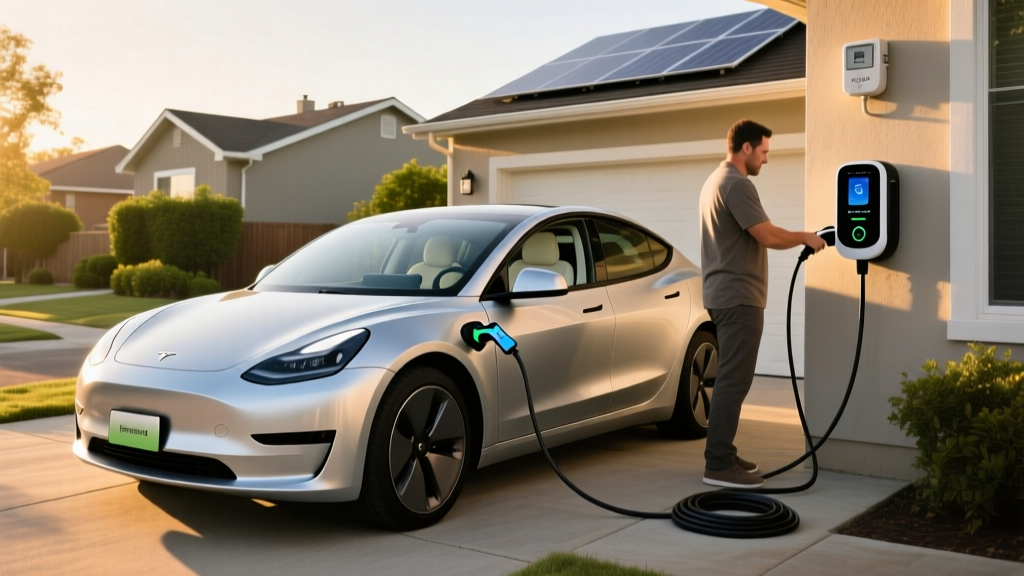
The single most important question isn't "which EV?" — it's "can I charge at home?" Home charging transforms the ownership experience. Without it, you're relying on public infrastructure that, despite rapid expansion, still has reliability gaps (broken chargers, occupied stalls, variable pricing).
Home Charging Setup Costs
| Item | Typical Cost Range |
|---|---|
| Level 2 charger hardware (e.g., ChargePoint Home Flex, Tesla Wall Connector) | $350–$700 |
| Electrician install (240V/40–60A circuit) | $500–$2,000 |
| Electrical panel upgrade (if needed, 100A → 200A) | $1,500–$3,500 |
| Permit / inspection | $50–$300 |
| Total (no panel upgrade) | $900–$3,000 |
If your home has a 200-amp panel with spare capacity, a Level 2 install typically lands under $2,000. Older homes with 100-amp service may need a panel upgrade, which adds significant cost. Some utilities offer rebates covering $200–$1,000 of charger or installation costs — check with your local provider.
Federal Tax Credit: §30D Rules for 2026
The federal clean vehicle credit offers up to $7,500, available as a point-of-sale reduction (applied directly to your purchase price at the dealer). But eligibility is layered:
- MSRP caps: $80,000 for SUVs, vans, and pickups; $55,000 for sedans
- Buyer income caps: $300,000 joint / $225,000 head of household / $150,000 single (modified AGI)
- Battery sourcing: Increasingly strict critical-mineral and battery-component requirements tied to free-trade-agreement countries — this disqualifies some trims
- Final assembly: Must occur in North America
The IRS updates qualifying vehicle lists regularly. Always verify at irs.gov before committing to a purchase. Never assume a vehicle qualifies based on brand alone.
Decision Framework: Which Electrified Vehicle Fits You?
Choose a BEV (full EV) if:
- You can install a Level 2 charger at home or have reliable workplace charging
- Your daily driving is under 80 miles round-trip (covers ~90% of American commutes per fueleconomy.gov data)
- You want the lowest per-mile fuel cost and minimal maintenance
- You take road trips under 300 miles or can plan 20-minute DC fast-charging stops
Choose a PHEV if:
- You want 25–45 miles of daily electric driving but also need 400+ mile gas range for road trips
- You lack reliable home or workplace charging but can plug in occasionally
- You live in an area with sparse DC fast-charging infrastructure
Choose an HEV (standard hybrid) if:
- You cannot charge at home or work and don't want to rely on public infrastructure
- You want better MPG (40–55 combined) without changing your fueling habits at all
Wait or reconsider if:
- You live in an apartment without charging access and your area has limited public DC fast chargers
- Your budget is under $30,000 and you need a new vehicle (the used EV market offers more options at this price point, with a separate $4,000 used-EV credit available under §25E)
Frequently Asked Questions
What does EV stand for in cars?
EV stands for Electric Vehicle. In automotive contexts, it most commonly refers to a battery electric vehicle (BEV) — a car powered entirely by an electric motor and rechargeable battery pack, with no internal combustion engine.
Is a Tesla the same as an EV?
Tesla makes EVs, but not all EVs are Teslas. In 2026, over 60 BEV models are available in the US from manufacturers including Hyundai, Kia, Ford, GM, BMW, Volkswagen, Rivian, and Lucid. Tesla's advantage remains its Supercharger network and software ecosystem, but competitors have closed the gap on range and charging speed.
How long do EV batteries last?
Most manufacturers warranty their battery packs for 8 years or 100,000 miles against capacity loss below 70%. Real-world data from fleets and high-mileage owners shows most NMC packs retain 85–90% capacity at 100,000 miles. LFP chemistry packs (used in standard-range Tesla Model 3/Y and some Ford models) show even lower degradation rates. Full battery replacement — rarely needed — costs $5,000–$20,000 depending on the vehicle and pack size.
How much does it cost to charge an EV at home?
At the US average residential rate of roughly $0.16/kWh (EIA 2025 data), fully charging a 75 kWh battery costs about $12. That delivers roughly 250–300 miles of range — equivalent to 8–9 gallons of gas at $3.50/gallon ($28–$31.50). Home charging cuts fuel costs roughly in half compared to gasoline.
Do EVs save money long-term?
Yes, for most owners who can charge at home. Over five years and 75,000 miles, a typical BEV saves $4,000–$8,000 in fuel and maintenance compared to a gas equivalent, depending on local rates. Higher insurance premiums ($200–$500/year more for some models) offset a portion of those savings. The breakeven point versus a comparable gas car is typically 3–5 years.
What happens if an EV runs out of charge?
The vehicle stops — just like running out of gas. However, EV range estimation is generally more accurate than gas-car fuel gauges, and navigation systems in modern EVs route you through chargers proactively. Roadside assistance (included with most new EVs for 3–5 years) can tow you to the nearest charger.
The ev meaning extends beyond "electric vehicle" — it represents a shift in how you fuel, maintain, and think about driving. The technology is mature, the economics work for most home-charging households, and 2026's lineup offers genuine choices across price points. Your next step: confirm your home's electrical capacity, check IRS §30D eligibility for your target model, and test-drive at least two EVs back-to-back against your current car.