If you've been searching "did Fisker go bankrupt" after spotting a Fisker Ocean on the road or browsing used-EV listings, you're not alone. The short answer is yes: Fisker Inc. filed for Chapter 11 bankruptcy protection in June 2024 and subsequently liquidated its remaining assets. But the Fisker Ocean — the company's sole production vehicle — was a genuinely compelling electric SUV on paper and in early owner hands. This profile breaks down every key spec, explains what bankruptcy means for current and prospective owners in 2026, and helps you decide whether a leftover or used Ocean is a smart buy or a parts-orphan risk.
The Fisker Ocean at a Glance: Key Specs
| Spec | Fisker Ocean Extreme / Ultra | Fisker Ocean Sport (Base) |
|---|---|---|
| EPA Range | 360 miles (Extreme) | 250 miles |
| Battery (Usable) | ~113 kWh (NMC, CATL) | ~80 kWh (LFP, CATL) |
| Drivetrain | Dual-motor AWD (Extreme); Single-motor FWD (Ultra) | Single-motor FWD |
| Horsepower | 564 hp (Extreme Hyper Range) | 275 hp |
| 0-60 mph | 3.9 sec (Extreme AWD) | 7.2 sec |
| DC Fast Charge (Peak) | 250 kW | 175 kW |
| 10-80% DC Time | ~30 min (est.) | ~33 min (est.) |
| Level 2 Home Charge | 11 kW onboard (~37 mi/hr) | 11 kW onboard (~27 mi/hr) |
| MPGe (Combined) | ~92 MPGe (Extreme est.) | ~105 MPGe (est.) |
| Cargo Volume | 32.5 cu ft (rear seats up); ~70 cu ft (folded) | Same |
| Base MSRP (at launch) | $68,999 (Extreme) | $37,499 (Sport) |
| Battery Warranty | 8 yr / 100,000 mi (original) | 8 yr / 100,000 mi (original) |
Note: Fisker ceased production in March 2024. These specs reflect the last published figures before the company's collapse. No 2025 or 2026 model-year Oceans were produced.
Did Fisker Go Bankrupt? The Timeline Explained
Yes. Here's the sequence that matters to buyers and owners:
- November 2022: Fisker Ocean production begins at Magna-Steyr's facility in Graz, Austria.
- Mid-2023: Deliveries begin in the U.S. and Europe; early reviews praise ride quality and range but flag software bugs and build inconsistencies.
- March 2024: Fisker halts production after building approximately 10,193 units, citing cash-flow problems and failure to secure a critical financing deal.
- June 17, 2024: Fisker Inc. files for Chapter 11 bankruptcy in the U.S. Bankruptcy Court for the District of Delaware, announcing plans to liquidate assets.
- Late 2024: Remaining inventory is sold off at steep discounts (some Oceans reportedly sold for under $25,000) through third-party dealers and liquidation channels.
- 2025-2026: No new vehicles, no official parts supply chain, no over-the-air (OTA) software updates from Fisker. Independent service shops and owner communities fill the gap.
For context, this is a liquidation, not a restructuring. Unlike the original Fisker Automotive (2007-2014, the Karma maker — a completely separate entity), Fisker Inc. (Henrik Fisker's second venture) did not emerge from bankruptcy with a new owner continuing production.
Real-World Range: EPA Sticker vs. What Owners Actually Saw
Real-world expectation: ~280-310 miles at highway speeds (70-75 mph); ~220-260 miles in cold weather (below 32°F / 0°C) with cabin heat.
Fisker Ocean Sport (EPA): 250 miles
Real-world expectation: ~200-220 miles highway; ~160-190 miles in freezing conditions.
The Ocean Extreme's 360-mile EPA figure placed it among the longest-range SUVs ever sold — behind only the Lucid Air sedan class. That number came from the massive ~113 kWh usable NMC battery pack supplied by CATL. However, early owner reports and independent testing showed the Ocean's boxy SUV shape and relatively heavy curb weight (~5,400 lbs for Extreme) penalized highway efficiency. At sustained 75 mph speeds, expect consumption around 34-38 kWh/100 mi, which translates to roughly 280-310 real highway miles before the buffer runs out.
The heat pump (standard on Extreme, optional on lower trims) helped mitigate cold-weather losses compared to resistive-heater EVs, but any EV loses 20-30% range in sub-freezing temperatures due to battery chemistry limitations and cabin heating demands. The smaller LFP pack in the Sport trim was more susceptible to cold-weather range loss, as LFP chemistry experiences higher internal resistance at low temperatures than NMC.
Charging: How Fast Does the Fisker Ocean Charge?
| Charging Method | Ocean Extreme (NMC) | Ocean Sport (LFP) |
|---|---|---|
| Level 1 (120V / 12A) | ~1.4 kW — ~4 mi/hr | ~1.4 kW — ~4 mi/hr |
| Level 2 (240V / 48A) | 11 kW — ~37 mi/hr | 11 kW — ~27 mi/hr |
| DC Fast Charge (Peak) | 250 kW (CCS1) | 175 kW (CCS1) |
| 10-80% DC Time | ~30 min (est.) | ~33 min (est.) |
| Connector | CCS1 (J1772 combo) | CCS1 (J1772 combo) |
The Ocean's 250 kW peak DC fast-charge rate was competitive with rivals like the Hyundai Ioniq 5 (240 kW) and Kia EV6 (239 kW) at launch. However, peak rate is not sustained rate. The Ocean's charging curve tapered significantly above 80% state of charge (SoC) — typical for NMC chemistry — meaning the last 20% could add another 25-35 minutes. For road-trip planning, figure on 30-minute stops for a 10-80% session at a 350 kW-capable Electrify America or EVgo station.
A critical distinction: kW (kilowatts) measures the power flow rate (how fast energy enters the battery), while kWh (kilowatt-hours) measures total energy stored (battery capacity). The Ocean Extreme has ~113 kWh of capacity and can accept up to 250 kW of power at peak.
For home charging, the 11 kW onboard charger is solid. A full Level 2 charge from empty takes roughly 10-11 hours on the Extreme — practical for overnight replenishment. Installation of a 48A / 240V home charger typically costs $500-$2,000 depending on panel capacity and wiring distance. (Consult a licensed electrician for your specific setup.)
One lingering concern in 2026: the Ocean uses the CCS1 connector, not the newer NACS (Tesla-style) plug now adopted by Ford, GM, Rivian, and others. CCS1 chargers remain widely available at Electrify America and other networks, and CCS-to-NACS adapters exist, but the long-term connector ecosystem is shifting toward NACS.
Pricing, Tax Credits, and the Liquidation Reality
| Trim | Original MSRP | Liquidation / Used Price (2025-2026 est.) | Federal §30D Credit (New) |
|---|---|---|---|
| Ocean Sport | $37,499 | $15,000 - $22,000 | Was eligible* (up to $7,500) |
| Ocean Ultra | $52,999 | $20,000 - $30,000 | Was eligible* (up to $7,500) |
| Ocean Extreme | $68,999 | $28,000 - $40,000 | Was eligible* (up to $7,500) |
*When sold new by Fisker, the Ocean could qualify for the IRS §30D federal clean vehicle credit of up to $7,500, subject to buyer income caps ($150K single / $300K joint), MSRP caps ($80,000 for SUVs), and critical-mineral/battery-component sourcing requirements. The Ocean's CATL battery raised sourcing questions under evolving rules. Now that Fisker is liquidated and vehicles are sold used, the new-vehicle §30D credit no longer applies. The used clean vehicle credit (up to $4,000 or 30% of sale price, whichever is lower) may apply if you buy from a licensed dealer and meet income thresholds ($75K single / $150K joint). Always verify current eligibility with a tax professional.
The steep depreciation is the defining financial story. Ocean buyers who paid full MSRP in 2023 absorbed 40-60% value loss within 18 months — among the worst depreciation events in modern EV history. For buyers in 2026, that depreciation creates an opportunity: a 360-mile-range electric SUV for under $35,000 is exceptional value — if you accept the ownership risks outlined below.
Performance, Tech, and Interior
The Ocean Extreme's dual-motor AWD powertrain delivered 564 hp and a 3.9-second 0-60 mph time — genuinely quick for a 5,400-lb family SUV. The single-motor Ultra (275 hp, FWD) and Sport (275 hp, FWD) were more sedate at 7.2 seconds but still adequate for highway merging. Ride quality drew praise from early reviewers, with a well-tuned adaptive suspension (on Extreme) that balanced comfort with composure.
Standout tech features:
- California Mode: All four windows (including rear quarter glass) and the solar-panel roof panel could open simultaneously for an open-air experience unique in the SUV segment.
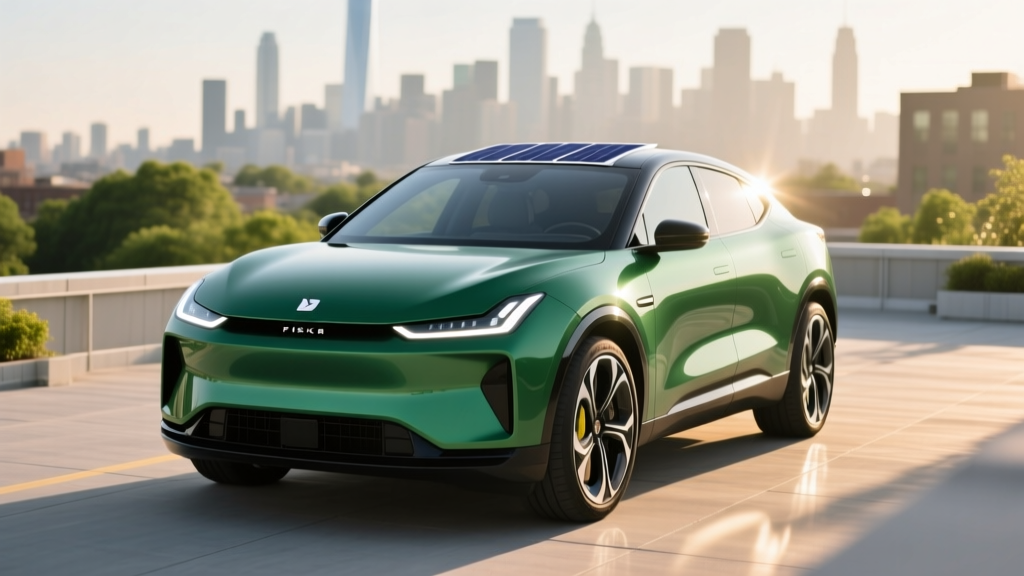
- Solar Roof (Extreme): A photovoltaic panel on the roof claimed to add up to 1,500 miles of range per year under ideal conditions — roughly 4 miles per full-sun day. A nice concept, negligible real-world impact.
- 17.1-inch rotating center display: Rotates between landscape ("Control Mode") and portrait ("Hollywood Mode") for media viewing while parked.
- Recycled/vegan interior materials: Aligned with Fisker's sustainability branding.
Notable drawbacks:
- Software instability: At launch and throughout production, the Ocean suffered from infotainment freezes, phantom warnings, and OTA update failures — a major factor in early negative reviews.
- Build quality inconsistencies: Panel gaps, rattles, and trim pieces coming loose were reported by multiple early owners.
- No Apple CarPlay / Android Auto: Fisker opted for a proprietary infotainment system, a decision that frustrated many buyers.
- ADAS limitations: Fisker's driver-assist suite (branded "Fisker Intelligent Pilot") was SAE Level 2 — requiring full driver attention at all times — and was widely considered behind Tesla Autopilot, Ford BlueCruise, and GM Super Cruise in refinement and capability.
Cargo and passenger space: The Ocean offers 32.5 cubic feet behind the second row and approximately 70 cubic feet with rear seats folded — competitive with the Tesla Model Y (30.2 / 72.1 cu ft) and Ford Mustang Mach-E (29.7 / 59.7 cu ft). Rear legroom is generous at ~39.5 inches. A small front trunk (frunk) adds additional storage.
Pros, Cons, and the Bankruptcy Ownership Risk
Pros
- Class-leading 360-mile EPA range (Extreme)
- Massive battery at a steeply discounted used price
- Unique open-air California Mode and solar roof
- Comfortable ride and strong AWD performance (Extreme)
- Spacious interior with competitive cargo volume
- Eye-catching design by Henrik Fisker
Cons
- Fisker is bankrupt — no manufacturer support
- Severe depreciation risk continues
- Software bugs may never receive fixes
- Parts availability is uncertain and dwindling
- Warranty claims have no corporate backing
- Proprietary infotainment with no CarPlay/Android Auto
- CCS1 connector in a market shifting to NACS
- Insurance may be difficult or expensive to obtain
Who Should (and Shouldn't) Buy a Fisker Ocean in 2026?
Consider a Fisker Ocean if:
- You're a technically savvy EV owner comfortable troubleshooting software issues independently
- You have access to an independent EV-specialist mechanic in your area
- You want maximum range per dollar and accept the orphan-brand risk
- You plan to drive the car into the ground rather than resell (further depreciation is likely)
- You can self-insure or have confirmed coverage with your insurer before purchase
Avoid the Fisker Ocean if:
- You need reliable warranty coverage and manufacturer-backed service
- You depend on OTA updates for safety or feature improvements
- You plan to finance the purchase (many lenders won't finance bankrupt-brand vehicles)
- You want strong resale value retention
- You live in a rural area far from specialized EV repair shops
Best alternative competitors to consider: The Hyundai Ioniq 5 (EPA 303 mi, 240 kW charging, full warranty and dealer support), Tesla Model Y Long Range (EPA 320 mi, Supercharger network access, strong resale), and Ford Mustang Mach-E Extended Range (EPA 312 mi, BlueCruise capability) all offer compelling packages with the manufacturer backing that Fisker can no longer provide.
Frequently Asked Questions
Did Fisker go bankrupt?
Yes. Fisker Inc. filed for Chapter 11 bankruptcy on June 17, 2024, and liquidated its assets. The company ceased Ocean production in March 2024 after building approximately 10,193 vehicles. This is a different company from the original Fisker Automotive (maker of the Fisker Karma, 2007-2014).
Can I still get parts and service for a Fisker Ocean?
There is no official Fisker parts supply chain as of 2026. Some third-party suppliers and owner-community networks have begun sourcing components. Magna-Steyr, the contract manufacturer that built the Ocean, may hold some parts inventory, but availability is not guaranteed. Independent EV shops can handle basic maintenance (tires, brakes, cabin filters), but proprietary components (battery modules, infotainment hardware, body panels) are increasingly scarce.
What is the real-world range of the Fisker Ocean Extreme?
The EPA rates the Ocean Extreme at 360 miles. Real-world highway driving (70-75 mph, moderate temperatures) yields approximately 280-310 miles. In cold weather (below freezing), expect 220-260 miles. The large 113 kWh battery provides a generous buffer, but the Ocean's aerodynamic profile and weight work against efficiency at speed.
Does the Fisker Ocean qualify for any EV tax credit in 2026?
The new-vehicle §30D federal credit (up to $7,500) is no longer available because Fisker is defunct and no new Oceans are being sold. However, if you purchase a used Ocean from a licensed dealer, you may qualify for the used clean vehicle credit — up to $4,000 or 30% of the sale price, whichever is lower. Income caps apply: $75,000 single / $150,000 joint filers. Confirm eligibility with a tax professional and check current IRS guidance on the used EV credit.
Is the Fisker Ocean safe?
The Ocean received a 5-star overall Euro NCAP rating in 2023. U.S. NHTSA ratings were not completed before the company's collapse. The vehicle includes standard automatic emergency braking, lane-keeping assist, blind-spot monitoring, and adaptive cruise control. However, without OTA updates, any future safety-related software improvements will not be delivered.
How does the Fisker Ocean compare to the Tesla Model Y?
The Ocean Extreme offers more EPA range (360 vs. ~320 miles) and a more distinctive design, but the Model Y wins on charging infrastructure (Tesla Supercharger network), software reliability, resale value, manufacturer support, and NACS connector compatibility. For most buyers in 2026, the Model Y's ecosystem advantages outweigh the Ocean's range edge — especially given Fisker's bankruptcy.
Will the Fisker Ocean's software ever be updated?
As of 2026, no. Fisker's OTA update servers were shut down during the liquidation process. Any bugs present in the last-delivered software version will persist. Some technically inclined owners have explored community-driven solutions, but there is no official path to software improvements.
Bottom line: The Fisker Ocean is a cautionary tale wrapped in an impressive spec sheet. Its 360-mile range, 250 kW charging, and bold design were genuine achievements. But the answer to "did Fisker go bankrupt" carries real ownership consequences in 2026: no warranty, no software updates, uncertain parts, and continued depreciation risk. If you're considering a used Ocean, go in with eyes open, a trusted independent mechanic, and a plan to drive it for the long haul.