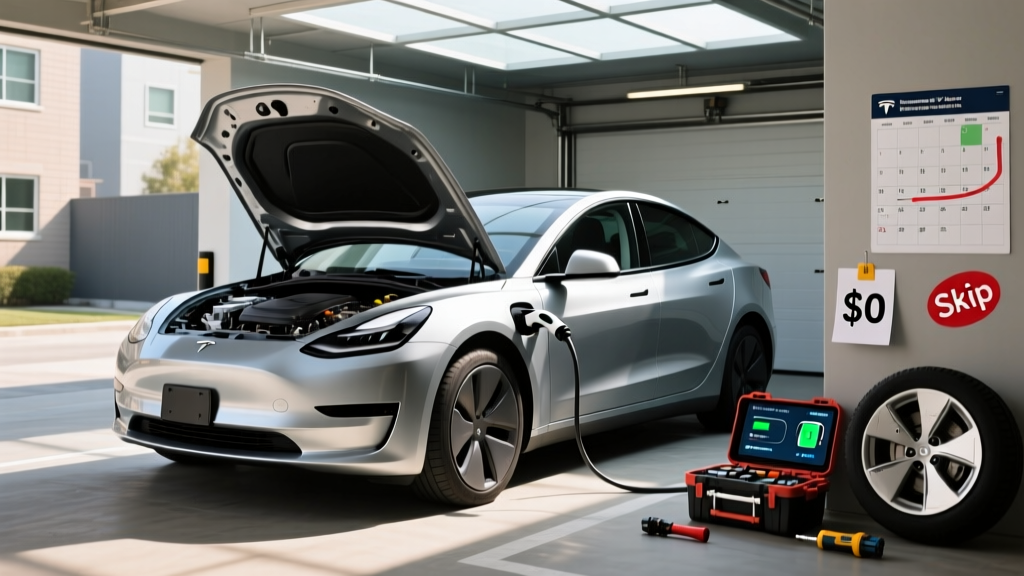
Electric vehicles have far fewer moving parts than internal-combustion cars, and the maintenance difference shows up in your wallet. According to fueleconomy.gov, EV owners spend roughly 6.1 cents per mile on fuel and maintenance combined, compared to about 11–13 cents for a comparable gas sedan. But "lower maintenance" doesn't mean "zero maintenance." Tires wear faster under EV torque and weight, cabin air filters still clog, brake fluid still absorbs moisture, and the 12V auxiliary battery will die on the same 3–5 year schedule as any other car.
The Short Answer on EV Maintenance
Expect to spend $300–$500 per year on routine maintenance for a typical EV — about 40–50% less than a comparable gas car. There are no oil changes, no spark plugs, no timing belts, no transmission fluid swaps, and no exhaust system repairs. Your biggest recurring costs are tires, cabin air filters, wiper fluid, and periodic brake fluid checks. The battery and drive unit are covered by an 8-year/100,000-mile federal warranty mandate.
What Maintenance Does an EV Actually Need?
Strip away the engine and transmission, and you're left with a surprisingly short service checklist. Here's what a typical 2025–2026 battery-electric vehicle (BEV) requires over its first five years:
- Tire rotation: Every 5,000–7,500 miles. Cost: $25–$50 per visit, or free at many dealers.
- Cabin air filter: Every 15,000–20,000 miles. Cost: $15–$35 for the part; DIY install takes 10 minutes on most models.
- Wiper blades: Every 12–18 months. Cost: $20–$45 per pair.
- Brake fluid inspection: Every 2 years or 30,000 miles; flush if moisture content exceeds 3%. Cost: $80–$120 per flush.
- Coolant check (battery thermal loop): Every 5 years or 60,000 miles on most models; some (like Tesla) specify no interval unless a leak is detected.
- 12V auxiliary battery: Replace every 3–5 years, just like a gas car. Cost: $150–$300 installed.
- Brake pads: Thanks to regenerative braking, pads often last 80,000–150,000+ miles. Many first owners never replace them.
That's essentially the full list. No oxygen sensors, no catalytic converters, no fuel injectors, no serpentine belts, no EGR valves. The electric motor itself is sealed and generally requires no scheduled service.
EV vs Gas Car Maintenance: The Real Cost Breakdown
Let's put concrete numbers to the difference. The following table compares five-year maintenance costs for a typical compact EV (think Hyundai Ioniq 6 or Tesla Model 3 RWD) against a similarly sized gas sedan (think Honda Civic or Toyota Corolla):
| Maintenance Item | EV (5-Year Cost) | Gas Car (5-Year Cost) |
|---|---|---|
| Oil changes (synthetic, every 7,500 mi) | $0 | $400–$600 |
| Engine air filter | $0 (no engine) | $75–$125 |
| Transmission fluid | $0 (single-speed reduction gear, sealed) | $150–$300 |
| Spark plugs | $0 | $150–$400 |
| Tire rotation & replacement | $1,200–$1,800 | $800–$1,200 |
| Brake pads & rotors | $0–$250 | $400–$800 |
| Cabin air filter | $75–$150 | $75–$150 |
| Brake fluid flush | $160–$240 | $160–$240 |
| Wiper blades | $60–$120 | $60–$120 |
| 12V battery replacement | $150–$300 | $150–$300 |
| Exhaust / emissions components | $0 | $0–$500 (O2 sensor, catalytic converter risk) |
| Total (5 years / 75,000 mi) | $1,645–$2,860 | $2,420–$4,635 |
The EV saves roughly $800–$1,800 over five years on maintenance alone. The gap widens further if the gas car needs an unexpected timing belt ($600–$1,200) or water pump replacement ($500–$900).
The One Area Where EVs Cost More: Tires
Here's where the honest data matters. EVs are heavy — a Tesla Model Y Long Range weighs 4,398 lbs, and a Ford F-150 Lightning tips the scales at over 6,000 lbs — and electric motors deliver instant torque from 0 RPM. That combination accelerates tread wear by 20–30% compared to a similarly sized gas vehicle, according to tire industry testing data.
What this means in practice:
- A set of all-season tires on a gas compact sedan might last 50,000–60,000 miles. On an EV of similar weight and power, expect 35,000–45,000 miles.
- EV-specific tires (like the Michelin e·Primacy or Hankook iON evo) use low-rolling-resistance compounds and noise-reducing foam inserts. They cost 15–25% more per tire than standard equivalents — roughly $200–$320 per tire vs $150–$240.
- Rotating tires every 5,000–7,000 miles is non-negotiable on an EV. Skipping rotations leads to uneven wear that shortens tire life significantly.
Budget roughly $200–$350 per year for tire-related costs (rotation + prorated replacement) on an EV, versus $130–$200 on a gas car.
Battery Longevity: The Maintenance Question Owners Actually Worry About
The high-voltage traction battery is the single biggest "what if" in EV ownership. Here's what the data says:
Federal warranty mandate: Every EV sold in the US must carry a battery warranty of at least 8 years / 100,000 miles (10 years / 150,000 miles in California and states that follow CARB rules). This warranty typically guarantees the battery will retain 70–80% of its original capacity. If it drops below that threshold, the manufacturer replaces or repairs it at no cost.
Real-world degradation data: Analysis of fleet data from Tesla, Hyundai, and BMW EVs shows most modern NMC and LFP batteries lose approximately 10–15% of capacity over the first 150,000 miles. A 2025 study by Geotab tracking over 10,000 EVs found an average annual degradation rate of about 1.8% per year, meaning a 300-mile EPA-range EV would still offer roughly 255–270 miles of range after 10 years.
Replacement cost if out of warranty: $5,000–$20,000 depending on the vehicle, with most mainstream models in the $8,000–$14,000 range. LFP batteries (used in base Tesla Model 3/Y, some Ford and Hyundai models) tend to cost less to replace than high-nickel NMC packs.
What you can do to slow degradation:
- For NMC batteries: Keep daily charging between 20–80% SoC; reserve 100% charges for road trips.
- For LFP batteries: Manufacturers often recommend charging to 100% at least weekly to keep the BMS calibrated — LFP chemistry tolerates full charges better.
- Minimize repeated DC fast charging to 100% — charge curves taper above 80% for a reason, and heat is the enemy of lithium-ion longevity.
- Precondition the battery before fast charging (most EVs do this automatically when you navigate to a charger).
Myth vs Fact: Common Misconceptions About EV Maintenance
| Myth | Fact |
|---|---|
| "EVs need no maintenance at all." | Tires, wipers, cabin filters, brake fluid, coolant, and 12V batteries all require scheduled attention. Budget $300–$500/year. |
| "The battery will need replacing every 5–8 years, costing $20,000." | Federal warranty covers 8 yr/100,000 mi minimum. Real-world data shows ~1.8% annual degradation. Most batteries outlast the car's first two owners. |
| "Regenerative braking means you never need brake service." | Brake pads last far longer (often 100,000+ miles), but brake fluid still absorbs moisture and must be tested every 2 years. Calipers can seize from lack of use — some owners need to "exercise" friction brakes periodically. |
| "EV tires are the same as regular tires." | EV-optimized tires use different compounds for lower rolling resistance and noise foam. Using standard tires on a heavy EV accelerates wear and increases road noise. |
| "You need a dealership for all EV service." | Tire shops can rotate and replace tires. Cabin air filters are DIY-friendly. Independent shops are increasingly EV-certified for brake and suspension work. Dealership visits are mainly needed for high-voltage system diagnostics and OTA-related issues. |
Real-World Ownership Variables That Change Your Maintenance Costs
Your actual maintenance spend depends heavily on how and where you drive:
Climate: Cold-climate owners (Upper Midwest, Northeast) will use wiper blades and washer fluid faster, may need winter tires (adding $600–$1,000 every 3–4 years), and will see battery range drop 20–30% in sub-freezing temperatures — though this doesn't increase mechanical maintenance. Hot-climate owners (Southwest, Texas) may see slightly faster battery degradation if the vehicle lacks active liquid cooling; most 2025–2026 models have robust thermal management.
Driving patterns: High-mileage commuters (20,000+ miles/year) will cycle through tires faster and hit brake-fluid intervals sooner. City drivers with heavy regen use will save even more on brake pads. Highway-dominant driving uses friction brakes more (for hard stops at speed), slightly reducing pad life.
Home charging access: This doesn't affect mechanical maintenance, but it defines your ownership experience. If you can install a Level 2 home charger (240V, typically 7–11 kW, adding 25–44 miles of range per hour), you'll start every day with a full "tank" and rarely need public charging. Home charger installation runs $500–$2,000 depending on panel capacity and run length — a cost that has nothing to do with vehicle maintenance but everything to do with daily convenience.
Towing and hauling: If you tow with an EV (the F-150 Lightning is rated for 7,700–10,000 lbs, the Rivian R1T for 11,000 lbs), expect accelerated tire and suspension wear, and plan for more frequent fluid checks on the drive unit cooling loop.
EV Maintenance Decision Framework: Should You Buy?
Is an EV Right for Your Maintenance Budget?
Choose an EV if:
- You want predictable, low maintenance costs ($300–$500/yr vs $600–$1,000+ for gas).
- You have home charging access or a reliable Level 2 charger at work.
- You drive under 300 miles per day (covers 95%+ of US drivers, per DOT data).
- You plan to keep the vehicle 5+ years to maximize the maintenance savings advantage.
- You qualify for the IRS §30D federal tax credit (up to $7,500, subject to MSRP caps of $55,000 for cars / $80,000 for SUVs and trucks, buyer income limits of $150K single / $300K joint, and battery-sourcing requirements).
Choose a hybrid (HEV or PHEV) instead if:
- You regularly drive 400+ miles between charging opportunities (road trips, rural routes).
- You lack home or workplace charging and public infrastructure in your area is sparse.
- You want some fuel savings without the upfront price premium of a full BEV.
- You accept higher maintenance (oil changes, spark plugs, transmission service) as a tradeoff for refueling flexibility.
Stick with a gas car for now if:
- You live in an apartment with no charging access and have no workplace charger.
- Your budget is under $25,000 and you need a used vehicle (the used EV market is growing, but selection below $25K is still limited).
- You tow heavy loads daily in extreme cold — a diesel or gas truck remains more practical for sustained heavy towing in sub-zero conditions.
Frequently Asked Questions
Do EVs need oil changes?
No. Battery-electric vehicles have no engine oil because they have no internal combustion engine. The electric motor uses a sealed reduction gear that does not require routine fluid changes on most models. This eliminates a $40–$80 expense that gas car owners face 1–2 times per year.
How often do EV brake pads need replacing?
Rarely. Because regenerative braking handles most deceleration — converting kinetic energy back into battery charge — friction brake pads see minimal use. Many EV owners report original brake pads at 100,000+ miles. However, brake calipers can corrode or seize from disuse, so some manufacturers recommend periodic "conditioning" drives where you use the friction brakes deliberately to keep them functional.
Is EV coolant the same as regular antifreeze?
Not exactly. EV battery thermal management systems use specific glycol-based coolant formulations designed to be electrically non-conductive and compatible with the battery cooling plates. Using the wrong coolant can damage the thermal management system. Always use the fluid specified in your owner's manual — typically a pre-mixed 50/50 formula available for $15–$25 per gallon.
What happens if my EV's 12V battery dies?
Your EV won't start, even though the main traction battery is full. The 12V battery powers the computers, door locks, lights, and the contactor that connects the high-voltage battery to the drive system. Many 2025–2026 EVs now include a 12V lithium-iron-phosphate auxiliary battery (Tesla, Hyundai) that lasts longer and is lighter than a traditional lead-acid unit, but it will still eventually need replacement — typically every 4–6 years.
Do EVs need state emissions inspections?
No tailpipe emissions means no emissions test. However, most states still require annual safety inspections (brakes, tires, lights, suspension), and EVs must pass those just like any other vehicle. Some states have introduced an annual EV registration surcharge ($50–$225 depending on the state) to offset lost gas-tax revenue — factor this into your ownership cost calculation.
How much does it cost to maintain a Tesla vs other EVs?
Tesla's maintenance costs are among the lowest in the EV segment because the company eliminates most scheduled service requirements. There's no mandatory annual service visit — Tesla recommends tire rotation, cabin filter replacement, and brake fluid testing on an as-needed basis. Owners report annual maintenance spend of $200–$400. Other brands (Hyundai, Ford, BMW) may recommend more structured service intervals, but costs remain in the same $300–$500/year range. The main Tesla-specific cost risk is body repair after a collision, which can be pricier due to aluminum-intensive construction and limited third-party body shop certification.