The Real Math Behind San Diego EV Leases in 2026
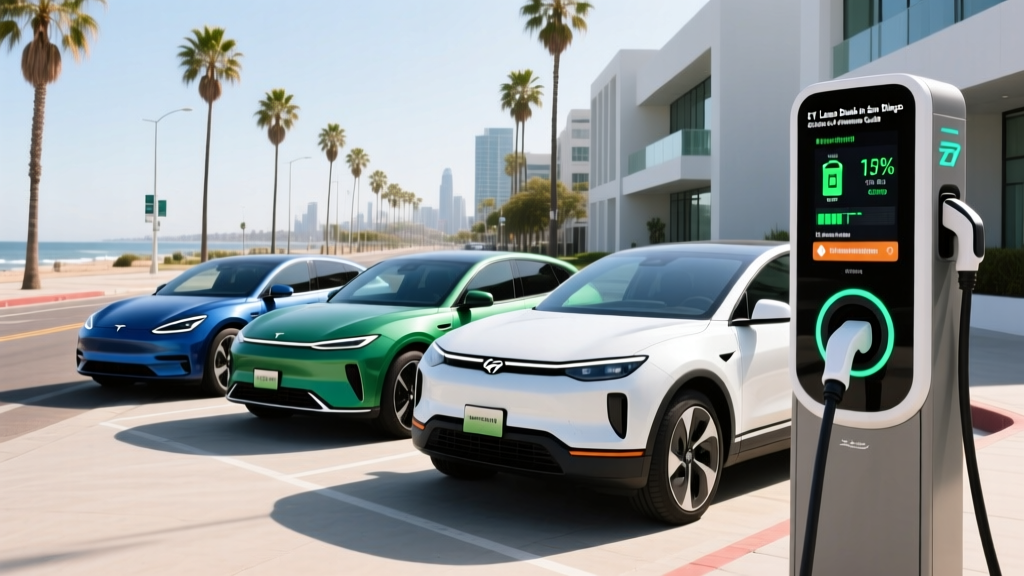
If you've been searching for EV lease deals in San Diego, you've likely seen eye-catching monthly payments on models like the Tesla Model Y, Hyundai Ioniq 5, or Chevrolet Equinox EV. But the lease sticker is only the beginning. San Diego's unique combination of SDG&E electricity rates, California's aggressive clean-air incentives, and year-round mild weather creates an ownership equation that looks very different from the rest of the country.
This guide breaks down the full 5-year cost of leasing and driving an EV in San Diego County — from federal tax credits passed through your lease to the real cost per mile on SDG&E's EV-TOU rate plan. We'll use concrete numbers, not marketing promises.
San Diego County buyers can stack federal, state, and utility incentives — but each has its own eligibility rules. SDG&E's EV-TOU-5 rate plan offers off-peak charging as low as ~$0.09/kWh overnight. California's CVRP (Clean Vehicle Rebate Project) availability varies by funding cycle. Always verify current rebate status at energy.ca.gov and SDG&E's EV rate page before signing.
5-Year Total Cost of Ownership: EV vs Gas in San Diego
To understand whether an EV lease in San Diego makes financial sense, we need to model a realistic 5-year ownership period. Below is a side-by-side comparison using a popular lease scenario: a 2026 Hyundai Ioniq 5 SEL (BEV) versus a comparably equipped 2026 Toyota RAV4 LE (gas). Both are leased or financed at competitive rates.
| Cost Category (5 Years) | 2026 Ioniq 5 SEL (BEV) | 2026 RAV4 LE (Gas) |
|---|---|---|
| Lease/Finance Payments (60 mo) | $24,600 ($410/mo) | $22,200 ($370/mo) |
| Federal Tax Credit (applied at lease signing) | −$7,500* | $0 |
| Fuel / Charging (75,000 miles) | $3,375 (home + public) | $9,375 ($4.20/gal, 28 MPG) |
| Maintenance & Repairs | $1,200 | $3,500 |
| Insurance (5-year avg) | $11,400 ($190/mo) | $9,000 ($150/mo) |
| Estimated Depreciation / Lease Residual Gap | Included in lease | Included in lease |
| NET 5-YEAR COST | ~$33,075 | ~$44,075 |
*Federal §30D credit passed through as a lease capitalization reduction — eligibility depends on MSRP caps, buyer income, and battery sourcing. See tax credit section below. Fuel estimates: SDG&E EV-TOU-5 blended rate ~$0.15/kWh avg, Ioniq 5 efficiency 3.0 mi/kWh. Gas: $4.20/gal San Diego avg, 28 combined MPG. Source: fueleconomy.gov.
The takeaway: even with higher insurance premiums, the Ioniq 5 lease scenario saves roughly $11,000 over 5 years in San Diego — driven primarily by the $7,500 federal credit applied at signing and $6,000 in fuel savings. But this math only works if you qualify for the credit and charge primarily at home on an off-peak rate plan.
Federal Tax Credit §30D: Do You Qualify for $7,500?
The federal EV tax credit under IRS §30D remains the single largest incentive for EV buyers — but it is far from automatic. When you lease an EV, the credit technically goes to the leasing company (the lessor). Most major automakers' captive finance arms (Hyundai Capital, GM Financial, Tesla's leasing partners) pass this credit through as a capitalized cost reduction, effectively lowering your monthly payment or amount due at signing.
- MSRP Cap: Vans/SUVs/pickups ≤ $80,000 MSRP; sedans/other ≤ $55,000 MSRP
- Buyer Income Cap: Modified AGI ≤ $150,000 (single), $225,000 (head of household), $300,000 (married filing jointly)
- Battery Sourcing: Required % of critical minerals must be extracted/processed in the US or an FTA partner country (thresholds increase annually)
- Component Manufacturing: Required % of battery components must be manufactured/assembled in North America
- Assembly: Vehicle must undergo final assembly in North America
- Point-of-Sale Transfer: You can transfer the credit to the dealer at purchase to receive it as a price reduction — or it's applied as a cap reduction in a lease
- One Credit Per VIN: Vehicle must not have been previously claimed for §30D
Full rules at irs.gov. Battery sourcing requirements tighten each year — a model that qualifies in early 2026 may not qualify later. Always verify before signing.
Lease loophole advantage: Under §30D, the income and MSRP caps technically apply to the lessor (the finance company), not to you. This means some lessees who wouldn't qualify for a purchase credit due to income caps or the vehicle's MSRP may still benefit when leasing. However, the battery sourcing and North American assembly requirements still apply to the vehicle itself. Consult a tax professional for your specific situation.
Charging Costs in San Diego: SDG&E Rates vs Gasoline
San Diego Gas & Electric offers dedicated EV rate plans that make home charging dramatically cheaper than gasoline. The key is charging during off-peak hours (overnight and midday on weekends).
| Charging Scenario | Cost per kWh | Cost per Mile* | Annual Cost (15K mi) |
|---|---|---|---|
| SDG&E EV-TOU-5 Off-Peak (overnight) | ~$0.09 | $0.03 | $450 |
| SDG&E EV-TOU-5 Blended Avg | ~$0.15 | $0.05 | $750 |
| SDG&E On-Peak (summer evening) | ~$0.45 | $0.15 | $2,250 |
| EA / EVgo DC Fast Charging | $0.35–$0.55 | $0.12–$0.18 | $1,800–$2,700 |
| Gasoline (28 MPG, $4.20/gal) | — | $0.15 | $2,250 |
*Based on an EV averaging 3.0 miles per kWh (e.g., Ioniq 5 RWD, EPA 132 MPGe combined). Actual efficiency varies by model, temperature, and driving style. SDG&E rates are approximate 2026 figures; verify current rates at sdge.com.
The critical insight: If you charge primarily at home on SDG&E's off-peak EV rate, your fuel cost drops to roughly $0.03 per mile — about one-fifth the cost of gasoline. But if you rely on on-peak home charging or exclusively on DC fast chargers, your cost per mile can match or even exceed gasoline. Home charging access on a time-of-use plan is the single biggest variable in EV ownership economics.
Maintenance Savings: Where EVs Actually Save You Money
EVs eliminate many routine maintenance items that gas car owners take for granted. Here's what disappears from your service schedule:
| Maintenance Item | Gas Car (5 yr / 75K mi) | EV (5 yr / 75K mi) |
|---|---|---|
| Oil Changes (~7 intervals) | $350–$700 | $0 |
| Transmission Fluid / Service | $200–$400 | $0 |
| Spark Plugs / Ignition | $300–$600 | $0 |
| Brake Pads (front + rear) | $600–$1,200 | $0–$300* |
| Cabin Air Filter | $100–$200 | $100–$200 |
| Tire Rotation / Replacement | $800–$1,200 | $900–$1,400† |
| TOTAL MAINTENANCE | $2,350–$4,300 | $1,000–$1,900 |
*Regenerative braking significantly extends brake pad life; many EV owners report 80,000+ miles on original pads. †EVs are heavier and produce instant torque, which can wear tires 10–20% faster. Budget for EV-specific tires (e.g., Michelin Pilot Sport EV, Hankook iON).
Net maintenance savings over 5 years: roughly $1,500–$2,500. The savings are real but not enormous — they won't single-handedly justify an EV purchase, but they contribute meaningfully to the total cost advantage.
The Insurance Reality: Expect to Pay More
Here's where the honest math gets uncomfortable. EV insurance premiums in California typically run 15–30% higher than equivalent gas vehicles. In San Diego, expect to pay $170–$220/month for comprehensive coverage on a mainstream EV like the Ioniq 5 or Model Y, versus $130–$170/month for a RAV4 or CR-V.
Why EVs cost more to insure:
- Higher repair costs: Battery pack damage from collisions often requires specialized (and expensive) replacement rather than repair
- Specialized labor: High-voltage system repairs require certified technicians, which are still scarce
- Higher vehicle values: EVs generally have higher MSRPs than comparable gas models, increasing collision/comprehensive payouts
- Parts availability: EV-specific parts (battery modules, power electronics) can have longer lead times
San Diego tip: Get quotes from at least 3 insurers before signing a lease. GEICO, State Farm, and Tesla Insurance (for Tesla models) often offer competitive EV rates in California. Some insurers offer discounts for EVs with advanced ADAS features like automatic emergency braking and lane-keeping assist — systems standard on most 2026 EVs.
EV Depreciation and Lease Residual Values
Depreciation has been the wildcard in EV ownership economics. In 2023–2024, EVs experienced steeper-than-expected depreciation due to aggressive price cuts (particularly from Tesla), growing used-EV inventory, and consumer uncertainty about battery longevity.
By 2026, the picture has stabilized somewhat:
- Lease residuals on mainstream EVs (Hyundai, Kia, GM) are typically set at 50–58% of MSRP for a 36-month lease — competitive with gas crossovers
- Tesla's residual values remain more volatile due to frequent price adjustments on new vehicles
- Luxury EVs (BMW iX, Mercedes EQE) still depreciate faster than luxury gas counterparts
- Battery health data from high-mileage EVs continues to reassure: most NMC and LFP packs retain 85–92% capacity at 100,000 miles, well above the 70% threshold for warranty coverage
Why leasing mitigates depreciation risk: When you lease, the residual value is locked in at signing. If EV values drop further, the leasing company absorbs the loss, not you. This makes leasing particularly attractive during periods of market uncertainty — and it's one reason why roughly 40% of EV transactions in California are leases rather than purchases.
California and San Diego-Specific Incentives
Beyond the federal §30D credit, California offers additional incentive layers. Availability changes frequently, so treat these as a starting point for research:
- CVRP (Clean Vehicle Rebate Project): Up to $2,000 rebate for eligible new EVs (income-dependent; funding subject to availability via the California Air Resources Board)
- SDG&E EV-TOU-5 Rate Plan: Time-of-use electricity pricing with overnight rates as low as ~$0.09/kWh — effectively cutting your fuel cost by 80%+ versus gasoline
- SDG&E Residential Charger Rebate: Periodically offered rebates of up to $500–$1,000 toward Level 2 home charger equipment (check current availability)
- Clean Air Vehicle Decal (HOV lane): qualifying EVs receive California white Clean Air Vehicle decals for solo carpool lane access — a significant time savings on I-5, I-8, and I-15 during San Diego rush hours
- SANDAG iCommute Program: Some San Diego employers offer additional EV purchase incentives through regional commute-reduction programs
Stacking the federal $7,500 credit (passed through the lease), a potential $2,000 CVRP rebate, SDG&E charger incentives, and HOV lane access can reduce your effective 3-year lease cost by $10,000–$12,000 compared to a similarly priced gas vehicle.
San Diego EV Lease Decision Framework
Choose an EV lease if:
- You can install a Level 2 charger at home (garage or driveway with 240V access)
- You qualify for the §30D credit (or the lease loophole applies to your situation)
- You drive 10,000–18,000 miles/year (maximizing fuel savings)
- You want HOV lane access on San Diego freeways
- You prefer locking in depreciation risk via the lease residual
Stick with gas or hybrid if:
- You live in an apartment/condo with no home charging option and limited public charging nearby
- Your household income exceeds §30D caps AND the lease loophole doesn't apply
- You regularly drive 300+ mile round trips to areas with sparse DC fast charging (e.g., eastern San Diego County, Imperial County)
- You plan to keep the vehicle 8+ years (purchasing becomes more economical)
Frequently Asked Questions
How much does it really cost to own an EV over 5 years in San Diego?
Based on our model above, a mainstream EV like the Hyundai Ioniq 5 SEL on an SDG&E EV-TOU rate plan costs approximately $33,000 over 5 years (including lease payments, fuel, maintenance, and insurance, minus the federal credit). A comparable gas RAV4 costs roughly $44,000 over the same period. Your actual number depends on your driving mileage, charging habits, and insurance quotes.
Do I qualify for the $7,500 federal tax credit on a leased EV?
When leasing, the §30D credit goes to the lessor (the finance company), and most pass it through as a lease cap reduction. The income and MSRP caps technically apply to the lessor, which can make leasing a way to access the credit even if your personal income exceeds the limits. However, the vehicle itself must still meet battery sourcing and North American assembly requirements. Verify the specific model's eligibility at irs.gov and confirm with the dealer that the credit is being applied to your lease.
How much do I save on fuel and maintenance with an EV in San Diego?
On SDG&E's off-peak EV rate, charging costs roughly $0.03 per mile versus $0.15 per mile for gasoline — a savings of about $1,800 per year at 15,000 miles. Add $300–$500 per year in maintenance savings (no oil changes, reduced brake wear), and total annual savings reach approximately $2,100–$2,300. Over 5 years, that's $10,500–$11,500 in operational savings.
Are EVs more expensive to insure in California?
Yes — typically 15–30% more than comparable gas vehicles. In San Diego, expect $170–$220/month for full coverage on a mainstream EV. The higher premiums reflect more expensive collision repairs, specialized high-voltage labor, and higher vehicle values. Shop multiple insurers and ask about ADAS safety-feature discounts.
How well do EVs hold their value compared to gas cars?
EV depreciation has stabilized since the 2023–2024 price-war era. Mainstream EVs (Hyundai, Kia, GM) now hold 50–58% of MSRP at 36 months — competitive with gas crossovers. Leasing protects you from further depreciation since the residual is locked at signing. Long-term battery health data (85–92% capacity retention at 100K miles) continues to support used EV values.
What's the best EV rate plan for San Diego residents?
SDG&E's EV-TOU-5 plan is generally the best option for home charging. It offers super off-peak rates (~$0.09/kWh) overnight and on weekends, with higher on-peak rates during weekday evenings. To maximize savings, schedule your EV charging between 12 AM and 6 AM using your vehicle's built-in charge scheduler or your Level 2 charger's timer function.