The Short Answer on EV Jet Skis
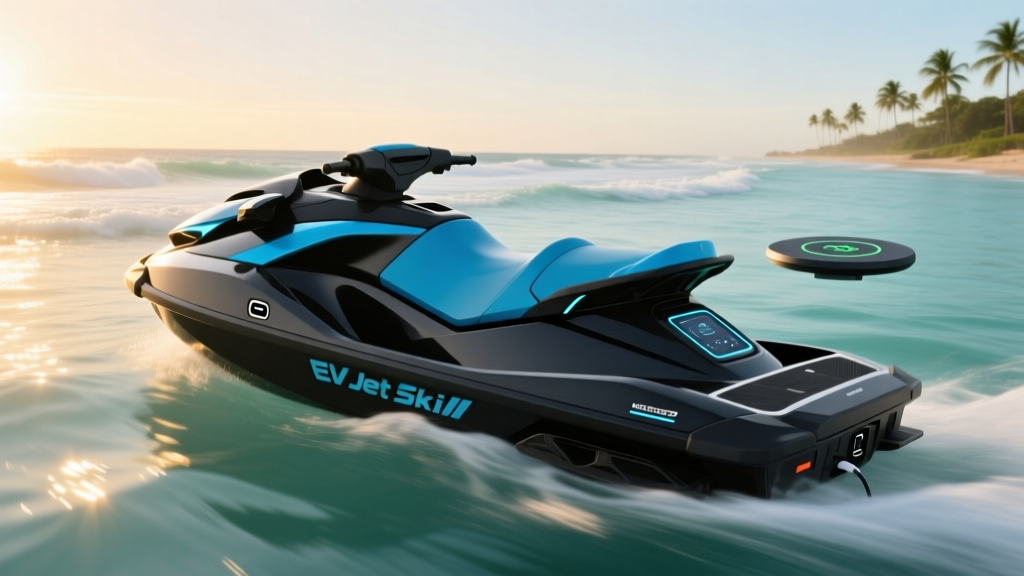
Electric personal watercraft (PWC) are a real, buyable product in 2026 — but the market is small and niche. The most prominent model is the Taiga Orca, a Canadian-built electric PWC with a ~45-mile range (at moderate speeds), a 23 kWh battery, and a starting price around $24,000. For comparison, a gas-powered Sea-Doo Spark starts near $7,500. If you ride primarily on lakes with shoreline charging access, value instant torque and near-silent operation, and can absorb the premium, an EV jet ski is a compelling toy. If you need 100+ mile range, open-ocean touring capability, or budget under $15,000, gas PWCs remain the practical choice.
Note: While autoedgeview.com focuses on electric cars, trucks, and SUVs, readers frequently ask about the broader electrified-vehicle landscape. This guide applies our data-driven EV ownership framework to the electric PWC segment.
What Is an EV Jet Ski? (And Who Makes Them?)
The term "EV jet ski" is colloquial — "Jet Ski" is a Kawasaki trademark for gas-powered PWCs. What buyers actually mean is an electric personal watercraft (PWC). As of 2026, the market includes:
- Taiga Motors Orca — The most established electric PWC, built in Quebec. Available in Carbon, Performance, and Sport trims. This is the closest thing to a "Tesla of the water."
- Narke Electrojet — A Hungarian-built electric PWC with limited North American distribution.
- Various prototype/concept craft — Several startups have announced electric PWCs, but most remain in pre-production or limited pilot programs.
The major PWC manufacturers — Sea-Doo (BRP), Yamaha (WaveRunner), and Kawasaki (Jet Ski) — have not released fully electric models as of 2026. BRP has publicly committed to electrification and has introduced electric prototypes, but no production electric Sea-Doo is available for purchase. If and when BRP launches an electric PWC, it would instantly become the segment benchmark given their ~50% global PWC market share.
Taiga Orca: Specs, Range, and Real-World Performance
Since the Taiga Orca dominates the buyable electric PWC market, let's examine it in detail:
| Spec | Taiga Orca Carbon | Taiga Orca Performance | Taiga Orca Sport |
|---|---|---|---|
| Base MSRP (approx.) | $35,000+ | ~$27,500 | ~$24,000 |
| Battery Capacity | 23 kWh (NMC lithium-ion) | 23 kWh | 23 kWh |
| Motor Output | ~180 kW (241 hp) peak | ~135 kW (181 hp) | ~100 kW (134 hp) |
| Top Speed | ~65 mph | ~56 mph | ~49 mph |
| 0-30 mph | ~2.6 sec | ~3.5 sec | ~4.5 sec |
| Claimed Range | ~45 mi (moderate cruise) | ~45 mi | ~45 mi |
| Real-World Range (aggressive riding) | ~20-30 mi (high-speed/aggressive use cuts range roughly in half) | ||
| Weight | ~590 lbs | ~590 lbs | ~590 lbs |
| Charging (Level 2, 240V) | ~3-4 hours (full charge via onboard ~6.6 kW charger) | ||
| DC Fast Charge | Not available — no DCFC port on current models | ||
Range Reality Check
The ~45-mile range figure assumes moderate, steady-speed cruising — think 20-25 mph on calm water. In real-world aggressive riding (hard acceleration, high-speed runs, towing tubers), expect 20-30 miles of effective range, translating to roughly 1.5 to 2.5 hours of ride time. Cold water temperatures (below 60°F) reduce battery efficiency by roughly 10-15%, similar to cold-weather range loss in EVs. For most lake riders doing 30-60 minute sessions, range is adequate — but multi-hour touring is not realistic on a single charge.
EV PWC vs. Gas PWC: The Data Comparison
How does an electric PWC stack up against a conventional gas model? Here's a direct comparison using the Taiga Orca Performance versus a popular mid-range gas PWC, the Sea-Doo GTX 230:
| Attribute | Taiga Orca Performance (Electric) | Sea-Doo GTX 230 (Gas) |
|---|---|---|
| MSRP | ~$27,500 | ~$17,500 |
| Peak Power | 135 kW (181 hp) | 170 kW (230 hp) |
| Top Speed | ~56 mph | ~67 mph |
| Range / Ride Time | ~45 mi / 2-3 hrs (moderate) | ~130 mi / 5+ hrs (16 gal tank) |
| "Refuel" Time | 3-4 hrs (Level 2, 240V) | ~3 min (gas station) |
| Fuel/Energy Cost per Hour | ~$1.50-$3.00 (electricity, varies by rate) | ~$15-$25 (premium gas, ~10 gal/hr at speed) |
| Annual Maintenance | ~$100-$200 (minimal — no oil, no impeller wear from combustion debris) | ~$400-$800 (oil, spark plugs, winterization, fuel stabilizer) |
| Noise Level | Near-silent (motor whine only) | 75-85 dB at speed |
| Emissions on Water | Zero tailpipe emissions | Unburned hydrocarbons, CO2 |
| Weight | ~590 lbs | ~850 lbs |
Key takeaway: The gas PWC wins on range, top speed, refueling convenience, and purchase price. The electric PWC wins on operating cost, noise, maintenance, and environmental impact. This mirrors the EV vs. gas car trade-off almost exactly — higher upfront cost, lower running cost, and range/refuel limitations.
The Real Cost of EV Jet Ski Ownership
Let's model a realistic 5-year ownership scenario for both options, assuming 50 hours of riding per year (a moderate-to-active rider):
| Cost Category (5-Year) | Taiga Orca Performance | Sea-Doo GTX 230 |
|---|---|---|
| Purchase Price | $27,500 | $17,500 |
| Energy/Fuel (50 hrs/yr × 5 yrs) | $375-$750 (at $0.15-$0.30/kWh, ~5 kWh/hr avg) | $3,750-$6,250 (at $4-$5/gal, ~10 gal/hr) |
| Maintenance (5 years) | $500-$1,000 | $2,000-$4,000 |
| Insurance (est. 5 yrs) | $3,000-$4,500 (limited carrier pool, higher replacement cost) | $2,000-$3,500 |
| Storage / Winterization | $1,500-$3,000 | $1,500-$3,000 |
| Estimated Resale Value (yr 5) | ~$14,000-$18,000 (battery SoH dependent) | ~$8,000-$11,000 |
| Total Net Cost (5 yrs) | ~$19,875-$30,750 | ~$21,750-$31,250 |
The 5-year net cost gap narrows significantly when you factor in fuel and maintenance savings on the electric side — but only if you ride enough to recoup the ~$10,000 purchase premium. At 50 hours/year, you're roughly breaking even. At 25 hours/year (casual rider), gas is cheaper overall. At 100+ hours/year (enthusiast or lake-house lifestyle), the EV PWC pulls ahead.
Common EV Jet Ski Misconceptions
| Myth | Fact |
|---|---|
| "Electric PWCs are toys with no power." | The Orca Carbon produces 241 hp with instant torque — it out-accelerates most gas PWCs 0-30 mph. |
| "You'll get stranded on the water." | The Orca includes a reserve mode and limp-home setting. Most lake riders stay within 1-2 miles of shore. Still, range planning is essential. |
| "Electric PWCs qualify for the $7,500 federal EV tax credit." | The IRS §30D credit applies to highway-capable motor vehicles with 4 wheels. PWCs do not qualify. No federal tax incentive applies to electric watercraft. |
| "Charging on a dock is easy." | Most marina docks have standard 120V (Level 1) outlets at best. A full charge from 120V takes 10+ hours. You'll want a dedicated 240V circuit at your dock or home garage for practical turnaround. |
| "Battery replacement will cost a fortune." | Taiga offers a battery warranty (typically 3-5 years). Replacement cost is estimated at $5,000-$8,000 out of warranty — significant, but comparable to a gas PWC engine rebuild. |
Charging Logistics: What EV PWC Buyers Must Plan For
This is where most prospective EV PWC owners underestimate the challenge. Unlike an EV car that charges in your garage overnight, a PWC lives on a trailer, at a marina, or on a boat lift — and charging infrastructure at waterways is rare.
Charging options ranked by practicality:
- Home garage (240V, Level 2): Best option. Trailer the PWC home, plug in, and have a full charge by morning. Requires a NEMA 14-50 outlet or hardwired EVSE — budget $500-$1,500 for electrician installation if you don't already have one. This works identically to home EV charging.
- Private dock with 240V: Ideal for lake-house owners. Installing a 240V outlet at a dock requires a licensed electrician, marine-grade wiring, GFCI protection, and potentially a permit. Budget $1,500-$4,000 depending on distance from your electrical panel.
- Marina shore power (120V/240V): Some marinas offer 240V/30A or 50A shore power for boats — this can charge an electric PWC, but you need to confirm voltage/amperage compatibility and get marina permission. Many marinas only have 120V/15A or 20A outlets, which means 10+ hour charge times.
- Public charging stations: Essentially nonexistent for PWCs. You cannot trailer a watercraft to a ChargePoint or Electrify America station and plug in — the connectors and physical setup are designed for cars.
Critical detail: The Taiga Orca uses a standard J1772-compatible charging inlet (the same connector used by most non-Tesla EVs for Level 2 AC charging). This means any standard EV Level 2 charging cable will physically connect. But the location of the charger — not the connector — is the bottleneck.
Who Should Buy an Electric PWC? (Decision Framework)
Choose an Electric PWC If:
- You ride primarily on a home lake with dock or garage charging access within 1-2 miles of your riding area.
- Your sessions are typically 1-2 hours and you don't need multi-hour touring range.
- Noise restrictions matter — many lakes have decibel limits or "electric only" zones, and an EV PWC is effectively silent.
- You value low maintenance — no winterization fuel stabilizer, no oil changes, no spark plugs, no exhaust system corrosion.
- You have the budget — $24,000-$35,000+ is a premium, and you should view it as a lifestyle purchase, not a pure cost-savings play.
- Environmental impact on waterways matters to you — gas PWCs discharge unburned fuel into the water (up to 25-30% of fuel in older 2-stroke models, far less in modern 4-strokes, but still nonzero).
Stick With a Gas PWC If:
- You ride on open water, large reservoirs, or ocean where range and quick refueling are safety-critical.
- You tour or ride 3+ hours per session regularly.
- Your budget is under $18,000 — the gas PWC market offers excellent options from $7,500 (Sea-Doo Spark) to $18,000 (fully loaded models).
- You lack reliable 240V charging access near where you store or launch the PWC.
- You want dealer network support — BRP/Yamaha/Kawasaki have thousands of service dealers. Taiga's service network is limited to select markets.
- Resale liquidity matters — gas PWCs have a deep, established used market. Electric PWC resale is unproven.
What First-Time EV PWC Buyers Should Know
If you're seriously considering an electric PWC, here are the practical realities that brochures won't emphasize:
1. Battery degradation is real but manageable. Like any lithium-ion battery, the Orca's NMC pack will lose capacity over time. Taiga quotes roughly 80% capacity retention after ~500 full charge cycles. At 50 rides/year with partial discharges, that translates to 8-10+ years before significant range loss. Store the PWC at ~50% state of charge during off-season — never fully charged or fully depleted for months.
2. Insurance requires specialty carriers. Most mainstream PWC insurers (Markel, GEICO Marine, etc.) have limited actuarial data on electric PWCs. Expect to shop 3-5 marine insurance carriers. Premiums may be 20-40% higher than an equivalent gas PWC due to the higher replacement value and limited repair network.
3. Service and repair is a genuine concern. If the motor controller, onboard charger, or battery management system fails, you cannot take it to a local Sea-Doo dealer. Taiga operates a limited service network, and turnaround times for proprietary parts can stretch to weeks during peak season. Ask about service availability in your region before purchasing.
4. No federal tax credit applies. Unlike electric cars and trucks, PWCs are not "motor vehicles" under IRS §30D rules. There is no $7,500 federal incentive. Some states or local utilities may offer rebates for electric off-road or marine equipment — check your state energy office and local utility for current programs, but do not budget around incentives that may not exist.
5. Towing and trailer weight are lighter. At ~590 lbs (PWC only) plus a lightweight trailer (~400-500 lbs), the total towed weight is under 1,200 lbs — easily within the towing capacity of any modern EV or small crossover. This is one area where electric PWCs pair well with electric tow vehicles.
The Bottom Line and What to Watch
Electric PWCs occupy the same position that electric cars held around 2015: real, functional, and exciting for early adopters — but limited in range, infrastructure, and dealer support compared to the gas incumbent. The Taiga Orca is a genuinely impressive machine with instant torque, near-silent operation, and minimal maintenance. For the right buyer — lake-house owner, noise-sensitive waterway, 1-2 hour sessions, 240V charging access — it's a compelling purchase.
The market inflection point will come when BRP (Sea-Doo) or Yamaha ships a production electric PWC with their dealer network, proven battery supply chain, and competitive pricing. Until then, electric PWCs remain a premium niche for informed buyers who understand the trade-offs.
Do electric jet skis have enough range for a full day on the water?
For moderate lake riding (1-2 hours of active riding with breaks), yes — the Taiga Orca's ~45-mile range covers most sessions. For all-day riding or long-distance touring, no. Gas PWCs offer 130+ miles on a tank and 3-minute refueling.
How long does it take to charge an EV jet ski?
With a 240V Level 2 connection (like a home EV charger), expect 3-4 hours for a full charge of the Taiga Orca's 23 kWh battery. On a standard 120V household outlet, plan for 10-14 hours. DC fast charging is not available on current electric PWCs.
Can I charge an electric PWC at a marina or boat ramp?
Rarely. Most boat ramps have no electrical infrastructure. Some marinas offer 120V or 240V shore power, but you must confirm compatibility and get permission. The most practical charging strategy is at home (garage or private dock) between rides.
Is the Taiga Orca worth the $24,000+ price?
It depends on your use case. If you value silent operation, zero water emissions, minimal maintenance, and instant acceleration — and you ride on a home lake with charging access — the premium over a gas PWC pays for itself in fuel and maintenance savings over 5-7 years of active use. If you're a casual rider (under 25 hours/year), a gas PWC at $7,500-$17,500 is the more rational financial choice.
Will Sea-Doo or Yamaha release an electric PWC?
BRP (Sea-Doo's parent company) has announced plans to offer electric models across all product lines by the end of the decade, and has shown electric PWC prototypes. Yamaha has been less specific publicly. As of 2026, neither has a production electric PWC available for purchase. Monitor BRP's annual announcements for updates.