The Short Answer on EV Hypercar Ownership
An EV hypercar in 2026 costs between $2.0 million and $3.4 million to purchase, delivers 1,900–2,012 horsepower, and achieves 0–60 mph in 1.74–1.97 seconds. Real-world highway range typically lands 15–25% below EPA estimates due to extreme power draw at sustained speeds. Expect to pay $45,000–$90,000 annually in insurance alone, with annual maintenance running $8,000–$15,000. These are limited-production, track-capable machines — not daily commuters — and home charging on a standard Level 2 setup takes 10–16 hours for a full charge from near-empty.
What Exactly Is an EV Hypercar?
An EV hypercar is a limited-production, battery-electric vehicle engineered for extreme performance — typically exceeding 1,500 horsepower, sub-2.0-second 0–60 mph times, and top speeds above 250 mph. Unlike mass-market EVs such as the Tesla Model S Plaid or Lucid Air Sapphire, hypercars are built in runs of fewer than 200 units, use bespoke carbon-fiber monocoques, and carry price tags north of $2 million.
As of 2026, the primary production EV hypercars include:
- Rimac Nevera — 150 units, 1,914 hp, Croatia-built
- Lotus Evija — 130 units, 2,012 hp, UK-built
- Pininfarina Battista — 150 units, 1,900 hp, Italy-assembled (Rimac platform)
- Deus Vayanne — 99 units, 2,200 hp (announced, limited deliveries)
These are fundamentally different from high-performance EVs like the $108,000 Lucid Air Sapphire (1,234 hp) or the $130,000 Tesla Model S Plaid (1,020 hp). The hypercar tier exists in a stratosphere where price-per-horsepower and exclusivity — not practicality — drive purchase decisions.
Spec Comparison: 2026 EV Hypercar Lineup
| Spec | Rimac Nevera | Lotus Evija | Pininfarina Battista |
|---|---|---|---|
| Base MSRP | ~$2,400,000 | ~$2,300,000 | ~$2,800,000 |
| Horsepower | 1,914 hp | 2,012 hp | 1,900 hp |
| Torque | 1,740 lb-ft | 1,254 lb-ft | 1,740 lb-ft |
| 0–60 mph | 1.74 sec | < 3.0 sec (claimed <2.0) | 1.79 sec |
| Top Speed | 258 mph | 217 mph (limited) | 217 mph (limited) |
| Battery (usable) | 120 kWh (NMC) | 70 kWh (NMC) | 120 kWh (NMC) |
| EPA-Est. Range | ~287 mi (WLTP 340 mi) | ~217 mi (WLTP 250 mi) | ~280 mi (WLTP 310 mi) |
| Peak DC Fast Charge | 500 kW | 350 kW | 250 kW |
| 10–80% DCFC Time | ~19 min | ~18 min (est.) | ~28 min |
| Level 2 Charge Rate | 22 kW | 11 kW | 22 kW |
| Curb Weight | 4,728 lbs | 4,160 lbs | 4,938 lbs |
| Production Run | 150 units | 130 units | 150 units |
Note: WLTP range figures are typically 10–20% higher than EPA equivalents. US-spec EPA data for low-volume hypercars is sometimes unavailable; figures above reflect best available estimates cross-referenced with manufacturer claims and fueleconomy.gov.
Real-World Range Reality
The Rimac Nevera's 287-mile EPA estimate assumes mixed driving. At sustained 80 mph highway speeds — where aerodynamic drag scales with the square of velocity — expect approximately 200–220 miles before needing to charge. In cold weather (below 40°F), add another 15–20% reduction, bringing usable range to roughly 165–185 miles. Track use at full power drains the 120 kWh pack in under 40 minutes of continuous lapping.
EV Hypercar vs. Gas Hypercar: Ownership Cost Comparison
How does owning an EV hypercar compare financially to a gas-powered equivalent like the Bugatti Chiron or Koenigsegg Jesko? The table below models a 3-year ownership period at 3,000 miles per year (typical for this segment).
| Cost Category (3 Years / 9,000 mi) | EV Hypercar (Rimac Nevera) | Gas Hypercar (Bugatti Chiron) |
|---|---|---|
| Purchase Price | $2,400,000 | $3,300,000 |
| Fuel/Energy Cost | $1,620 (at $0.18/kWh avg) | $10,800 (at $5.00/gal, 9 mpg) |
| Insurance (Annual Avg × 3) | $195,000 ($65K/yr) | $165,000 ($55K/yr) |
| Scheduled Maintenance | $30,000 | $75,000 |
| Tire Replacement (1 set) | $12,000 | $12,000 |
| Federal Tax Credit (§30D) | $0 (MSRP/income cap exceeded) | $0 |
| Depreciation (est. 3-yr) | -$350,000 (15%) | -$600,000 (18%) |
| Total 3-Year Cost of Ownership | ~$2,688,620 | ~$3,962,800 |
The EV hypercar saves substantially on fuel and maintenance — electric drivetrains eliminate oil changes, spark plugs, transmission fluid, and exhaust system repairs. However, insurance premiums for EV hypercars run 15–25% higher than gas equivalents due to specialized repair requirements, carbon-fiber bodywork costs, and limited collision-center expertise with high-voltage systems exceeding 800V.
Charging Infrastructure: What Hypercar Owners Actually Face
Charging an EV hypercar introduces complications that mass-market EV owners rarely encounter.
Home Charging
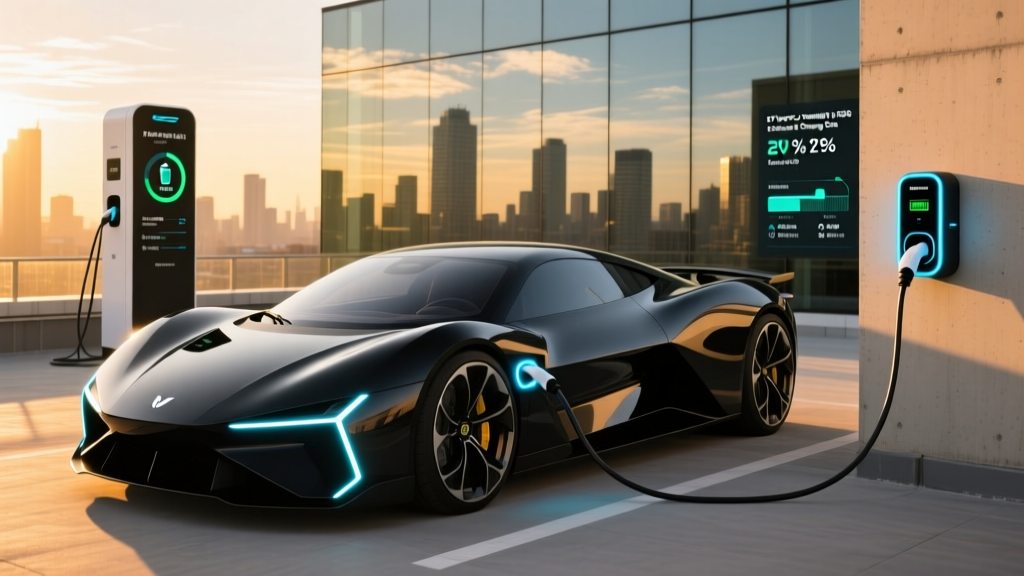
Most hypercar owners install dedicated Level 2 charging at 22 kW (requiring a 100-amp circuit). A full charge of the Nevera's 120 kWh battery at 22 kW takes approximately 5.5 hours. For owners with the Lotus Evija's 70 kWh pack at 11 kW Level 2, a full charge takes roughly 6.5 hours. Electrical panel upgrades to 400A service may be necessary, costing $3,000–$7,000 depending on your home's existing infrastructure.
Public DC Fast Charging
The Rimac Nevera's 500 kW peak charge rate is among the fastest of any production vehicle, but it requires a compatible charger. As of 2026, very few public stations deliver above 350 kW. On a 350 kW Electrify America or Tesla Supercharger V4 stall, expect:
- 10–80% in ~22–25 minutes (not the 19 minutes possible at 500 kW)
- Charge curve taper begins around 60% SoC, dropping to ~150 kW above 80%
- Preconditioning is critical — without battery warm-up, cold-soak can cut peak charge rates by 40–50%
Hypercar ground clearance (often 3.5–4.5 inches) can make some public charging stalls physically inaccessible due to curb height and cable routing.
Connector Compatibility
All current EV hypercars sold in the US use the CCS1 connector standard. The industry-wide shift to NACS (Tesla's connector) does not yet affect these low-volume vehicles. Owners may need a CCS-to-NACS adapter for future Supercharger access, though Tesla's 2026 Supercharger network compatibility with non-Tesla CCS vehicles remains limited to select stations.
Common EV Hypercar Misconceptions
| Myth | Fact |
|---|---|
| "EV hypercars have no range limitations." | At highway speeds, real range is 200–220 miles for a Nevera — comparable to many mainstream EVs. Track use drops this to under 40 minutes of lapping. |
| "You can charge anywhere, anytime." | 500 kW chargers are extremely rare. Most public DCFC stalls deliver 50–150 kW, adding 30–60+ minutes to a 10–80% charge for a 120 kWh pack. |
| "EV hypercars qualify for the $7,500 federal tax credit." | No. The IRS §30D credit caps at $55,000 MSRP for sedans (and $80,000 for SUVs/trucks). A $2.4M hypercar is ineligible. Buyer income limits ($300K joint / $150K single) also apply. |
| "Maintenance is essentially free." | While there are no oil changes, hypercar-specific tires ($3,000–$4,000 per corner), brake fluid flushes, coolant system service for battery thermal management, and software-calibration visits run $8,000–$15,000/year. |
| "Battery replacement will bankrupt you." | Rimac and Pininfarina offer 8-year/high-mileage battery warranties with 70% capacity retention guarantees. Out-of-warranty replacement for a 120 kWh NMC pack is estimated at $80,000–$120,000, but these packs are engineered for 200,000+ mile cycle life. |
| "They're self-driving on the highway." | EV hypercars have minimal ADAS. Most lack even basic lane-centering. The Rimac Nevera offers adaptive cruise control, but no system in this segment approaches SAE Level 2 automation like Tesla Autopilot or GM Super Cruise. |
First-Time EV Hypercar Buyer: What You Must Know
Purchase Process
You cannot walk into a dealership and buy an EV hypercar. All three major models allocate through application, deposit (typically $50,000–$200,000), and factory configuration. Wait times for remaining allocation slots in 2026 range from 6–18 months. The secondary market (via dealers like DuPont Registry or auction houses) often commands premiums of 10–30% over MSRP for delivered examples.
Insurance Reality
Specialty insurers (Hagerty, Chubb, AIG Private Client) underwrite hypercar policies. Expect:
- Annual premiums: $45,000–$90,000 depending on driving record, mileage limits, and storage conditions
- Agreed-value policies (not actual cash value) are standard
- Mileage restrictions: many policies cap at 2,500–5,000 miles/year
- Track-day coverage is an add-on rider, typically $5,000–$15,000/year extra
- Garage requirements: climate-controlled, secured storage is mandatory for policy issuance
Storage and Climate Considerations
NMC battery chemistry — used in all current EV hypercars — degrades faster in sustained high temperatures. If you live in Phoenix or Dubai, a climate-controlled garage maintaining 60–75°F is essential for long-term battery health. Conversely, extreme cold (below 20°F) temporarily reduces available capacity by 20–30% and disables full-power launch modes until the battery warms.
Tire Wear
The instant torque of a 1,900 hp EV hypercar accelerates tire wear dramatically. Michelin Pilot Sport Cup 2 or Pirelli P Zero Trofeo R tires — the standard fitments — typically last 2,000–4,000 miles under normal road use, and far less with hard launches. Budget $12,000–$16,000 per set, with replacement every 12–18 months at typical mileage.
Decision Framework: Should You Buy an EV Hypercar?
Choose an EV Hypercar If:
- You want the fastest-accelerating production cars ever built (sub-2.0-sec 0–60)
- You have climate-controlled garage space with 100A+ electrical service
- You drive fewer than 5,000 miles/year and accept 165–220 mile real-world range
- You value instant torque delivery and near-silent operation over engine sound
- You view the purchase as a collectible — limited production runs support residual values
- Your net worth comfortably supports a $2M+ depreciating asset with $65K+/year carrying costs
Choose a Gas Hypercar Instead If:
- Track-day endurance matters — gas hypercars refuel in 3 minutes vs. 20+ minutes for EVs
- You want the sensory experience of a W16 or V8 engine at 7,000+ RPM
- You plan cross-country touring where DC fast charging infrastructure is sparse
- You prioritize established service networks (Bugatti has 30+ authorized service points globally)
Choose a High-Performance EV (Not Hypercar) If:
- Your budget is under $150,000 — the Lucid Air Sapphire ($108,000, 1,234 hp, EPA 427 mi) or Tesla Model S Plaid ($108,490, 1,020 hp, EPA 396 mi) deliver 90% of the thrill at 4% of the cost
- You need daily usability: 4 doors, 300+ mile range, and access to widespread service centers
- You want modern ADAS features for highway commuting
Frequently Asked Questions
Can I daily-drive an EV hypercar?
Technically yes, but practically no. Ground clearance of 3.5–4.5 inches makes speed bumps and driveways hazardous. The 165–220 mile real-world range requires careful trip planning. Insurance policies often restrict annual mileage. Most owners trailer these cars to events or track days.
Do EV hypercars hold their value?
Limited production runs (99–150 units) create scarcity that supports residuals. The Rimac Nevera has held approximately 80–85% of its MSRP on the secondary market as of 2026, outperforming many gas hypercars that depreciate 20–30% in three years. However, this is highly dependent on mileage, condition, and provenance.
What happens if the battery degrades?
All three major EV hypercars carry 8-year battery warranties guaranteeing 70% capacity retention. Rimac's modular pack design allows individual module replacement rather than a full $100K+ pack swap. Real-world data from early Nevera owners (2022–2026) shows approximately 4–6% degradation at 15,000–20,000 miles — well within warranty thresholds.
Is the Rimac Nevera faster than a Bugatti Chiron?
In a straight line to 60 mph, yes — the Nevera's 1.74-second time beats the Chiron's 2.4 seconds. However, the Chiron's 304 mph top speed (Super Sport variant) exceeds the Nevera's 258 mph. Above 180 mph, the Chiron's quad-turbo W16 pulls harder due to the Nevera's single-speed reduction gearing and increasing aerodynamic drag on its 4,728-lb frame.
What electrical service do I need at home?
For 22 kW Level 2 charging, you need a dedicated 100-amp, 240-volt circuit. Most residential panels (200A total service) require an upgrade to 400A to support this alongside normal household loads. Budget $3,000–$7,000 for the panel upgrade and $1,500–$3,000 for the charger installation (hardwired, not plug-in). Consult a licensed electrician — never attempt this as a DIY project given the amperage involved.
Are EV hypercars eligible for any tax incentives?
No. The IRS §30D federal tax credit is capped at vehicles with an MSRP of $55,000 (sedans) or $80,000 (SUVs/vans/trucks), and buyer modified adjusted gross income cannot exceed $300,000 (joint) or $150,000 (single). A $2.4 million hypercar exceeds these limits by orders of magnitude. Some states offer additional incentives, but none apply to vehicles in this price range. Consult a tax professional for your specific situation.