Your EV Garage Starts With the Right Electric Impact Drill
Quick Answer: The best electric impact drill for EV owners mounting a Level 2 home charger is a brushless 18V/20V cordless model producing at least 1,800 in-lbs of torque — such as the Milwaukee M18 Fuel or DeWalt 20V MAX XR. You need it to drill into masonry or studs for a 240V NEMA 14-50 outlet or hardwired wall connector. Budget $120–$250 for the tool, plus $500–$2,000 for the licensed electrician who actually does the wiring. The drill is for mounting hardware only; never DIY the high-voltage electrical work.
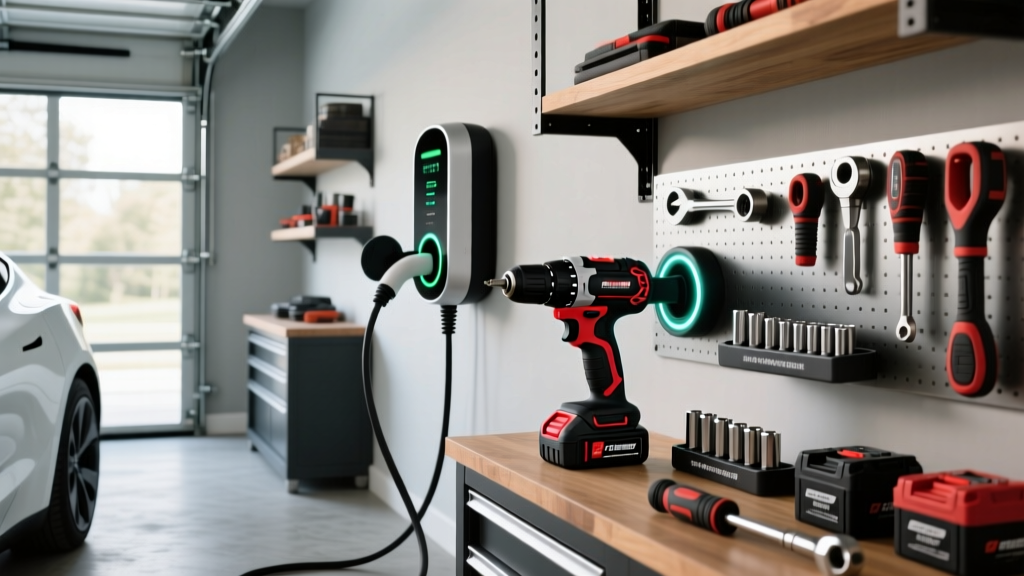
Buying an electric vehicle is only half the equation. The other half is preparing your garage for daily Level 2 charging, and that preparation starts with a physical installation that requires real tools. Whether you're hanging a ChargePoint Home Flex, a Tesla Wall Connector, or an Emporia Vue charger, you'll need to drill into drywall, wood studs, or concrete block to mount the bracket and route conduit. A quality electric impact drill (more precisely, an impact driver paired with a hammer drill for masonry) is the first tool EV owners reach for.
This guide covers the exact tool specs you need, how EV home charging installation actually works, what it costs compared to fueling a gas car, and the real-world ownership factors — from cold-weather range loss to tax credits — that every first-time EV buyer should understand before signing a purchase agreement.
Why EV Owners Need a Reliable Electric Impact Drill
Level 2 home chargers (240V, typically 32–48 amps) weigh between 12 and 20 pounds and mount to your garage wall using lag bolts driven into studs or masonry anchors drilled into concrete. The mounting process requires:
- Drilling pilot holes into wood studs (standard framing) or CMU/concrete block walls
- Driving 3/8" or 1/2" lag screws to secure the charger mounting bracket
- Running conduit holes through drywall or exterior walls for the 240V circuit
- Securing cable management hooks along the wall for the charging cord
A standard 12V cordless drill can handle drywall and light wood screws, but it will stall on concrete anchors and large lag bolts. You need a brushless electric impact drill rated for at least 1,800 inch-pounds of torque and 2,500+ RPM. Here's how the top picks compare for EV charger installation:
| Tool | Voltage | Torque | Weight | Price (2026) | Best For |
|---|---|---|---|---|---|
| Milwaukee M18 Fuel Impact Driver | 18V | 2,000 in-lbs | 2.3 lbs | $179 | Concrete anchors, heavy lag bolts |
| DeWalt 20V MAX XR Impact | 20V | 1,825 in-lbs | 2.0 lbs | $149 | All-around garage use |
| Makita XDT16Z | 18V LXT | 1,710 in-lbs | 2.1 lbs | $159 | Precision work, tight spaces |
| Ryobi ONE+ HP Brushless | 18V | 2,200 in-lbs | 2.5 lbs | $119 | Budget option, high torque |
Pair any of these with a hammer drill function (or a separate rotary hammer for extensive concrete work) when mounting into masonry garage walls, which are common in regions like Florida and the Southwest.
Level 2 Charger Installation: What the Electrician Actually Does
Your electric impact drill handles the mounting hardware. The electrical work — running a dedicated 40–60 amp, 240V circuit from your breaker panel to the charger location — must be performed by a licensed electrician. Here's a realistic cost breakdown for a typical 2026 home installation:
| Component | Low Estimate | High Estimate | Notes |
|---|---|---|---|
| Level 2 charger unit (ChargePoint, Tesla, Emporia) | $350 | $700 | 48A hardwired units cost more than plug-in NEMA 14-50 models |
| Electrical permit | $50 | $200 | Varies by municipality |
| Electrician labor (run 240V circuit, 6 AWG wire) | $400 | $1,500 | Depends on panel proximity; longer runs = higher cost |
| Panel upgrade (if needed: 100A → 200A) | $1,500 | $3,500 | Older homes may need this; not required for most modern panels |
| Mounting hardware & conduit | $50 | $150 | Where your electric impact drill earns its keep |
| Total (no panel upgrade) | $850 | $2,550 | Most homeowners pay $1,200–$1,800 |
Important: The federal government does not currently offer a direct tax credit for residential EV charger installation under §30D. Some states and utilities offer rebates — check your local utility and the Alternative Fuels Data Center for state-specific incentives. Always verify current-year rules, as they change frequently.
EV vs. Gas: The Real Cost of Ownership in 2026
Once your charger is mounted (thanks to your electric impact drill and a good electrician), the ongoing economics of EV ownership become the main question. Here's how a mainstream EV like the 2026 Hyundai Ioniq 5 SE (EPA 303 miles, 77.4 kWh battery, $44,950 MSRP) compares to a popular gas crossover like the 2026 Toyota RAV4 LE AWD (EPA 30 MPG combined, ~$31,000 MSRP) over 5 years and 75,000 miles:
| Cost Category | Hyundai Ioniq 5 SE (EV) | Toyota RAV4 LE AWD (Gas) |
|---|---|---|
| Purchase price (MSRP) | $44,950 | $31,000 |
| Estimated federal tax credit (§30D) | −$3,750 to −$7,500* | $0 |
| Home charging install | $1,500 | $0 |
| Fuel/energy (75K mi) | $2,250 (home, $0.13/kWh avg) | $8,750 ($3.50/gal, 30 MPG) |
| Maintenance (5 years) | $1,200 | $3,500 |
| Insurance (5-year avg) | $9,500 | $7,500 |
| 5-year total (approx.) | $55,650 (after max credit: $48,150) | $50,750 |
*§30D credit eligibility depends on MSRP caps ($55K SUVs / $80K vans-trucks), buyer income limits ($150K single / $300K joint AGI), and battery critical-mineral sourcing requirements. Consult the IRS clean vehicle credits page and a tax professional before relying on a specific credit amount.
The EV saves significantly on fuel and maintenance — no oil changes, no transmission fluid, no spark plugs, and regenerative braking extends pad life to 80,000+ miles in many cases. But insurance premiums run 15–25% higher for EVs due to costlier collision repairs, and the upfront price gap is real. The math works best when you have home charging access and drive 12,000+ miles annually.
Common EV Myths vs. Facts
| Myth | Fact |
|---|---|
| "EV batteries need replacing every 5 years" | Modern NMC and LFP batteries are warrantied for 8 years/100,000 miles at 70%+ capacity retention. Real-world data from Recurrent shows average degradation of ~12% after 5 years for liquid-cooled packs. |
| "You can't drive an EV in cold weather" | Cold reduces range by 15–30% (verified by AAA and fueleconomy.gov testing). A 300-mile EV may deliver 210–255 miles at 20°F. Preconditioning while plugged in recovers significant range. |
| "Public charging is always broken" | Reliability varies by network. Tesla Superchargers maintain ~97% uptime. Electrify America and ChargePoint DC stations average 80–85% uptime. Plan routes around reliable networks. |
| "I need a 400-mile EV to road trip" | With 200–350 kW DC fast charging, a 10–80% session takes 18–25 minutes. Most road-trippers stop every 2–3 hours anyway. Charging speed matters more than total range. |
| "I can install my own 240V charger outlet" | DIY 240V electrical work is dangerous, violates code in most jurisdictions, and voids your homeowner's insurance coverage for related incidents. Always hire a licensed electrician. Your electric impact drill is for mounting brackets — not wiring. |
First-Time EV Buyer's Decision Framework
Use this if/then framework to decide if an EV is right for your situation:
- IF you have a garage or dedicated parking spot where a Level 2 charger can be installed → THEN an EV is highly practical. Daily home charging eliminates most range concerns.
- IF you rely exclusively on street parking or apartment living with no charging access → THEN consider a PHEV (plug-in hybrid like the Toyota RAV4 Prime, 42 miles electric-only) or wait until workplace/public charging is confirmed.
- IF your daily commute is under 80 miles round-trip → THEN virtually any modern EV (200+ mile EPA range) will work, even accounting for cold-weather and highway losses.
- IF you regularly tow over 3,000 lbs or drive 500+ mile routes in rural areas → THEN check specific model towing ratings and verify DC fast-charger coverage along your routes. The Ford F-150 Lightning (EPA 230–320 mi, 5,000–10,000 lb tow rating) or Rivian R1T are purpose-built options.
- IF you want the lowest total cost of ownership → THEN prioritize models eligible for the §30D credit, LFP battery chemistry (longer cycle life, lower degradation), and home charging at off-peak utility rates ($0.08–$0.13/kWh).
Real-World Ownership Considerations Beyond the Garage
Climate matters. If you live in Minnesota, Montana, or New England, expect 20–30% range reduction in sustained sub-freezing temperatures. A heat pump (standard on the Ioniq 5, Tesla Model Y, and BMW iX) reduces this penalty by roughly 10% compared to resistive heating. Precondition your cabin while the car is still plugged in to preserve range.
Charging speed isn't just about peak kW. A car that peaks at 250 kW but tapers aggressively after 60% SoC may charge slower overall than one sustaining 180 kW to 80%. The Hyundai Ioniq 5 and Kia EV6 (both on the E-GMP 800V architecture) sustain high charge rates longer, achieving 10–80% in approximately 18 minutes at a 350 kW station. Always check the full charge curve, not just the peak number.
Insurance is the hidden cost. According to industry data, EV insurance premiums average 15–25% higher than equivalent gas vehicles. Get quotes before purchasing — the gap can be $400–$800/year depending on model and state.
Maintenance is genuinely minimal. EVs eliminate oil changes, transmission service, and exhaust repairs. Expect to replace cabin air filters ($30–$60), brake fluid (every 2–3 years, $80–$120), and tires (EVs are heavier and torque-heavy; expect 30,000–45,000 miles on OEM tires). Total annual maintenance: $200–$400 vs. $600–$1,000 for a gas car.
Frequently Asked Questions
Can I use a regular cordless drill instead of an electric impact drill for mounting my EV charger?
For drywall anchors and small screws into wood studs, a standard 12V drill works. For the 3/8"–1/2" lag bolts that secure a 15+ lb charger to studs or masonry, you need the higher torque (1,800+ in-lbs) of an electric impact drill. Using an underpowered drill risks stripped fasteners, insecure mounting, and a charger that could pull free from the wall.
How much does home EV charging cost per mile compared to gas?
At the US average residential rate of $0.16/kWh (EIA 2025 data) and an EV efficiency of 3.5 miles/kWh (typical for a midsize crossover), home charging costs approximately $0.046 per mile. A gas car at 30 MPG and $3.50/gallon costs $0.117 per mile — roughly 2.5× more. Over 15,000 miles/year, that's $690 for electricity vs. $1,750 for gas, a savings of about $1,060 annually.
Do I need a 200-amp electrical panel for a Level 2 charger?
Not always. A 48-amp Level 2 charger draws about 60 amps of panel capacity (per NEC 80% continuous-load rule). Most modern 100-amp or 150-amp panels can accommodate this if they have sufficient spare capacity. Your electrician will perform a load calculation. A panel upgrade to 200 amps costs $1,500–$3,500 but is only required if your existing panel is near capacity.
Is it worth buying an electric impact drill just for EV charger installation?
If you plan to mount only one charger and have no other projects, you can rent a brushless impact driver from Home Depot or a local tool library for $25–$40/day. However, most EV owners find ongoing garage use for the tool — mounting shelving, building workbenches, installing bike racks, and securing cable management hooks. At $120–$200, it pays for itself within a few projects.
What's the difference between NACS and CCS connectors for home charging?
For Level 2 home charging, all EVs use the J1772 connector (or Tesla's proprietary connector, which is NACS-compatible). The NACS vs. CCS distinction matters primarily for DC fast charging. As of 2025–2026, most automakers have adopted NACS (Tesla's standard) for new models. If you buy a CCS-equipped EV, adapters are available. For home Level 2, connector compatibility is rarely an issue — choose a charger with the right plug for your vehicle, or use a universal J1772-to-NACS adapter.