What Is EV Foam?
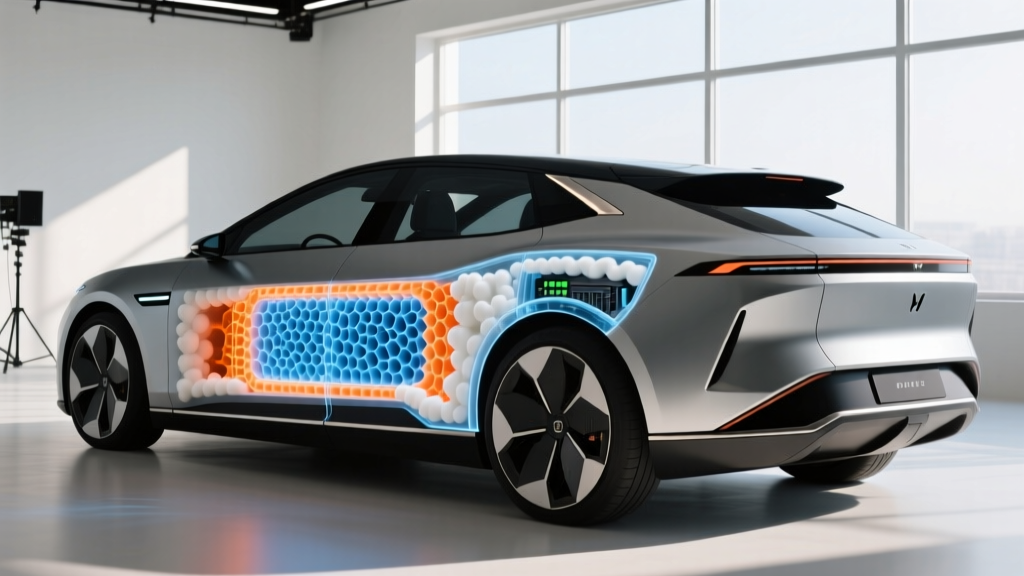
EV foam refers to the specialized insulating and protective foam materials used inside electric vehicle battery packs and around high-voltage components. Its primary roles are thermal management (keeping battery cells within optimal temperature ranges), acoustic dampening (reducing road and motor noise), vibration absorption, and fire propagation resistance. Modern EVs in 2026 use a combination of polyurethane, silicone-based, and aerogel-infused foams engineered to withstand the extreme thermal loads of fast charging and cold-weather operation. It is not a consumer-facing feature you select at purchase — it's a critical engineering component that directly impacts your real-world range, charging speed, and long-term battery health.
Why EV Foam Matters for Your Battery and Range
Every EV buyer obsesses over EPA range and battery capacity in kWh, but the unsung hero behind those numbers is thermal management — and foam insulation is a foundational layer of that system. Lithium-ion battery cells (whether NMC or LFP chemistry) operate most efficiently between roughly 20°C and 40°C (68°F–104°F). Outside that window, you lose range, sacrifice charging speed, and accelerate long-term degradation.
EV foam works in concert with active liquid cooling and heating loops. While the coolant plates handle the heavy thermal lifting during DC fast charging or extreme ambient temperatures, the foam provides passive insulation that reduces the energy the thermal management system must expend to maintain cell temperature. Less energy spent on heating or cooling means more energy directed to the wheels.
Consider the practical impact: in cold-weather testing, EVs with advanced aerogel-based insulation foams have demonstrated 5–8% less range loss at 20°F compared to earlier-generation packs relying on basic polyurethane barriers. On a vehicle with a 320-mile EPA range, that's the difference between seeing ~230 miles and ~250 miles of real-world winter range — a meaningful buffer when you're 40 miles from the next charger.
Types of Foam Used in EV Battery Packs
Not all EV foam is created equal. Automakers and tier-one suppliers use several foam categories, each serving distinct functions within the battery enclosure:
| Foam Type | Primary Function | Typical Location | Key Properties |
|---|---|---|---|
| Polyurethane (PU) foam | Structural cushioning, vibration dampening | Between modules, pack perimeter | Low cost, good compression recovery, moderate thermal insulation |
| Silicone foam | Thermal insulation, fire resistance | Cell-to-cell barriers, module wraps | High temp stability (up to ~300°C), flame retardant, flexible |
| Aerogel-infused foam | Ultra-low thermal conductivity insulation | Pack floor, lid, critical thermal bridges | Extremely low k-value (~0.015 W/m·K), lightweight, premium cost |
| Intumescent foam/pads | Fire propagation barrier | Between cells, around bus bars | Expands when heated to seal gaps, delays thermal runaway propagation |
| Acoustic foam | NVH (noise, vibration, harshness) reduction | Pack exterior, underbody panels, cabin floor | Open-cell structure absorbs road/motor noise |
Companies like DuPont, 3M, Rogers Corporation, and Zotefoams supply these materials to major OEMs. In 2026, the trend is toward multi-functional foams that combine thermal insulation with fire protection in a single layer, reducing pack weight and assembly complexity.
How EV Foam Affects Cold-Weather Range and Charging
Cold weather is the single biggest real-world range killer for EVs. At 20°F, the average EV loses 20–30% of its EPA-rated range due to a combination of increased cabin heating demand, higher battery internal resistance, and energy consumed by the pack heater. Foam insulation directly addresses one of these factors: it slows heat loss from the battery pack, reducing the duty cycle of the electric pack heater.
Here's where the data gets practical. A 2025 study by the Idaho National Laboratory found that pack-level thermal insulation improvements — including advanced foam and aerogel barriers — reduced the energy consumed by battery heating systems by approximately 12–18% during cold-soak scenarios. On a vehicle with an 82 kWh usable battery, that translates to roughly 1.5–2.5 kWh saved per cold-start cycle — enough for an extra 5–8 miles of range in winter conditions.
Foam insulation also impacts DC fast charging in cold weather. Battery preconditioning — the process of warming cells to ~30–35°C before high-power charging — happens faster and with less energy when the pack is well-insulated. If you've ever arrived at a Supercharger or Electrify America station and watched the charge curve crawl because the pack was still cold, better insulation means you reach peak charge kW sooner.
Cold-Weather Range Reality Check
EPA sticker: 320 miles
Real-world at 70°F highway: ~280–295 miles
Real-world at 20°F with basic insulation: ~220–240 miles
Real-world at 20°F with advanced foam/aerogel insulation: ~240–260 miles
Insulation won't eliminate cold-weather losses, but it narrows the gap. Combined with a heat pump for cabin heating, the best-insulated 2026 EVs are closing in on all-season usability.
EV Foam and Fire Safety: Thermal Runaway Protection
Battery fires are rare — NHTSA data and independent analyses consistently show EVs have a lower fire incidence rate than internal combustion vehicles. But when a lithium-ion cell does enter thermal runaway (typically from a severe impact, manufacturing defect, or extreme abuse), the priority shifts to containing it and preventing propagation to adjacent cells.
This is where intumescent foams and silicone-based fire barriers earn their keep. These materials are engineered to:
- Expand when heated, filling gaps and sealing off oxygen pathways between cells
- Delay propagation by minutes to tens of minutes, giving occupants time to exit
- Withstand temperatures exceeding 1,000°C for short durations without structural failure
The 2026 regulatory environment is also pushing this forward. Updated UN GTR 20 (Global Technical Regulation for EV safety) and China's GB 38031 standard now require that thermal runaway in a single cell must not propagate to cause a passenger-compartment hazard within five minutes. Advanced foam barriers are one of the primary engineering solutions OEMs use to meet this requirement without adding excessive weight.
Cost Impact: Does Better Insulation Foam Make EVs More Expensive?
The short answer: marginally at the component level, but the value shows up in total ownership. Aerogel-based insulation foams cost roughly 3–5x more per square meter than standard polyurethane. In a typical 80–100 kWh battery pack, the total foam and insulation material cost might range from $80–$150 for basic PU setups to $250–$500 for advanced multi-layer systems with aerogel and intumescent barriers.
| Cost Factor | Basic PU Foam Pack | Advanced Multi-Layer Pack (Aerogel + Silicone + Intumescent) |
|---|---|---|
| Foam material cost | $80–$150 | $250–$500 |
| Winter range benefit (est.) | Baseline | +15–25 miles at 20°F |
| Cold-weather fast-charge prep | Slower preconditioning | Faster time to peak kW |
| Thermal runaway delay | Moderate | 5+ minutes (meets GTR 20) |
| Pack weight impact | ~2–4 kg | ~3–6 kg (offset by reduced coolant loop duty) |
When you're evaluating a $42,000–$65,000 EV purchase, a few hundred dollars in insulation materials is a rounding error — but the downstream effects on winter usability, charging speed, and long-term battery degradation (less thermal cycling stress) are meaningful over a 10-year ownership period.
EV vs. Gas: Where Insulation Fits in the Ownership Equation
| Factor | Electric Vehicle | Gasoline Vehicle |
|---|---|---|
| Thermal management complexity | High — battery, motors, power electronics all require active + passive thermal control | Moderate — engine cooling loop, cabin heater uses waste engine heat |
| Cold-weather range/efficiency loss | 20–30% range loss at 20°F (mitigated by insulation + heat pump) | 10–15% fuel economy loss (cabin heat is essentially free from engine waste heat) |
| Noise insulation needs | Higher — no engine noise to mask road/wind noise; acoustic foam is critical for cabin refinement | Lower — engine noise masks road noise; less acoustic treatment needed |
| Fire risk profile | Lower incidence, harder to extinguish (thermal runaway); foam barriers critical for propagation delay | Higher incidence, well-understood suppression; fuel system design focus |
| Annual "fuel" cost (15,000 mi/yr) | ~$540–$720 (home Level 2 at $0.13/kWh, 3.5 mi/kWh) | ~$1,680–$2,100 ($3.50–$4.00/gal, 28 MPG combined) |
The insulation story highlights a fundamental EV trade-off: you trade the free waste heat of a gas engine for a complex thermal management challenge. Good foam insulation is one of the tools engineers use to close that gap, particularly in climates with cold winters.
What First-Time EV Buyers Should Know About Thermal Management
You won't find "EV foam" on a window sticker or spec sheet. But you can evaluate a vehicle's thermal management sophistication — which includes its insulation strategy — through these proxy indicators:
- Heat pump presence: A heat pump (standard on the Hyundai Ioniq 5, Tesla Model Y, and most 2026 VW ID. models) signals a manufacturer that has invested in comprehensive thermal efficiency. Vehicles with heat pumps almost always also feature better pack insulation.
- Cold-weather range retention data: Check owner forums and fueleconomy.gov for real-world winter range reports. Vehicles that hold range better in cold weather typically have superior insulation and thermal management.
- Preconditioning features: If the vehicle offers battery preconditioning for scheduled charging or navigation-to-charger warming (Tesla, Rivian, Porsche, Hyundai/Kia all offer this in 2026), it indicates an active thermal system paired with passive insulation.
- Battery warranty terms: The federal minimum is 8 years/100,000 miles, but manufacturers confident in their thermal management (including insulation protecting against degradation from thermal cycling) often stand behind longer coverage. Hyundai offers 10 years/100,000 miles on the battery.
Does Insulation Quality Change Your Purchase Decision?
If you live in a mild climate (rarely below 40°F): Foam insulation quality is a nice-to-have. Focus on EPA range, charging speed (peak kW + 10–80% time), and price.
If you live in a cold climate (regularly below 32°F): Prioritize vehicles with heat pumps, battery preconditioning, and documented cold-weather range retention. These features correlate with better insulation design. Expect 20–30% winter range loss regardless — budget your charging stops accordingly.
If you DC fast-charge frequently: Good thermal insulation helps sustain peak charge rates longer by reducing the thermal management system's workload during high-current sessions. Look for vehicles that sustain above 100 kW past 60% SoC — that's a sign of effective thermal design, including insulation.
Frequently Asked Questions
Can I add aftermarket foam insulation to my EV battery?
No. Battery pack insulation is engineered at the cell and module level during manufacturing. Opening or modifying a high-voltage battery pack is extremely dangerous (voltages of 400V–800V) and will void your battery warranty. If you're concerned about cold-weather range, use your vehicle's preconditioning features and consider a garage or car cover to reduce cold-soak severity.
Does EV foam insulation degrade over time?
Most automotive-grade foams (silicone, polyurethane, aerogel composites) are designed for 15+ year service life within the sealed battery enclosure. They don't experience the UV exposure, moisture cycling, or mechanical fatigue that exterior components face. Degradation is not a practical concern for typical ownership periods.
Do all EVs use the same type of battery foam?
No. Budget-oriented EVs may use basic polyurethane cushioning with minimal thermal barriers, while premium and long-range models typically employ multi-layer systems combining aerogel insulation, silicone fire barriers, and intumescent pads. The Tesla Model 3 Highland, Hyundai Ioniq 5, and BMW iX all use different foam strategies optimized for their respective pack architectures and price points.
Is EV foam related to the foam used in EV tires?
They're separate systems. Some EV-specific tires (like the Michelin Pilot Sport EV or Hankook iON) include acoustic foam liners inside the tire cavity to reduce road noise resonance — a separate application from battery pack insulation foam. Both address noise, but in completely different locations and with different materials.
How does insulation foam factor into the §30D federal tax credit?
It doesn't directly. The IRS §30D tax credit eligibility depends on MSRP caps ($55,000 for sedans, $80,000 for SUVs/trucks), buyer income limits ($150K single / $300K joint), battery component manufacturing origin, and critical mineral sourcing. However, vehicles that invest in advanced insulation tend to be from manufacturers with more sophisticated overall engineering — which often correlates with better credit-eligible battery sourcing compliance. Always verify current-year eligibility on irs.gov before purchasing.