When shoppers talk about EV design, they usually mean styling. But the design decisions that actually determine your daily experience happen under the skin: whether the vehicle was engineered as an electric from day one or adapted from a gas-car platform, where the battery sits, how the motors are packaged, and what chemistry powers the cells. These choices dictate EPA range, interior volume, charging speed, weight distribution, and ultimately what you pay at the dealership and the charger.
Quick Answer
A dedicated EV platform (e.g., Hyundai E-GMP, GM Ultium, VW MEB) typically delivers 10-15% more usable interior space, lower center of gravity, and 5-10% better efficiency than an adapted gas-car platform at the same price point. For buyers, the most practical EV design indicators are: battery kWh capacity, wheelbase length, motor count, and whether the vehicle supports 800V architecture for faster DC charging.
Why Platform Architecture Is the Biggest EV Design Decision
Every electric vehicle on sale in 2026 falls into one of two categories: dedicated EV platforms built from scratch around a battery pack and electric motors, or adapted platforms where engineers modified an existing internal-combustion architecture to accept batteries and motors. The difference shows up in your driveway.
Dedicated platforms eliminate the transmission tunnel, exhaust routing, and engine bay constraints of gas vehicles. That freed space becomes cargo room, legroom, or a larger battery. The Hyundai Ioniq 5, built on the E-GMP platform, packs an 84 kWh usable NMC battery into a crossover footprint while offering 53.1 cu ft of rear cargo space with seats folded — competitive with midsize SUVs built on frames twice as long.
Adapted platforms, like the one underpinning the Subaru Solterra (co-developed with Toyota's bZ4X on the e-TNGA architecture), often carry compromises: raised floor heights that reduce headroom, smaller battery packs limited by the original chassis dimensions, and charge ports placed where gas filler doors used to be rather than where they're most convenient. The Solterra's 71.4 kWh battery yields an EPA-estimated 222 miles in its most efficient trim — roughly 80 miles fewer than the dedicated-platform Ioniq 5 at a similar MSRP.
| Metric | Dedicated (Ioniq 5 SEL AWD) | Adapted (Solterra Limited) | Gas Baseline (Toyota RAV4 XLE) |
|---|---|---|---|
| Platform | Hyundai E-GMP | e-TNGA (adapted) | TNGA-K (ICE) |
| EPA Range | 290 mi | 222 mi | N/A (410 mi tank) |
| Usable Battery | 84 kWh (NMC) | 71.4 kWh (NMC) | N/A |
| Peak DC Charge | 238 kW (800V) | 100 kW (400V) | N/A |
| 10-80% DC Time | ~18 min | ~56 min | N/A |
| Cargo (seats down) | 53.1 cu ft | 56.9 cu ft | 69.8 cu ft |
| Base MSRP | $49,850 | $46,295 | $32,350 |
| MPGe (combined) | 110 MPGe | 102 MPGe | 30 MPG |
Sources: fueleconomy.gov side-by-side comparison, manufacturer spec sheets.
How Battery Placement and Chemistry Shape Real-World Driving
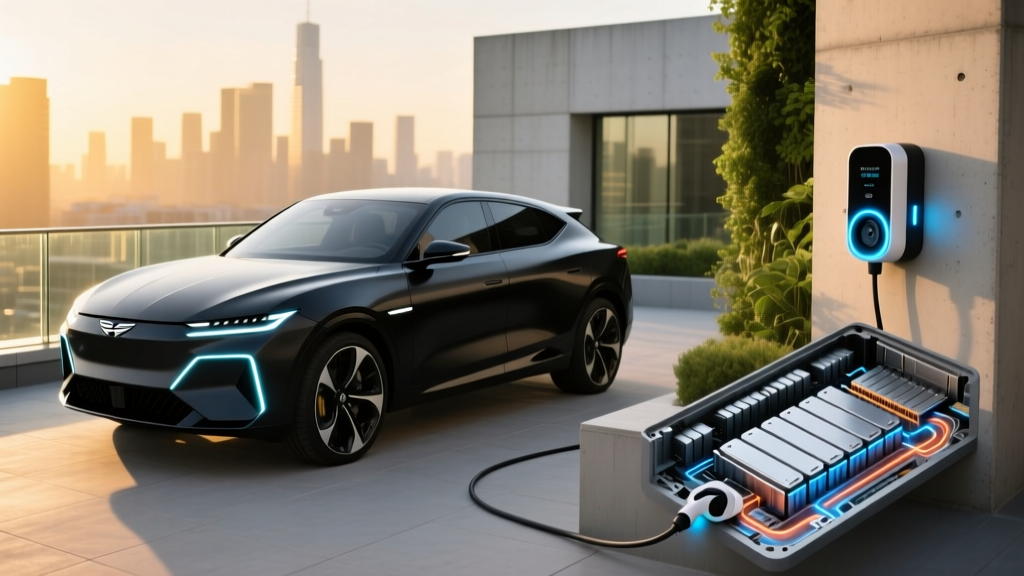
The most recognizable feature of dedicated EV design is the skateboard platform: a flat battery pack mounted beneath the floor between the axles. This placement drops the center of gravity to roughly 18 inches — comparable to a Porsche 911 — which improves handling and reduces rollover risk. NHTSA data consistently shows dedicated-platform EVs earning 5-star rollover ratings, in part because of this low mass concentration.
But the chemistry inside that pack matters just as much as its position. Most 2026 EVs use either NMC (nickel manganese cobalt) or LFP (lithium iron phosphate) cells:
| Factor | NMC (e.g., Ioniq 5, F-150 Lightning) | LFP (e.g., Tesla Model 3 RWD, Ford Mustang Mach-E Select) |
|---|---|---|
| Energy Density | Higher — more range per kg | Lower — heavier for same kWh |
| Usable Capacity | ~5-95% SoC recommended | Can charge to 100% daily without degradation concern |
| Cycle Life | ~1,000-1,500 cycles to 80% SoH | ~2,500-3,500 cycles to 80% SoH |
| Cold-Weather Loss | ~25-35% range loss at 20°F | ~30-40% range loss at 20°F (worse without preconditioning) |
| Cost | $120-150/kWh (pack level) | $90-110/kWh (pack level) |
| Best For | Maximum range buyers, AWD performance trims | Daily commuters, high-mileage drivers, budget-conscious buyers |
For a buyer in Minneapolis facing -10°F January mornings, an NMC pack with a heat pump (like the Ioniq 5's standard system) will retain more usable range than an LFP pack without active preconditioning. But for a Phoenix commuter who charges nightly to 100% and drives 40 miles round-trip, LFP's longevity advantage — potentially 15+ years of daily cycling vs. 10-12 for NMC — makes it the smarter design choice.
Motor Layout and 800V Architecture: The Charging Speed Differentiator
EV design also determines how quickly you can recharge on the road. Most adapted platforms and budget EVs use 400-volt architecture, capping DC fast-charge speeds around 100-150 kW. Dedicated premium platforms increasingly use 800V systems (Hyundai E-GMP, Porsche J1, GM's newer Ultium variants), enabling peak rates of 230-350 kW.
Here's what that means in practice at a 350 kW Electrify America or Tesla Supercharger V4 station:
- 800V / 238 kW peak (Ioniq 5): 10-80% in approximately 18 minutes, adding ~200 miles of range
- 400V / 150 kW peak (most adapted platforms): 10-80% in approximately 35-40 minutes, adding ~150 miles
- 400V / 100 kW peak (Solterra, bZ4X): 10-80% in approximately 56 minutes, adding ~130 miles
Motor placement is the other hidden design variable. Single-motor RWD designs (base Tesla Model 3, Ioniq 5 SE Standard Range) are the most efficient, typically achieving 3.5-4.0 miles per kWh. Dual-motor AWD adds 80-150 hp and traction security but costs 10-15% in efficiency. Tri-motor setups (Tesla Model S Plaid, Rivian R1T Tri-Motor) deliver supercar acceleration — 0-60 in under 2.5 seconds — at the expense of weight and highway range.
Real Cost of Ownership: EV Design Choices Hit Your Wallet
Design decisions compound over five years of ownership. A dedicated-platform EV with 800V charging, a heat pump, and NMC chemistry will cost more upfront but can save thousands in charging time, efficiency, and longevity compared to an adapted-platform competitor. Here's a realistic five-year breakdown comparing a well-designed dedicated EV against both an adapted EV and a gas baseline:
| Cost Category | Dedicated EV (Ioniq 5 SEL AWD, $49,850) | Adapted EV (Solterra Limited, $46,295) | Gas (RAV4 XLE AWD, $32,350) |
|---|---|---|---|
| Purchase Price | $49,850 | $46,295 | $32,350 |
| Federal Tax Credit (§30D)* | -$7,500 (if eligible) | -$7,500 (if eligible) | $0 |
| Fuel/Energy (60k mi) | $3,600 (home L2 avg $0.14/kWh) | $4,100 | $7,200 ($3.60/gal, 30 MPG) |
| Maintenance | $1,200 (tire rotation, cabin filter, fluid top-off) | $1,200 | $3,500 (oil, filters, brakes, spark plugs) |
| Insurance (avg) | $9,000 ($1,800/yr) | $8,500 ($1,700/yr) | $7,000 ($1,400/yr) |
| Depreciation (est.) | $18,000 | $19,500 | $12,000 |
| 5-Year Total | $46,150 | $49,595 | $53,050 |
*Federal §30D tax credit eligibility depends on MSRP caps ($80,000 SUVs, $55,000 sedans), buyer income limits ($300k MFJ, $150k single), and battery critical-mineral sourcing requirements. Verify current-year rules at IRS.gov §30D. Credit can be transferred to the dealer at point of sale as of 2024+.
The dedicated-platform EV wins on fuel and maintenance savings but carries higher insurance premiums (typically 15-25% above gas equivalents due to repair costs for aluminum panels and high-voltage components) and steeper depreciation. The adapted EV sits in an awkward middle: higher energy costs from lower efficiency, slower charging that may force more expensive DC sessions, and similar insurance overhead.
First-Time EV Buyer: What EV Design Means for Your Daily Life
If you're transitioning from a gas vehicle, here are the design-driven realities that spec sheets don't highlight:
Home charging access is non-negotiable for most owners. A Level 2 home charger (240V, 32-48 amps, 7.7-11.5 kW) adds 25-44 miles of range per hour of charging. Installation costs $800-$2,500 if your panel has capacity, or $3,000-$5,000+ if you need a 200-amp panel upgrade. Without home charging, you'll rely on public DC fast chargers at $0.30-$0.48/kWh — roughly double the home rate — and spend 2-4 hours per week at stations.
EPA range is a best-case estimate. Expect 15-25% less range at sustained highway speeds (70+ mph) and 25-40% less in sub-freezing weather, regardless of platform. A 290-mile EPA rating realistically means 220-245 miles on a summer road trip and 175-210 miles in a Midwest January. Dedicated platforms with heat pumps (standard on Ioniq 5, EV6, BMW iX) lose 5-10% less range in cold than resistive-heater-equipped vehicles.
Charging curves taper hard above 80%. That "18-minute 10-80% charge" spec means the final 20% can take another 15-25 minutes. Smart trip planning means charging to 80% and moving on, not waiting for a full battery at the station.
Weight affects tires and brakes. EVs are 500-1,000 lbs heavier than gas equivalents due to battery mass. Expect tire replacement every 25,000-35,000 miles (vs. 40,000-60,000 for gas cars) and budget $800-$1,400 for a set of EV-rated tires with low rolling resistance and noise foam.
Decision Framework: Which EV Design Approach Fits You?
Choose Based on Your Situation
Choose a dedicated-platform EV (E-GMP, Ultium, MEB, SEA) if:
- You take regular road trips over 200 miles and need 800V fast-charging capability
- You want maximum interior volume relative to exterior dimensions
- You plan to keep the vehicle 8+ years and value platform longevity
- You live in a cold climate and want integrated heat-pump efficiency
- Budget allows $45,000+ before incentives
Choose an adapted-platform EV if:
- You find a compelling deal and your daily commute is under 60 miles round-trip
- You have reliable home Level 2 charging and rarely road-trip
- You prefer a specific brand's styling or dealer network and accept the range/charging trade-offs
- The adapted model is priced $5,000-$8,000 below dedicated competitors and you'll reinvest the savings in home solar or a Level 2 charger
Choose a PHEV (plug-in hybrid) instead if:
- You lack home charging access and can't install a Level 2 unit
- You regularly drive 300+ miles through charging-desert corridors
- Your budget is under $35,000 and you want electric commuting with gas-car flexibility
- You live in an apartment or condo without charging infrastructure
Common EV Design Misconceptions
| Myth | Fact |
|---|---|
| "All EVs are basically the same underneath." | Platform architecture creates 10-20% differences in efficiency, charging speed, and interior space at similar price points. |
| "More kWh is always better." | A 100 kWh pack in a heavy, inefficient adapted platform may deliver fewer real-world miles than an 84 kWh pack in a lightweight, aerodynamic dedicated design. |
| "EV batteries need replacing every 5-8 years." | Federal law mandates 8-year/100,000-mile battery warranties retaining ≥70% capacity. Real-world data from Tesla, Hyundai, and GM shows most packs retain 85-92% at 100k miles. Replacement is rare before 150k+ miles. |
| "Bigger motors mean better EVs." | Single-motor RWD designs are 10-15% more efficient and $3,000-$5,000 cheaper. AWD and performance motors are only worth the cost if you face snow/ice or need towing capacity. |
| "You need a special home charger for 800V EVs." | 800V architecture only matters at DC fast-charging stations. Home Level 2 chargers (240V AC) work identically for all EVs; the car's onboard charger converts AC to DC regardless of platform voltage. |
Frequently Asked Questions
Does EV design affect resale value?
Yes. Dedicated-platform EVs with strong charging infrastructure support (NACS compatibility, 800V capability) tend to depreciate 5-10% less over three years than adapted models, primarily because buyers increasingly recognize the charging-speed and efficiency advantages. However, the EV resale market remains volatile — all EVs depreciated more steeply than projected in 2023-2024 due to Tesla price cuts and inventory oversupply.
Can I tell if an EV uses a dedicated platform just by looking at it?
Two visual clues: a flat floor with no center tunnel hump inside the cabin, and a front trunk (frunk). Dedicated platforms almost always offer a frunk (even if small) because there's no engine. Adapted platforms typically have no frunk or only a shallow compartment. The wheelbase relative to overall length is another indicator — dedicated EVs push wheels to the corners, creating longer wheelbases for more interior room.
Are all 800V EVs faster to charge?
Not automatically. An 800V architecture enables faster charging, but the actual peak kW depends on battery chemistry, thermal management, and the manufacturer's charge-curve programming. The Hyundai Ioniq 5 (800V, 84 kWh) peaks at 238 kW and sustains above 180 kW to roughly 55% SoC. The Porsche Taycan (800V, 93.4 kWh) peaks at 270 kW but costs nearly twice as much. Always check the 10-80% time, not just the peak kW number.
What EV design features matter most for cold climates?
Prioritize a heat pump (reduces cabin-heating energy draw by 40-60% vs. resistive heaters), battery preconditioning (warms the pack before DC charging), heated seats and steering wheel (so you can lower cabin temp and save range), and NMC chemistry (which handles cold slightly better than LFP). The Ioniq 5, EV6, BMW iX, and Tesla Model Y all include heat pumps standard; some budget EVs still use resistive heating, which can cut winter range by an additional 10-15%.
How do I verify a vehicle's platform type before buying?
Check the manufacturer's press site for platform naming (E-GMP, Ultium, MEB, SEA, J1 = dedicated; e-TNGA, modified unibody = adapted). Third-party sources like IIHS and EPA data at fueleconomy.gov provide efficiency and safety data that often reflects platform quality. A dedicated platform typically shows MPGe above 100 combined and 5-star NHTSA rollover ratings.