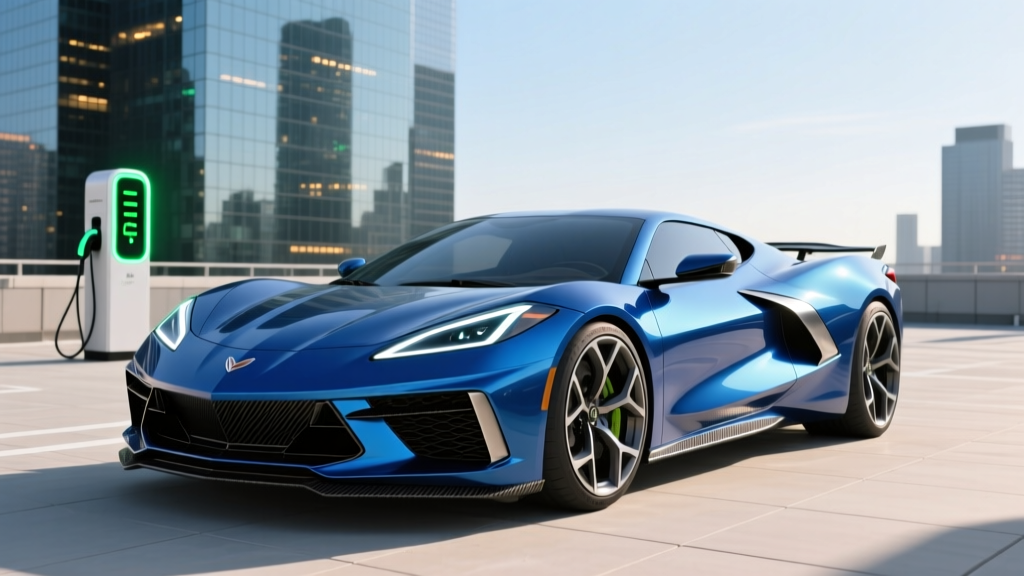
The Short Answer: Is There an EV Corvette?
As of early 2026, Chevrolet has not officially announced or released a fully electric Corvette. However, GM executives have repeatedly confirmed that an electrified Corvette is part of the brand's future, and the current C8 Zora prototype and E-Ray hybrid variant signal a clear trajectory toward full battery-electric performance. The Corvette E-Ray — a 655-hp all-wheel-drive hybrid pairing a 6.2L V8 with a front-mounted electric motor — is the closest thing available today. A fully electric Corvette, likely built on GM's Ultium-derived BEV3 or a dedicated performance architecture, is widely expected to debut no earlier than the 2028–2029 model year.
Why an EV Corvette Is Inevitable
General Motors has committed to offering 30 all-electric models globally by 2025 and aims for an all-electric light-duty lineup by 2035. The Corvette, as Chevrolet's halo performance car, cannot remain untouched by that mandate. In a 2023 interview, Corvette chief engineer Tadge Juechter confirmed that the C8 architecture was designed with electrification in mind from day one — including provisions for battery packaging, electric motor mounting, and high-voltage routing.
The E-Ray, launched for the 2024 model year and still in production for 2026, serves as the bridge. Its 1.9 kWh lithium-ion battery pack and front-axle electric motor demonstrate that Chevrolet can integrate electrified drivetrains into the mid-engine C8 platform without compromising the car's identity. The logical next step: replacing the rear V8 entirely with one or more electric motors and a substantially larger Ultium-based battery pack.
Estimated EV Corvette Specs: What an Electric C8 Could Look Like
While final specifications remain unconfirmed, we can project realistic numbers based on GM's Ultium platform capabilities, the C8 chassis dimensions, and competitive benchmarks from the Porsche Taycan, Lotus Evija, and Tesla Model S Plaid.
| Specification | Estimated EV Corvette | 2026 Corvette Stingray (Gas) | 2026 Corvette E-Ray (Hybrid) |
|---|---|---|---|
| Powertrain | Dual/Tri-Motor AWD BEV | 6.2L V8 RWD | 6.2L V8 + E-Motor AWD |
| Horsepower | 700–900 hp | 490 hp (495 w/Z51) | 655 hp combined |
| 0–60 mph | ~2.0–2.5 sec | 2.9 sec (Z51) | 2.5 sec |
| Battery Capacity | 85–110 kWh (est.) | N/A | 1.9 kWh |
| EPA Range (est.) | 250–320 miles | ~350 miles (19-gal tank) | ~280 miles (gas+elec) |
| Peak DC Fast Charge | 200–350 kW | N/A | N/A (no DC charging) |
| 10–80% Charge Time | ~18–25 min (est.) | N/A | N/A |
| Estimated Base MSRP | $90,000–$120,000 | $69,995 | $106,595 |
| Weight (est.) | 4,400–4,800 lbs | 3,637 lbs | 3,940 lbs |
Important caveat: These are projections, not manufacturer-confirmed figures. GM may opt for a dedicated performance EV platform rather than adapting Ultium directly, which could shift battery size, cell chemistry (potentially high-nickel NMC for energy density), and motor configuration.
The Weight Problem: Can an EV Corvette Still Handle Like a Corvette?
The single biggest engineering challenge for an electric Corvette is mass. The current Stingray weighs approximately 3,637 pounds. A comparable Ultium-based battery pack (100 kWh) adds roughly 1,100–1,300 pounds of cell mass alone. Even accounting for the removal of the V8, transmission, exhaust, and fuel system (saving ~600–800 lbs), the net weight increase would likely push an EV Corvette past 4,500 pounds.
That's territory the Porsche Taycan Turbo S (5,121 lbs) and Tesla Model S Plaid (4,766 lbs) already occupy — and both are praised for their handling despite their mass. The solution lies in:
- Low center of gravity: A skateboard-style battery pack mounted beneath the floor keeps weight low, improving roll stiffness.
- Torque vectoring: Individual front and rear motors (or even per-wheel motors) can distribute torque dynamically, compensating for higher inertia in corners.
- Structural battery integration: GM's Ultium pack serves as a stressed member, increasing torsional rigidity — something Lotus has exploited in the Eletre.
The real question is whether Chevrolet can preserve the Corvette's communicative, analog steering feel in a heavier, software-defined platform. This will define the car's reception among enthusiasts more than any spec-sheet number.
EV Corvette vs. Gas Stingray: Ownership Cost Comparison
Even at a higher purchase price, an electric Corvette could offer meaningful operating savings. Here's a 5-year/60,000-mile cost comparison using the projected EV variant against the current Stingray 3LT:
| Cost Category | EV Corvette (Projected $105K) | 2026 Stingray 3LT ($82K) |
|---|---|---|
| Purchase Price | $105,000 | $82,000 |
| Federal Tax Credit (§30D) | $0–$7,500* | $0 |
| Fuel/Energy (60K mi) | $2,700–$4,200** | $9,600*** |
| Maintenance (5 yr) | $800–$1,200 | $3,500–$4,500 |
| Insurance (5 yr avg.) | $14,000–$18,000 | $12,000–$15,000 |
| Estimated Depreciation | $35,000–$45,000 | $20,000–$28,000 |
| 5-Year Total (est.) | $120,000–$148,500 | $107,100–$129,900 |
* §30D tax credit eligibility for a future EV Corvette depends on 2028–2029 IRS rules, battery sourcing requirements, MSRP caps (currently $55,000 for sedans, but sports cars may fall under different classification), and buyer income limits. Check IRS.gov for current rules.
** Based on $0.14/kWh national average and 3.0–3.5 kWh/mi consumption.
*** Based on 18 MPG combined and $3.60/gal premium fuel.
The EV Corvette's higher purchase price and steeper projected depreciation (typical for first-generation EVs and high-performance electric cars) offset much of the fuel and maintenance savings. However, if GM prices the base model aggressively near $90,000 and the §30D credit applies, the gap narrows considerably.
Real-World Charging and Ownership Considerations
If you're considering a future electric Corvette — or any high-performance EV — these practical factors will shape your experience:
Home Charging Is Essential
A performance EV with a ~100 kWh battery will need a Level 2 home charger (9.6–11.5 kW) to replenish overnight. On a 11.5 kW circuit, expect roughly 9–11 hours for a full charge. Without home charging access, ownership becomes significantly more inconvenient — relying on public DC fast chargers for a daily-driver sports car is not practical for most buyers. Budget $500–$1,500 for a Level 2 charger installation (equipment + electrician), and potentially $2,000–$5,000 if your electrical panel needs a 200-amp upgrade.
DC Fast Charging on Road Trips
A 200–350 kW peak charge rate would enable 10–80% replenishment in roughly 18–25 minutes on compatible chargers. However, sustained charge rates matter more than peak numbers — expect the charge curve to taper significantly above 80% State of Charge (SoC), adding another 15–20 minutes for the final 20%. On a 300-mile road trip, plan one 25-minute stop.
Cold-Weather Range Loss
High-performance EVs typically use NMC (nickel-manganese-cobalt) chemistry for energy density, which suffers 20–30% range reduction in sub-freezing temperatures. A projected 300-mile EPA range could drop to 210–240 miles in winter highway driving. A heat pump (standard on most modern Ultium vehicles) mitigates cabin heating losses but doesn't fully eliminate cold-weather range penalties.
Common EV Corvette Misconceptions
| Myth | Fact |
|---|---|
| "An electric Corvette won't feel like a real Corvette." | Instant torque delivery and AWD torque vectoring could produce sub-2.5-second 0–60 times — faster than any production C8 gas model. The emotional question is sound and steering feel, not straight-line speed. |
| "The E-Ray is basically an EV Corvette." | The E-Ray's 1.9 kWh battery provides less than 4 miles of electric-only driving at low speeds. It's a performance hybrid, not a plug-in EV. You cannot charge it from a wall outlet. |
| "I'll get the $7,500 tax credit when it launches." | Federal §30D credit rules change frequently. Eligibility depends on battery critical-mineral sourcing, MSRP caps, buyer income limits, and vehicle classification — all of which may differ by 2028–2029. Never assume credit availability for an unreleased vehicle. |
| "An EV Corvette will be too heavy to handle." | Weight is a legitimate concern, but low CG, torque vectoring, and structural battery packs have enabled 4,800+ lb EVs (Taycan, Model S Plaid) to achieve exceptional track performance. The engineering challenge is real but solvable. |
| "I can charge it at any public station." | GM has adopted the NACS (Tesla) charging standard for new Ultium vehicles starting in 2025. A future EV Corvette will likely use NACS natively, giving access to Tesla Superchargers and eliminating the CCS adapter hassle that plagued earlier GM EVs. |
Should You Wait for an EV Corvette or Buy Now?
Decision Framework
Buy the 2026 Stingray or Z06 now if:
- You want a Corvette today with proven V8 character, 3,600-lb agility, and strong resale value.
- You drive more than 300 miles between stops regularly and don't want to plan charging.
- Natural-aspiration engine sound and mechanical engagement are non-negotiable for you.
- You want to avoid first-generation EV depreciation risk.
Buy the 2026 E-Ray if:
- You want AWD traction, 655 hp, and a taste of electrification without range anxiety.
- You value the 2.5-second 0–60 time and don't mind the $106,595 starting price.
- You plan to transition to a full EV for your next purchase after the electric Corvette debuts.
Wait for the EV Corvette (2028–2029 est.) if:
- You have reliable home Level 2 charging access and your daily driving stays under 250 miles.
- Sub-2.5-second 0–60 performance and instant torque appeal to you more than engine note.
- You're willing to accept first-generation depreciation and potential software refinements post-launch.
- You want a daily-drivable performance car with near-zero maintenance (no oil changes, no exhaust system, fewer moving parts).
What First-Time EV Buyers Should Know About Performance EVs
If the EV Corvette is your entry into electric ownership, understand these fundamentals:
- kW vs. kWh: kW (kilowatts) measures power — how fast you charge or how much output the motors produce. kWh (kilowatt-hours) measures energy — the battery's total capacity, which determines range. A 100 kWh battery charged at 200 kW doesn't fill in 30 minutes; the charge curve tapers as the battery approaches full.
- EPA range vs. real-world: Performance driving, highway speeds above 70 mph, cold weather, and elevation changes all reduce range below the EPA sticker. Budget 20–30% below EPA for realistic planning.
- Tire costs: High-torque EVs wear tires faster than gas equivalents. Expect to replace performance tires every 15,000–25,000 miles at $300–$500 per corner for EV-rated rubber.
- Insurance premiums: Performance EVs typically cost 15–30% more to insure than comparable gas sports cars due to higher repair costs, specialized parts, and total-loss thresholds tied to battery replacement. Get quotes before ordering.
Frequently Asked Questions
Has Chevrolet officially confirmed an all-electric Corvette?
No. As of early 2026, GM has confirmed that an electrified Corvette is in the brand's future but has not announced a specific all-electric model, timeline, or specifications. The E-Ray hybrid is the only electrified Corvette currently on sale.
Will the EV Corvette use GM's Ultium battery platform?
It's highly likely, though GM may develop a performance-specific variant of Ultium optimized for lower ride height, higher discharge rates, and sports car packaging constraints. The standard Ultium skateboard (used in the Silverado EV and Blazer EV) is too tall for a mid-engine sports car.
How much will an electric Corvette cost?
Based on current Corvette pricing ($69,995–$115,000+ for gas models) and competitive EV performance car pricing, a reasonable estimate is $90,000–$120,000 for a base electric Corvette, with high-performance variants (Z06-equivalent) potentially exceeding $140,000.
Will it have a manual transmission or simulated gears?
EVs don't require multi-speed transmissions — most use a single-speed reduction gear. However, Hyundai's Ioniq 5 N simulates 8-speed shifts with software and haptic feedback to engage enthusiasts. Chevrolet may adopt a similar approach, though this is unconfirmed.
Can I reserve an EV Corvette now?
No. Since Chevrolet has not officially announced the vehicle, no reservations or pre-orders are available. Be wary of any third-party site claiming to accept deposits for an unreleased EV Corvette.
Sources: Chevrolet Corvette Official Page, fueleconomy.gov — 2026 Corvette Stingray, IRS §30D Clean Vehicle Credit