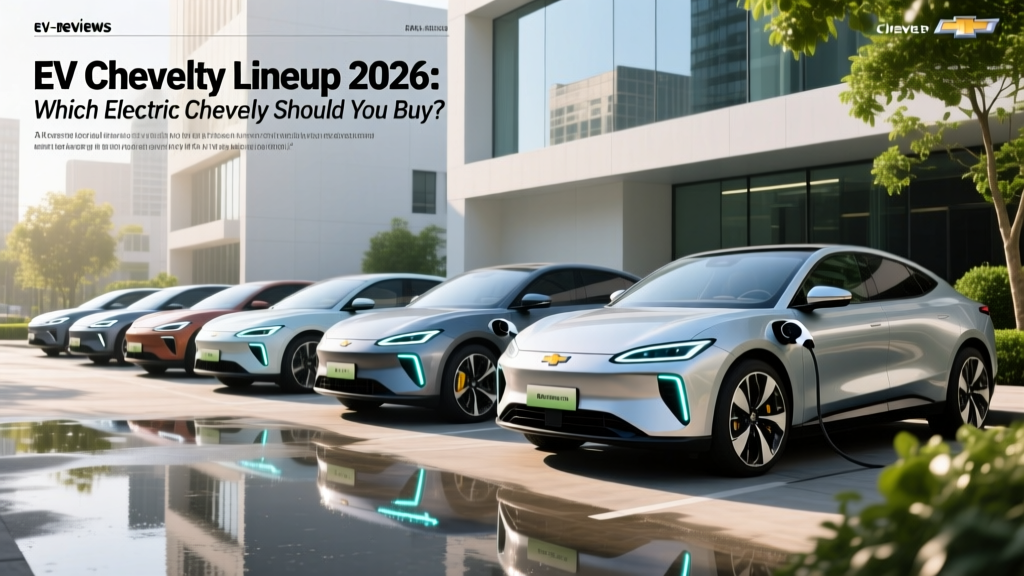
Quick Answer: If you're shopping for an EV Chevy in 2026, the Chevy Equinox EV (starting ~$33,600, EPA 319 miles) is the best value for most buyers and may qualify for the §30D federal tax credit. The Blazer EV (~$44,600, EPA 324 miles) suits those wanting more space and power. The Silverado EV (~$55,900+, EPA 390–440 miles) targets truck buyers needing payload and range. All three ride on GM's Ultium platform with NMC battery chemistry, DC fast-charge capability up to 190–350 kW depending on model, and Level 2 home charging at 11.5–19.2 kW. Your best pick depends on budget, cargo needs, and whether you qualify for the up-to-$7,500 federal credit under current IRS rules.
The 2026 Chevy EV Lineup at a Glance
Chevrolet currently sells three battery-electric vehicles in the U.S., all built on GM's Ultium architecture with nickel-manganese-cobalt (NMC) lithium-ion battery packs. Each targets a distinct buyer: the compact crossover segment, the midsize SUV segment, and the full-size pickup segment. Here's how they stack up on paper before we get into real-world ownership.
| Spec | Equinox EV (2LT AWD) | Blazer EV (2LT AWD) | Silverado EV (4WT) |
|---|---|---|---|
| EPA Range | 319 mi | 324 mi | 390–440 mi |
| Battery (usable) | ~85 kWh | ~102 kWh | ~200 kWh (max pack) |
| Chemistry | NMC (Ultium) | NMC (Ultium) | NMC (Ultium) |
| Peak DC Fast Charge | ~150 kW | ~190 kW | up to 350 kW |
| 10–80% DC Time | ~30 min | ~28 min | ~20 min |
| Level 2 Rate | 11.5 kW | 11.5 kW | 19.2 kW |
| Horsepower | 288 hp | 288 hp (RS: 557 hp w/SS) | 510–754 hp |
| 0–60 mph | ~7.4 sec | ~6.0 sec (RS: ~3.5 sec SS) | ~4.5 sec |
| Base MSRP | ~$33,600 | ~$44,600 | ~$55,900 |
| Battery Warranty | 8 yr / 100,000 mi | 8 yr / 100,000 mi | 8 yr / 100,000 mi |
Sources: fueleconomy.gov, Chevrolet EV specs. Real-world range is typically 10–20% below EPA estimates on sustained highway driving at 70+ mph, and cold weather (below 30°F) can reduce range an additional 15–30% due to cabin heating demands and increased battery internal resistance.
Real-World Range: What the EPA Sticker Doesn't Tell You
EPA range figures are tested on a dynamometer using a mix of city and highway cycles. They're useful for comparison shopping, but your actual miles will vary based on speed, temperature, terrain, and accessory use. Here's what to realistically expect from each Chevy EV:
Equinox EV (EPA 319 mi): Expect ~260–280 mi on a mixed highway commute at 65–70 mph. In winter conditions (20–30°F) without preconditioning, plan for ~210–240 mi. The smaller 85 kWh pack is efficient around 3.5–3.8 mi/kWh in moderate weather.
Blazer EV (EPA 324 mi): Despite a larger 102 kWh pack, the heavier curb weight and less aerodynamic profile yield similar real-world figures: ~265–285 mi highway, ~215–245 mi cold. Efficiency sits around 3.0–3.3 mi/kWh.
Silverado EV (EPA 390–440 mi): The massive 200 kWh pack delivers genuine long-haul capability. Real-world highway: ~320–360 mi unloaded. Towing a 7,000-lb trailer? Expect that to drop to ~180–220 mi depending on speed and grade. This is physics — moving mass requires energy.
One advantage all three share: GM's Ultium battery management system includes active thermal preconditioning. When you navigate to a DC fast charger via the built-in route planner, the battery warms (or cools) to an optimal temperature, which can shave 5–10 minutes off your 10–80% charge time and help you sustain peak charge rates longer.
Charging at Home vs. on the Road: What It Actually Costs
Home charging is where EV ownership economics shine — but only if you have access. Let's break down the numbers.
Home Level 2 Charging
All three Chevy EVs accept Level 2 AC charging via a J1772 connector (or NACS on newer builds with the Tesla Supercharger adapter included). At 11.5 kW (Equinox/Blazer) or 19.2 kW (Silverado), you'll add roughly 30–50 miles of range per hour of charging. A full overnight charge from 10% to 90% takes 7–9 hours for the Equinox/Blazer and 9–11 hours for the Silverado's larger pack.
At the national average residential electricity rate of ~$0.16/kWh (check your local utility), a full Equinox EV charge costs roughly $13.60 for 85 kWh. That delivers ~260 real-world miles — about $0.052/mile. Compare that to a gas-powered Equinox AWD at 26 MPG combined and $3.40/gallon: $0.131/mile. The EV costs roughly 60% less per mile to fuel at home.
DC Fast Charging on the Road
Public DC fast charging is more expensive and less predictable. Networks like Electrify America and EVgo charge $0.35–$0.55/kWh depending on location and membership. At $0.45/kWh, filling the Equinox EV from 10–80% (~60 kWh) costs about $27 — still cheaper than gas for equivalent miles, but the gap narrows. Frequent road-trippers should factor this into their total cost of ownership.
| Cost Factor | Equinox EV (Home Charge) | Equinox EV (DC Fast) | Gas Equinox AWD |
|---|---|---|---|
| Cost per mile | $0.052 | $0.104 | $0.131 |
| Annual fuel/energy (12,000 mi) | $624 | $1,248 | $1,572 |
| Annual maintenance | ~$300 | ~$300 | ~$900 |
| 5-year fuel + maintenance | $4,620 | $7,740 | $12,360 |
Maintenance estimates reflect EVs eliminating oil changes, spark plugs, and transmission fluid. Brake wear is significantly reduced thanks to regenerative braking. EV insurance premiums, however, tend to run 10–20% higher than equivalent gas vehicles — factor in an extra $150–$300/year depending on your carrier and state.
Federal Tax Credit: Does Your EV Chevy Qualify?
The IRS §30D Clean Vehicle Credit offers up to $7,500 for qualifying new EVs, but eligibility hinges on several requirements that change as battery sourcing rules tighten:
- MSRP Cap: SUVs and pickups must be under $80,000; sedans under $55,000. All three Chevy EVs clear this in most trims.
- Buyer Income Limits: AGI must not exceed $150,000 (single), $225,000 (head of household), or $300,000 (joint).
- Battery Sourcing: Increasing percentages of critical minerals and battery components must be sourced from the U.S. or free-trade-agreement countries. GM has been aggressively onshoring Ultium cell production at plants in Ohio and Tennessee, which improves credit eligibility for 2026 models.
- Point-of-Sale Transfer: You can transfer the credit to the dealer at purchase, reducing your out-of-pocket cost immediately rather than waiting for a tax refund.
- Final Assembly: Vehicle must undergo final assembly in North America. All current Chevy EVs qualify.
The Equinox EV is the strongest candidate for the full $7,500 credit given its price point. A 2LT AWD at ~$33,600 minus $7,500 drops to an effective ~$26,100 — a compelling price for a 319-mile electric crossover. Always verify current eligibility on the IRS website or with a tax professional before purchasing, as sourcing rules are updated annually.
EV Chevy vs. Gas and Hybrid: The Ownership Decision
Not sure if an EV Chevy is right for you versus a gas or hybrid alternative? Here's a data-driven comparison using the Equinox as the baseline:
| Factor | Equinox EV 2LT AWD | Equinox Gas AWD | CR-V Hybrid AWD |
|---|---|---|---|
| Base Price | ~$33,600 | ~$30,000 | ~$35,500 |
| After Tax Credit | ~$26,100 | $30,000 | $35,500 |
| EPA Efficiency | 109 MPGe | 26 MPG | 40 MPG |
| Annual Fuel/Energy | $624 | $1,572 | $1,020 |
| 5-Year Total Fuel | $3,120 | $7,860 | $5,100 |
| 5-Year Maintenance | ~$1,500 | ~$4,500 | ~$3,500 |
| Cargo Volume | 26.4 cu ft | 29.9 cu ft | 36.3 cu ft |
| Cold-Weather Penalty | 15–30% range loss | Minimal | Minimal |
The EV wins on running costs and effective purchase price (post-credit), but gas and hybrid options still offer advantages in cargo flexibility, cold-weather consistency, and refueling convenience if you lack home charging. The hybrid sits in the middle — better fuel economy than gas, no charging dependency, but no federal tax credit (unless it's a qualifying PHEV).
Common EV Chevy Misconceptions — Fact-Checked
| Myth | Fact |
|---|---|
| "The battery will need replacing in 5 years." | GM warranties Ultium batteries for 8 years/100,000 miles with a capacity-retention threshold. Real-world data from early Bolt EVs shows ~8–10% degradation after 100,000 miles. NMC packs with active thermal management are lasting well beyond warranty periods. |
| "You can't road-trip an EV Chevy." | With DC fast-charge capability (150–350 kW), a 10–80% charge takes 20–30 minutes. GM provides access to the Tesla Supercharger network via the included NACS adapter, adding 17,000+ fast-charger locations nationwide. Plan stops around natural rest breaks. |
| "Charging at home requires a panel upgrade." | Most homes with a 200-amp panel can support a 48-amp (11.5 kW) Level 2 charger on a 60-amp circuit. A licensed electrician will confirm this during a site assessment. Installation typically runs $500–$2,000 depending on run length and local code. Only older 100-amp panels may need an upgrade ($1,500–$3,000). |
| "EVs are worse in the cold." | Range drops are real (15–30%), but preconditioning the battery and cabin while plugged in mitigates much of the loss. Seat heaters and a heat pump (available on Blazer/Silverado EV) use far less energy than resistive cabin heating. Traction and AWD performance are excellent thanks to instant torque and low center of gravity. |
| "The Equinox EV is too small for a family." | At 26.4 cu ft behind the rear seats and 57.2 cu ft with seats folded, it accommodates a double stroller and groceries. The flat floor (no transmission tunnel) makes the rear seat feel roomier than gas crossovers with similar exterior dimensions. |
Decision Framework: Which EV Chevy Is Right for You?
Choose the Equinox EV if:
- Your budget is $26,000–$38,000 (after potential tax credit)
- You commute 30–60 miles daily and want to charge at home overnight
- You want the lowest cost-per-mile of any Chevy EV
- Cargo needs are moderate (26.4 cu ft is sufficient)
Choose the Blazer EV if:
- You need more rear-seat room and a premium interior
- Performance matters (the SS trim delivers 557 hp and a ~3.5-sec 0–60)
- Budget is $40,000–$55,000 and you value styling and tech
- You want a larger 102 kWh battery for less frequent charging
Choose the Silverado EV if:
- You need truck capability: up to 10,000-lb towing, a Multi-Flex midgate, and a 5'11" bed
- Range is paramount (390–440 mi EPA for long-haul work or travel)
- You want V2L (vehicle-to-load) capability to power tools or a campsite
- Budget is $55,000+ and you'll use it as a primary work or adventure vehicle
Choose a gas or hybrid Chevy instead if:
- You cannot install a home charger and lack reliable public charging access
- You regularly drive in extreme cold (-10°F or below) where range loss compounds
- You frequently tow heavy trailers long distances where charging infrastructure is sparse
- Your budget is strictly under $25,000 and you cannot wait for credit qualification
Frequently Asked Questions
Can I use Tesla Superchargers with a Chevy EV?
Yes. Starting with 2025 models, GM includes a NACS adapter (or native NACS port on newer builds) that provides access to the Tesla Supercharger network. This adds over 17,000 DC fast-charger locations to your route-planning options. Charge speeds on Superchargers are limited to what the vehicle can accept (150–190 kW for Equinox/Blazer), not the stall's maximum output.
How long does an Ultium battery actually last?
GM's NMC Ultium cells use active liquid thermal management, which is the single biggest factor in long-term battery health. Based on degradation data from the earlier Bolt EV (which used older LG cells without the same thermal sophistication), owners reported ~8–10% capacity loss after 100,000 miles over 5–6 years. Ultium packs are expected to perform at least as well, likely better. The 8-year/100,000-mile warranty guarantees a minimum capacity-retention threshold (typically 60–70% of original capacity). Full pack replacement, if ever needed out of warranty, currently runs $10,000–$18,000 depending on pack size — but this is a last-resort scenario.
What does a Level 2 home charger installation actually cost?
For a typical installation with a 240V/60A circuit near your electrical panel: equipment (a quality Level 2 charger like the ChargePoint Home Flex or Emporia Vue) costs $400–$700. Electrician labor, conduit, wiring, and permit run $500–$1,500 for a short run (under 30 feet from panel to garage). Total: $900–$2,200. If your panel is far from the garage or you need a panel upgrade from 100A to 200A, add $1,500–$3,000. Many utilities offer rebates of $200–$500 for charger installation — check with your provider.
Is the Equinox EV eligible for the $7,500 tax credit in 2026?
As of early 2026, the Equinox EV qualifies for up to $7,500 under §30D, depending on your income, the specific build's battery-sourcing compliance, and MSRP. GM has been increasing domestic content in Ultium packs, improving eligibility. You can transfer the credit at point of sale to reduce your purchase price directly. Always confirm current status on fueleconomy.gov and with your tax professional before signing.
How does Super Cruise work in Chevy EVs?
Super Cruise is GM's Level 2 hands-free driver-assistance system (per SAE automation levels, Level 2 means the driver must remain attentive and ready to take over). It operates on over 750,000 miles of mapped divided highways in the U.S. and Canada. It is not self-driving — it does not handle city streets, unmapped roads, or complex intersections. Available on Blazer EV and Silverado EV trims, typically as a $2,000–$2,500 package or subscription add-on.