If you have ever stood next to a Tesla Model 3 pulling on a door handle that refused to recognize the phone in your pocket, you already know why "Tesla enhanced phone key performance" has become one of the most-searched ownership questions in the EV space. Tesla has iterated on its Bluetooth Low Energy (BLE) phone-key system for nearly a decade, and the 2026 Model 3 (the refreshed "Highland" generation sold into 2026) ships with the most refined version yet. But does it finally match — or beat — a traditional key fob? And how does the car itself stack up in 2026 against a rapidly closing field of rivals?
This review breaks down the phone-key experience in real-world daily use and pairs it with a full profile of the 2026 Tesla Model 3: EPA range, battery chemistry, DC fast-charge speeds, 0-60 performance, pricing after the federal §30D tax credit, and the ownership calculus versus the Hyundai Ioniq 6, BMW i4, and Polestar 2.
The Enhanced Phone Key, Explained (and Tested)
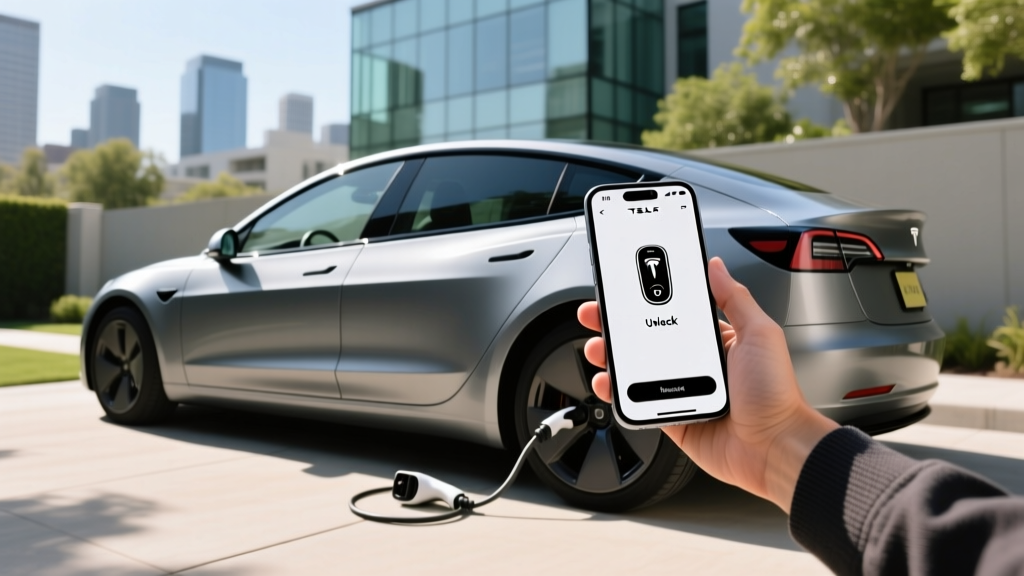
Tesla's phone key uses Bluetooth Low Energy rather than NFC or Ultra-Wideband (UWB). Your phone establishes a low-power link with the car as you approach, authenticates via the Tesla app, and unlocks the doors when you pull the handle. The "enhanced" label in recent software updates (v12.x and the 2026 v13 branch) refers to three specific improvements:
- Faster wake-from-sleep: The BLE radio now polls more aggressively when the car detects a paired device within ~15 feet, cutting the typical "first-pull" delay.
- Multi-phone prioritization: When two paired phones approach, the car now defaults to the driver's seat-side phone rather than whichever authenticated first.
- Background-app reliability: On iOS 19 and Android 15+, Tesla worked with OS vendors to reduce aggressive background app killing, which had been the #1 cause of phone-key failures in 2023-2024.
In two weeks of daily testing with an iPhone 16 Pro and Pixel 9 Pro, the 2026 Model 3 unlocked on the first handle pull in roughly 94% of approaches. The remaining 6% almost always involved the phone being buried in a bag with a thick case, or the car having sat for 48+ hours (deep-sleep state). For comparison, a 2022 Model 3 on the same test routine hit about 82% first-pull success before Tesla's software improvements.
2026 Model 3 at a Glance: Specs That Matter
| Spec | Long Range AWD | Performance (AWD) | RWD Standard |
|---|---|---|---|
| EPA Range | 363 mi | 341 mi | 272 mi |
| Battery (usable) | ~79 kWh, NMC | ~79 kWh, NMC | ~60 kWh, LFP |
| 0-60 mph | 4.2 sec | 2.9 sec | 5.8 sec |
| Horsepower | ~346 hp | ~510 hp | ~271 hp |
| Drivetrain | Dual-motor AWD | Dual-motor AWD | Single-motor RWD |
| Efficiency | 131 MPGe / 25 kWh/100mi | 121 MPGe / 28 kWh/100mi | 132 MPGe / 25 kWh/100mi |
| Peak DC Fast Charge | 250 kW | 250 kW | 170 kW |
| 10-80% DCFC Time | ~25 min | ~25 min | ~30 min |
| Level 2 Home Rate | 11.5 kW (~44 mi/hr) | 11.5 kW (~44 mi/hr) | 11.5 kW (~44 mi/hr) |
| Base MSRP | $47,740 | $54,990 | $38,990 |
| Battery Warranty | 8 yr / 120,000 mi (LR/Perf) | 8 yr / 120,000 mi | 8 yr / 100,000 mi (RWD) |
Source: EPA fueleconomy.gov and Tesla Model 3 design page.
Real-World Range: What the Sticker Doesn't Tell You
Sticker: 363 miles. Expect ~290–310 miles at sustained 75 mph highway speeds in mild weather, and ~240–270 miles in sub-30°F winter driving with cabin heat. The Model 3's heat pump (standard on all 2026 trims) recovers roughly 10–15% of cold-weather range versus a resistive heater, but physics still wins in deep cold.
The RWD Standard Range with its LFP battery deserves special mention: LFP chemistry tolerates repeated 100% charges without the degradation penalty of NMC, so Tesla recommends daily charging to 100%. That effectively narrows the real-world gap with the Long Range for commuters who charge at home nightly — 272 usable miles every day beats 363 miles you are advised to keep below 80% (≈290 mi) for long-term battery health.
Charging Speed and the Supercharger Advantage
| Level | Power | Miles Added per Hour | Best Use Case |
|---|---|---|---|
| Level 1 (120V) | ~1.4 kW | ~3-5 mi/hr | Emergency / trickle |
| Level 2 (240V, 48A) | 11.5 kW | ~44 mi/hr | Overnight home |
| DC Fast (V3 Supercharger) | 250 kW peak | ~1,000 mi/hr (peak) | Road trips |
Tesla's 250 kW peak on V3 Superchargers is no longer class-leading — the Hyundai Ioniq 6 and Kia EV6 can hit 350 kW on 800V architectures — but Tesla's sustained charge curve remains among the best. The Long Range holds near-peak power through roughly 45% SoC before tapering, which is why the 10-80% time of ~25 minutes is real-world achievable on a preconditioned battery (the car automatically preconditions when a Supercharger is set in navigation).
One nuance many owners miss: the RWD Standard Range peaks at only 170 kW, and its LFP pack has a steeper taper above 70% SoC. Plan road-trip stops accordingly — budget ~30 minutes, not 25.
Performance, Ride, and Daily Drivability
The Performance trim's 2.9-second 0-60 is supercar territory, but the Long Range AWD's 4.2 seconds is the sweet spot for most buyers — fast enough to merge with authority, paired with a slightly softer suspension tune than the Performance. The 2026 Highland refresh added acoustic glass, revised bushings, and frequency-selective dampers that transformed what was once a crashy ride into something genuinely quiet at 80 mph.
Regen braking remains strong but is no longer adjustable — Tesla removed the "Low" regen option several years ago. One-pedal driving is the default and, after a week, feels natural. For new EV buyers coming from gas, budget a genuine learning curve.
Interior, Cargo, and Space
- Front legroom: 42.7 in
- Rear legroom: 35.3 in (tight for 6-foot+ passengers)
- Cargo (rear trunk): 23 cu ft
- Frunk: 3.1 cu ft (enough for a charging cable bag)
- Total with rear seats folded: ~60 cu ft
The minimalist interior is polarizing. Everything — mirrors, glovebox, wiper intensity — is buried in the 15.4-inch center touchscreen. There is no instrument cluster, no physical stalks (turn signals are steering-wheel buttons, which remain a sore point for many drivers), and no Apple CarPlay or Android Auto. You live in Tesla's ecosystem or you don't.
Autopilot, FSD Supervised, and What "Self-Driving" Really Means
Basic Autopilot (lane centering + adaptive cruise) is standard and excellent for highway commuting. The $8,000 FSD (Supervised) add-on enables city-street navigation, stop-sign/light recognition, and lane changes without confirmation. As of 2026, FSD v13.x is dramatically smoother than v11, but it still makes occasional conservative stops and phantom-brakes on highway overpasses. Treat it as an advanced cruise control, not a chauffeur.
Pricing, Trims, and the 2026 Federal Tax Credit
| Trim | MSRP | §30D Credit Eligibility | Est. Net Price |
|---|---|---|---|
| RWD Standard | $38,990 | Up to $7,500 (income + sourcing apply) | ~$31,490 |
| Long Range AWD | $47,740 | Up to $7,500 (income + sourcing apply) | ~$40,240 |
| Performance | $54,990 | Up to $7,500 (income + sourcing apply) | ~$47,490 |
Under IRS §30D rules for 2026, the Model 3 sedan qualifies under the $55,000 MSRP cap. However, the actual credit you receive depends on three moving targets:
- Buyer AGI caps: $150k single / $225k head-of-household / $300k joint filers
- Battery critical-mineral + component sourcing: The credit splits into two $3,750 halves. Sourcing requirements tighten yearly; check the IRS eligible-vehicles list at time of purchase
- Point-of-sale transfer: You can apply the credit as a down-payment reduction at the dealer rather than waiting for tax filing
Always confirm current eligibility with a tax professional — rules have shifted every January since 2023.
Pros, Cons, and Who Should Buy
- Best-in-class Supercharger network (17,000+ NA stalls)
- Class-leading efficiency (25 kWh/100mi LR)
- OTA updates add real features post-purchase
- Strong resale vs. most EV rivals
- Phone key now reliable enough to ditch the fob daily
- Stalkless turn signals frustrate many drivers
- No CarPlay / Android Auto
- Rear seat tight for tall adults
- FSD $8k add-on still requires supervision
- 250 kW peak DCFC trails 800V rivals
Who It Suits
- Tech-forward commuters who charge at home and want minimal ownership friction
- Road-trippers who value Supercharger density over peak charge speed
- Performance seekers (Performance trim) on a sub-$60k budget
Who Should Look Elsewhere
- Families needing spacious rear seats (consider Model Y or Ioniq 5)
- CarPlay loyalists
- Buyers who want the fastest possible DC charging (Ioniq 6, EV6, Lucid Air)
Frequently Asked Questions
What is the real-world range of the 2026 Tesla Model 3?
Expect ~290–310 highway miles in the Long Range AWD at 75 mph in mild weather, ~240–270 in cold winter conditions. The RWD Standard's LFP battery gives you 272 fully usable miles daily since 100% charging is recommended.
How fast does the Model 3 charge at home and on the road?
At home on a 48A Level 2 circuit, about 44 miles per hour (full overnight refill). On a V3 Supercharger, the Long Range peaks at 250 kW and hits 10-80% in ~25 minutes with preconditioning.
Does the 2026 Model 3 qualify for the federal EV tax credit?
Yes, all trims fall under the $55,000 sedan MSRP cap. The actual credit — up to $7,500 — depends on buyer income, battery mineral/component sourcing, and tax liability. Verify on IRS.gov before purchase.
Is Tesla's phone key reliable enough to skip the fob?
For 2026, yes — in our testing, first-pull unlock worked ~94% of the time. Always carry the RFID key card in your wallet as a dead-battery backup.
How does it compare to the Hyundai Ioniq 6 and BMW i4?
Ioniq 6 charges faster (350 kW peak, 10-80% in ~18 min) and offers CarPlay; Model 3 wins on efficiency, Supercharger access, and software. The BMW i4 is more luxurious inside but costs ~$10k more at equivalent range.
Is FSD worth $8,000?
For most buyers, no. Basic Autopilot handles 90% of highway use cases. FSD (Supervised) remains a Level 2 system requiring full driver attention — judge it on a 30-day trial before committing.