The Real Answer: It Depends on Where and How You Charge
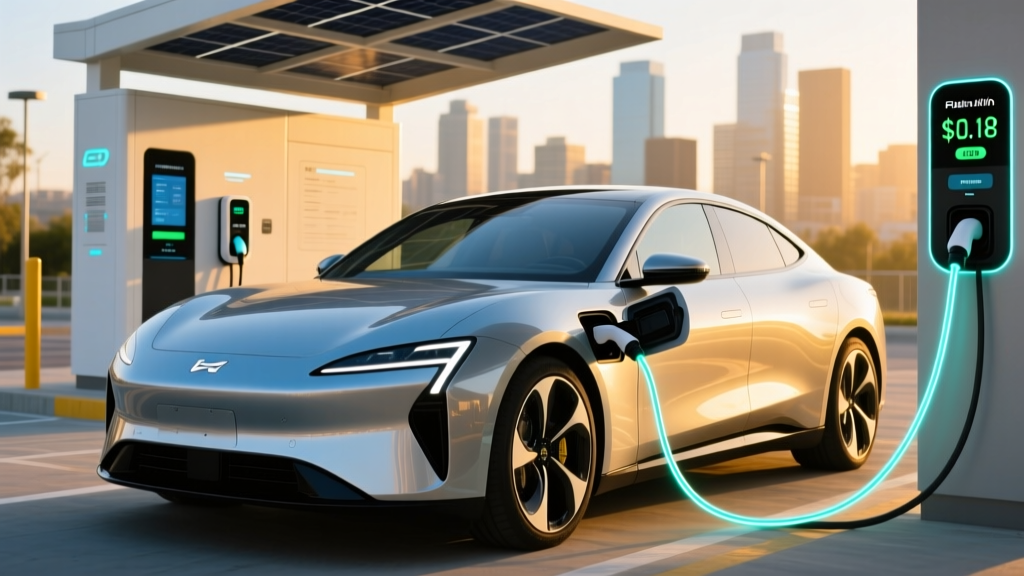
Search "how much does it cost to charge my electric car" and you'll find answers ranging from $3 to $25 per session. Both can be true — the spread between plugging into a 120V wall outlet at $0.13/kWh in Idaho and pulling 200 kW from an Electrify America stall in California at $0.56/kWh is enormous. The honest answer requires separating energy (kilowatt-hours, kWh — what your battery stores) from power (kilowatts, kW — how fast you fill it) and then mapping those to your actual driving and charging habits.
For a 2026 Hyundai Ioniq 5 with its 84 kWh usable battery and 310-mile EPA range, a full 0-100% charge at the US residential average of $0.17/kWh costs about $14.28. That same fill on a public DC fast charger at $0.48/kWh? Roughly $40.32. But most owners don't charge from zero to full, and most charging happens at home. Let's build the real picture — not just the per-session number, but the full 5-year cost of ownership.
Charging Cost Per Mile: EV vs Gas, by the Numbers
The metric that actually matters is cost per mile, not cost per fill-up. Here's how a representative EV stacks up against a comparable gas vehicle using 2026 energy prices.
| Vehicle | Energy Source | Efficiency | Unit Cost | $/Mile |
|---|---|---|---|---|
| Hyundai Ioniq 5 (AWD) | Home L2 (avg US) | 30 kWh/100 mi | $0.17/kWh | $0.051 |
| Hyundai Ioniq 5 (AWD) | Public DCFC (avg) | 30 kWh/100 mi | $0.48/kWh | $0.144 |
| Tesla Model 3 RWD | Home L2 (avg US) | 25 kWh/100 mi | $0.17/kWh | $0.043 |
| Tesla Model 3 RWD | Supercharger (avg) | 25 kWh/100 mi | $0.35/kWh | $0.088 |
| Toyota Camry LE (2.5L) | Gasoline | 32 MPG combined | $3.40/gal | $0.106 |
| Honda Accord 1.5T | Gasoline | 30 MPG combined | $3.40/gal | $0.113 |
The takeaway: home charging delivers fuel costs roughly half what gasoline costs per mile. Public DC fast charging, however, can equal or exceed gas costs on a per-mile basis — which is why exclusive reliance on public charging fundamentally changes the ownership equation. According to fueleconomy.gov, the Ioniq 5 AWD achieves 110 MPGe combined, translating to the 30 kWh/100 mi figure above.
Real-world caveat: Efficiency degrades in cold weather. Expect 25-35% higher kWh/100mi consumption below 30°F, which proportionally raises your cost per mile in winter months. Highway driving at 75+ mph also pushes consumption 10-15% above the combined EPA figure.
5-Year Total Cost of Ownership: The Full Spreadsheet
Charging cost is one line item. The real purchase decision requires the full picture. Below is a 5-year / 75,000-mile TCO comparison using a 2026 Tesla Model 3 Long Range (MSRP $42,490) versus a 2026 Toyota Camry XSE (MSRP $33,490).
| Category | Tesla Model 3 LR AWD | Toyota Camry XSE | Notes |
|---|---|---|---|
| Purchase Price (MSRP) | $42,490 | $33,490 | Before incentives |
| Federal Tax Credit (§30D) | −$7,500 | $0 | Model 3 LR qualifies in 2026; see rules below |
| Effective Purchase Price | $34,990 | $33,490 | After credit applied at point of sale |
| Fuel / Charging (5 yr) | $3,188 | $7,969 | EV: 80% home / 20% DCFC; Gas: $3.40/gal, 30 MPG |
| Maintenance (5 yr) | $1,800 | $4,200 | EV: cabin filter, wipers, tire rotation, fluid top-off |
| Insurance (5 yr) | $12,750 | $8,400 | EV premiums avg ~50% higher; varies by carrier/state |
| Depreciation (5 yr) | $18,200 | $12,800 | EVs depreciating faster post-2023 price wars |
| Total 5-Year Cost | $70,928 | $66,859 | EV costs ~$4,069 more over 5 years in this scenario |
This comparison is deliberately conservative. The Model 3's higher insurance and steeper depreciation offset much of its fuel and maintenance savings. However, if you qualify for a state incentive (e.g., Colorado's $5,000 credit, or California's CVRP for income-qualified buyers), the math can swing in the EV's favor by $1,000-$5,000. Time-of-use electricity rates and solar-charging also compress the EV fuel line further.
Federal Tax Credit: Do You Actually Qualify?
The IRS §30D Clean Vehicle Credit offers up to $7,500 for qualifying new EVs, but the eligibility matrix is dense and has tightened significantly since the Inflation Reduction Act's battery-sourcing requirements phased in. As of 2026, the full credit splits into two $3,750 halves — one for critical minerals, one for battery component sourcing — and you must meet both to get the full $7,500.
2026 §30D Eligibility Checklist (source: IRS.gov)
- MSRP Caps: Vans, SUVs, and pickups ≤ $80,000; sedans and other vehicles ≤ $55,000
- Buyer Income Limits (MAGI): Single filers ≤ $150,000; Head of household ≤ $225,000; Joint filers ≤ $300,000
- Critical Minerals (worth $3,750): Must be extracted or processed in the US or a free-trade-agreement country, or recycled in North America — percentage thresholds increase annually
- Battery Components (worth $3,750): Must be manufactured or assembled in North America — percentage thresholds increase annually
- Foreign Entity of Concern (FEOC) Exclusion: Vehicles with battery components from a FEOC (certain Chinese, Russian, North Korean, Iranian entities) are disqualified entirely
- Point-of-Sale Transfer: You can transfer the credit to the dealer at purchase, reducing your out-of-pocket cost immediately — even if you have no tax liability
- Vehicle Assembly: Final assembly must occur in North America
Vehicles that typically qualify in 2026 (always verify on fueleconomy.gov before purchasing): Tesla Model 3 Long Range, Tesla Model Y (all trims), Ford F-150 Lightning, Chevrolet Equinox EV, Cadillac Lyriq, Volkswagen ID.4 (US-built trims).
Vehicles that may NOT qualify: Many Hyundai/Kia EVs (final assembly in Korea), Nissan Ariya, certain BMW and Mercedes EVs. The Hyundai Ioniq 5 built at the Metaplant in Georgia does qualify, but earlier Korea-sourced inventory may not — always check the VIN.
State, Local, and Utility Incentives
Beyond federal credits, incentives vary enormously by jurisdiction. Examples as of early 2026:
- California (CVRP): Up to $7,000 for income-qualified buyers (under 400% federal poverty level)
- Colorado: $5,000 state tax credit for new EVs under $80,000 MSRP
- Massachusetts (MOR-EV): Up to $3,500, income-scaled
- Utility Rebates: Many utilities offer $500-$1,500 for Level 2 home charger purchase/installation; some offer off-peak charging credits (e.g., PG&E's EV-A rate plan, Con Edison's SmartCharge NY)
- HOV Lane Access: Available in CA, CO, FL, GA, MD, MN, NJ, NY, VA, and others — value is real but hard to price
Check your state energy office and local utility for current programs; these change annually and sometimes have funding caps.
Maintenance Savings: Where EVs Genuinely Win
The maintenance gap between EVs and internal-combustion vehicles is one of the most reliable ownership advantages — and it's rooted in physics, not marketing. A battery-electric powertrain has roughly 20 moving parts versus 200+ in a combustion engine. No oil changes, no spark plugs, no timing belts, no exhaust system, no catalytic converter, and dramatically reduced brake wear thanks to regenerative braking.
| Service Item | EV Cost | Gas Car Cost | Why the Difference |
|---|---|---|---|
| Oil Changes | $0 | $600-$900 | EVs have no engine oil |
| Brake Pads/Rotors | $0-$200 | $800-$1,500 | Regen braking saves 70-90% of pad wear |
| Transmission Fluid | $0 | $150-$300 | Most EVs use a single-speed reduction gear, sealed for life |
| Coolant Flush | $150-$250 | $150-$250 | EVs still need thermal management fluid service (~every 5 yr) |
| Cabin Air Filter | $100-$200 | $100-$200 | Same interval, ~every 15-20k miles |
| Tire Rotation | $150-$250 | $150-$250 | EVs can be harder on tires due to instant torque and higher weight |
| Tire Replacement | $1,200-$2,000 | $800-$1,400 | EV-specific tires (low rolling resistance, foam-lined) cost more |
| Total Estimated | $1,600-$2,900 | $2,750-$4,800 | Net EV savings: ~$1,150-$1,900 over 5 years |
The tire caveat: EVs are heavier (the Ioniq 5 AWD weighs 4,650 lbs vs a comparable gas Tucson at ~3,500 lbs) and deliver instant torque, which accelerates tire wear by 15-25% in real-world driving. Budget for one extra tire set over 5 years compared to a gas equivalent. Some owners report needing replacement at 25,000-35,000 miles on the original OEM tires.
Insurance: The Cost Nobody Talks About
EV insurance premiums run 20-50% higher than equivalent gas vehicles, and this is the single biggest offset to fuel and maintenance savings. According to industry data, the average annual EV insurance premium in 2026 is approximately $2,550 versus $1,680 for a comparable gas sedan.
Why EV insurance costs more:
- Higher repair costs: Battery packs are structural and expensive to replace after collision damage; a minor undercarriage impact can total a battery that costs $12,000-$22,000 to replace
- Specialized labor: High-voltage system repairs require certified EV technicians, of which there's still a shortage
- Parts availability: OEM EV body panels and battery modules can have longer lead times than mass-market gas-car parts
- Higher purchase prices: Insurers factor in replacement cost; a $42,000 EV costs more to insure than a $28,000 gas sedan
- Total-loss frequency: Insurers are more likely to declare EVs total after battery-adjacent damage due to safety/liability concerns
How to reduce EV insurance costs: Shop at least 5 carriers (Tesla Insurance, GEICO, Progressive, State Farm, and USAA show wide variance for the same driver). Bundling home/auto, telematics-based programs (like Progressive's Snapshot), and choosing higher deductibles ($1,000 vs $500) can shave 15-25% off premiums. Tesla's real-time driving-score insurance, available in many states, can reward safe drivers with rates below the EV average.
Depreciation and Resale Value: The Moving Target
EV depreciation has been volatile since 2022. Tesla's aggressive price cuts in 2023-2024 cratered used EV values across the board, and the market is still stabilizing. As of early 2026, the 5-year depreciation picture looks like this:
- Tesla Model 3: ~42-48% depreciation over 5 years (worse than pre-2023 norms, driven by new-price volatility)
- Tesla Model Y: ~38-44% depreciation over 5 years
- Hyundai Ioniq 5: ~45-52% depreciation over 5 years
- Toyota Camry (gas): ~35-40% depreciation over 5 years
- Toyota RAV4 Hybrid: ~28-33% depreciation over 5 years (hybrids currently hold value best)
Why EVs depreciate faster right now: Rapid technology obsolescence (newer models charge faster and go farther), battery health uncertainty for second owners, the expiration of the used-EV credit (§25E, $4,000 cap) for certain models, and continued new-vehicle price competition. However, as the market matures and battery longevity data accumulates (many 2018-2020 EVs are showing 90%+ state of health at 100,000+ miles), depreciation curves are expected to normalize.
If you plan to keep your EV for 8-10 years, depreciation matters less — you'll ride out the curve. If you trade every 3 years, leasing may be the smarter play, especially since the §30D credit can be transferred to the lessor and reflected in your lease terms regardless of your personal income eligibility.
Decision Framework: Is an EV Cheaper for YOU?
Choose an EV if:
- You can install Level 2 home charging (the economics break down without it)
- You qualify for the full or partial §30D credit (check income caps and vehicle eligibility)
- Your daily commute is under 80 miles (staying within home-charge range most days)
- You live in a state with additional incentives or low electricity rates
- You plan to keep the vehicle 6+ years (absorbing depreciation)
Choose a hybrid (HEV/PHEV) instead if:
- You lack reliable home or workplace charging access
- You frequently drive 300+ mile routes through areas with sparse DC fast-charging infrastructure
- You want maximum resale value retention (Toyota RAV4 Hybrid currently leads)
- You live in extreme cold climates where EV range loss of 25-40% is routine in winter
Frequently Asked Questions
How much does it cost to charge an EV at home per month?
For a driver covering 1,000 miles/month in a vehicle averaging 28 kWh/100mi at the US residential average of $0.17/kWh, expect roughly $47.60/month in home charging costs. That compares to about $106/month for gasoline at 30 MPG and $3.40/gallon. If you have time-of-use rates and charge during off-peak hours (typically 10 PM - 6 AM), you can reduce that to $30-$38/month depending on your utility.
Is public DC fast charging more expensive than gas?
It can be. At $0.48-$0.56/kWh (common 2026 rates at Electrify America, EVgo, and non-Tesla networks), an EV averaging 30 kWh/100mi costs $0.14-$0.17 per mile — exceeding the $0.11/mile cost of a 32 MPG gas car at $3.40/gallon. Tesla Superchargers average $0.30-$0.38/kWh, making them competitive with gas on a per-mile basis. The economics of EV ownership strongly depend on home charging being your primary source.
Do I qualify for the $7,500 federal EV tax credit?
It depends on three factors: your modified adjusted gross income (MAGI must be under $150K single / $300K joint), the vehicle's MSRP (under $55K for sedans, $80K for SUVs/trucks/vans), and the vehicle's battery sourcing (critical minerals and components must meet escalating domestic-content thresholds). Since 2024, you can transfer the credit to the dealer at point of sale, reducing your purchase price immediately — even if you owe no federal tax. Always verify current eligibility on IRS.gov and fueleconomy.gov before signing a purchase agreement.
How much do I save on maintenance with an EV?
Typical 5-year maintenance savings range from $1,150 to $1,900 compared to a gas car. You eliminate oil changes ($600-$900 over 5 years), dramatically reduce brake wear ($600-$1,300 savings thanks to regenerative braking), and skip transmission and exhaust service. The main offset is tire cost — EVs wear tires 15-25% faster due to higher weight and instant torque, so budget for one additional tire set over 75,000 miles.
Are EVs more expensive to insure?
Yes, typically 20-50% more expensive than comparable gas vehicles. The average EV premium in 2026 is around $2,550/year versus $1,680/year for a gas sedan. Higher repair costs (battery replacement after collision), specialized labor, and elevated vehicle purchase prices drive the gap. Shopping multiple carriers, using telematics programs, and selecting higher deductibles can reduce premiums by 15-25%.
How well do EVs hold their value?
As of 2026, most EVs depreciate 38-52% over 5 years, which is worse than the 28-40% typical for gas cars and hybrids. Tesla price volatility, rapid tech advancement, and battery longevity uncertainty have pressured resale values. If depreciation is a top concern, consider leasing (transferring the risk to the lessor) or choosing a high-demand hybrid like the RAV4 Hybrid, which currently retains value best among electrified vehicles.
Does cold weather affect my charging cost?
Yes, significantly. Below 30°F, battery efficiency drops and cabin heating draws additional energy, increasing consumption by 25-40%. An EV that uses 28 kWh/100mi in mild weather may use 36-40 kWh/100mi in deep winter, raising your per-mile charging cost proportionally. Preconditioning the battery while plugged in (a feature on most modern EVs) mitigates some of this loss and also improves DC fast-charging speeds in cold conditions.