The Short Answer on Norway's EV Market
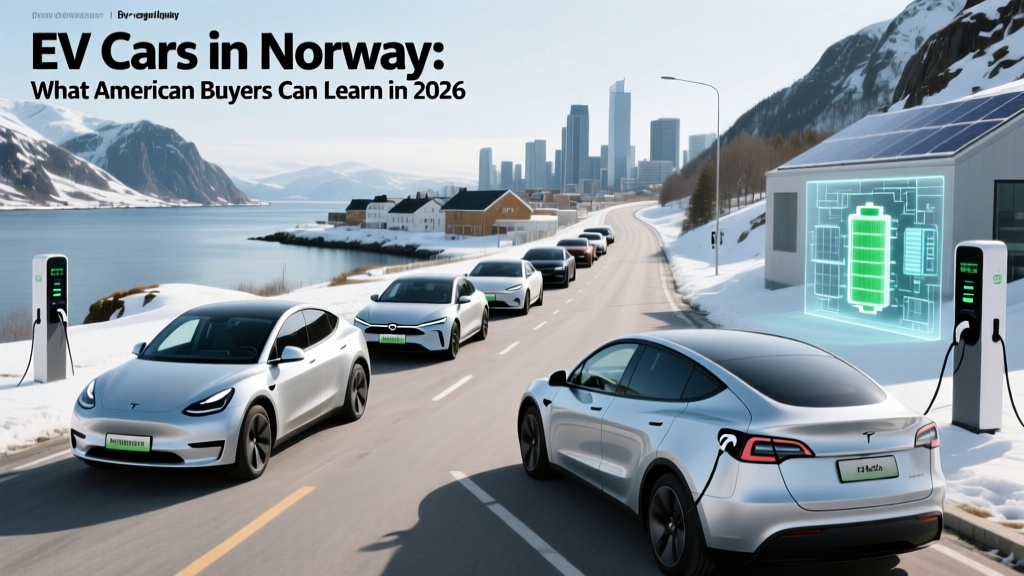
Norway is the global benchmark for electric-vehicle adoption: over 90% of new car sales are fully electric, with models like the Tesla Model Y, Volkswagen ID.4, and Toyota bZ4X dominating registrations. For US buyers researching ev cars norway, the Nordic nation offers a living laboratory of real-world data — especially on cold-weather range loss, charging infrastructure density, and long-term ownership economics. The practical takeaway? Norwegian EV owners experience 15–30% range reduction in sub-freezing temperatures, rely on a 22,000+ public charger network per capita unmatched anywhere, and save roughly $2,500–$4,000 annually versus gas equivalents. These numbers translate directly to cold-climate US states like Minnesota, Michigan, and Colorado.
Why Norway's EV Data Matters to US Shoppers
Norway's market is roughly 15 years ahead of the United States in EV penetration. By studying Norwegian registration data from the Norwegian Road Federation (OFV), American buyers gain access to longitudinal ownership data that simply doesn't exist yet in the US market. This includes battery degradation curves over 150,000+ miles, real-world winter efficiency across dozens of models, and the actual impact of incentive phase-outs on resale values.
Consider this: the Norwegian Automobile Federation (NAF) conducts annual winter range tests on popular EVs. Their 2025 test showed the Tesla Model Y Long Range achieved 285 miles of its EPA-rated 330 miles at 32°F, but dropped to approximately 220 miles at -4°F (a 33% loss). The VW ID.4 Pro S lost 28% under the same conditions. These figures help US buyers in northern states set realistic expectations rather than relying solely on EPA window-sticker estimates.
Norway EV vs Gas: Annual Ownership Cost Comparison (2026 Estimates)
| Cost Category | EV (Tesla Model Y LR) | Gas (Toyota RAV4 AWD) | Annual Savings |
|---|---|---|---|
| Energy/Fuel | $540 (home charging avg) | $1,850 (12,000 mi @ 28 MPG) | $1,310 |
| Maintenance | $350 | $850 | $500 |
| Insurance | $1,680 | $1,420 | -$260 |
| Depreciation (Year 1-3 avg) | $5,200/yr | $3,800/yr | -$1,400 |
| Net Annual Difference | +$150 EV savings | ||
Note: Norwegian data adapted to US pricing. EV depreciation has narrowed significantly since 2024 as battery confidence grows. Insurance remains 10–20% higher for EVs due to repair costs. Source: NAF, AAA Your Driving Costs 2025.
Cold-Weather Range: What Norwegian Owners Actually Experience
The single most valuable dataset Norway provides US buyers is cold-climate efficiency. The Norwegian Automobile Federation's recurring winter tests measure real-world consumption at temperatures between -4°F and 32°F, using a standardized 200-mile mixed-driving loop.
Key findings relevant to US cold-state buyers:
- Heat pump advantage: EVs equipped with heat pumps (standard on Tesla Model Y, Hyundai Ioniq 5, Kia EV6) lose 15–22% range at 20°F. Models without heat pumps lose 25–35%.
- Preconditioning impact: Vehicles preconditioned while plugged in recover 5–8% of cold-weather range loss versus those started cold.
- Charging speed penalty: At -4°F, DC fast charging from 10–80% takes 40–60% longer than at 70°F unless the battery is preconditioned. A Tesla Model Y that charges 10–80% in 18 minutes at moderate temps may take 28–32 minutes in deep cold without preconditioning.
- LFP vs NMC in cold: LFP (lithium iron phosphate) batteries, found in base Tesla Model 3/Y and some BYD models, show slightly greater cold-weather range loss (an additional 3–5%) compared to NMC chemistry, but offer superior long-term cycle life.
Norway-Sourced EV Myths vs Facts
| Myth | Fact (Norwegian Data) |
|---|---|
| "EVs can't handle real winters" | Norway averages 19°F in Oslo, -10°F in the north. EVs are 90%+ of new sales. Range loss is real (15–30%) but manageable with planning. |
| "Batteries won't last" | NAF data shows average 8-year degradation of 10–15% for liquid-cooled packs. Many Norwegian Tesla Model S owners report 85%+ capacity at 120,000 miles. |
| "Charging infrastructure can't keep up" | Norway has 1 charger per 18 EVs nationally. Wait times at popular highway stations average under 4 minutes during off-peak hours. |
| "EVs cost more over their lifetime" | After accounting for fuel savings, lower maintenance, and Norwegian tax incentives, EVs break even vs gas at ~45,000 miles. Without incentives, break-even extends to ~70,000 miles in the US. |
Popular EV Cars in Norway: US Availability & Specs
Norway's top-selling models overlap heavily with the US market. Here's how the best-sellers stack up with current 2026 model-year specs:
| Model | EPA Range | Battery (kWh) | Peak DC Charge | 10–80% Time | 0–60 mph | Base MSRP (US) |
|---|---|---|---|---|---|---|
| Tesla Model Y LR AWD | 330 mi | 75 kWh (NMC) | 250 kW | ~18 min | 4.8s | $44,990 |
| VW ID.4 Pro S AWD | 291 mi | 82 kWh (NMC) | 175 kW | ~28 min | 6.7s | $46,290 |
| Toyota bZ4X AWD | 252 mi | 72.8 kWh (NMC) | 150 kW | ~30 min | 6.5s | $43,070 |
| Hyundai Ioniq 5 AWD | 290 mi | 84 kWh (NMC) | 350 kW* | ~18 min | 5.1s | $48,350 |
| BMW iX xDrive50 | 324 mi | 111.5 kWh (NMC) | 195 kW | ~31 min | 4.6s | $87,250 |
*350 kW peak requires a compatible 800V DC fast charger (e.g., Electrify America 350 kW stations). Most US chargers deliver 50–150 kW, where the Ioniq 5 charges at ~180–200 kW sustained.
Cost Breakdown: What Norwegian Ownership Teaches Us About US Economics
Norway's incentive structure differs dramatically from the US — no purchase tax, no VAT, reduced tolls, and free ferry rides for EVs. But stripping away Norway-specific perks reveals a universal truth: the energy cost differential is the single largest savings driver for EV ownership.
5-Year Total Cost of Ownership: US Cold-Climate State (Modeled on Norwegian Patterns)
| Category | 2026 Tesla Model Y LR | 2026 Toyota RAV4 AWD (Gas) |
|---|---|---|
| Purchase Price (MSRP) | $44,990 | $33,425 |
| Federal Tax Credit (§30D)* | -$7,500 (if eligible) | $0 |
| Effective Purchase | $37,490 | $33,425 |
| Energy (5 yr / 60,000 mi) | $2,700 | $9,250 |
| Maintenance (5 yr) | $1,750 | $4,250 |
| Insurance (5 yr) | $8,400 | $7,100 |
| Estimated Resale (Year 5) | -$21,000 | -$15,500 |
| 5-Year Net Cost | $29,340 | $38,525 |
*§30D eligibility requires income under $150K single / $300K joint, vehicle MSRP under $55K (sedans) or $80K (SUVs/trucks), and battery critical-minerals sourcing requirements per IRS guidelines. Point-of-sale transfer available at participating dealers. Verify current-year eligibility before purchase.
Norwegian data confirms that the EV cost advantage widens significantly after year 3, when gas vehicles begin requiring more frequent maintenance (brakes, transmission fluid, timing components) while EVs continue at minimal service intervals.
First-Time EV Buyer: What Norwegian Owners Wish They'd Known
Survey data from the Norwegian EV Association (Norsk elbilforening), which represents over 120,000 members, reveals consistent lessons for first-time buyers:
- Home charging is the deciding factor. 92% of Norwegian EV owners charge at home. Those without home charging report 3x higher dissatisfaction. If you cannot install a Level 2 (240V, 7–11 kW) home charger, a PHEV may be a better fit.
- Plan for 20% less range than the EPA sticker in winter. Norwegian owners who budgeted for full EPA range in cold months report the most range anxiety. Budgeting for 75–80% of EPA in winter eliminates the stress.
- Charging curves matter more than peak kW. A car advertising 350 kW peak may only sustain that rate for 2–3 minutes before tapering. Norwegian owners prioritize 10–80% charge time over peak rate. The Hyundai Ioniq 5 and Porsche Taycan lead here due to 800V architecture.
- Regenerative braking changes in cold weather. Below 32°F, regen braking strength decreases until the battery warms up. Norwegian owners report needing friction brakes more frequently in the first 10–15 minutes of cold-weather driving.
- Tire wear increases 15–25% on EVs due to instant torque and heavier curb weight. Norwegian owners budget for tire replacement at 25,000–35,000 miles versus 40,000–50,000 on gas vehicles.
Decision Framework: Should You Buy an EV Based on the Norway Playbook?
Choose a BEV (full EV) if:
- You have access to Level 2 home or workplace charging (240V, 32A+)
- Your daily commute is under 80 miles round-trip
- You live in a cold-climate state and can accept 20–30% winter range loss
- You qualify for the §30D federal tax credit (reducing effective price by $7,500)
- You drive 12,000+ miles/year (higher mileage = faster break-even on fuel savings)
Choose a PHEV (plug-in hybrid) if:
- You lack reliable home or workplace Level 2 charging
- You frequently drive 200+ miles between charging opportunities
- You live in a region with sparse DC fast-charging infrastructure
- You want electric-only commuting (25–40 mi) without range anxiety on road trips
Wait on EV adoption if:
- You cannot install or access any Level 2 charging and rely solely on 120V (Level 1 adds only 3–5 miles/hour)
- Your budget is under $30,000 and you cannot access used-EV credits (§25E, up to $4,000 on vehicles under $25,000)
- You live in a charging desert with no planned infrastructure expansion
Charging Infrastructure: Norway's Density vs US Reality
Norway has roughly 22,000 public charging points for a population of 5.5 million — about 1 charger per 250 residents. The US has approximately 180,000 public ports for 335 million people — about 1 per 1,860 residents. The gap is significant, but narrowing: US DC fast-charger deployments grew 45% year-over-year through 2025, driven by the NEVI program and private networks like Tesla Supercharger, Electrify America, and EVgo.
Norwegian data shows that charger reliability matters as much as density. In a 2025 NAF survey, 78% of Norwegian chargers were operational at any given time — a figure the US has not yet matched nationally. Tesla's Supercharger network consistently achieves 99%+ uptime in both markets, which is why Tesla remains the best-selling EV brand in Norway.
For US buyers, the practical lesson: prioritize EVs with NACS connectors (now standard on Tesla, Ford, GM, Rivian, and many others for 2026 models) for access to the most reliable charging network. CCS-equipped vehicles are gaining Supercharger access via adapters, but native NACS offers the most seamless experience.
Frequently Asked Questions
What is the most popular EV in Norway?
The Tesla Model Y has been Norway's best-selling vehicle (not just EV) since 2022, accounting for roughly 15–18% of all new car registrations. The VW ID.4 and Toyota bZ4X round out the top three. This mirrors growing US preferences for electric crossovers.
How do Norwegian EV owners handle extreme cold?
Norwegian owners rely on battery preconditioning (warming the pack while plugged in before departure), heat pump HVAC systems, and route planning that includes charging stops at stations with high-power chargers. Most Norwegian EVs are garage-parked, which reduces cold-soak effects significantly.
Do EVs in Norway have battery degradation problems?
Long-term Norwegian data shows liquid-cooled battery packs (standard on all major brands) retain 85–90% capacity after 8 years / 100,000 miles. This aligns with manufacturer warranties, which guarantee 70% capacity retention at 8 years / 100,000 miles. Real-world degradation has consistently outperformed warranty minimums.
Can US buyers replicate the Norwegian EV experience?
Partially. The US lacks Norway's tax exemptions and toll waivers, but the §30D federal credit ($7,500) plus state incentives in states like California, Colorado, and New York narrow the gap. Home charging access and improving public infrastructure make the ownership experience increasingly similar — particularly in metro areas with dense charger networks.
Are LFP batteries viable in cold US climates?
LFP batteries (found in base Tesla Model 3/Y RWD and some BYD models) show 3–5% greater range loss in extreme cold versus NMC chemistry. However, LFP offers superior longevity (3,000+ charge cycles vs ~1,500 for NMC) and lower cost. For cold-climate buyers, the trade-off is acceptable if you spec a larger battery pack to offset the marginal cold-weather penalty.
What does Norwegian EV data say about resale values?
Norway's EV resale market matured significantly after 2023. Three-year-old EVs now retain 50–60% of original value, compared to 55–65% for gas equivalents. The gap has narrowed as battery health data (State of Health readings) gives used buyers more confidence. Tesla and Porsche EVs lead in residual value retention.