Quick Answer: What Does EV Car Service Actually Cost?
Most EV owners spend between $300 and $500 annually on routine maintenance — roughly 40-50% less than comparable gas vehicles. The biggest recurring expenses are tire rotations ($40-$80 every 6,000 miles), cabin air filter replacement ($50-$120 every 15,000-20,000 miles), and brake fluid checks ($80-$150 every 2-3 years). EVs eliminate oil changes, spark plugs, timing belts, and exhaust repairs. However, tire replacement costs run 15-25% higher than gas cars due to heavier vehicle weight and instant torque accelerating wear.
The Real EV Maintenance Bill: What You'll Actually Pay
When shoppers research EV ownership, range and charging dominate the conversation. But service costs determine whether an electric vehicle saves money over years of ownership. Let's break down exactly what EV car service looks like in 2026, using real data from manufacturer maintenance schedules and owner reports.
Unlike internal combustion engines with hundreds of moving parts, electric powertrains are mechanically simple. The electric motor has roughly 20 moving components versus 2,000+ in a gas engine. No transmission fluid (most EVs use single-speed reducers). No catalytic converter to fail at $2,000. No oxygen sensors, mass airflow sensors, or fuel injectors to replace.
Here's what your actual service calendar looks like:
| Service Item | Frequency | Cost Range | Gas Car Equivalent |
|---|---|---|---|
| Tire Rotation | Every 6,000-7,500 miles | $40-$80 | $40-$80 (same) |
| Cabin Air Filter | Every 15,000-20,000 miles | $50-$120 | $50-$120 (same) |
| Brake Fluid Check/Flush | Every 2-3 years | $80-$150 | $80-$150 (same) |
| Windshield Washer Fluid | As needed | $5-$15 | $5-$15 (same) |
| Coolant System Check | Every 5 years/100k miles | $100-$200 | $100-$200 (same) |
| Tire Replacement (Set of 4) | 30,000-45,000 miles | $800-$1,400 | $600-$1,100 |
| Brake Pad Replacement | 80,000-120,000+ miles | $200-$400 | $250-$500 (every 30-50k) |
| Total Annual Average | — | $300-$500 | $600-$900 |
The numbers reveal an important pattern: EVs shift maintenance costs from mechanical systems to tires. That's because electric vehicles are heavier (a Tesla Model Y weighs 4,400 lbs versus 3,500 lbs for a comparable RAV4) and deliver instant torque that accelerates tread wear, especially on driven wheels.
EV vs Gas Car Service: The Full Cost Picture
Comparing service costs requires looking at five years of ownership, not just individual visits. The U.S. Department of Energy estimates EV maintenance costs at 6.1 cents per mile versus 10.1 cents per mile for gas vehicles — a 40% savings.
| Category | Electric Vehicle | Gas Vehicle | Difference |
|---|---|---|---|
| Oil Changes | $0 | $400-$750 | EV saves $400-$750 |
| Tire Replacements (2 sets) | $1,600-$2,800 | $1,200-$2,200 | Gas saves $400-$600 |
| Brake Service | $200-$400 (1 set) | $750-$1,500 (2-3 sets) | EV saves $350-$1,100 |
| Engine/Transmission Repairs | $0 | $500-$2,000 | EV saves $500-$2,000 |
| Cabin Filter & Fluids | $400-$600 | $400-$600 | Tie |
| 5-Year Total | $2,200-$3,800 | $3,250-$7,050 | EV saves $1,050-$3,250 |
Regenerative braking is the hidden MVP here. By using the electric motor to slow the vehicle, regen braking reduces friction brake usage by 60-80%. Many EV owners report original brake pads lasting 100,000+ miles. Tesla's maintenance documentation notes brake pad replacement is typically unnecessary before 100,000 miles under normal driving conditions.
However, the tire cost gap is real and often surprises first-time EV buyers. A 2024 study by Consumer Reports found EV tires wear 20-30% faster than gas car tires. The solution: choose EV-specific tire compounds (Michelin Pilot Sport EV, Hankook iON) designed for higher load ratings and lower rolling resistance. Expect to pay $200-$350 per tire versus $150-$275 for standard all-season rubber.
Battery Degradation: The Service Cost That Scares Buyers
The single biggest misconception about EV car service is that battery replacement is imminent and catastrophic. Let's address this with data, not fear.
Modern lithium-ion EV batteries (NMC and LFP chemistries) are engineered for longevity. Real-world degradation data from Recurrent Auto, which tracks over 15,000 EVs, shows:
- Average degradation after 5 years/75,000 miles: 8-12% capacity loss
- Average degradation after 10 years/150,000 miles: 15-20% capacity loss
- Battery failure rate (requiring replacement): Less than 2% of vehicles
Every 2026 EV sold in the U.S. carries a federally mandated battery warranty: minimum 8 years/100,000 miles with capacity retention above 70% (California and states adopting CARB standards require 10 years/150,000 miles). If your battery degrades below the threshold within warranty, replacement is free.
Out-of-warranty battery replacement costs have dropped significantly. A 2025 Chevrolet Bolt EUV battery (65 kWh) runs $8,000-$10,000 installed. A Tesla Model 3 Standard Range (60 kWh LFP) costs $12,000-$14,000. These are worst-case scenarios — most batteries outlast the vehicle's economic life.
Pro tip for longevity: Avoid routinely charging to 100% or draining below 10%. For daily driving, set your charge limit to 80%. LFP batteries (Tesla Model 3 RWD, Ford Mustang Mach-E Select) tolerate 100% charges better than NMC, but the 80% rule still extends calendar life.
Where Can You Actually Get EV Service Done?
This is where EV ownership gets complicated in 2026. Service options depend heavily on your vehicle brand and location.
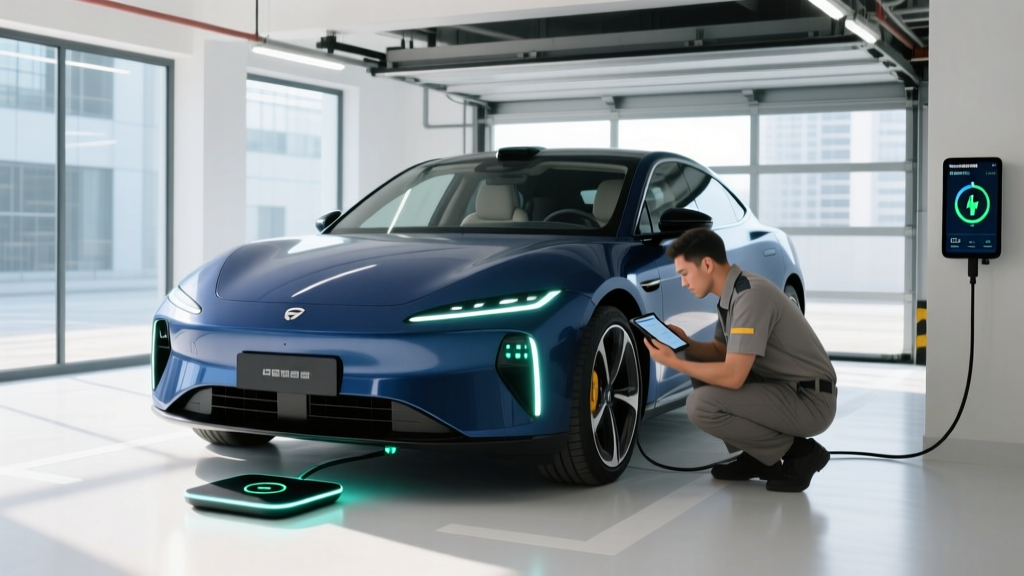
Tesla: Mobile service handles 80% of repairs (12V battery, cabin filters, tire rotations, minor body work) at your home or office. For major issues, you visit a Tesla Service Center. Wait times in major metros: 1-3 weeks for non-critical appointments.
Legacy automakers (Ford, Hyundai, Chevrolet, VW): Certified dealerships with EV-trained technicians. Independent shops are increasingly capable for tire work, brakes, and suspension, but high-voltage system diagnostics require dealer tools. Rural areas face 50-100 mile drives to qualified service centers.
Rivian, Lucid, BMW iX: Mobile service fleets cover major metros. Rivian's service vans handle 70% of repairs on-site. For body damage or drive unit replacement, you visit a certified center.
The independent shop gap is real. Most local mechanics lack high-voltage certification (ASE L3 or manufacturer-specific training). This is improving — the Bureau of Labor Statistics projects a 4% annual growth in EV technician demand through 2030 — but for now, plan your service logistics before buying.
Insurance Costs: The Hidden Service Expense
EV insurance premiums run 15-25% higher than equivalent gas vehicles, according to IIHS data. Why?
- Higher repair costs after collisions (specialized parts, high-voltage safety protocols)
- Greater vehicle weight causing more damage to other vehicles
- Limited independent body shop capacity for aluminum and composite EV structures
Example: A 2026 Tesla Model Y Long Range ($48,000 MSRP) averages $2,400-$3,000 annually for full coverage, versus $1,900-$2,400 for a 2026 Toyota RAV4 ($32,000 MSRP). However, the Model Y qualifies for a $7,500 federal tax credit (subject to IRS §30D income and sourcing requirements), partially offsetting higher insurance.
Shop quotes from EV-friendly insurers (Tesla Insurance, Geico, Progressive) and ask about telematics discounts. Safe drivers can reduce premiums 20-30% with usage-based programs.
Common EV Service Myths vs Reality
| Myth | Fact |
|---|---|
| "EV batteries need replacement every 5 years" | Average degradation is 8-12% at 5 years. Most batteries retain 80%+ capacity at 10 years. |
| "You can't service an EV without going to the dealer" | Tire shops, brake specialists, and mobile services handle 70% of routine maintenance. |
| "EVs cost more to maintain because parts are expensive" | EVs have fewer parts to replace. Total 5-year service costs are 30-50% lower than gas cars. |
| "Regenerative braking eliminates brake maintenance entirely" | Brake fluid still requires flushing every 2-3 years. Pads last longer but still wear eventually. |
| "Cold weather destroys EV batteries" | Cold reduces range temporarily (15-30% loss below 20°F) but doesn't cause permanent damage. Battery thermal management systems protect long-term health. |
Decision Framework: Is an EV Right for Your Service Budget?
Choose an EV if:
- You drive 12,000+ miles annually — higher mileage amplifies fuel and maintenance savings
- You have home charging access — eliminates public charging costs and inconvenience
- You live within 50 miles of a certified service center — or own a Tesla/Rivian with mobile service coverage
- You plan to keep the vehicle 5+ years — long-term ownership maximizes service savings and avoids early depreciation
- You qualify for the federal tax credit — up to $7,500 offsets higher purchase price and insurance
Stick with gas or hybrid if:
- You drive under 8,000 miles annually — low mileage doesn't justify EV's upfront cost premium
- You lack reliable home or workplace charging — public-only charging erodes cost savings and adds time
- You live in a rural area with no nearby EV service — 100+ mile service drives negate maintenance savings
- You frequently tow heavy loads — towing cuts EV range 40-50%, making gas trucks more practical
- You need maximum cargo/passenger capacity on a tight budget — gas SUVs still offer more space per dollar
Frequently Asked Questions
Do EVs need oil changes?
No. Electric vehicles have no engine oil, transmission fluid (most use sealed single-speed reducers), or fuel system. The only fluids are coolant (checked every 5 years), brake fluid (flushed every 2-3 years), and windshield washer fluid.
How often do EV tires need replacement?
Expect 30,000-45,000 miles from a set of EV-rated tires, versus 40,000-60,000 miles for gas car tires. Rotate every 6,000 miles to maximize life. Budget $800-$1,400 for a set of four EV-specific tires.
Can any mechanic work on an electric vehicle?
For tires, brakes, suspension, and 12V battery replacement, yes. For high-voltage system diagnostics, battery issues, or drive unit repairs, you need a technician with ASE L3 certification or manufacturer-specific training. Most independent shops don't yet have this capability.
What's the most expensive EV repair?
Out-of-warranty battery replacement ($8,000-$18,000 depending on capacity) or drive unit replacement ($4,000-$8,000). However, failure rates are under 2%, and federal warranty coverage (8 years/100,000 miles minimum) protects most owners.
Do EVs break down less than gas cars?
Yes. J.D. Power's 2025 Vehicle Dependability Study found EVs average 180 problems per 100 vehicles versus 215 for gas vehicles. Fewer moving parts means fewer failure points. However, EVs score lower on infotainment and build quality in some brands.
Is it worth buying an extended warranty for an EV?
Generally no, unless you plan to keep the vehicle past the 8-year/100,000-mile powertrain warranty. The battery and drive unit are already covered. Extended warranties for electronics and suspension can make sense for high-mileage drivers (20,000+ miles/year) but cost $2,000-$4,000 upfront.
EV car service in 2026 is simpler, cheaper, and less frequent than gas vehicle maintenance — but it's not zero. Budget $300-$500 annually for tires, filters, and fluid checks. Factor in higher tire costs and insurance premiums. And verify service center proximity before purchasing. The math favors EVs for most drivers covering 12,000+ miles per year with home charging access, but run your own numbers using the framework above.