The Short Answer on EV Car Design
EV car design is fundamentally dictated by battery placement and chemistry. Most modern EVs use a "skateboard" platform — a flat battery pack slung beneath the floor — which lowers the center of gravity, maximizes cabin and cargo space, and allows modular battery sizing. This architecture directly determines the vehicle's EPA range (typically 230–380 miles in 2026 models), weight distribution, ride quality, and ultimate price. Design choices like LFP vs. NMC battery chemistry further split vehicles into budget-friendly/durable vs. range-maximized categories. Understanding these design fundamentals tells you exactly what you're buying — and what trade-offs you're accepting.
Why EV Architecture Looks Nothing Like a Gas Car
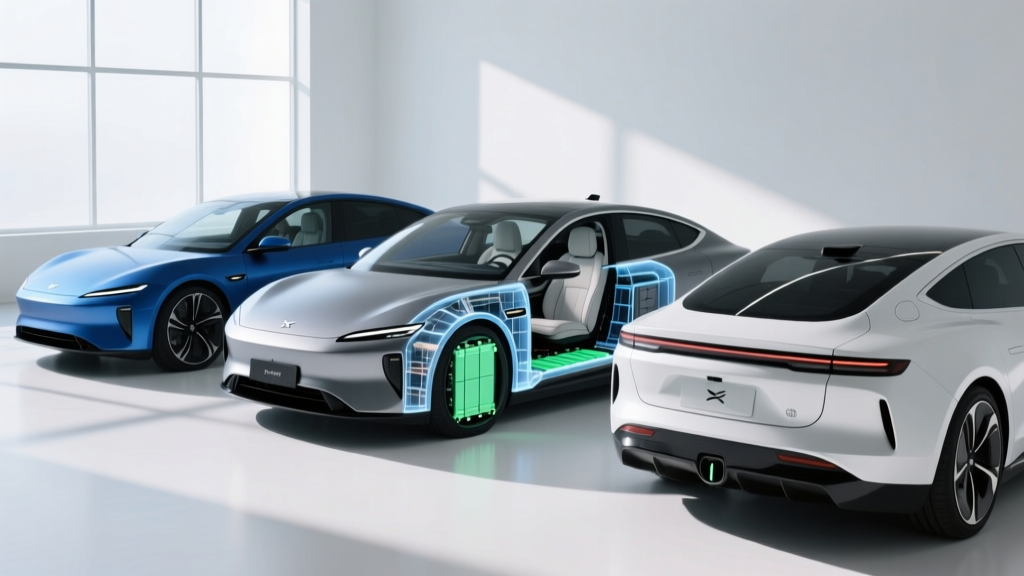
Strip away the body panels and a gas car is dominated by a front-mounted engine, a transmission tunnel running down the center, and a fuel tank under the rear seats. An EV replaces all of that with a flat battery pack, one or two electric motors (front, rear, or both), and a compact power-electronics module. This difference isn't cosmetic — it reshapes every dimension of the vehicle.
The dominant design paradigm in 2026 is the dedicated EV skateboard platform, used by vehicles built on architectures like Hyundai's E-GMP (Ioniq 5, Ioniq 6, EV6), GM's Ultium (Equinox EV, Blazer EV, Silverado EV), VW's MEB (ID.4, ID.7), and Tesla's structural battery pack (Model Y, Cybertruck). These platforms share a common philosophy: the battery is the chassis floor. This yields specific measurable advantages:
- Wheelbase stretch: Without an engine bay or transmission tunnel, designers push wheels to the corners. The Ioniq 5's 118.1-inch wheelbase on a 182.7-inch overall length gives it midsize-sedan rear legroom (41.7 inches) in a compact-crossover footprint.
- Flat floor: No center hump means three-across rear seating is genuinely usable, not a compromise.
- Frunk space: Removing the engine frees front-trunk storage — typically 0.8 to 4.1 cubic feet depending on whether the car uses a front motor.
- Lower center of gravity: A 1,000–1,500 lb battery pack mounted at the lowest point reduces body roll, improving handling without stiffer (harsher) suspension tuning.
The trade-off? Ride height and ground clearance. That underfloor battery must be protected from impacts, which is why most EVs sit 5.5–7.0 inches off the ground and why dedicated EV platforms rarely produce low-slung sedans without raising the floor and compromising headroom.
Battery Chemistry: The Design Choice That Defines Your Ownership
The single most consequential EV car design decision — one that affects range, longevity, charging behavior, and price — happens at the cell level: LFP (lithium iron phosphate) vs. NMC (nickel manganese cobalt) chemistry.
| Factor | LFP (Lithium Iron Phosphate) | NMC (Nickel Manganese Cobalt) |
|---|---|---|
| Energy density | Lower (~160 Wh/kg cell-level) | Higher (~250–300 Wh/kg cell-level) |
| EPA range impact | Shorter for same pack weight (typically 230–270 mi) | Longer (typically 290–380+ mi) |
| Cycle life | 3,000–5,000+ cycles to 80% SoH | 1,000–2,000 cycles to 80% SoH |
| Charging to 100% | Recommended regularly (helps BMS calibration) | Best kept 20–80% for daily use |
| Cold-weather range loss | Greater (~35–40% loss below 20°F) | Moderate (~25–30% loss below 20°F) |
| Cost per kWh (pack-level) | ~$95–$115 | ~$125–$150 |
| Typical vehicles (2026) | Tesla Model 3 RWD, Model Y RWD, base Chevy Equinox EV | Model 3 Long Range, Ioniq 5 Long Range, F-150 Lightning Extended |
| Warranty (federal minimum) | 8 years / 100,000 miles (capacity ≥70%) | 8 years / 100,000 miles (capacity ≥70%) |
The practical translation: If you're a daily commuter driving under 50 miles round-trip with home charging, an LFP-equipped EV saves you $3,000–$6,000 upfront and will likely outlast the car's ownership life. If you regularly drive 200+ miles between charges or live in a cold climate, NMC's higher energy density and better cold-weather performance justify the premium.
Design Trade-Offs: Range, Weight, and Efficiency by the Numbers
EV car design is an exercise in physics-driven compromise. More range requires a larger battery, which adds weight, which reduces efficiency, which requires even more battery. Here's how this plays out across current 2026 models, with data from fueleconomy.gov:
| Vehicle | Battery (kWh usable) | Chemistry | Curb Weight (lbs) | EPA Range (mi) | Efficiency (kWh/100mi) | 0–60 mph (sec) | Base MSRP |
|---|---|---|---|---|---|---|---|
| Tesla Model 3 RWD | 57.5 | LFP | 3,862 | 272 | 25 | 5.8 | $38,990 |
| Tesla Model 3 Long Range AWD | 75 | NMC | 4,034 | 363 | 25 | 4.2 | $44,990 |
| Hyundai Ioniq 5 SE Std Range | 58 | NMC | 4,244 | 240 | 28 | 7.4 | $42,600 |
| Hyundai Ioniq 5 SEL AWD | 77.4 | NMC | 4,660 | 290 | 30 | 5.1 | $49,850 |
| Ford F-150 Lightning Std | 98 | NMC | 6,171 | 240 | 47 | 4.5 | $54,995 |
| Ford F-150 Lightning Ext | 131 | NMC | 6,360 | 320 | 48 | 3.8 | $69,995 |
| Toyota Camry LE (gas baseline) | — | — | 3,310 | ~448 (14.5 gal) | 32 MPG comb. | 7.6 | $28,700 |
Notice the pattern: the F-150 Lightning Extended Range carries 131 kWh of battery and weighs 6,360 lbs to achieve 320 miles of range. The Model 3 Long Range carries 75 kWh and weighs 4,034 lbs to achieve 363 miles. The efficiency gap is stark — 48 kWh/100mi for the truck vs. 25 kWh/100mi for the sedan. Design intent (towing, payload, ground clearance) directly dictates how far each kWh takes you.
Real-World Range Reality Check
EPA range is a laboratory composite. In real-world ownership, expect the following adjustments:
- Highway driving (70–80 mph): Subtract 15–25% from EPA range. Aerodynamic drag scales with the square of speed, and EVs have no gears to optimize at high velocity.
- Cold weather (below 32°F): Subtract 20–40% depending on chemistry (LFP hit harder) and whether the vehicle has a heat pump. Battery heating and cabin HVAC draw are significant loads.
- DC fast charging: Peak kW is not sustained kW. A vehicle advertising 250 kW peak (like the Ioniq 5) typically sustains that rate only from ~10–45% SoC, tapering sharply above 60%. Expect 10–80% in 18–22 minutes at a capable charger, not the "15 minutes" marketing headline.
The True Cost of EV Design Choices: 5-Year Ownership Breakdown
Design decisions at the engineering level translate directly into your wallet. Here's a 5-year / 60,000-mile total cost of ownership comparison for a typical buyer — assuming 12,000 miles/year, 80% home Level 2 charging at $0.14/kWh national average, and 20% public DC fast charging at $0.40/kWh.
| Cost Category | Tesla Model 3 LR AWD ($44,990) | Toyota Camry LE ($28,700) |
|---|---|---|
| Purchase price (MSRP) | $44,990 | $28,700 |
| Federal §30D tax credit (if eligible) | −$7,500 (point-of-sale transfer) | $0 |
| Effective purchase price | $37,490 | $28,700 |
| Fuel / energy (60,000 mi) | $4,536 (est. 25 kWh/100mi blended cost) | $7,200 (est. 32 MPG at $3.84/gal) |
| Maintenance (5 years) | ~$1,200 (cabin filter, tire rotation, wiper fluid) | ~$3,800 (oil changes, brakes, filters, spark plugs) |
| Insurance (avg. annual) | ~$2,400/yr ($12,000 total) | ~$1,600/yr ($8,000 total) |
| Estimated 5-yr depreciation | ~$16,000 (43% of effective price) | ~$11,500 (40% of MSRP) |
| Total 5-Year Cost | ~$71,226 | ~$59,200 |
| Cost per mile | ~$1.19/mi | ~$0.99/mi |
The EV saves roughly $5,300 in fuel and maintenance over five years but gives it back — and then some — in higher insurance premiums and steeper upfront cost even after the tax credit. The Model 3's design (lighter, more efficient, NMC battery) keeps its energy cost low, but insurance remains a persistent ownership penalty for most EVs due to higher repair costs from battery-integrated structural components.
Critical tax credit caveat: The IRS §30D credit has strict eligibility requirements: buyer income caps ($150K single / $300K joint), vehicle MSRP caps ($55K sedans / $80K SUVs and trucks), and battery critical-mineral and component sourcing requirements that change annually. Not every EV qualifies for the full $7,500 — verify current-year eligibility on the IRS website or with a tax professional before committing to a purchase.
How Design Choices Affect Charging Speed and Infrastructure Fit
Not all EV architectures charge at the same speed, and the design decision around electrical architecture voltage has a direct, measurable impact on your road-trip experience.
Most EVs use a 400-volt electrical architecture. Hyundai/Kia/Genesis vehicles on E-GMP use an 800-volt system, which enables faster DC charging without requiring thicker (heavier, more expensive) cabling. Here's the real-world difference:
| Vehicle | Architecture Voltage | Peak DC Charge Rate | 10–80% Time (350 kW charger) | Connector (2026) |
|---|---|---|---|---|
| Hyundai Ioniq 5 (77.4 kWh) | 800V | 240 kW | ~18 min | NACS (native) |
| Tesla Model 3 LR (75 kWh) | 400V | 250 kW | ~22 min | NACS (native) |
| VW ID.4 (82 kWh) | 400V | 175 kW | ~28 min | NACS (adapter or native) |
| Chevy Equinox EV (85 kWh) | 400V | 150 kW | ~32 min | NACS (native) |
The 800V Ioniq 5's advantage isn't peak rate — Tesla matches or exceeds it — but the shape of its charge curve. The Ioniq 5 sustains above 200 kW for a wider SoC window before tapering, meaning the 10–80% time is genuinely shorter. On a 300-mile road trip with two charging stops, that's roughly 8–12 minutes saved total. Over a year of road trips, it's meaningful; for a one-time buyer test drive, it's invisible.
Connector compatibility in 2026 has largely consolidated around NACS (North American Charging Standard, now SAE J3400). Tesla Superchargers, Electrify America, EVgo, and most new public stations offer NACS natively. CCS1 vehicles can access most networks via adapter, but verify your specific model's adapter availability and any network-specific restrictions before relying on it for road trips.
Common EV Car Design Misconceptions — Myth vs. Fact
| Myth | Fact (with data) |
|---|---|
| "EV batteries need replacing every 5–8 years." | Federally mandated warranty is 8 years / 100,000 miles with ≥70% capacity retention. Real-world degradation data from Tesla's 2025 Impact Report shows Model 3/Y packs retain ~88% capacity at 150,000 miles. LFP packs often exceed 90% at that mileage. |
| "A bigger battery always means more range." | Not if the vehicle is heavier and less aerodynamic. The F-150 Lightning (131 kWh) gets 320 mi EPA; the Model 3 LR (75 kWh) gets 363 mi. Efficiency (kWh/100mi) matters more than raw capacity. |
| "All EVs charge at the same speed." | Peak rates range from 100 kW (base Nissan Leaf-class) to 350 kW (Lotus Eletre, Porsche Taycan). A 150 kW-limited vehicle on a 350 kW charger gains nothing beyond its ceiling. |
| "EV design means no maintenance ever." | Tires wear 15–25% faster on EVs due to instant torque and higher weight. Cabin air filters, brake fluid (every 2 years), wiper blades, and coolant loops still require service. Savings are real (~60–70% less than gas) but not zero. |
| "EVs are all equally efficient." | Efficiency spans from 24 kWh/100mi (Lucid Air) to 50+ kWh/100mi (GMC Hummer EV). That's a 2x cost-per-mile difference at the charger. |
Your Decision Framework: Which EV Design Philosophy Fits You?
Choose Based on Your Actual Driving Pattern
Choose an LFP-equipped compact/midsize EV (Model 3 RWD, base Equinox EV) if:
- Your daily round-trip commute is under 60 miles
- You have reliable Level 2 home charging (240V, 32–48A circuit)
- You want the lowest purchase price and longest battery cycle life
- You live in a mild climate (rarely below 25°F)
- You plan to own the vehicle 8+ years
Choose an NMC long-range EV (Model 3 LR, Ioniq 5 AWD, ID.7) if:
- You regularly drive 150+ miles in a single day
- You take 4+ road trips per year over 200 miles
- You live in a cold climate and need minimized winter range loss
- You want 300+ miles EPA range as a buffer for highway/cold conditions
Choose an electric truck or large SUV (F-150 Lightning, Rivian R1S, Tahoe-based Ultium SUV) if:
- You need towing capacity (5,000–10,000 lbs) or 3-row seating
- You accept 240–320 miles of real-world range as sufficient for your pattern
- You understand that efficiency will be 40–50 kWh/100mi (higher fueling cost)
- You have home charging and a garage that fits a 230+ inch vehicle
Consider a PHEV instead of a BEV if:
- You cannot install home Level 2 charging (apartment, street parking)
- Your daily commute is under 35 miles (PHEVs like the RAV4 Prime offer 42 mi electric-only)
- You take frequent long road trips and don't want to plan around charging stops
- You want EV-like daily driving without range anxiety in cold or remote conditions
What First-Time EV Buyers Must Know About Design-Driven Ownership
The design of the EV you choose determines your daily ownership experience more than any feature package or color option. Here's the practical checklist before you sign:
- Verify your home electrical panel capacity. A 48-amp Level 2 charger requires a 60-amp dedicated circuit. Many older homes with 100-amp main panels need a $1,500–$3,500 panel upgrade to 200 amps. Get a licensed electrician's assessment before purchasing the car — not after.
- Match battery size to actual driving, not anxiety. A 57 kWh LFP pack charged nightly at home covers 95% of American driving patterns. Paying $6,000–$10,000 extra for 350+ miles of range you use twice a year is a design choice driven by fear, not data.
- Check the charge curve, not just peak kW. A vehicle with a 250 kW peak that tapers to 40 kW above 60% SoC will feel slower on a road trip than a 200 kW vehicle with a flatter curve. Read independent charge-curve tests, not manufacturer press releases.
- Factor in insurance early. Get quotes before purchasing. EV insurance premiums run 15–40% higher than comparable gas vehicles due to battery replacement costs in collision claims. This is a direct consequence of skateboard design — the battery is a structural, expensive, underfloor component.
- Understand your connector reality. In 2026, NACS is the dominant standard. If you buy a CCS-equipped vehicle (some 2024–2025 models still in inventory), confirm adapter availability for the networks you'll use.
Does EV car design affect safety in crashes?
Yes, generally positively. The skateboard layout creates a massive front crumple zone (no engine block to intrude) and an extremely low rollover risk due to the floor-mounted battery weight. The NHTSA and IIHS consistently rate dedicated-platform EVs highly. The Model 3, Ioniq 5, and ID.4 all earn IIHS Top Safety Pick+ designations. The concern is post-crash battery thermal management — first responders are trained for this, and manufacturer repair protocols are well-established.
Why do some EVs have a "frunk" and others don't?
Frunk (front trunk) availability depends on whether the design uses a front motor. An AWD EV with a front motor has less space for front storage — often just a small compartment for charging cables. RWD-only or rear-motor-biased designs (Tesla Model 3, some RWD configurations) can offer 3–4 cubic feet of frunk space. It's a direct trade-off between all-wheel-drive traction and storage utility.
Will EV design improve enough to make today's models obsolete soon?
Incrementally, yes — obsoletely, no. Solid-state batteries promise 30–40% more energy density and faster charging, but commercial availability at scale remains 2028–2030 for mainstream vehicles. 800V architectures are spreading beyond Hyundai/Porsche into GM and Stellantis platforms. Today's EVs will remain competitive for years; the design fundamentals (skateboard, flat floor, low center of gravity) are settled engineering. Buy for your needs now rather than waiting for a breakthrough that's perpetually two years away.
How does EV car design impact resale value?
Battery health (State of Health, or SoH) is the dominant resale factor. Vehicles with proven low-degradation chemistries (LFP) or strong manufacturer warranty support tend to hold value better. Tesla's high-volume data transparency helps its resale. Depreciation for EVs averaged 45–55% over 3 years as of early 2026, steeper than gas vehicles, driven largely by price cuts on new models and rapid feature advancement rather than mechanical obsolescence.