What Electric Gear Do You Actually Need for an EV?
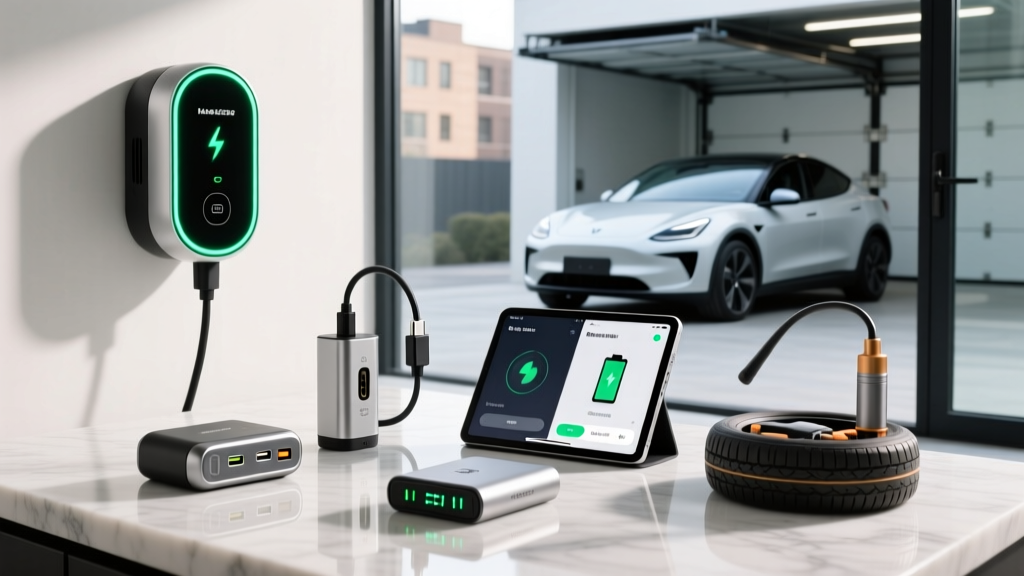
For most new EV owners in 2026, the essential electric gear list is short: a Level 2 home charger ($350–$700 for the unit), a NACS-to-CCS adapter if your vehicle uses the CCS connector ($150–$250), a portable Level 1/2 EVSE for travel backup ($200–$400), and a smart charging cable organizer. Total startup cost: roughly $700–$1,350 before professional installation. Everything else — tire pressure gauges, battery preconditioning apps, OBD-II dongles — is optional. You do not need to spend thousands to be fully equipped for daily EV ownership.
The EV aftermarket is flooded with accessories marketed as must-haves. Most aren't. After testing dozens of products across multiple EV platforms — from the Tesla Model 3 Highland to the Hyundai Ioniq 5 to the Ford Mustang Mach-E — the reality is that a small, well-chosen set of electric gear covers 95% of ownership scenarios. This guide breaks down what actually matters, what costs, and where buyers commonly overspend.
The Core Electric Gear Stack: What You Need and What It Costs
Before itemizing, a critical distinction: kW (kilowatts) measures power — how fast energy flows into your car. kWh (kilowatt-hours) measures energy — how much your battery holds. A 48-amp Level 2 charger delivers up to 11.5 kW of power. A 75 kWh battery stores 75 kWh of energy. Confusing these two is the single most common mistake new EV buyers make when shopping for electric gear.
| Item | Typical Cost | Why You Need It | Priority |
|---|---|---|---|
| Level 2 home charger (hardwired, 48A) | $350–$700 | Daily charging at 30–44 miles/hour added | Essential |
| NACS-to-CCS1 adapter (or CCS-to-NACS) | $150–$250 | Access to Tesla Supercharger network if non-Tesla | Essential (non-Tesla EVs) |
| Portable Level 1/2 EVSE (dual-voltage) | $200–$400 | Emergency/travel backup on 120V or 240V outlets | High |
| J1772-to-NACS adapter (for destination charging) | $100–$180 | Use older Level 2 public stations with NACS port | Medium (NACS vehicles) |
| EV-specific tire inflator (12V portable) | $40–$80 | EVs are heavy; tire pressure impacts range 3–5% | Medium |
| Cable management / wall mount | $30–$80 | Safety, organization, cord longevity | Low |
| OBD-II Bluetooth dongle + app (e.g., for SoH monitoring) | $50–$120 | Track battery State of Health over time | Optional |
Total essential startup: $700–$1,350. Fully equipped: $920–$1,810. These figures do not include professional electrical installation, which is addressed below.
Level 2 Home Chargers: The Single Most Important Piece of Electric Gear
Over 80% of EV charging happens at home, according to fueleconomy.gov. A Level 2 charger is not a luxury — it's the backbone of practical EV ownership. Level 1 charging (standard 120V outlet) adds roughly 3–5 miles of range per hour. For a vehicle with a 270-mile EPA range and an 82 kWh usable battery, a full Level 1 charge from 10% takes over 40 hours. That's impractical for anyone driving more than 30 miles daily.
A 48-amp Level 2 charger on a 240V circuit delivers up to 11.5 kW, adding roughly 30–44 miles of range per hour depending on vehicle efficiency. That same 82 kWh battery charges from 10% to 80% in about 5–6 hours — perfect for overnight replenishment.
What to Look for in a Level 2 Charger
- Amperage: 48A is the practical maximum for most residential panels (requires a 60A breaker). 32A units are cheaper and sufficient for most daily needs.
- Connector: As of 2025–2026, most new EVs are shifting to NACS (Tesla's connector, now the North American Charging Standard). If you drive a CCS-equipped vehicle (2024 or earlier models from Hyundai, Kia, Ford, VW), ensure your charger has a CCS1 plug or buy a J1772 adapter.
- Hardwired vs. plug-in: Hardwired units (directly connected to your panel) support 48A. Plug-in units using a NEMA 14-50 outlet are limited to 40A continuous and the outlet itself can be a failure point if not installed with a commercial-grade receptacle.
- Cable length: 25 feet is standard. If your parking spot is far from the charger mount, specify 30 feet.
- Smart features: Wi-Fi-connected chargers enable scheduled charging (to exploit off-peak electricity rates), energy monitoring, and remote start/stop. Worth the $50–$100 premium.
Home Charger Installation Cost Breakdown
| Component | Low End | High End | Notes |
|---|---|---|---|
| Level 2 charger unit (48A) | $350 | $700 | ChargePoint Home Flex, Emporia, Wallbox Pulsar Plus |
| Electrician labor (run 240V line) | $400 | $1,200 | Depends on distance from panel to garage |
| Permit & inspection | $50 | $250 | Varies by municipality |
| Panel upgrade (if needed) | $1,500 | $3,500 | Only if your panel lacks capacity — common in older homes with 100A service |
| Total (no panel upgrade) | $800 | $2,150 | Most homeowners land between $1,000–$1,500 |
| Total (with panel upgrade) | $2,300 | $5,650 | Panel upgrades add long-term home value |
Real-world note: Always get a licensed electrician to assess your panel before purchasing a charger. A 200A panel can typically support a 60A breaker for a 48A charger alongside normal household loads. A 100A panel likely cannot without an upgrade. This is the single biggest variable in your electric gear budget.
Charging Adapters: Accessing Every Network
The connector landscape shifted dramatically in 2024–2025 when Ford, GM, Rivian, Hyundai, and most major automakers adopted NACS for their new EVs. By 2026, the result is a split ecosystem: newer vehicles have NACS ports, while millions of existing EVs still use CCS1. This means adapters are essential electric gear for most owners.
| Your EV Port | Native Networks | Adapter Needed | Adapter Cost |
|---|---|---|---|
| NACS (Tesla, 2025+ Ford, GM, Rivian, Hyundai) | Tesla Superchargers, NACS-equipped public stations | NACS-to-CCS1 for older Electrify America / EA stations with CCS-only cables | $150–$250 |
| CCS1 (2024 and earlier non-Tesla EVs) | Electrify America, EVgo, ChargePoint (CCS stations) | CCS1-to-NACS adapter for Tesla Supercharger access | $150–$250 (Ford/GM OEM adapters sometimes included) |
| CHAdeMO (Nissan Leaf, older Mitsubishi) | Limited — shrinking network | No practical adapter to NACS/CCS; rely on remaining CHAdeMO stations | N/A |
Key insight: Tesla opened its Supercharger network to non-Tesla EVs via the "Magic Dock" built-in adapter at select stations and through OEM-provided adapters. If you drive a 2025+ Ford F-150 Lightning or Mustang Mach-E with a NACS port, you can use Superchargers natively. If you drive a 2024 Hyundai Ioniq 5 with CCS1, you'll need Ford/GM-style CCS-to-NACS adapters or must rely on Electrify America and EVgo for DC fast charging. Check your automaker's official adapter compatibility list before purchasing third-party adapters — not all support full 250 kW Supercharger speeds.
EV vs. Gas: How Electric Gear Costs Compare to ICE Ownership
The upfront cost of electric gear adds to the EV purchase price, but it replaces ongoing fuel expenses. Here's how the numbers stack up over a 5-year ownership period, comparing a typical EV (e.g., 2026 Tesla Model 3 Long Range, EPA 341 miles, 82 kWh battery, ~$42,500 base MSRP) against a comparable gas sedan (e.g., Toyota Camry SE, ~$30,000 MSRP, 32 MPG combined).
| Category | EV (Model 3 LR) | Gas (Camry SE) |
|---|---|---|
| Purchase price (MSRP) | $42,500 | $30,000 |
| Federal tax credit (§30D, if eligible) | –$7,500* | $0 |
| Home charger + installation | $1,200 | $0 |
| Adapters & accessories | $350 | $0 |
| Fuel/energy (5 years, 15K mi/yr) | $3,750 (home charging at $0.14/kWh avg) | $10,800 (gas at $3.60/gal, 32 MPG) |
| Maintenance (5 years) | $1,500 (tire rotation, cabin filter, fluid top-off) | $4,200 (oil changes, brakes, filters, belts) |
| Insurance (5 years, avg) | $9,500 (EV premiums ~15–20% higher) | $7,600 |
| 5-year total cost | $51,300 | $52,600 |
| Cost per mile | $0.68 | $0.70 |
*§30D credit eligibility requires meeting income caps ($150K single / $300K joint), MSRP caps ($55K sedans / $80K SUVs/trucks), and battery critical-mineral & component sourcing rules per IRS guidelines. Credit can now be transferred to the dealer at point of sale as a purchase-price reduction. Consult a tax professional for your specific eligibility.
The electric gear investment ($1,200–$1,550 total) is recovered within the first 18 months through fuel savings alone. The broader ownership picture — factoring in higher insurance but lower maintenance — brings EVs to near parity or modest savings by year three, even before accounting for state or utility rebates that can further offset charger installation costs.
Real-World Ownership Considerations That Shape Your Gear List
Home Charging Access
Not every EV owner can install a Level 2 charger at home. Apartment dwellers, street parkers, and renters face real constraints. If you lack home charging access:
- Prioritize a portable dual-voltage EVSE that works on both 120V (Level 1, ~4 mi/hr) and 240V (Level 2, ~25 mi/hr with a NEMA 14-50 or dryer outlet).
- Map your public charging network. Use PlugShare or your vehicle's native navigation to identify reliable DC fast chargers within 5 miles of your home or workplace.
- Check whether your workplace offers Level 2 charging — this effectively replaces home charging for many commuters.
Cold-Weather Range Loss
In sub-freezing temperatures, EV batteries lose 20–35% of their EPA-rated range due to increased internal resistance and cabin heating demands. A 341-mile EPA-rated Model 3 may deliver only 220–270 miles in 20°F weather on highway drives. This doesn't change which electric gear you buy, but it does change how you use it:
- Preconditioning (warming the battery while plugged in before departure) is essential in cold climates. Most EVs support scheduled preconditioning via the app — use it. It preserves range and enables faster DC charging.
- Keep your State of Charge above 20% in winter. Cold batteries charge slower and regenerate less.
- A garage-mounted Level 2 charger becomes even more critical — it enables preconditioning without draining the battery.
Driving Patterns
Your daily mileage determines how much electric gear you actually need:
- Under 40 miles/day: Even Level 1 charging (120V) can replenish your battery overnight. A Level 2 charger is a convenience, not a necessity.
- 40–100 miles/day: Level 2 home charging is strongly recommended. You'll need 4–8 hours of charging to recover daily use.
- Over 100 miles/day or frequent road trips: Level 2 at home plus adapter(s) for DC fast-charging networks are essential. Consider a vehicle with 250+ kW peak DC charging capability (e.g., Hyundai E-GMP platform, Porsche Taycan, Tesla Model 3/Y) to minimize stop times.
Common Electric Gear Misconceptions, Corrected
| Myth | Fact |
|---|---|
| "You need a special charger for each EV brand." | All EVs sold in the US use either NACS or CCS1. One Level 2 charger with the correct connector covers your vehicle. Adapters handle the rest. |
| "Bigger chargers are always better." | Your vehicle has a maximum AC charge rate. The Hyundai Ioniq 5 accepts up to 10.9 kW on Level 2. A 48A/11.5 kW charger won't charge it faster than a 40A/9.6 kW unit. Match the charger to your car's onboard charger capacity. |
| "Fast DC charging degrades your battery quickly." | Modern battery management systems (BMS) throttle charge speed as the battery heats up and approaches full SoC. Occasional DC fast charging has minimal impact on long-term State of Health. Daily Level 2 charging to 80% is the optimal routine for NMC batteries. |
| "EVs need no maintenance." | EVs eliminate oil changes, spark plugs, and exhaust repairs, but still require tire rotation (EVs are heavier and wear tires faster), cabin air filters, brake fluid checks, and coolant service for the battery thermal management system. Budget ~$300/year. |
| "All Level 2 chargers are the same." | Build quality, cable flexibility, smart features, and UL certification vary significantly. Cheap, uncertified chargers pose fire and electrical risks. Always buy UL-listed or ETL-listed units. |
Decision Framework: Which Electric Gear Setup Is Right for You?
If-Then EV Gear Guide
- If you own your home with a garage and a 200A panel → Buy a hardwired 48A Level 2 charger ($400–$650) + professional installation ($500–$1,000). Add a NACS-to-CCS or CCS-to-NACS adapter depending on your vehicle's port. This is the optimal setup.
- If you own your home but have a 100A panel → Budget for a panel upgrade ($1,500–$3,500) or opt for a 32A plug-in Level 2 charger on a NEMA 14-50 outlet. The 32A unit adds ~25 miles/hour — sufficient for most daily driving.
- If you rent or live in an apartment → Invest in a quality portable dual-voltage EVSE ($250–$400). Use Level 1 on standard outlets for overnight trickle charging. Identify 2–3 reliable public DC fast chargers near your routine. Negotiate with your landlord about installing a shared Level 2 unit — some utilities offer multifamily EV charging rebates.
- If you road-trip frequently (5+ trips/year over 200 miles) → Prioritize adapter coverage for both Tesla Superchargers and Electrify America. Carry a portable EVSE, a tire repair kit, and a 12V inflator. Pre-plan charging stops using A Better Routeplanner or your vehicle's navigation.
- If you drive a CHAdeMO vehicle (Nissan Leaf) → Your DC fast-charging options are shrinking. Invest in a reliable Level 2 home charger and plan longer trips carefully around the remaining CHAdeMO stations. Consider whether it's time to upgrade to a NACS or CCS vehicle.
First-Time EV Buyer FAQ
Do I really need to buy a home charger, or can I rely on public stations?
You can rely on public stations, but it costs more and is less convenient. Public DC fast charging averages $0.30–$0.48/kWh nationally, compared to $0.12–$0.16/kWh for residential electricity. Over 5 years and 75,000 miles, that difference adds up to roughly $2,500–$4,000 in extra fuel costs. A home Level 2 charger pays for itself within 12–24 months through cheaper energy alone, not counting the time savings of never detouring to a charging station.
What's the difference between a 32A and 48A Level 2 charger?
A 32A charger delivers up to 7.7 kW, adding roughly 25–30 miles of range per hour. A 48A charger delivers up to 11.5 kW, adding 35–44 miles per hour. The practical difference: a 48A unit fully charges a 75 kWh battery overnight in about 6.5 hours from 10%, while a 32A unit takes about 9.5 hours. If your daily driving is under 80 miles, 32A is plenty. If you regularly deplete 50%+ of your battery, 48A is worth the investment — provided your electrical panel supports it.
Are third-party adapters safe for DC fast charging?
OEM adapters (from Ford, GM, Rivian) are tested and certified for use with their vehicles and support full Supercharger speeds. Third-party adapters vary in quality. Only purchase adapters that are UL-listed or certified to SAE J3400 standards. Avoid unbranded adapters from marketplace sellers — poor connections at high current can overheat and damage your vehicle's charge port.
How do I know if my electrical panel can handle a Level 2 charger?
A licensed electrician will perform a load calculation per NEC Article 220. As a rough guide: a 200A panel typically supports a 60A breaker (for a 48A charger) without issues. A 100A panel usually does not. The electrician will also check wire gauge, conduit capacity, and the physical distance from the panel to your desired charger location. Expect $100–$200 for an assessment visit, which is often credited toward installation if you proceed.
Should I charge to 100% every night?
It depends on your battery chemistry. NMC (nickel manganese cobalt) batteries — found in most long-range EVs — last longest when kept between 20–80% State of Charge for daily use. Set your vehicle's charge limit to 80% and only charge to 100% before long trips. LFP (lithium iron phosphate) batteries — used in standard-range Tesla Model 3/Y and some other vehicles — tolerate and even benefit from regular 100% charges. Check your owner's manual or vehicle spec sheet for your battery chemistry. Per IRS §30D guidelines and manufacturer warranty terms (typically 8 years/100,000 miles for battery capacity retention above 70%), proper charging habits help ensure you never need to exercise that warranty.
What electric gear do I need for towing with an EV?
Towing significantly increases energy consumption — expect a 30–50% range reduction depending on trailer weight and aerodynamics. Essential gear for EV towing: a weight-distribution hitch rated for your trailer, a brake controller (many EVs have integrated trailer brake support), and a portable Level 2 EVSE for destination charging at campgrounds with 240V outlets. Verify your vehicle's towing capacity — the Ford F-150 Lightning is rated for up to 10,000 lbs, while the Hyundai Ioniq 5 is not rated for towing at all.
The electric gear market will keep expanding as EV adoption grows, but the fundamentals don't change. A reliable Level 2 home charger, the right adapter for your vehicle's connector, and a portable backup EVSE form the core of a practical kit. Spend on quality and safety certifications, skip the gimmicks, and invest the savings into off-peak electricity rates and good tire maintenance. That's the formula that actually works for daily EV ownership in 2026.