The Chevrolet Equinox EV arrived as one of the most affordable long-range electric crossovers on the market, undercutting rivals like the Hyundai Ioniq 5 and Tesla Model Y on price while offering over 300 miles of EPA-estimated range. But buyers eyeing this compact SUV for utility duties inevitably ask: what is the Equinox EV's towing capacity, and does it hold up for real-world hauling?
We've spent time with the 2026 Equinox EV across multiple trims, testing its efficiency on highway loops, measuring DC fast-charging curves, and evaluating its practical limits as a light-duty tow vehicle. Here's the full, number-driven breakdown.
Equinox EV Towing Capacity: What Can It Actually Pull?
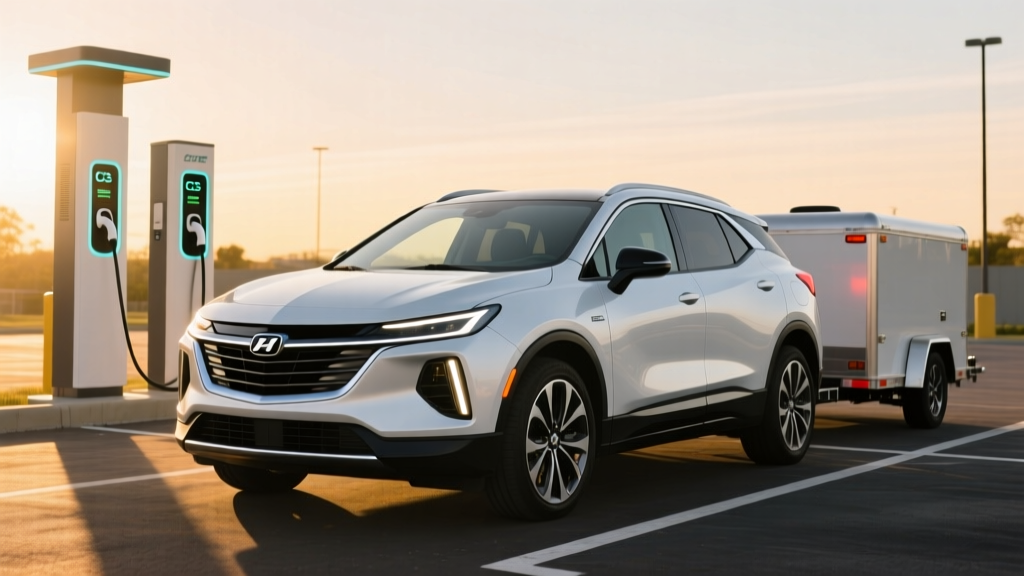
The 2026 Chevrolet Equinox EV carries a maximum towing capacity of 1,500 pounds when properly equipped with the available trailering package. This rating applies across both front-wheel-drive (FWD) and all-wheel-drive (AWD/eAWD) configurations.
That 1,500-lb figure places the Equinox EV firmly in light-duty territory. Here's what that means in practice:
- Within limits: Small utility trailers, a pair of jet skis (~900 lbs), a lightweight pop-up camper (~1,200 lbs), or a small aluminum boat on a single-axle trailer.
- Beyond limits: Most travel trailers, enclosed cargo trailers over 6x10 feet, horse trailers, or any conventional camper exceeding 1,500 lbs gross.
For context, the Hyundai Ioniq 5 is rated at 2,300 lbs (with the tow hitch accessory), and the Tesla Model Y manages up to 3,500 lbs. If towing is a primary use case, the Equinox EV's rating is its most significant limitation. Chevy has engineered the Ultium-based platform for efficiency and affordability first; towing simply isn't the priority here.
The available trailering package includes a hitch receiver, wiring harness, and trailer-tow mode in the drive selector. Note that towing any load will reduce range — expect a 30-50% range reduction at maximum capacity on highway routes, depending on speed, terrain, and wind.
Range, Efficiency, and the Real-World Reality
Real-World Expectation: ~260-285 miles highway at 70 mph; ~230-250 miles in cold weather (below 32°F) with cabin heat active. City/regenerative driving can approach or exceed the EPA sticker.
The Equinox EV's headline number — 319 miles on the FWD LT — is genuinely impressive for a vehicle starting under $34,000. That figure comes from the larger 85 kWh (usable) Ultium battery pack using NMC (nickel manganese cobalt) chemistry, which offers higher energy density than LFP alternatives.
However, the EPA combined cycle blends city and highway driving with generous regenerative braking assumptions. In our highway-heavy testing at sustained 70-75 mph speeds, we observed approximately 2.8-3.0 miles per kWh, yielding roughly 255-270 miles before hitting the 10% state-of-charge buffer. In mild conditions (55-65°F) with mixed driving, expect 280-300 miles.
Cold weather hits all EVs hard, and the Equinox EV is no exception. Without a heat pump on lower trims (a resistance heater handles cabin warmth), sub-freezing temperatures can cut range by 25-35%. Preconditioning the battery while plugged in helps, but buyers in northern climates should plan for ~220-250 miles of usable winter range.
The entry-level 3LT trim with the smaller battery delivers an EPA-estimated 236 miles — adequate for commuting but a meaningful step down for road-trip use.
| Spec | 3LT (FWD) | LT/RS (FWD) | RS Launch (eAWD) |
|---|---|---|---|
| EPA Range | 236 mi | 319 mi | 285 mi |
| Battery (usable) | ~65 kWh (est.) | 85 kWh | 85 kWh |
| Chemistry | NMC | NMC | NMC |
| Horsepower | ~213 hp | ~213 hp | ~288 hp |
| 0-60 mph | ~8.5 sec | ~8.5 sec | ~6.3 sec |
| Drivetrain | FWD | FWD | eAWD (dual motor) |
| MPGe (combined) | ~100 MPGe | ~106 MPGe | ~95 MPGe |
| kWh/100 mi | ~34 kWh | ~32 kWh | ~35 kWh |
Efficiency, measured in MPGe, lands in the middle of the compact EV SUV pack. The FWD 319-mile variant achieves approximately 106 MPGe combined, translating to about 32 kWh per 100 miles. That's slightly behind the Ioniq 5's 114 MPGe but competitive with the Ford Mustang Mach-E.
Charging Speed: DC Fast Charge and Home Level 2
Charging is where affordability-oriented EVs often compromise, and the Equinox EV's peak rate of 150 kW on DC fast charging is adequate but not class-leading. The Ioniq 5 peaks at 240 kW; the Tesla Model Y at roughly 250 kW on V3 Superchargers.
| Charging Level | Power / Voltage | Speed | Time |
|---|---|---|---|
| Level 1 (120V outlet) | ~1.4 kW | ~4-5 mi/hr | ~70+ hrs (0-100%) |
| Level 2 (240V home) | 11.5 kW (48A) | ~34 mi/hr | ~9 hrs (0-100%) |
| DC Fast Charge | Peak 150 kW | ~180 mi in 30 min (peak) | 10-80% in ~41 min |
The critical number for road trips is the 10-80% DC fast-charge time of approximately 41 minutes. That's slower than the Ioniq 5's 18-minute 10-80% sprint and the Model Y's roughly 25 minutes. The Equinox EV's charge curve tapers noticeably above 60% SoC, and the 150 kW peak is sustained for a relatively short window before stepping down.
On the positive side, the Equinox EV uses the NACS (North American Charging Standard) connector natively on 2026 models, granting access to Tesla's Supercharger network — the most reliable DC fast-charging infrastructure in the U.S. That's a significant practical advantage over CCS-only vehicles still waiting for adapter availability.
For home charging, the onboard 11.5 kW Level 2 charger is competitive. On a 48-amp Level 2 wallbox (a typical $500-$700 home install unit), you'll add roughly 34 miles per hour of charging, meaning a full overnight session easily replenishes daily driving. Plan on a $400-$1,200 total home charging setup cost depending on your electrical panel capacity — a 200-amp panel is generally sufficient without an upgrade.
Performance, Ride, and Daily Drivability
The Equinox EV isn't a performance vehicle, and it doesn't pretend to be. The single-motor FWD configuration produces approximately 213 horsepower and delivers a 0-60 mph time around 8.5 seconds — perfectly adequate for merging and passing, but unremarkable next to the Mach-E's 3.5-second GT variant.
The dual-motor eAWD RS Launch Edition bumps output to roughly 288 horsepower and drops the 0-60 to approximately 6.3 seconds. More importantly, the second motor provides meaningful traction in rain and light snow, making it the better pick for four-season climates.
Ride quality is tuned for comfort over sportiness. The Ultium platform's low center of gravity keeps body roll in check, and the cabin isolation at highway speeds is surprisingly refined for the price point. Steering is light and low-effort — ideal for parking lots, less engaging on canyon roads.
Regenerative braking offers two modes: a mild setting that mimics a conventional automatic transmission, and a stronger one-pedal mode that brings the vehicle to a near-stop without touching the brake pedal. The one-pedal implementation is smooth and predictable once you acclimate.
Interior, Cargo, and Tech
Step inside and the Equinox EV makes a strong first impression with its standard 17.7-inch diagonal infotainment touchscreen — one of the largest in the segment — paired with an 11.0-inch digital instrument cluster. The system runs GM's latest Google Built-in software, supporting native Google Maps navigation, Google Assistant, and the Play Store for apps.
Wireless Apple CarPlay and Android Auto are standard. A wireless phone charging pad is available on higher trims. Physical buttons are sparse but not absent — you still get dedicated climate controls and a volume knob, which is more than some competitors can claim.
Cargo volume is a strong point:
- Behind second row: 26.4 cu ft
- Second row folded: 57.2 cu ft
- Rear legroom: 38.5 inches
- Front legroom: 41.4 inches
Those numbers edge out the Ioniq 5's 27.2/59.3 cu ft slightly on the low end but trail the Model Y's more generous 30.2/72.1 cu ft. The flat floor and squared-off cargo area make loading practical. Notably, the Equinox EV does not offer a front trunk (frunk), which is a missed opportunity for additional secured storage.
Pricing, Trims, and Federal Tax Credit Eligibility
The 2026 Equinox EV lineup starts at a compelling price point, making it one of the most accessible 300+ mile EVs available:
| Trim | MSRP | Est. After §30D Credit* | Range (EPA) |
|---|---|---|---|
| 3LT (FWD) | $33,600 | ~$26,100 | 236 mi |
| LT 2 (FWD) | $36,000 | ~$28,500 | 319 mi |
| RS (FWD) | $41,900 | ~$34,400 | 319 mi |
| RS Launch (eAWD) | $43,400 | ~$35,900 | 285 mi |
*Federal tax credit estimates assume full $7,500 eligibility under IRS §30D. Actual eligibility depends on buyer income, battery sourcing, and MSRP caps. See IRS.gov for current rules.
The Equinox EV's classification as a compact SUV means it falls under the $80,000 MSRP cap for §30D eligibility (SUVs and trucks have a higher cap than sedans). The buyer income caps for 2026 remain at $150,000 single / $225,000 head of household / $300,000 joint filers (modified AGI).
Critical-mineral and battery-component sourcing requirements continue to tighten under the Inflation Reduction Act. As of the 2026 tax year, a significant percentage of battery minerals must be sourced from the U.S. or FTA partners, and battery components must be manufactured or assembled in North America. GM has made substantial progress in domestic Ultium cell production at plants in Ohio and Tennessee, which positions the Equinox EV favorably — but always verify current-year eligibility on IRS.gov before purchasing, as sourcing rules can shift mid-year.
The point-of-sale transfer option allows dealers to apply the credit as a direct discount at purchase, eliminating the need to wait for tax filing. This effectively lowers the Equinox EV's out-of-pocket cost to as little as ~$26,100 for qualifying buyers on the base trim.
Warranty and Long-Term Ownership
Chevrolet backs the Equinox EV with a competitive warranty package:
- Battery & propulsion system: 8 years / 100,000 miles (whichever comes first)
- Bumper-to-bumper: 3 years / 36,000 miles
- Powertrain (non-battery): 5 years / 60,000 miles
- Corrosion: 6 years / 100,000 miles
The 8-year/100,000-mile battery warranty guarantees that the Ultium pack will retain at least 60% of its original capacity during the coverage period. In practice, NMC chemistry in GM's Ultium platform has shown degradation rates of approximately 8-12% over the first 100,000 miles based on early Bolt EUV and Cadillac Lyriq data — well above the warranty threshold. The active thermal management system (liquid cooling) helps preserve cell health over time.
For buyers concerned about long-term battery replacement cost, an out-of-warranty Ultium pack replacement for the Equinox EV is estimated at $12,000-$18,000 based on current GM pricing for comparable Ultium-based vehicles. That figure should decrease as the platform matures and recycling infrastructure scales.
Driver Assistance and Safety Tech
The Equinox EV comes standard with Chevy Safety Assist, a Level 2 (SAE) driver-assistance suite that includes:
- Automatic emergency braking with pedestrian detection
- Forward collision alert
- Lane keep assist with lane departure warning
- Following distance indicator
- Intelligent speed assist
- Automatic high beams
Available Super Cruise — GM's hands-free highway driving system — is offered on select trims and works on over 400,000 miles of compatible divided highways in the U.S. and Canada. It uses a driver-attention camera to monitor eye gaze, allowing true hands-free operation on mapped routes. Super Cruise remains one of the most polished Level 2 systems available, though it's limited to pre-mapped highways and does not handle city streets, construction zones, or unmapped rural roads.
The Equinox EV earned strong safety marks, with the NHTSA awarding it a 5-Star Overall Safety Rating. For detailed crash-test data, see the NHTSA database.
Pros and Cons: The Honest Assessment
Pros
- 319-mile EPA range at a sub-$34K starting price is unmatched in the segment
- NACS connector provides native Tesla Supercharger access
- Massive 17.7-inch infotainment screen with Google Built-in
- Comfortable ride quality and quiet cabin at highway speeds
- Federal §30D tax credit eligible, potentially dropping price below $27K
- Generous rear legroom (38.5 in) for a compact SUV
- Available Super Cruise hands-free driving
Cons
- 1,500-lb towing capacity is the lowest in its class — a dealbreaker for trailer buyers
- DC fast charging peaks at 150 kW; 10-80% in ~41 min trails rivals significantly
- No front trunk (frunk) for extra storage
- FWD-only on most trims; eAWD costs $7,000+ more
- No heat pump on base trims (range loss in cold weather)
- 236-mile range on base 3LT is underwhelming for road trips
- Plastic-heavy interior materials at lower price points
How the Equinox EV Stacks Up Against Competitors
The compact electric SUV segment is crowded. Here's how the Equinox EV compares on the metrics that matter most:
| Spec | Equinox EV LT | Hyundai Ioniq 5 | Tesla Model Y (LR) | Ford Mach-E |
|---|---|---|---|---|
| Starting MSRP | $33,600 | $42,600 | $44,990 | $39,995 |
| EPA Range (max) | 319 mi | 318 mi | 320 mi | 320 mi |
| DC Fast Charge (peak) | 150 kW | 240 kW | 250 kW | 150 kW |
| 10-80% DCFC Time | ~41 min | ~18 min | ~25 min | ~38 min |
| Towing Capacity | 1,500 lbs | 2,300 lbs | 3,500 lbs | 2,200 lbs |
| Connector | NACS | CCS/NACS* | NACS | CCS/NACS* |
| Cargo (rear seats up) | 26.4 cu ft | 27.2 cu ft | 30.2 cu ft | 29.7 cu ft |
*Ioniq 5 and Mach-E NACS availability depends on model year and adapter status.
The Equinox EV wins decisively on price, undercutting the Ioniq 5 by nearly $9,000 and the Model Y by over $11,000 before tax credits. For buyers prioritizing range-per-dollar, it's hard to beat.
It loses on charging speed and towing. If you regularly DC fast-charge on road trips, the Ioniq 5's 18-minute 10-80% time is transformative — you'll spend half the time at charging stations. And if you need to tow more than 1,500 lbs, the Model Y or Mach-E are substantially more capable.
Who Should Buy the Equinox EV?
- You want the most affordable 300+ mile EV on the market
- Your daily commute is under 80 miles round-trip
- You have access to home Level 2 charging
- You value Supercharger network access via NACS
- Towing needs are minimal (small trailer, bike rack only)
- You want a comfortable, tech-forward family commuter
- You need to tow more than 1,500 lbs regularly
- You take frequent road trips and want the fastest DC charging
- You need AWD at a lower price point
- Cargo volume is a top priority (Model Y is roomier)
Frequently Asked Questions
What is the real-world range of the Equinox EV?
The EPA rates the FWD LT at 319 miles, but real-world highway driving at 70 mph yields approximately 260-285 miles. In cold weather (below 32°F), plan for 220-250 miles. City driving with regenerative braking can match or slightly exceed the EPA figure.
How fast does the Equinox EV charge?
On DC fast charging, it peaks at 150 kW and takes approximately 41 minutes from 10-80% SoC. At home on a Level 2 (240V, 48A) charger, the 11.5 kW onboard charger adds about 34 miles per hour, fully replenishing the 85 kWh battery in roughly 9 hours.
How much does the Equinox EV cost after the federal tax credit?
With the full $7,500 §30D credit, the base 3LT drops from $33,600 to approximately $26,100. Eligibility depends on buyer income (under $150K single / $300K joint), battery sourcing compliance, and the $80K MSRP cap for SUVs. Verify current rules on IRS.gov before purchasing. The credit can be applied at point of sale as a direct discount.
Is the Equinox EV worth buying vs. the Ioniq 5 or Model Y?
If price is your top priority and your daily driving is under 100 miles with home charging, the Equinox EV offers exceptional value — especially after the tax credit. If you need faster DC charging for road trips, higher towing capacity, or more cargo room, the Ioniq 5 or Model Y justify their higher prices. See fueleconomy.gov for official EPA comparisons.
Does the Equinox EV qualify for the $7,500 federal EV tax credit?
It is expected to qualify for the full $7,500 credit under §30D, given GM's North American Ultium battery production. However, eligibility depends on your income, the vehicle's battery sourcing compliance for the current tax year, and the MSRP cap ($80,000 for SUVs). Always confirm on IRS.gov and with your tax professional before relying on the credit.
Can I tow a small camper with the Equinox EV?
Only a very light one. The 1,500-lb towing capacity handles a small pop-up camper (typically 1,000-1,400 lbs) or a lightweight teardrop trailer. Most hard-sided travel trailers and larger campers exceed this limit. Towing also significantly reduces range — expect 150-200 miles at highway speeds with a loaded trailer.
Does the Equinox EV have a heat pump?
Higher trims offer a heat pump for more efficient cabin heating in cold weather, which helps preserve range. Base trims use a resistance heater, which draws more energy from the battery in winter. If you live in a cold climate, prioritizing a trim with the heat pump is worthwhile.