Quick Answer: What Is an Emergency Plug for EV?
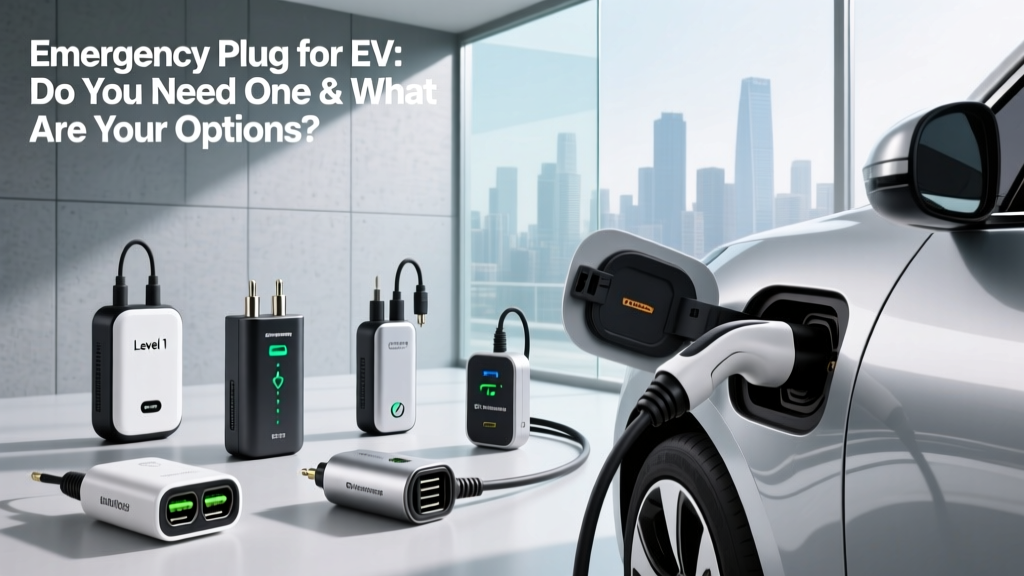
An emergency plug for EV use is a portable charging cable or compact mobile EVSE (Electric Vehicle Supply Equipment) that lets you charge from a standard 120V household outlet (Level 1) or a 240V outlet like a dryer receptacle (Level 2) when you're away from home or your primary charger fails. Expect 3-5 miles of range per hour on 120V and 14-30 miles per hour on 240V, depending on your vehicle's onboard charger. Quality units cost $300-$700 and can be the difference between a minor inconvenience and a costly tow.
If you've owned an electric vehicle for more than a few months, you've probably had the thought: what happens if I can't find a working charger? Public DC fast charging networks still suffer from reliability issues — J.D. Power's 2025 EV Experience Index found that roughly 1 in 5 public charging sessions fail to initiate. An emergency plug for EV scenarios gives you a fallback that fits in your trunk.
Why Every EV Owner Should Consider an Emergency Charging Solution
Most new EVs ship with a basic Level 1 mobile connector, but automakers have been quietly dropping them from the box. Tesla stopped including the Gen 2 Mobile Connector as standard equipment in 2022, and several other manufacturers followed suit. That means many 2025 and 2026 EV buyers are taking delivery with nothing but a J1772 or NACS inlet and no way to plug in outside of public stations.
Here's the reality of EV charging infrastructure in 2026: while the Tesla Supercharger network and Electrify America have expanded significantly, charging deserts still exist in rural corridors, national parks, and older apartment complexes. According to the U.S. Department of Energy's Alternative Fuels Data Center, there are roughly 72,000 public charging stations nationwide — but distribution is heavily skewed toward metro areas.
An emergency plug isn't about daily charging. It's about the edge cases:
- You're visiting family in a rural area with no public chargers within 40 miles
- Your home Level 2 charger malfunctions and you need a backup before the electrician arrives
- A road trip takes you through a stretch where DC fast chargers are offline or occupied
- You're parked at a rental property with a 240V dryer outlet you could use with the right adapter
Types of Emergency Plugs for EV Charging
Not all portable EV chargers are created equal. Here's a breakdown of the three main categories and what each delivers in real-world use:
| Type | Power Source | Max kW Output | Miles of Range Per Hour | Typical Cost | Best For |
|---|---|---|---|---|---|
| Level 1 Portable (120V) | Standard household outlet (NEMA 5-15) | 1.2-1.4 kW | 3-5 mi/hr | $150-$300 | Overnight trickle at a friend's house |
| Level 2 Portable (240V) | Dryer/RV outlet (NEMA 14-50, 6-50, 10-30) | 3.3-7.7 kW | 14-30 mi/hr | $350-$700 | Fastest emergency top-up away from home |
| Dual-Voltage Mobile EVSE | Swappable plugs for 120V and 240V | 1.4 kW / 7.7 kW | 3-5 or 14-30 mi/hr | $400-$650 | Maximum flexibility for travel |
Important distinction: kW (kilowatts) measures the power flow rate — how fast energy moves into your battery. kWh (kilowatt-hours) measures total energy stored. A 7.7 kW portable charger delivers 7.7 kWh of energy in one hour of charging. If your EV has an 80 kWh battery, that 7.7 kW unit would take roughly 10.5 hours to charge from empty to full.
Level 1 Emergency Plug: The Bare Minimum
A 120V Level 1 emergency plug will charge any EV, but slowly. Plugging into a standard wall outlet at 12 amps continuous gives you about 1.4 kW. For a vehicle rated at 3-4 miles per kWh (like the 2026 Hyundai Ioniq 5 at 3.5 mi/kWh combined), that translates to roughly 4-5 miles of range per hour of charging.
Is that useful? It depends on your situation. Eight hours of overnight Level 1 charging adds 30-40 miles — enough to reach a DC fast charger the next morning if you're stranded in a rural area. It won't replace a real charging stop, but it prevents a tow.
Level 2 Portable: The Practical Emergency Plug
A portable Level 2 EVSE that plugs into a NEMA 14-50 outlet (the same 240V receptacle used by electric ranges and RV parks) is the sweet spot for emergency charging. At 32 amps, these units deliver up to 7.7 kW — roughly 25-30 miles of range per hour for most mid-size EVs.
Many RV parks, campgrounds, and older homes have NEMA 14-50 outlets. With a quality portable Level 2 unit and the right adapter, you can add 100+ miles of range in a 4-hour visit. Units like the Emporia Level 2 portable or the Lectron V-Box Pro offer this capability with built-in safety features including ground fault protection and temperature monitoring.
Real-World Cost Breakdown: Emergency Plug vs. Tow vs. Public Charging
Let's put actual numbers to the emergency plug decision. Here's what various "stranded" scenarios cost:
| Scenario | Cost | Time to Resolve | Range Added |
|---|---|---|---|
| Portable Level 1 overnight (8 hrs at a friend's house) | $0.96 (at $0.12/kWh, 8 kWh) | 8 hours | ~30-35 miles |
| Portable Level 2 at RV park (4 hrs, NEMA 14-50) | $3.84 (at $0.12/kWh, 32 kWh) | 4 hours | ~100-120 miles |
| DC fast charge at Electrify America (10-80%) | $12-$18 (varies by location/kWh rate) | 20-35 minutes | ~180-220 miles |
| Flatbed tow to nearest charger (50 miles) | $250-$500 | 2-4 hours | 0 (just relocation) |
| Roadside assistance battery boost service | $75-$150 (membership or per-call) | 1-2 hours | ~10-20 miles (limited) |
The math is clear: a $400-$600 portable Level 2 emergency plug pays for itself the first time it saves you from a tow. Even AAA's EV roadside assistance programs, which have expanded significantly by 2026, still rely on flatbed trucks in many regions rather than mobile charging vans.
Emergency Plug vs. Gas Car Spare Fuel Can: The Ownership Comparison
Gas car owners carry a spare fuel can or know the nearest gas station is 5 minutes away. EV owners need a different contingency plan. Here's how the two paradigms compare:
| Factor | EV with Emergency Plug | Gas Car with Spare Fuel Can |
|---|---|---|
| Backup energy cost | $0.96-$3.84 per emergency session | $10-$15 per gallon of gasoline |
| Range from backup | 30-120 miles (depending on plug type/time) | 25-50 miles from a 1-2 gallon can |
| Time to deploy | Minutes to plug in; hours to charge | Minutes to pour; immediate range |
| Storage requirement | 15-20 lb cable bag in trunk | 5-10 lb fuel can (safety/ventilation concerns) |
| Availability of source | 120V outlets virtually everywhere; 240V at RV parks, homes | Gas stations every 10-30 miles in most areas |
| Shelf life of backup | Indefinite (cable doesn't degrade like fuel) | 6-12 months before gasoline degrades |
The gas can offers faster deployment, but the EV emergency plug provides more total range and costs far less per use. The trade-off is time: you'll need to park and wait, whereas pouring gasoline takes 60 seconds.
Common Misconceptions About Emergency EV Charging
| Myth | Fact |
|---|---|
| "You can't charge an EV from a regular wall outlet." | Every EV sold in the U.S. supports Level 1 charging from a standard 120V NEMA 5-15 outlet. It's slow (3-5 mi/hr), but it works. |
| "Plugging into someone's outlet is stealing electricity." | At $0.12-$0.18/kWh, charging 20 kWh costs the homeowner $2.40-$3.60. Most people won't notice, and asking permission with an offer to pay resolves any concern. |
| "Portable chargers will damage my EV battery." | EVSE units don't charge the battery directly — they communicate with your car's onboard charger, which manages all charging parameters. A quality UL-listed portable EVSE is no different from a wall-mounted unit. |
| "I need a special adapter for every outlet type." | A NEMA 14-50 plug covers most RV parks and newer homes. A NEMA 5-15 covers standard outlets. Two adapter types handle 90% of emergency scenarios. |
| "Emergency charging takes forever, so it's useless." | Level 1 overnight adds 30-40 miles — enough to reach a DC fast charger. Level 2 portable adds 100+ miles in 4 hours. Both prevent a tow. |
What to Look for in an Emergency Plug for Your EV
Not every portable charger is suited for emergency use. Here's a practical decision framework:
Choose Your Emergency Plug Based on Your Situation
Choose a Level 1 (120V) portable if:
- You always have access to a garage or outlet at destinations (visiting family, vacation rentals)
- Your daily driving is under 40 miles and overnight charging covers your needs
- Budget is tight and you want a $150-$250 backup
- Your EV has a smaller battery (under 60 kWh) where Level 1 is more practical
Choose a Level 2 portable (NEMA 14-50) if:
- You road-trip through rural areas or RV parks regularly
- Your EV has a large battery (75-100+ kWh) where Level 1 would take 60+ hours
- You want to add 100+ miles in a single afternoon
- You're willing to spend $400-$650 for real emergency capability
Choose a dual-voltage mobile EVSE if:
- You want maximum flexibility without carrying multiple units
- You frequently encounter both 120V and 240V outlets at destinations
- You value compact storage and swappable plug heads
Key Specs to Verify Before Buying
- Amperage: Look for 32A on Level 2 units (7.7 kW). Some budget units only offer 16A (3.8 kW), which cuts charging speed in half.
- Cable length: Minimum 20 feet; 25 feet is ideal for reaching outlets in awkward locations.
- Safety certification: UL-listed or ETL-listed. Avoid uncertified units from unknown brands — EV charging involves sustained high current.
- Connector type: Verify J1772 for most 2025 and earlier non-Tesla EVs, or NACS for Tesla and 2025+ models from Ford, GM, Rivian, and others adopting the standard.
- Weather rating: NEMA 4 (indoor/outdoor) if you plan to charge outside in rain or snow.
- Weight: Quality Level 2 portable units weigh 12-18 lbs. Lighter units may sacrifice cable gauge or safety components.
First-Time EV Buyer: Where the Emergency Plug Fits in Your Charging Plan
If you're purchasing your first EV in 2026, your charging hierarchy should look like this:
- Primary: Home Level 2 charger (240V, 40-48A, $500-$800 unit + $500-$2,000 installation by a licensed electrician). This handles 90%+ of your charging.
- Secondary: Public DC fast charging for road trips (Tesla Supercharger, Electrify America, EVgo). Expect $0.30-$0.50/kWh at public chargers.
- Emergency: Portable Level 1/Level 2 EVSE in the trunk ($200-$650). This is your safety net.
The IRS §30D federal tax credit for new clean vehicles can provide up to $7,500 for qualifying EVs — subject to MSRP caps ($55,000 for sedans, $80,000 for SUVs/trucks), buyer income limits ($150K single / $300K joint), and critical mineral and battery component sourcing requirements. Check current-year eligibility on irs.gov, as sourcing rules tighten annually. Some states offer additional incentives that can offset the cost of home charger installation.
Budget $400-$600 for a quality portable emergency plug alongside your home charger purchase. Consider it part of your EV onboarding cost — like buying a spare tire for a gas car that doesn't come with one.
Frequently Asked Questions
Can I use an extension cord with my emergency EV plug?
Manufacturers universally advise against it, and for good reason. Standard extension cords aren't rated for the sustained high current EV charging demands. A 12-gauge, 120V extension cord running 12 amps for 10 hours can overheat at the connections. If you absolutely must extend reach, use a heavy-duty 10-gauge cord rated for 15A continuous, keep it under 25 feet, and inspect connections for heat every hour. For 240V, never use an extension cord — get a portable EVSE with a long enough cable.
Will charging from a 120V outlet damage my EV battery?
No. Your EV's onboard charger and battery management system (BMS) control all charging parameters regardless of the source. Level 1 charging is actually gentler on battery chemistry than DC fast charging because the low power generates minimal heat. LFP (lithium iron phosphate) and NMC (nickel manganese cobalt) batteries both handle Level 1 charging without any accelerated degradation.
How do I find NEMA 14-50 outlets when traveling?
Apps like PlugShare allow users to tag locations with specific outlet types, including NEMA 14-50. RV parks and campgrounds almost universally have 14-50 or 14-30 outlets at each site. Some hotels with EV charging also maintain 240V outlets. Call ahead and ask — many lodging operators will let you use an outlet for a small fee or free if you're a guest.
What's the difference between an emergency plug and a portable EV charger?
Functionally, nothing. "Emergency plug" describes the use case; "portable EVSE" or "mobile connector" describes the device. The same unit that serves as your emergency backup can also be your primary charger if you don't install a wall-mounted Level 2 — though a dedicated wall unit offers faster charging (up to 11.5 kW / 48A) and avoids the wear of repeated plugging and unplugging.
Do I need a NACS or J1772 emergency plug?
Check your vehicle's charge port. Tesla vehicles and 2025-2026 models from Ford, GM, Rivian, and several others use the NACS (North American Charging Standard) connector. Most 2024 and earlier non-Tesla EVs use J1772. If you drive a J1772 vehicle but want NACS compatibility for the future, adapters are available for $100-$200. Buy the connector that matches your current vehicle.
How much does it cost to run a portable EV charger?
At the U.S. average residential electricity rate of roughly $0.16/kWh (EIA 2025 data), fully charging an 80 kWh battery via a portable Level 2 unit costs about $12.80 — compared to $45-$55 for an equivalent tank of gas in a 25 MPG vehicle at $3.50/gallon. The electricity cost is the same whether you use a wall-mounted charger or a portable unit; the only difference is charging speed.