Quick Answer: Electric wheel motors for mining equipment replace traditional mechanical drivetrains with individual hub-mounted or near-wheel electric motors on haul trucks and loaders. As of 2026, battery-electric haul trucks like the Komatsu PC2000-11E and Caterpillar 793E hybrid-electric variants deliver 30–50% lower per-ton operating costs compared to diesel equivalents, primarily through regenerative braking on decline routes, elimination of transmission maintenance, and zero underground ventilation requirements. Capital costs remain 1.5–2.5x higher than diesel rigs, but payback typically occurs within 3–5 years on high-utilization mine sites.
What Are Electric Wheel Motors in Mining Equipment?
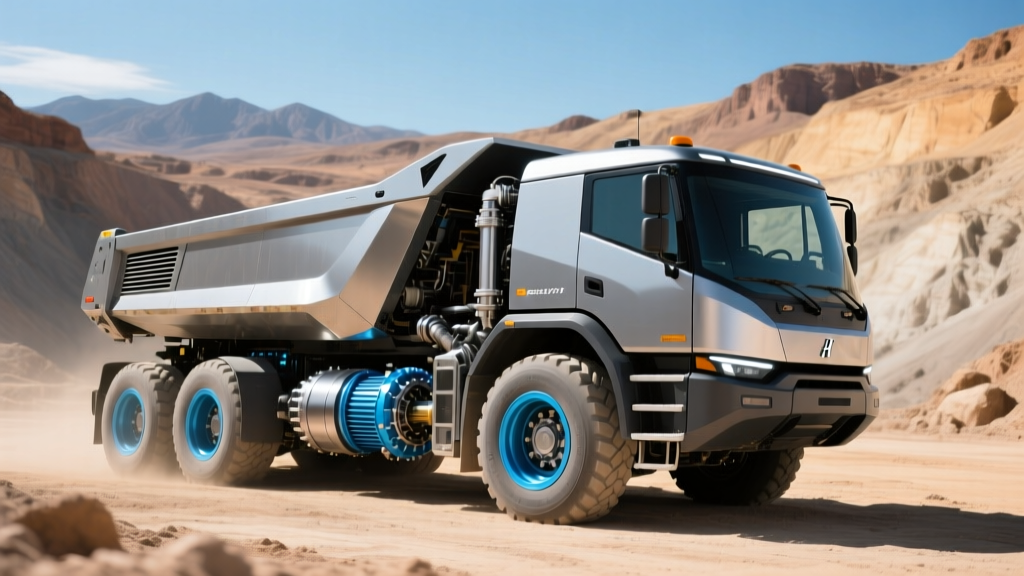
Electric wheel motors — also called in-wheel or hub motors — mount directly at each wheel assembly, eliminating the need for a central engine, transmission, driveshaft, and differentials. In mining applications, these are typically high-torque AC induction or permanent-magnet synchronous motors rated between 150 kW and 600 kW per wheel, depending on vehicle class.
The architecture isn't new to mining: diesel-electric haul trucks have used a diesel generator feeding electric wheel motors for decades — the 400-ton class Caterpillar 797F and Komatsu 930E both use this topology. What's changing in 2026 is the shift toward battery-electric and trolley-assist configurations where the diesel genset is replaced entirely or supplemented by grid-tied overhead catenary lines or large onboard battery packs (typically 300–700 kWh, LFP chemistry for thermal stability).
Companies like Komatsu, Caterpillar, Hitachi (now part of ABB's mining division), and newer entrants like BluVein and Fortescue are deploying battery-electric haul trucks in Australian, Canadian, and Chilean operations. The core advantage of the electric wheel motor architecture is that each wheel can independently manage torque, regenerative braking force, and traction control — critical on the steep, loose-surface grades typical of open-pit mines.
Electric vs Diesel Mining Trucks: Cost and Performance Data
The economics of electric wheel motors in mining hinge on duty cycle. Trucks running loaded downhill (from a pit floor to a surface crusher) can regenerate enormous energy — sometimes enough to net-positive charge the battery. Trucks running loaded uphill consume heavily and may require trolley assist or opportunity charging at the dump point.
| Metric | Diesel Haul Truck (240-ton class) | Battery-Electric Haul Truck (240-ton class) |
|---|---|---|
| Capital Cost (2026) | $4.5–5.2 million | $7.0–9.5 million |
| Energy Cost per Hour | $180–260 (diesel @ $4.20/gal, 18 gal/hr) | $45–90 (electric @ $0.08–0.15/kWh) |
| Drivetrain Maintenance / Year | $120,000–180,000 | $25,000–45,000 |
| Brake Wear Replacement / Year | $60,000–90,000 | $10,000–20,000 (regen handles 80%+) |
| Ventilation Required (Underground) | $2–4M / year per shaft | Minimal (zero particulate/NOx) |
| Usable Energy Capacity | ~1,200 gal diesel tank | 400–700 kWh LFP battery |
| Refuel / Recharge Time | 20–30 minutes | 35–60 min (600 kW DC) or trolley continuous |
| Torque at Wheels | Mechanical, gear-limited | Instant, per-wheel vectoring |
| Typical Duty Life | 60,000–80,000 hours | 80,000+ hours (fewer wear components) |
These figures assume high-utilization operations (6,000+ hours/year). Lower-utilization sites may not recover the capital premium within a single machine lifecycle.
Battery Chemistry, Charging, and Trolley-Assist Infrastructure
Mining battery-electric trucks overwhelmingly use LFP (lithium iron phosphate) chemistry rather than the NMC common in passenger EVs. The reasons are specific to mining:
- Thermal stability: LFP cells are far less prone to thermal runaway — a critical concern in underground operations where fire suppression is difficult and consequences are catastrophic.
- Cycle life: LFP delivers 3,000–5,000 full cycles to 80% state of health, vs. 1,000–2,000 for NMC. A mining truck running 2-3 partial cycles daily needs this longevity.
- Energy density trade-off: LFP is heavier per kWh, but mining trucks are ballast-heavy anyway — the 5–8 ton weight penalty for a 500 kWh LFP pack is negligible on a 240-ton payload vehicle.
Charging infrastructure for mining EVs diverges sharply from passenger-vehicle norms:
| Charging Method | Power (kW) | Infrastructure Cost | Typical Application |
|---|---|---|---|
| DC Fast Charge (depot) | 350–600 kW | $800K–1.5M per station | Surface mines, shift-change charging |
| Trolley Assist (catenary) | 1,500–3,000 kW continuous | $5–12M per mile of overhead line | Fixed-route uphill hauls |
| Battery Swap | N/A (mechanical exchange) | $3–5M per swap station + spare packs | Continuous 24/7 operations |
| Opportunity Charge (dump point) | 150–300 kW | $200K–500K per pad | Top-up during loading waits |
Trolley assist is the highest-throughput option and is gaining adoption at sites like First Quantum's Sentinel mine in Zambia and several Pilbara iron ore operations. The truck raises a pantograph to connect to overhead lines on the main haul ramp, drawing grid power directly while simultaneously charging the battery — effectively unlimited range on the trolley-equipped segment.
Real-World Ownership Considerations for Mine Operators
Transitioning to electric wheel motor haul trucks involves operational changes that go well beyond the vehicle itself:
Grid capacity: A fleet of 10 battery-electric 240-ton trucks charging at 600 kW simultaneously requires 6 MW of dedicated grid connection — equivalent to powering roughly 4,000 homes. Remote mine sites often need dedicated substations or on-site generation (solar + BESS is increasingly common in Australian operations).
Cold-climate performance: LFP batteries lose 15–25% usable capacity at -20°C. Canadian and Siberian operations must invest in battery thermal management systems (liquid heating loops drawing 15–30 kW during cold-soak startup) and heated depot infrastructure. This is a real cost that diesel doesn't carry.
Maintenance workforce transition: Diesel mechanic skillsets don't transfer directly. Electric wheel motor systems require high-voltage certification (typically 600V+ DC bus), power electronics troubleshooting, and battery management system diagnostics. Training programs run 6–12 months and cost $15,000–25,000 per technician.
Tire and bearing loads: In-wheel motors add unsprung mass directly at the wheel — typically 800–1,500 kg per corner on a 240-ton truck. This increases bearing loads and can reduce tire life by 5–12% compared to mechanical-drive equivalents, a non-trivial cost given that a single 59/80R63 haul truck tire costs $40,000–65,000 and lasts 4,000–7,000 hours.
Total Cost of Ownership: 5-Year Mining Fleet Breakdown
Below is a simplified 5-year TCO model for a single 240-ton haul truck at a surface mine running 6,500 hours/year on a loaded-downhill profile (favorable for regen):
| Cost Category (5-Year) | Diesel Truck | Battery-Electric Truck |
|---|---|---|
| Capital (machine purchase) | $4,800,000 | $8,200,000 |
| Energy (fuel / electricity) | $6,100,000 | $2,200,000 |
| Drivetrain maintenance | $750,000 | $175,000 |
| Brake consumables | $375,000 | $75,000 |
| Tire replacement (regen weight penalty) | $480,000 | $530,000 |
| Charging infrastructure (amortized share) | $0 | $650,000 |
| Ventilation savings (underground only) | $0 | -$3,000,000 (credit) |
| Total (Surface Mine) | $12,505,000 | $11,830,000 |
| Total (Underground Mine) | $15,505,000 | $8,830,000 |
Source: Adapted from U.S. DOE mining electrification analysis and operator-reported data from BHP and Rio Tinto sustainability disclosures.
The underground case is dramatically favorable because diesel ventilation — required to clear particulate matter, NOx, and CO from confined spaces — represents one of the largest operating costs in hard-rock mining. Eliminating it can justify the capital premium in under 2 years.
Common Misconceptions About Electric Mining Equipment
| Myth | Fact |
|---|---|
| "Electric haul trucks can't match diesel torque" | Electric wheel motors deliver peak torque at zero RPM — a 240-ton BEV truck can produce 18,000+ Nm per wheel from standstill, exceeding diesel-mechanical equivalents that require 1,200+ RPM to reach peak torque. |
| "Batteries won't survive mine vibration and dust" | Mining-grade LFP packs are IP67/IP69K sealed, rated to 5G shock, and use welded-cell busbars rather than wire-bonded connections. Field data from Fortescue's 2023–2025 deployment shows less than 4% capacity degradation over 12,000 operating hours. |
| "Regenerative braking eliminates all brake maintenance" | Regen handles ~80–90% of service braking, but friction brakes remain mandatory for emergency stops, parking, and low-speed holding. Expect 10–20% of conventional brake wear costs to persist. |
| "Trolley assist means no battery needed" | Trolley segments cover main ramps only. Trucks still need onboard batteries for off-trolley maneuvering at the face, dump point, and maintenance areas. Typical trolley-assist trucks carry 200–400 kWh packs (smaller than full BEV). |
| "Electric mining trucks qualify for the §30D federal tax credit" | The IRS §30D credit applies to light-duty vehicles under 14,000 lbs GVWR. Mining haul trucks (GVWR 400,000+ lbs) are not eligible. However, the §45W commercial clean vehicle credit and §48C advanced energy project credit may apply — consult a tax professional. |
Decision Framework: Should Your Operation Go Electric?
Choose battery-electric wheel motor trucks if:
- Your operation is underground (ventilation savings dominate the economics)
- You have loaded-downhill haul profiles (regen energy recovery is massive)
- Grid power is available at $0.10/kWh or less, or you can build solar+BESS at competitive LCOE
- You run 6,000+ hours/year (amortize the capital premium faster)
- ESG/carbon reporting pressures are material to your financing or offtake agreements
- You plan to keep equipment 7+ years (LFP packs outlast typical diesel drivetrain overhaul cycles)
Stick with diesel or diesel-electric if:
- Your haul profile is predominantly loaded-uphill without trolley-assist infrastructure
- Grid connection is unavailable and diesel logistics are established and cheap
- The mine has a short remaining life (under 5 years — insufficient payback window)
- You need flexible redeployment across sites without fixed charging infrastructure
- Ambient temperatures regularly drop below -30°C without heated infrastructure investment
Consider trolley-assist hybrid-electric if:
- You have fixed main-haul ramps suitable for catenary installation
- You want to reduce diesel consumption 40–60% without full BEV capital commitment
- Your utility offers favorable industrial electricity tariffs for high-load-factor connections
Frequently Asked Questions
How long do electric wheel motors last in mining conditions?
Industrial-grade AC induction wheel motors used in 200–400 ton class haul trucks are rated for 60,000–100,000 operating hours before major overhaul — significantly longer than diesel engines (typically 20,000–30,000 hours to rebuild). The motor itself has very few wear components: bearings and insulation are the primary lifecycle limits. Expect 15–25 year service life at typical utilization rates.
What's the range of a battery-electric 240-ton haul truck?
Unlike passenger EVs, mining trucks don't have a single "range" figure — they operate on fixed circuits. A typical 240-ton BEV with a 500 kWh LFP pack can complete 2–4 loaded haul cycles (3–8 km each, depending on mine geometry) before requiring a charge. On loaded-downhill routes, regenerative braking can extend this to 6–8 cycles or even achieve net-neutral energy operation. The relevant metric is cycles per shift, not miles.
Do electric wheel motors work in extreme heat (45°C+)?
Yes, but with derating considerations. LFP battery packs begin thermal management intervention above 40°C cell temperature, which can reduce available charge/discharge power by 10–20%. Australian Pilbara operations typically spec liquid-cooled packs with 50–80 kW cooling capacity. The electric motors themselves handle heat well — stator winding insulation is rated to 155°C+ (Class F/H). Ambient heat is less problematic for electric drivetrains than for diesel engines, which lose power density as intake air temperature rises.
Can existing diesel haul trucks be retrofitted with electric wheel motors?
Technically yes, and companies like BluVein and Hydra Energy offer repower kits for certain truck classes. However, retrofit economics are challenging: the conversion typically costs $2–4 million per truck (including battery, motors, power electronics, and control systems) and the resulting vehicle is often 5–10 tons heavier than a purpose-built BEV due to structural compromises. Most operators find that trading in diesel assets and purchasing purpose-built electric trucks yields better lifecycle economics, unless the truck chassis is relatively new (under 3 years old).
What safety certifications apply to electric mining equipment?
Battery-electric underground equipment must meet MSHA (U.S.), DGMS (India), or equivalent national mining safety authority standards for electrical equipment in potentially explosive atmospheres. Key requirements include intrinsic safety of battery management systems, arc-flash protection on high-voltage bus connections, automatic fire suppression integrated with the battery thermal management system, and emergency disconnect procedures. The MSHA approval process for battery-electric underground equipment typically takes 12–18 months.
Note: Federal tax credits referenced in this article reflect 2026 IRS rules. Mining equipment eligibility for specific credits depends on GVWR, application, and sourcing requirements. Always consult a qualified tax professional and reference IRS guidance before making purchasing decisions based on incentive availability.