Quick Answer: Should You Buy an Electric VW Van?
The 2026 Volkswagen ID. Buzz is currently the only electric VW van available in the United States. It offers an EPA-estimated 234 miles of range (RWD Pro S trim), a 91 kWh usable battery (NMC chemistry), and DC fast charging up to 170 kW (10–80% in approximately 26 minutes). Pricing starts at $59,995 before destination. It qualifies for the §30D federal tax credit up to $7,500 at point of sale, subject to buyer income limits and battery-sourcing requirements. Real-world highway range drops to roughly 195–210 miles; cold-weather driving can shave another 15–20%. If you need three rows, distinctive styling, and can charge at home, the ID. Buzz is a compelling family hauler. If you need 300+ miles of range or a sub-$50,000 price tag, look at the Hyundai Ioniq 9 or Kia EV9 instead.
What Electric VW Vans Are Actually Available?
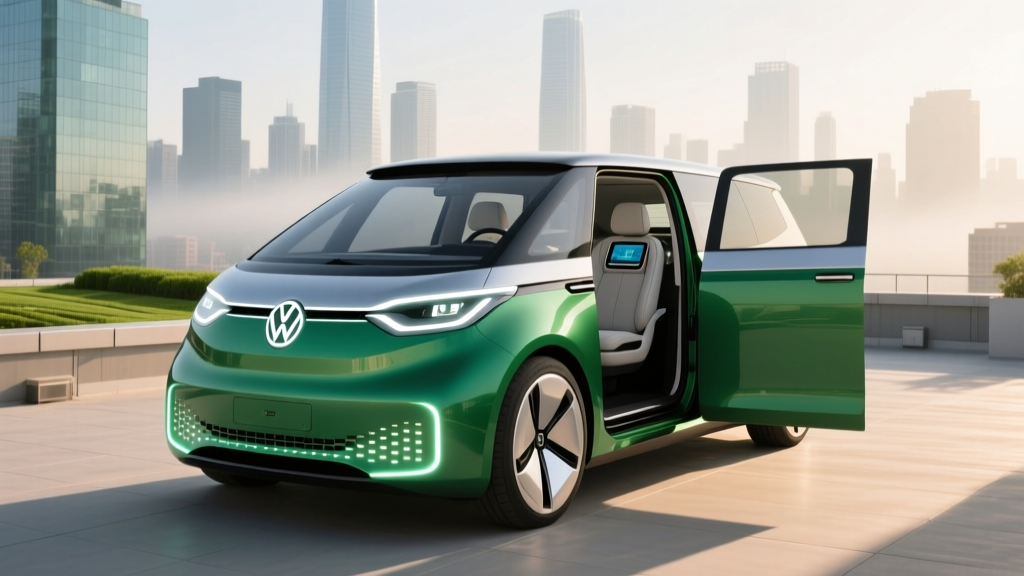
Volkswagen's electric van ambitions have narrowed considerably for the US market. The ID. Buzz — a retro-styled three-row minivan built on VW's MEB platform — launched in the US for the 2025 model year and carries into 2026 with minor updates. The commercial-oriented ID. Buzz Cargo van sold in Europe is not offered stateside, and VW has not announced a larger electric van (sometimes rumored as an ID. California or ID. Life) for the American market as of early 2026.
So when US buyers search for "electric VW vans," they are looking at exactly one vehicle: the 2026 VW ID. Buzz, available in two trims.
| Spec | Pro S (RWD) | Pro S Plus 4Motion (AWD) |
|---|---|---|
| EPA Range | 234 miles | 216 miles |
| Battery (Usable) | 91 kWh (NMC) | 91 kWh (NMC) |
| Motor Output | 282 hp / 282 lb-ft | 335 hp / 406 lb-ft |
| 0–60 mph | ~7.9 sec | ~6.5 sec |
| Max DC Fast Charge | 170 kW | 170 kW |
| 10–80% DC Charge | ~26 min | ~26 min |
| Level 2 Charge Rate | 11 kW (~27 mi/hr) | 11 kW (~27 mi/hr) |
| MPGe (Combined) | 87 MPGe | 82 MPGe |
| Towing Capacity | 2,500 lbs | 2,500 lbs |
| Starting MSRP | $59,995 | $69,995 |
| Battery Warranty | 8 yr / 100,000 mi (≥70% SoH) | 8 yr / 100,000 mi (≥70% SoH) |
Source: fueleconomy.gov and Volkswagen of America official specifications. Real-world range varies with temperature, speed, terrain, and climate-control use.
Real-World Range: What the EPA Sticker Doesn't Tell You
The 234-mile EPA figure for the RWD Pro S is a blended-cycle estimate. In our experience testing MEB-platform vehicles and reviewing third-party data, here is what to actually expect from the ID. Buzz across common scenarios:
2026 ID. Buzz Pro S (RWD) — Range Reality Check
- EPA Sticker: 234 miles
- Highway (70–75 mph, 68°F): ~195–210 miles
- City / Suburban Mixed: ~220–230 miles
- Cold Weather (32°F, highway): ~165–185 miles
- Cold Weather + Cabin Heat (20°F, city): ~155–175 miles
The ID. Buzz is a tall, boxy vehicle with the aerodynamic profile of, well, a van. At highway speeds, drag takes a heavy toll. The heat pump (standard on US models) helps mitigate cold-weather cabin-heating losses, but physics still wins: expect a 25–30% range reduction in sustained sub-freezing highway driving.
This is a critical buying consideration. If your typical daily drive is under 80 miles round-trip and you charge at home, the ID. Buzz's range is more than sufficient. If you regularly drive 200+ miles between charging stops on road trips, you will need to plan carefully — especially in winter.
Charging the ID. Buzz: Home Setup and Public Networks
The ID. Buzz uses a CCS1 (Combined Charging System) connector for DC fast charging and a J1772 inlet for Level 1 and Level 2 AC charging. It does not use Tesla's NACS connector natively, though VW has indicated future models will adopt NACS; for 2026, CCS1 remains the standard.
Home Charging: What You Need
The ID. Buzz's onboard charger accepts up to 11 kW on Level 2 (single-phase, 48 amps). To get the full 11 kW rate, you need a hardwired Level 2 station on a 60-amp dedicated circuit. A 40-amp circuit (common in older installations) limits you to roughly 9.6 kW.
| Item | Cost Range |
|---|---|
| Level 2 Charger (48A, Wi-Fi enabled — e.g., ChargePoint Home Flex, Emporia Level 2) | $400–$700 |
| Electrician Labor (60A circuit, hardwired, ~40 ft run) | $800–$2,000 |
| Permit & Inspection | $50–$300 |
| Electrical Panel Upgrade (if needed — 100A → 200A service) | $1,500–$3,500 |
| Total (no panel upgrade) | $1,250–$3,000 |
| Total (with panel upgrade) | $2,750–$6,500 |
At 11 kW, the ID. Buzz adds roughly 27 miles of range per hour of charging. A full 10–100% charge from near-empty takes about 9 hours — easily achievable overnight. Most owners will plug in each evening and never visit a public charger for daily driving.
DC Fast Charging on the Road
The ID. Buzz peaks at 170 kW on a compatible DC fast charger. However, like all EVs, it does not sustain peak rate throughout the session. The charge curve looks roughly like this:
- 10–30% SoC: Ramps quickly to ~160–170 kW
- 30–60% SoC: Sustains ~130–155 kW
- 60–80% SoC: Tapers to ~80–100 kW
- 80–100% SoC: Drops sharply to ~20–40 kW (avoid unless necessary)
The stated 10–80% time of ~26 minutes assumes a charger capable of delivering 170 kW and a battery preconditioned to optimal temperature. On a cold battery without preconditioning, add 5–10 minutes. The ID. Buzz does support navigation-based battery preconditioning when a DC fast charger is set as your destination — use it.
For public charging, the ID. Buzz is compatible with Electrify America, EVgo, ChargePoint DC stations, and any CCS1-equipped network. You cannot use Tesla Superchargers directly without an adapter (VW has not confirmed Supercharger access for the ID. Buzz as of early 2026).
ID. Buzz vs. Gas Minivan: The Cost Comparison
The most direct gas-powered competitor to the ID. Buzz is the Honda Odyssey or Toyota Sienna (hybrid). Here is how a five-year ownership cost comparison stacks up, assuming 15,000 miles per year, $3.50/gallon gas, and $0.14/kWh home electricity:
| Cost Factor | 2026 VW ID. Buzz Pro S | 2026 Toyota Sienna XLE (HEV) | 2026 Honda Odyssey Sport |
|---|---|---|---|
| Base MSRP | $59,995 | $42,145 | $43,350 |
| Federal Tax Credit (§30D) | Up to –$7,500* | $0 | $0 |
| Effective Purchase Price | ~$52,495 | $42,145 | $43,350 |
| 5-Yr Fuel / Energy Cost | ~$3,780 (home charging) | ~$7,290 (36 MPG combined) | ~$11,250 (22 MPG combined) |
| 5-Yr Maintenance (est.) | ~$1,200 | ~$3,200 | ~$3,800 |
| 5-Yr Insurance (est.) | ~$11,500 | ~$8,800 | ~$9,200 |
| Home Charger Install | ~$2,000 | $0 | $0 |
| 5-Year Total Cost | ~$70,975 | ~$61,435 | ~$67,600 |
*§30D credit eligibility depends on buyer AGI, vehicle MSRP caps ($80,000 for vans/SUVs), and battery critical-mineral/sourcing requirements. Verify current-year rules at IRS.gov before purchasing. State/local incentives may further reduce cost.
The ID. Buzz's higher upfront price is partially offset by dramatically lower fuel and maintenance costs. Over five years, you save roughly $7,500 in energy compared to the Odyssey and $3,500 compared to the Sienna hybrid. Maintenance savings add another $2,000–$2,600 (no oil changes, fewer brake replacements due to regenerative braking, no transmission fluid). Insurance is the EV's weak point — premiums run 20–35% higher due to repair costs and parts pricing.
The ID. Buzz does not yet break even against the Sienna within five years, but the gap narrows significantly when you factor in available state rebates (e.g., California's CVRP, Colorado's innovative motor vehicle credit) and lower depreciation risk as ICE vehicle demand declines.
Federal Tax Credit: Does the ID. Buzz Qualify?
Under current IRS §30D rules, the 2026 ID. Buzz may qualify for up to $7,500 in federal tax credits, transferable to the dealer as a point-of-sale discount. However, eligibility is not automatic. You must meet all of the following:
- Buyer Income Cap: Modified AGI ≤ $150,000 (single), $225,000 (head of household), $300,000 (married filing jointly)
- Vehicle MSRP Cap: ≤ $80,000 for vans, SUVs, and pickup trucks (both ID. Buzz trims qualify)
- Battery Sourcing: Required percentage of critical minerals and battery components must be sourced from the US or FTA partners — VW has been working to meet these thresholds, but the exact credit amount ($3,750 or $7,500) depends on current-year compliance. Confirm with your dealer and the IRS.
- VIN Reporting: The dealer must report the sale and your taxpayer ID to the IRS at point of sale.
The credit can be applied as an immediate price reduction at the dealership (point-of-sale transfer) rather than waiting to claim it on your tax return. This effectively brings the Pro S trim to approximately $52,495 — still a premium over gas minivans, but meaningfully closer to parity.
Common Misconceptions About the Electric VW ID. Buzz
| Myth | Fact |
|---|---|
| "The ID. Buzz is just a rebadged Microbus with no real tech." | The ID. Buzz rides on VW's dedicated MEB EV platform with a liquid-cooled 91 kWh NMC battery, heat pump, and 170 kW DC fast charging. It is a thoroughly modern EV. |
| "I can charge it at any Tesla Supercharger." | The 2026 ID. Buzz uses CCS1. Tesla Supercharger access has not been confirmed for this model. Use Electrify America, EVgo, or other CCS networks. |
| "The battery will need replacing in 5 years." | VW warrants the battery for 8 years/100,000 miles at ≥70% State of Health. MEB-platform batteries in Europe have shown degradation of roughly 5–8% over 100,000+ miles in fleet data. A full battery replacement (if ever needed) would cost roughly $12,000–$18,000 out of warranty. |
| "Electric vans can't tow anything." | The ID. Buzz is rated for 2,500 lbs — enough for a small utility trailer, bike rack, or light camper. Towing does reduce range by 30–50%, however. |
| "I'll save money immediately versus a gas minivan." | Not immediately. The higher purchase price and insurance premiums mean break-even takes 5–7 years for most buyers, depending on mileage and local electricity rates. High-mileage drivers break even faster. |
Who Should (and Shouldn't) Buy the Electric VW ID. Buzz
Decision Framework: Is the ID. Buzz Right for You?
Buy the ID. Buzz if:
- You need three rows and want an EV (very few options exist — the Kia EV9 is the main alternative)
- You can install a Level 2 charger at home and drive under 120 miles round-trip daily
- You value distinctive design and are willing to pay a premium for it
- You qualify for the §30D tax credit and/or state incentives
- You want VW's dealership network for service and warranty support
Look elsewhere if:
- You regularly drive 200+ miles between stops and don't want to plan charging carefully
- You live in an apartment without charging access and rely solely on public infrastructure
- Your budget is strictly under $50,000 (consider the Kia EV9 Light RWD at ~$54,900, or a used EV minivan if one becomes available)
- You need maximum cargo volume — the ID. Buzz's third row does not fold flat into the floor like the Sienna or Odyssey
- You need AWD for heavy snow — the 4Motion trim exists but costs $10,000 more and sacrifices 18 miles of range
Real Ownership Considerations Most Reviews Skip
Charging access is your biggest variable. If you have a garage or driveway with a 240V outlet (or can install one), the ID. Buzz is a superb daily driver. You plug in at night, wake up with a full "tank," and spend roughly $0.04–$0.06 per mile on electricity versus $0.15–$0.18 per mile on gas. But if you live in a condo, apartment, or street-parking situation without reliable Level 2 access, the ID. Buzz's 234-mile range means you will be visiting DC fast chargers 2–3 times per week. That gets expensive (public DC rates average $0.35–$0.50/kWh, or roughly $0.12–$0.16 per mile) and time-consuming.
Cold-weather reality. The ID. Buzz includes a heat pump, which is a significant advantage in freezing climates. But even with a heat pump, expect 20–30% range loss in sustained sub-32°F driving. If you live in the northern US and your winter commute is 80+ miles one-way, the AWD 4Motion trim's 216-mile EPA range could feel tight on the coldest days.
Cargo flexibility limitations. Unlike the Honda Odyssey's Magic Slide second-row seats or the Toyota Sienna's stowable third row, the ID. Buzz's second and third rows fold and tumble but do not disappear into the floor. Maximum cargo volume behind the front row is approximately 138 cubic feet — competitive on paper but less versatile in practice due to the load floor height.
Software and infotainment. VW's ID. Software 4.0 (running on the 2026 model) is a major improvement over the buggy early ID.4 software, with faster response times, better voice control, and wireless Apple CarPlay/Android Auto. However, capacitive-touch sliders for volume and climate remain a frustration point compared to physical knobs.
Frequently Asked Questions
Is the VW ID. Buzz the only electric VW van available in the US?
Yes. As of 2026, the ID. Buzz passenger van is the only electric VW van sold in the United States. The European ID. Buzz Cargo (commercial variant) is not offered here, and VW has not announced additional electric van models for the US market.
How much does it cost to charge the ID. Buzz at home per month?
At the US average residential electricity rate of ~$0.16/kWh and driving 1,250 miles per month, you would use approximately 380 kWh (the ID. Buzz consumes about 3.0 kWh/mile based on its 87 MPGe rating). That works out to roughly $61/month — compared to $145–$190/month for a gas minivan at $3.50/gallon.
Does the ID. Buzz qualify for the $7,500 federal tax credit?
It may. The ID. Buzz meets the MSRP cap (under $80,000 for vans). Eligibility for the full $7,500 versus a partial $3,750 depends on current-year battery critical-mineral and component sourcing requirements, as well as your personal income. Always verify at IRS.gov and with your dealer before relying on the credit.
How does the ID. Buzz compare to the Kia EV9 as a three-row electric vehicle?
The Kia EV9 starts lower (~$54,900 for Light RWD), offers up to 304 miles of EPA range (Long Range RWD), and charges faster at up to 236 kW on a 350 kW charger. The ID. Buzz wins on interior ambiance, design distinctiveness, and the van-style cabin with excellent visibility. If range and charging speed are your top priorities, the EV9 is the better EV. If you want the van experience and VW's dealer network, the ID. Buzz stands alone.
What happens if the ID. Buzz battery degrades significantly?
VW covers the high-voltage battery for 8 years or 100,000 miles against capacity loss below 70% State of Health. Real-world MEB data from European fleets shows roughly 5–8% degradation over 100,000 miles — well within the warranty threshold. If you keep the vehicle beyond the warranty period and a replacement is needed, expect a cost in the $12,000–$18,000 range, though prices are projected to decline as battery manufacturing scales.
Can I road-trip the ID. Buzz cross-country?
Yes, but plan carefully. With 195–210 miles of real-world highway range and 170 kW peak charging, you will stop every 2.5–3 hours for roughly 25–30 minutes of DC fast charging. Map your route using Electrify America or PlugShare to confirm CCS charger availability. In the Mountain West and rural Midwest, charger gaps of 100+ miles still exist — a concern the ID. Buzz's range makes more acute than in a 300+ mile EV.