The Quick Answer on Electric VW Cars
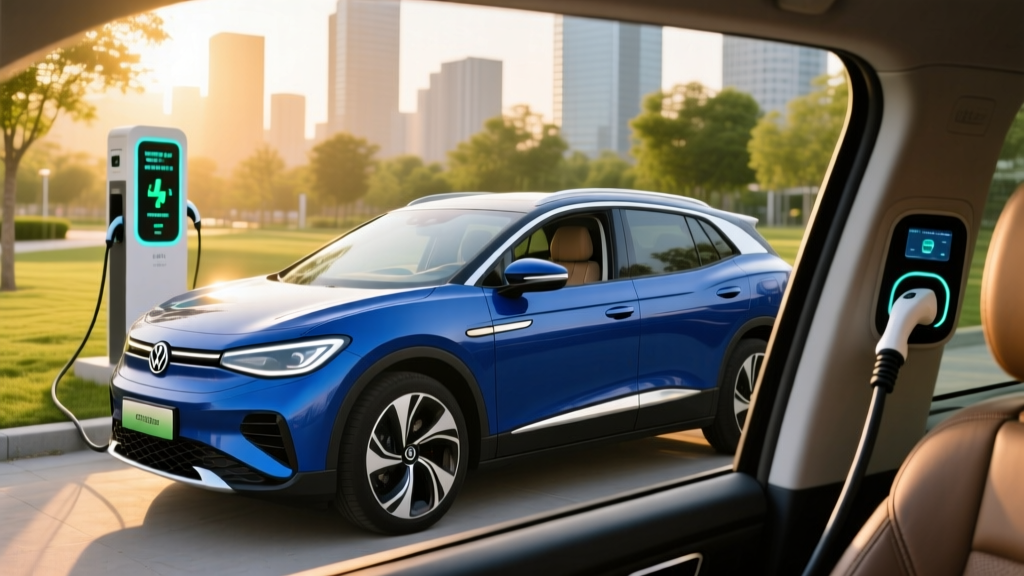
If you're researching electric VW cars in the U.S. market for 2026, the Volkswagen ID.4 remains the brand's sole battery-electric model available stateside. It offers an EPA-estimated 291 miles of range (RWD Pro, 82 kWh usable battery), peaks at 175 kW DC fast charging (10–80% in roughly 28 minutes), and starts at approximately $40,790 MSRP before incentives. Compared to a similarly sized gas crossover like the VW Tiguan, the ID.4 costs more upfront but can save $4,000–$6,500 over five years in fuel and maintenance — provided you have reliable home Level 2 charging access. The ID.4 qualifies for a partial or full federal tax credit under IRS §30D, but eligibility depends on your income, the vehicle's MSRP cap compliance, and battery-component sourcing rules that tighten annually.
2026 VW ID.4: Core Specs at a Glance
Volkswagen's electric strategy in North America is currently a one-model affair. The ID.4, built at VW's Chattanooga, Tennessee plant, is a compact electric crossover competing directly with the Hyundai Ioniq 5, Tesla Model Y, and Ford Mustang Mach-E. Here's what the numbers look like for the 2026 model year:
| Spec | ID.4 Pro (RWD) | ID.4 Pro S AWD |
|---|---|---|
| EPA Range | 291 miles | 263 miles |
| Battery (usable) | 82 kWh (NMC) | 82 kWh (NMC) |
| Motor Output | 282 hp / 339 lb-ft | 335 hp / 339 lb-ft (dual motor) |
| 0–60 mph | ~7.3 sec | ~5.4 sec |
| Max DC Fast Charge | 175 kW (CCS1) | 175 kW (CCS1) |
| 10–80% DC Time | ~28 min | ~28 min |
| Level 2 AC Charge Rate | 11 kW (~37 mi/hr) | 11 kW (~37 mi/hr) |
| MPGe (combined) | 104 MPGe | 95 MPGe |
| Base MSRP | ~$40,790 | ~$49,290 |
| Battery Warranty | 8 yr / 100,000 mi | 8 yr / 100,000 mi |
Source: fueleconomy.gov and Volkswagen of America specifications.
Real-World Range: What the EPA Sticker Doesn't Tell You
The EPA's 291-mile estimate for the RWD ID.4 is derived from a controlled lab cycle that blends city and highway driving at moderate temperatures. In practice, your mileage will vary — sometimes significantly — based on three major factors:
Real-World Range Expectations (ID.4 Pro RWD):
- Mild weather, mixed driving: 265–285 miles achievable
- Highway-only at 75 mph: Expect 230–250 miles (aerodynamic drag increases consumption ~15–20%)
- Cold weather (below 30°F), cabin heat: 190–220 miles — a 25–35% reduction is typical for NMC packs without a heat pump running efficiently
The ID.4 comes equipped with a heat pump on most trims, which mitigates cold-weather losses compared to resistive cabin heating, but physics still wins in deep winter. If your daily commute is under 60 miles round-trip and you charge at home nightly, even worst-case winter range is a non-issue. If you regularly drive 200+ miles in cold climates, the AWD variant's lower 263-mile EPA rating will compress further, and you'll want to plan DC fast-charging stops.
One ownership nuance: the ID.4's usable battery buffer is roughly 82 kWh out of a gross ~91 kWh pack. VW reserves top and bottom buffer to protect long-term cell health. You won't see "91 kWh" on the dash — and that's intentional, not deceptive.
Charging the ID.4: Home, Public, and the CCS Reality
VW equips the ID.4 with a CCS1 (Combined Charging System) port. This matters because the U.S. charging landscape is rapidly shifting toward Tesla's NACS connector. As of 2026, Electrify America, EVgo, and ChargePoint stations still widely support CCS1, and VW includes a CCS-to-NACS adapter with new ID.4 purchases for Supercharger access.
| Level | Power | Miles Added per Hour | Typical Use Case |
|---|---|---|---|
| Level 1 (120V household) | ~1.4 kW | ~4–5 mi/hr | Overnight top-up only |
| Level 2 (240V home/public) | 11 kW max | ~37 mi/hr | Daily home charging; full charge in ~8.5 hrs |
| DC Fast Charge | Peak 175 kW | ~200+ mi in 28 min (10–80%) | Road trips |
Charging-curve reality check: The ID.4 does not sustain 175 kW for the entire session. Peak rate applies roughly between 10–30% State of Charge. From 30–60%, expect ~130–150 kW. Above 80%, the rate tapers sharply to protect the cells — charging from 80–100% can take as long as the 10–80% segment. For road-trip efficiency, plan stops that take you from ~15% to ~75–80%, then move on.
Home charging setup cost: A hardwired 48-amp Level 2 wallbox (like a ChargePoint Home Flex or Emporia Level 2) costs $500–$750 for equipment. Professional electrician installation typically runs $800–$2,000 depending on panel proximity and conduit runs. If your home has a 200-amp electrical panel with spare capacity, expect the lower end. Older 100-amp panels may require a $1,500–$3,000 service upgrade.
ID.4 vs Gas Crossover: The 5-Year Cost Breakdown
The most common question from first-time EV buyers is whether the higher sticker price pays off. Let's compare the ID.4 Pro RWD against a 2026 VW Tiguan 2.0T SE (a similarly sized gas crossover) over five years and 75,000 miles of ownership:
| Cost Category | VW ID.4 Pro (RWD) | VW Tiguan 2.0T SE (AWD) |
|---|---|---|
| Base MSRP | $40,790 | $32,090 |
| Fed. Tax Credit (§30D, est.) | –$3,750 to –$7,500* | $0 |
| Effective Purchase Price | ~$33,290–$37,040 | $32,090 |
| Fuel/Energy (75k mi) | $3,100–$4,200† | $8,400–$9,800‡ |
| Maintenance (5 yr) | ~$1,200 | ~$3,500 |
| Insurance (5 yr avg.) | ~$9,500 | ~$7,800 |
| Est. 5-Year Total Cost | ~$47,090–$55,440 | ~$51,790–$53,190 |
*§30D credit amount depends on battery sourcing compliance, buyer AGI limits ($150k single/$300k joint), and MSRP cap ($55k for SUVs). Consult IRS.gov and a tax professional.
†Assumes $0.14/kWh national avg home charging; public DC fast charging adds cost.
‡Assumes 26 MPG combined, $3.40/gal avg regular unleaded.
The takeaway: the ID.4 breaks even or wins on total cost within 4–5 years, primarily through fuel and maintenance savings. However, EV insurance premiums run 15–25% higher than gas equivalents due to repair-cost data — factor this into your monthly budget. And if you rely exclusively on public DC fast charging at $0.40–$0.55/kWh, your energy costs nearly double, eroding the advantage.
Federal Tax Credit Eligibility: What Actually Applies
The §30D Clean Vehicle Credit offers up to $7,500, but the ID.4's exact credit amount fluctuates based on battery-component and critical-mineral sourcing requirements that phase in more stringently each year. As of the 2026 tax year:
- MSRP cap: The ID.4 (an SUV) must be under $80,000 MSRP — all trims qualify.
- Buyer income cap: Modified AGI cannot exceed $150,000 (single), $225,000 (head of household), or $300,000 (joint).
- Battery sourcing: A percentage of critical minerals and battery components must be sourced from the U.S. or free-trade-agreement countries. The ID.4 is assembled in Tennessee, but cell sourcing determines the exact credit tier — $3,750 or $7,500.
- Point-of-sale transfer: You can transfer the credit to the dealer at purchase for an immediate price reduction rather than waiting to claim it on your tax return.
Because these rules change and VW's supply chain evolves, always verify current eligibility on the IRS Clean Vehicle Credit page or with your tax advisor before signing a purchase agreement.
Common Misconceptions About Electric VW Cars
| Myth | Fact |
|---|---|
| "The battery will need replacing in 5 years for $20,000." | VW warrants the battery for 8 years/100,000 miles against degradation below 70% capacity. Real-world data from European ID.4 fleets shows ~5–8% degradation at 60,000 miles. Full replacement is rare and covered if defective. |
| "You can't take an EV on road trips." | With 175 kW DC charging and Electrify America/Supercharger adapter access, the ID.4 adds ~150 miles in 20 minutes. A 600-mile trip requires 2–3 stops of 25–30 minutes each — plan around meal and restroom breaks. |
| "EVs are worse in winter." | Range drops 25–35% in sub-freezing temps, but the ID.4's heat pump, battery preconditioning, and heated seats/steering wheel mitigate this. Preconditioning while plugged in preserves range and charges the cabin before departure. |
| "The ID.4 charges as fast as a Tesla." | At 175 kW peak, the ID.4 is slower than Tesla Model Y (250 kW) or Hyundai Ioniq 5 (350 kW on 800V architecture). Expect ~28 min for 10–80%, versus ~18 min for an Ioniq 5. |
| "All electric VW cars are the same." | In the U.S., only the ID.4 is sold. Europe also gets the ID.3, ID.5, ID.7, and ID. Buzz. VW has announced but not yet released the ID.2 and ID. Cross concepts for North America — these remain preliminary. |
Decision Framework: Is the ID.4 Right for You?
Buy the VW ID.4 if:
- You have access to Level 2 home charging (garage or driveway with a 240V circuit).
- Your daily driving is under 120 miles round-trip, and you take road trips 3–5 times per year.
- You want a mainstream-brand EV with a traditional dealer service network.
- You prioritize a quiet, comfortable ride over sporty performance.
- Your household income falls under the §30D AGI caps and you can capture the tax credit.
Look elsewhere if:
- You live in an apartment with no charging access and your area has sparse public infrastructure.
- You regularly tow — the ID.4's 2,200-lb tow rating is below gas crossovers.
- You want the fastest DC charging available (consider the Hyundai Ioniq 5 or Kia EV6 with 800V architecture).
- You need three rows of seating — the ID.4 is strictly a two-row, five-passenger vehicle.
- You want a plug-in hybrid as a bridge — VW does not currently offer a PHEV in the U.S. (consider the Toyota RAV4 Prime or Hyundai Tucson PHEV instead).
Frequently Asked Questions
Does Volkswagen make any other electric cars for the U.S. besides the ID.4?
As of the 2026 model year, the ID.4 is the only battery-electric VW sold in the United States. The ID. Buzz (an electric minivan) launched in limited markets and may expand, but availability is restricted. VW has announced future models (ID.2, ID. Cross) but these are not yet in production for North America.
How long does the ID.4 battery last?
VW's battery warranty guarantees the pack will retain at least 70% of its original capacity for 8 years or 100,000 miles, whichever comes first. Independent fleet data from European ID.4 taxis and corporate vehicles shows degradation curves flattening after initial break-in, with most packs retaining 88–93% capacity at 60,000 miles. Full battery replacement costs, if needed out of warranty, are estimated at $12,000–$18,000 including labor, but this is rarely required.
Can I use Tesla Superchargers with the ID.4?
Yes. VW provides a CCS-to-NACS adapter with new ID.4 purchases, enabling access to Tesla's Supercharger network. You'll need to use the Tesla app or a compatible adapter-authenticated session. Charging speed will be limited by the ID.4's 175 kW peak — even at a 250 kW Supercharger, you won't exceed the vehicle's onboard acceptance rate.
Is the ID.4 self-driving?
No. The ID.4 offers Volkswagen's IQ.DRIVE suite, which includes adaptive cruise control, lane-centering assist, and emergency braking. This is classified as SAE Level 2 driver assistance — you must keep your hands on the wheel and eyes on the road at all times. It is not autonomous or "self-driving." No production VW offers Level 3 or higher automation.
What does it cost to charge an ID.4 at home?
At the U.S. national average electricity rate of ~$0.14/kWh, fully recharging the ID.4's 82 kWh usable battery from empty costs roughly $11.50. For context, filling a Tiguan's 15.3-gallon tank at $3.40/gal costs ~$52. If you drive 12,000 miles per year at the ID.4's efficiency of ~30 kWh/100 mi, your annual home charging cost is approximately $500–$560, versus $1,600–$1,900 in gasoline for the Tiguan.
Should I wait for future electric VW cars?
VW's next-generation SSP (Scalable Systems Platform) vehicles are expected to bring faster charging (potentially 200+ kW), improved range, and lower pricing — but U.S. availability is projected for 2027–2028 at the earliest. If you need an EV now and the ID.4 fits your driving profile, waiting carries opportunity cost in continued gas spending. If your current vehicle is functional and you want 800V-class charging speeds, it's reasonable to wait or consider Hyundai/Kia alternatives available today.