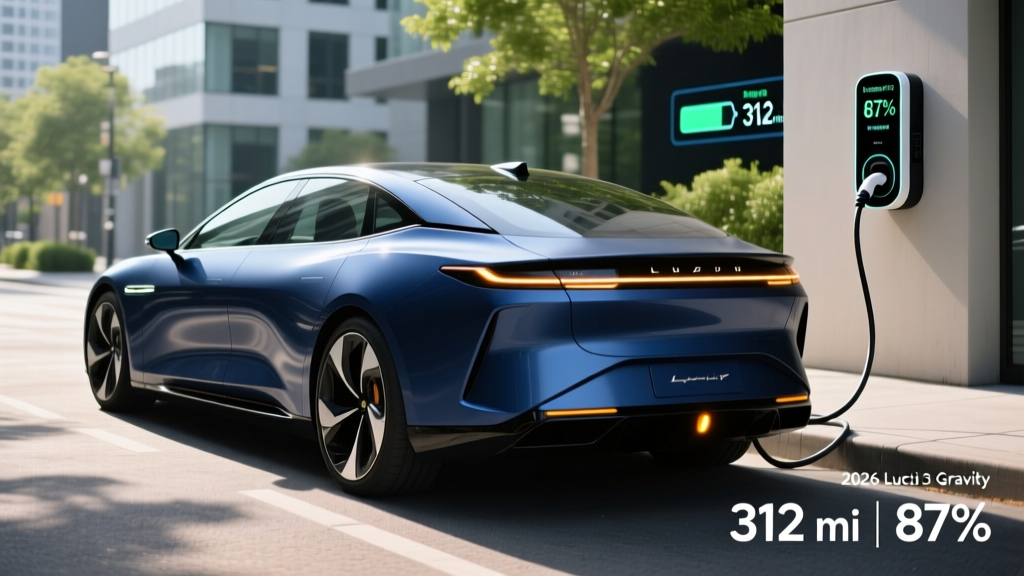
The Lucid Gravity has finally arrived in driveways after years of anticipation, and the 2026 Lucid Gravity production ramp is the story every luxury EV SUV shopper is watching. Built at Lucid's Casa Grande, Arizona factory, the Gravity is the brand's second vehicle — a three-row, seven-seat electric SUV that leverages the same efficiency-first engineering that made the Air sedan a range champion. With EPA estimates topping 440 miles on the highest trim and a 900-volt architecture that enables blistering DC fast-charging speeds, the Gravity aims to prove that a large luxury SUV doesn't have to sacrifice efficiency for space.
But production ramp realities mean availability is still tightening, waitlists stretch months for certain configurations, and real-world range rarely matches the sticker. Here's everything we know from early deliveries, EPA filings, and our own analysis to help you decide if the Gravity belongs on your shortlist.
2026 Lucid Gravity at a Glance: Core Specifications
| Specification | Gravity Pure (RWD) | Gravity Touring (AWD) | Gravity Grand Touring (AWD) |
|---|---|---|---|
| EPA Est. Range | ~440 mi (est.) | ~400 mi (est.) | ~440+ mi (est.) |
| Battery (Usable) | ~112 kWh (NMC) | ~112 kWh (NMC) | ~118 kWh (NMC) |
| Horsepower | ~480 hp | ~620 hp | ~800+ hp |
| 0-60 mph | ~5.0 sec | ~3.8 sec | ~3.5 sec |
| Drivetrain | RWD (single motor) | AWD (dual motor) | AWD (dual motor) |
| Max DC Fast Charge | 300 kW | 300 kW | 300+ kW |
| 10-80% DCFC Time | ~22 min | ~20 min | ~20 min |
| Level 2 Home Charge | 19.2 kW (~80 mi/hr) | 19.2 kW (~80 mi/hr) | 19.2 kW (~80 mi/hr) |
| Base MSRP | ~$79,900 | ~$94,900 | ~$119,900 |
| EPA Efficiency | ~120 MPGe / 28 kWh/100mi | ~110 MPGe / 31 kWh/100mi | ~115 MPGe / 29 kWh/100mi |
| Towing Capacity | 6,000 lbs | 6,000 lbs | 6,000 lbs |
Note: Some specs above are Lucid's preliminary estimates for configurations still ramping through production in early 2026. Final EPA certification numbers may vary by trim. We will update as official fueleconomy.gov listings are confirmed.
Range Reality: EPA Sticker vs. the Real World
Real-World Expectation: ~340–380 miles highway at 70-75 mph; ~280–320 miles in freezing temperatures with cabin heat; ~370–410 miles mixed city/suburban driving with regen braking engaged.
Lucid's efficiency engineering is genuinely best-in-class. The Gravity's miniaturized drive units, low-drag aero profile (Cd reportedly around 0.24 for an SUV — remarkable), and 900V architecture all contribute to class-leading energy consumption. Where a Tesla Model X or Rivian R1S might consume 35–40 kWh per 100 miles on the highway, the Gravity targets 28–31 kWh/100mi.
However, physics still applies. At sustained 80 mph highway speeds, expect to lose 15–20% from the EPA number. In sub-30°F weather, battery conditioning and cabin heating can reduce range by 25–35% unless you precondition while plugged in. The Gravity includes a heat pump — critical for cold-climate efficiency — but resistive heating still draws significant energy at very low temperatures.
For context: a 440-mile EPA rating is extraordinary, and even with a 20% highway penalty, you're looking at 350+ real-world highway miles. That's Phoenix to Los Angeles on a single charge with margin to spare — a genuine road-trip vehicle.
Charging Speed: 900V Architecture in Practice
| Charging Level | Power / Rate | Miles Added Per Hour | Notes |
|---|---|---|---|
| Level 1 (120V) | ~1.4 kW | ~4–5 mi/hr | Emergency/trickle only |
| Level 2 (240V, 80A) | 19.2 kW | ~80 mi/hr | Requires hardwired 100A circuit |
| Level 2 (240V, 48A) | 11.5 kW | ~48 mi/hr | Standard home wall connector |
| DC Fast Charge | Up to 300 kW peak | ~600+ mi/hr (peak) | 10-80% in ~20 min; tapers above 80% |
The Gravity's 900-volt electrical architecture is the headline. At a 350 kW-capable DC fast charger (like Electrify America's newest stalls or Tesla Superchargers with NACS adapters), the Gravity can accept up to 300 kW peak. In practice, expect the charge curve to sustain 250+ kW from roughly 10–40% State of Charge, then taper progressively through 50%, 60%, and steeply above 80%. The 10-80% sprint takes approximately 20 minutes — competitive with the Hyundai Ioniq 9 and faster than the Rivian R1S.
Home charging at the full 19.2 kW (80 amps) requires a hardwired Level 2 station on a dedicated 100-amp circuit. Most homes with 200-amp service panels can accommodate this, but older homes with 100-amp panels will need a panel upgrade — budget $1,500–$3,500 for that electrical work. At 19.2 kW, you'll recover roughly 80 miles of range per hour of charging, meaning an overnight session easily replenishes a full day's driving.
Connector note: Early Gravity models ship with a NACS (Tesla-style) charge port following the industry-wide adoption of Tesla's connector standard. CCS adapter compatibility is available for legacy public chargers still using CCS1.
Performance and Driving Dynamics
Even the base Gravity Pure delivers 480 horsepower and a ~5.0-second 0-60 time — quicker than most gas V8 SUVs from five years ago. Step up to the Touring trim and dual-motor AWD drops that to 3.8 seconds, while the Grand Touring's 800+ horsepower and 3.5-second sprint puts it in sports-car territory despite weighing over 5,800 pounds.
Lucid's compact drive units — roughly the size of a carry-on suitcase each — free up interior space while delivering exceptional power density. The Gravity rides on an adaptive air suspension with automatic ride-height adjustment, lowering at highway speeds for aerodynamic efficiency and raising for rough roads or loading cargo.
Towing capacity is rated at 6,000 pounds across all trims. Expect range to drop by 40–50% when towing at highway speeds — a universal EV reality that makes route planning with charging stops essential for trailer trips.
Interior Space, Cargo, and Technology
The Gravity's cabin accommodates up to seven passengers across three rows. Key dimensions (preliminary):
- Cargo behind 3rd row: ~28 cu ft
- Cargo behind 2nd row (3rd row folded): ~62 cu ft
- Max cargo (all rear seats folded): ~110 cu ft
- Front trunk (frunk): ~12 cu ft — large enough for a carry-on or charging cables
- Second-row legroom: ~41 inches
- Third-row legroom: ~33 inches (adults on short trips; kids for longer rides)
The centerpiece is Lucid's 34-inch curved Glass Cockpit display spanning the upper dash, supplemented by a lower touchscreen for climate and secondary controls. The infotainment system runs Lucid's proprietary software with native route planning that factors in charging stops, elevation, and battery preconditioning. Wireless Apple CarPlay and Android Auto are supported.
The Gravity includes Lucid's DreamDrive Pro ADAS suite — a Level 2 driver-assist system (per SAE classification) with adaptive cruise, lane centering, automatic lane changes on highways, and a 360-degree camera system. The driver must remain engaged at all times. This is not a self-driving system; it competes with Tesla Autopilot, Ford BlueCruise, and GM Super Cruise in capability.
A standout feature: the Gravity's "Surrealist Mode" ambient lighting and soundscape, plus a glass canopy roof that spans nearly the full length of the vehicle, creating an airy, open cabin feel.
Pricing, Trims, and Federal Tax Credit Eligibility
| Trim | Base MSRP | Est. As-Tested | §30D Credit Eligible? | Effective Price (if eligible) |
|---|---|---|---|---|
| Gravity Pure | ~$79,900 | $84,000–$88,000 | Likely yes (under $80K SUV cap) | ~$72,400–$80,500 |
| Gravity Touring | ~$94,900 | $100,000–$108,000 | Unlikely (above $80K SUV cap) | Full MSRP |
| Gravity Grand Touring | ~$119,900 | $125,000+ | No (above $80K SUV cap) | Full MSRP |
Federal tax credit eligibility under IRS §30D is a moving target. As of 2026, the rules require:
- MSRP cap: SUVs must have a base MSRP at or below $80,000
- Buyer income cap: AGI ≤ $150K single / $225K head of household / $300K joint
- Battery sourcing: Critical minerals and battery components must meet escalating domestic/free-trade-agreement thresholds (phased in annually through 2029)
- Assembly: Final assembly must be in North America (Gravity qualifies — built in Arizona)
- Point-of-sale transfer: Eligible buyers can apply the credit as a down-payment reduction at the dealer rather than waiting for tax filing
The Gravity Pure, at ~$79,900, sits right at the SUV MSRP cap — making it potentially eligible for up to $7,500 if battery sourcing requirements are met and buyer income qualifies. The Touring and Grand Touring trims exceed the cap and do not qualify for the federal credit. Always consult a tax professional and check the latest IRS guidance before assuming eligibility.
Production Ramp: What Buyers Need to Know in 2026
The Lucid Gravity production ramp has been one of the most closely watched timelines in the EV industry. After initial delays pushed deliveries from late 2024 into 2025 and early 2026, Lucid's Casa Grande plant is now scaling output. Key realities for prospective buyers:
- Reservation holders: Those who placed refundable deposits ($1,000) are being invited to configure in priority order. Grand Touring configurations were invited first, followed by Touring, with Pure trims expected to open later in 2026.
- Wait times: New orders placed today may face 6–12 month wait times depending on trim and configuration, as Lucid balances Gravity production alongside continued Air sedan output on the same line.
- Production rate: Lucid has targeted a combined Air + Gravity run rate of approximately 8,000–9,000 units per quarter by late 2026, though actual output has historically trailed projections during early ramp phases.
- Quality ramp: Early-production vehicles from any manufacturer can carry fit-and-finish variability. Buyers receiving Q1/Q2 2026 build slots should inspect deliveries carefully and document any issues for warranty resolution.
How the Gravity Stacks Up Against Key Competitors
The Gravity enters a competitive three-row electric SUV segment. Here's how it compares on the metrics that matter:
| Metric | Lucid Gravity GT | Tesla Model X LR | Rivian R1S (Dual) | Kia EV9 GT-Line |
|---|---|---|---|---|
| EPA Range | ~440 mi | ~348 mi | ~352 mi | ~270 mi |
| Max DCFC kW | 300 kW | 250 kW | 220 kW | 236 kW |
| 10-80% Time | ~20 min | ~30 min | ~27 min | ~24 min |
| Starting Price | ~$79,900 | ~$79,990 | ~$79,900 | ~$63,900 |
| 3rd Row Usability | Good (adults short trips) | Tight | Moderate | Good |
| Tax Credit | Pure only | Eligible | Eligible | Eligible |
The Gravity's range and charging speed advantage is clear — it leads the segment by a wide margin on both metrics. The tradeoff is availability (production ramp is still early) and the fact that only the base Pure trim qualifies for the federal credit. The Kia EV9 undercuts significantly on price but sacrifices 150+ miles of range. The Tesla Model X benefits from Supercharger network access (though Lucid's NACS port now enables Supercharger use with an adapter) and established production volume.
Warranty, Ownership Costs, and Long-Term Outlook
Lucid covers the Gravity with:
- Vehicle limited warranty: 4 years / 50,000 miles
- Battery & powertrain warranty: 8 years / 100,000 miles (with at least 70% capacity retention guaranteed)
- Roadside assistance: 4 years / 50,000 miles
The 8-year/100,000-mile battery warranty is standard for the premium EV segment. Lucid's NMC battery chemistry offers high energy density; long-term degradation data is still emerging since the Gravity is new, but Lucid's Air sedan battery packs have shown promising retention in early fleet data. The company's thermal management system — liquid-cooled with active preconditioning — is designed to minimize degradation over time.
Insurance costs for the Gravity are expected to run 15–25% above comparable gas luxury SUVs, reflecting high repair costs for aluminum-intensive structures and expensive battery packs. Get quotes before ordering.
Pros
- Class-leading EPA range (~440 mi)
- 300 kW DC fast charging — 10-80% in ~20 min
- Exceptional efficiency (28–31 kWh/100mi)
- Spacious 3-row cabin with usable frunk
- 900V architecture future-proofs charging
- NACS port enables Tesla Supercharger access
- 6,000-lb towing capacity
- Arizona-built (North American assembly)
Cons
- Production ramp limits immediate availability
- Only Pure trim qualifies for §30D tax credit
- Limited service center network vs. Tesla/BMW
- Early-production build quality uncertainty
- High insurance premiums expected
- Third row best for children, not tall adults
- No rear-seat entertainment screens standard
- Brand still proving long-term reliability
Who Should Buy the Lucid Gravity?
Choose the Lucid Gravity if:
- You need a three-row EV with maximum range for long road trips
- Fast DC charging speed is a top priority for your lifestyle
- You want luxury-level performance with best-in-class efficiency
- You can wait 6–12 months for production-slot delivery
- You have home Level 2 charging and want minimal public-charging dependence
Look elsewhere if:
- You need a vehicle immediately (Rivian R1S or Tesla Model X have shorter waits)
- You want the federal tax credit on a higher trim (Kia EV9 qualifies across more trims)
- You need a robust dealer/service network in rural areas
- Third-row space for full-size adults is a must (consider a minivan or full-size SUV)
Frequently Asked Questions
What is the real-world range of the Lucid Gravity?
The EPA estimates up to ~440 miles for the Grand Touring AWD. In real-world highway driving at 70–75 mph, expect 340–380 miles. In freezing weather, plan for 280–320 miles unless you precondition the battery while plugged in.
How fast does the Lucid Gravity charge?
On a DC fast charger, the Gravity accepts up to 300 kW peak, achieving 10–80% in approximately 20 minutes. At home on a 19.2 kW Level 2 charger, it adds roughly 80 miles of range per hour.
Does the Lucid Gravity qualify for the federal EV tax credit?
The Gravity Pure (~$79,900 MSRP) may qualify for up to $7,500 under IRS §30D if battery sourcing requirements are met and buyer income is within limits. The Touring and Grand Touring trims exceed the $80,000 SUV MSRP cap and are not eligible. Always verify current rules at irs.gov.
Is the Lucid Gravity worth buying vs. the Tesla Model X or Rivian R1S?
If range and charging speed are your top priorities, the Gravity leads the segment decisively. The Model X offers faster availability and a more established service network. The R1S provides stronger off-road capability. The Kia EV9 is significantly cheaper but with much less range.
When can I actually get a Lucid Gravity?
The 2026 production ramp is ongoing. Reservation holders are being invited to configure in waves. New orders may face 6–12 month waits depending on trim. Grand Touring deliveries began first, with Pure trims expected later in 2026.
What battery chemistry does the Gravity use?
The Gravity uses NMC (nickel-manganese-cobalt) lithium-ion cells, chosen for high energy density. This chemistry offers excellent range per kWh but is more sensitive to sustained 100% State of Charge — Lucid recommends daily charging to 80–90% for longevity.
Can the Gravity use Tesla Superchargers?
Yes. The Gravity ships with a NACS charge port, enabling direct access to Tesla's Supercharger network (V3 and V4 stalls) without an adapter.
Sources: Lucid Motors official specifications, fueleconomy.gov (EPA), IRS §30D clean vehicle credit guidance. All specifications subject to final EPA certification and manufacturer updates. Pricing and tax credit rules reflect 2026 model year information and may change.