The Short Answer on the Electric VW Camper Van
If you're searching for an electric VW camper van, the 2025–2026 Volkswagen ID. Buzz is the only factory-built, fully electric option currently on sale in the US. It delivers an EPA-estimated 234 miles of range (rear-wheel drive), a 91 kWh usable battery, and DC fast charging up to 200 kW. Pricing starts around $59,995 before destination. However, it does not qualify for the federal §30D tax credit due to battery sourcing and assembly requirements, and real-world highway range drops to roughly 190–210 miles. It's a compelling lifestyle EV for road-trippers who can charge at home, but it is not a budget purchase.
What the VW ID. Buzz Actually Is (and Isn't)
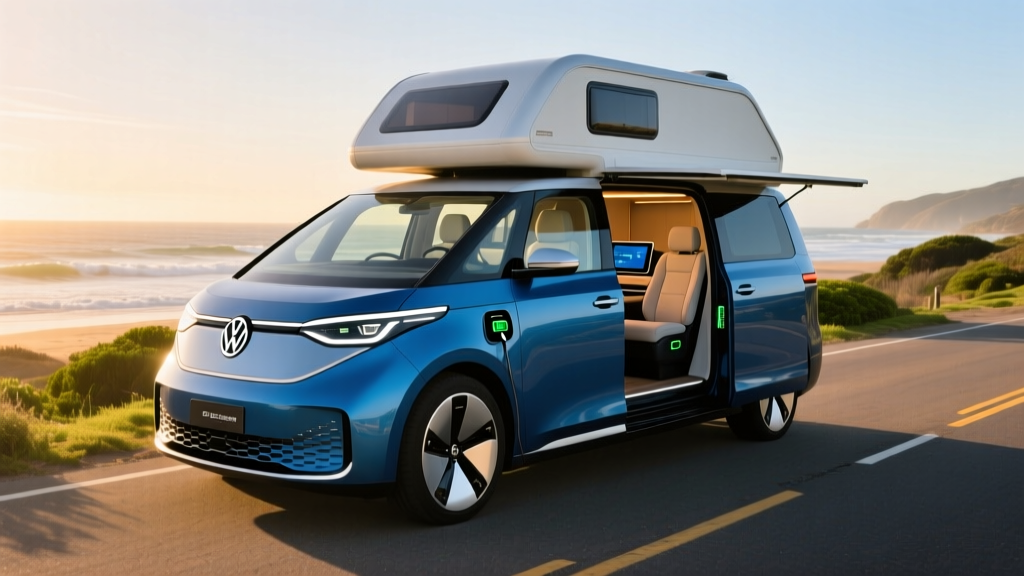
The ID. Buzz is Volkswagen's retro-styled electric van built on the MEB platform — the same architecture underpinning the ID.4 crossover. For the US market, VW offers it exclusively in a long-wheelbase (LWB) configuration with three rows of seating for up to seven passengers. Despite the "camper van" association from its Type 2 Microbus heritage, the US-spec ID. Buzz ships as a passenger van, not a factory camper conversion. Several upfitters (Lightship, Peace Vans, Colorado Camper Vans) offer aftermarket pop-top and interior camper conversions, but these add $15,000–$40,000+ to the base price.
If you want a turnkey electric VW camper van from the factory, the California edition (with a built-in pop-top roof, kitchenette, and camping interior) was announced for Europe but has not been confirmed for the US market as of early 2026. American buyers must rely on the passenger version plus third-party conversion.
Specs That Matter: Range, Battery, and Charging
| Specification | ID. Buzz RWD (Std) | ID. Buzz AWD (4MOTION) |
|---|---|---|
| EPA Range | 234 miles | 231 miles |
| Battery (Usable) | 91 kWh (NMC) | 91 kWh (NMC) |
| Peak DC Fast Charge | 200 kW | 200 kW |
| 10–80% DC Charge Time | ~26 minutes | ~26 minutes |
| Level 2 AC Charge Rate | 11 kW | 11 kW |
| Level 2 Full Charge Time | ~9 hours | ~9 hours |
| Horsepower | 282 hp | 330 hp |
| 0–60 mph | ~7.9 sec | ~5.9 sec |
| Towing Capacity | Not rated (US) | Not rated (US) |
| Cargo Volume (behind 3rd row) | 18.4 cu ft | 18.4 cu ft |
| Base MSRP (Pro S trim) | $59,995 | $64,495 |
| Battery/Powertrain Warranty | 8 yr / 100,000 mi | 8 yr / 100,000 mi |
Real-World Range Expectations
EPA Sticker: 234 miles (RWD) / 231 miles (AWD)
Real-World Highway (70–80 mph): Expect 190–210 miles in mild weather. The ID. Buzz's tall, boxy profile creates significant aerodynamic drag at highway speeds, which is the biggest efficiency killer for any EV.
Cold Weather (below 32°F): Plan for 160–185 miles. The NMC chemistry loses roughly 20–30% range in freezing temperatures, even with the heat pump VW includes as standard.
Camper Conversion Penalty: Adding a pop-top, interior build-out, and gear can add 400–800 lbs, reducing range by an estimated 5–12% depending on weight and aerodynamic changes.
The Charging Reality: Home, Public, and On the Road
| Charging Level | Power (kW) | Miles Added Per Hour | Best For |
|---|---|---|---|
| Level 1 (120V outlet) | ~1.4 kW | ~3–4 mi/hr | Emergency top-ups only |
| Level 2 (240V home charger) | 11 kW (max) | ~28–32 mi/hr | Daily charging, overnight full charge |
| DC Fast Charging | Up to 200 kW | ~140+ mi in 15 min | Road trips, en-route stops |
Home Level 2 charging is essential for practical ID. Buzz ownership. A full overnight charge on an 11 kW home charger takes roughly 9 hours — fine for daily use if you plug in when you get home. However, installing a 48-amp Level 2 charger (like a ChargePoint Home Flex or Wallbox Pulsar Plus) typically costs $800–$2,500 for equipment and electrician labor, assuming your panel has capacity. If your home needs a 200-amp panel upgrade, budget an additional $1,500–$3,500.
For road trips, the ID. Buzz uses the CCS1 connector (Combined Charging System). VW has not adopted the NACS (Tesla) connector for the ID. Buzz, though adapters from CCS to NACS are becoming available from companies like Lectron and A2Z for access to Tesla Superchargers. On Electrify America or other CCS networks, expect peak charging at 200 kW that tapers significantly above 80% state of charge — a typical 10–80% session takes about 26 minutes, but 80–100% can add another 25–30 minutes.
Cost Breakdown: What the Electric VW Camper Van Actually Costs to Own
| Cost Category | VW ID. Buzz (Electric) | Comparable Gas Minivan (e.g., Chrysler Pacifica) |
|---|---|---|
| Base MSRP | $59,995 | $39,695 |
| Federal Tax Credit (§30D) | $0 (does not qualify) | N/A |
| Estimated Purchase Price (after incentives) | ~$59,995 | ~$39,695 |
| Annual "Fuel" Cost (12,000 mi/yr) | ~$600–$900 (electricity at $0.14/kWh avg) | ~$1,800–$2,400 (gas at $3.50/gal, 22 MPG) |
| Annual Maintenance | ~$200–$400 | ~$600–$1,000 |
| Annual Insurance (est.) | ~$1,800–$2,400 | ~$1,200–$1,700 |
| 5-Year Total Operating Cost | ~$13,000–$18,500 | ~$18,000–$25,500 |
| Camper Conversion (aftermarket) | $15,000–$40,000+ | $10,000–$30,000+ |
The ID. Buzz's lack of federal tax credit eligibility is a significant financial blow. Under current IRS §30D rules, a vehicle must meet battery component and critical mineral sourcing requirements, have final assembly in North America, fall under MSRP caps ($80,000 for vans/SUVs), and the buyer must meet income thresholds ($300,000 joint / $150,000 single). The ID. Buzz is assembled in Hanover, Germany, which immediately disqualifies it from the new-vehicle credit regardless of other factors.
Where the ID. Buzz recoups cost is in operating expenses. Charging at home at the US average of ~$0.14/kWh, and with the van consuming roughly 2.0–2.3 kWh per mile (or about 44–50 MPGe equivalent per fueleconomy.gov), you'll spend roughly $600–$900 annually on electricity versus $1,800–$2,400 on gasoline for a comparable minivan. That's roughly $1,000–$1,500 in annual fuel savings, meaning the price gap takes 10–15 years to close through fuel savings alone — longer than most owners keep a vehicle.
EV vs. Gas: Is the Electric VW Camper Van Worth It?
| Factor | ID. Buzz (EV) | Gas Minivan / Camper |
|---|---|---|
| Upfront Cost | $60k–$100k+ (with conversion) | $40k–$70k+ (with conversion) |
| Range (real-world) | 190–234 miles | 350–450 miles |
| Refuel/Recharge Time | 26 min (10–80% DC), 9 hr (L2 home) | 5 min (gas station) |
| Remote/Off-Grid Camping | Limited — needs grid charging | Better — gas stations are everywhere |
| V2L (Vehicle-to-Load) | Not available on US ID. Buzz | N/A (generator needed) |
| Noise & Vibration | Near-silent driving | Engine noise, vibration |
| Maintenance | Minimal (no oil, filters, spark plugs) | Regular (oil, transmission, exhaust) |
| Cold Weather Impact | 20–30% range loss | Minimal impact |
For weekend camping within 150 miles of home with reliable charging at your destination or along the route, the ID. Buzz is a comfortable, quiet, low-operating-cost platform. For boondocking, cross-country road trips through charging deserts (parts of the Mountain West, rural Nevada, etc.), a gas or diesel camper still offers far more flexibility. The ID. Buzz's range, while adequate for daily driving, becomes a real constraint when loaded with camping gear, driving at highway speeds in hot or cold weather, and needing to detour to chargers.
Common Misconceptions About the Electric VW Camper Van
| Myth | Fact |
|---|---|
| "The ID. Buzz is a factory camper van in the US." | The US version is a 7-seat passenger van. The factory California camper edition is Europe-only as of 2026. |
| "It qualifies for the $7,500 federal tax credit." | It does not. The ID. Buzz is assembled in Germany, failing §30D's North American assembly requirement. |
| "234 miles of range is enough for road trips." | EPA range assumes mixed driving. At sustained highway speeds with cargo, expect 190–210 miles real-world. Plan charging stops accordingly. |
| "You can use Tesla Superchargers directly." | The ID. Buzz has a CCS1 port, not NACS. You need a third-party CCS-to-NACS adapter for Supercharger access, and compatibility varies by station. |
| "The battery will need replacing soon." | VW warranties the battery for 8 years/100,000 miles with a minimum 70% capacity retention. NMC batteries in liquid-cooled systems typically retain 85–90% capacity after 100,000 miles based on industry data. |
| "It can power my campsite (V2L)." | The US-spec ID. Buzz does not currently support Vehicle-to-Load (V2L) functionality, unlike some Korean EVs (Hyundai Ioniq 5, Kia EV6). |
Decision Framework: Should You Buy the Electric VW Camper Van?
Choose the ID. Buzz If:
- You have home Level 2 charging — this is non-negotiable for practical daily ownership of any EV with a 91 kWh battery.
- Your trips are mostly under 200 miles or you're willing to plan DC fast-charging stops on longer drives.
- You value the retro design and driving experience — the ID. Buzz turns heads and drives smoothly, quietly, and with surprising acceleration for a van.
- You plan to use a third-party camper conversion and accept the combined $75k–$100k+ investment.
- You want low operating costs and don't mind the higher upfront price.
Look Elsewhere If:
- You need 350+ mile range for cross-country or remote camping — consider a gas/diesel Sprinter or a longer-range EV platform (Rivian R1T/R1S with Max battery: ~400 miles EPA).
- You need V2L to power campsite appliances — the Hyundai Ioniq 5 or Ford F-150 Lightning offer this natively.
- Budget is under $50,000 — the ID. Buzz starts at $60k before conversion, with no tax credit offset.
- You live in an apartment or lack home charging access — relying solely on public DC charging for a 91 kWh battery is expensive and time-consuming.
- You need towing — the US ID. Buzz has no published tow rating.
First-Time EV Buyer Essentials for the ID. Buzz
If the ID. Buzz is your first EV, here's what you need to know before signing:
- Install Level 2 home charging before delivery. A NEMA 14-50 outlet or hardwired 48-amp charger is essential. Budget $800–$2,500 and hire a licensed electrician. Confirm your panel has 40–50 amps of spare capacity.
- Download charging apps now. PlugShare, Electrify America, and ChargePoint are your road-trip lifelines. Filter for CCS-compatible stations and read recent reliability reviews — not all public chargers work flawlessly.
- Understand the charge curve. The ID. Buzz peaks at 200 kW only between roughly 10–35% state of charge. Above 80%, charging slows dramatically to protect battery health. Plan to charge to 80% and go, rather than waiting for a full charge at a DC station.
- Precondition the battery before fast charging. Navigate to a DC charger using the built-in navigation, and the ID. Buzz will warm or cool the battery to optimal temperature, improving charge speed — especially critical in winter.
- Insurance will cost more. EVs generally carry 15–30% higher insurance premiums than comparable gas vehicles due to repair costs and battery replacement risk. Get quotes before purchasing.
- Check state incentives. While the federal credit is off the table, some states (California, Colorado, New York, etc.) offer their own EV rebates or HOV lane access. Check your state's energy office or DMV for current programs — these vary by jurisdiction and change frequently.
Frequently Asked Questions
Does the VW ID. Buzz come with a pop-top roof or kitchen in the US?
No. The US-market ID. Buzz is a 7-seat passenger van. The factory "California" camper version with pop-top, kitchen, and camping interior is sold only in Europe. US buyers must use aftermarket conversion companies like Peace Vans, Lightship, or Colorado Camper Vans for a camper build-out, typically adding $15,000–$40,000.
How long does the ID. Buzz battery last?
VW warranties the 91 kWh NMC battery for 8 years or 100,000 miles with at least 70% capacity retention. Based on industry data from similar MEB-platform vehicles (ID.4), expect 85–92% capacity after 100,000 miles with normal use and DC fast charging. A full battery replacement, if needed out of warranty, would likely cost $15,000–$25,000+ based on current NMC pack pricing, though costs continue to decline.
Can I charge the ID. Buzz at Tesla Superchargers?
Not directly. The ID. Buzz uses a CCS1 connector, while Tesla Superchargers use NACS. Third-party CCS-to-NACS adapters (from brands like Lectron) are available for approximately $200–$350 and may allow access to Superchargers that support non-Tesla vehicles through the "Magic Dock" or adapter-friendly stations. However, compatibility is not universal — check Tesla's app for station support before relying on this.
Is the ID. Buzz good for cold-weather camping?
The ID. Buzz includes a heat pump, which helps preserve range in cold weather compared to resistive heating. However, expect 20–30% range loss in temperatures below freezing. For winter camping trips, plan for roughly 160–185 miles of real-world range and ensure your route has reliable DC charging. Cabin preheating while plugged in at home is a major advantage of any EV.
What's the total cost to convert the ID. Buzz into a camper?
Expect to pay $59,995–$69,995 for the vehicle itself (depending on trim and AWD), plus $15,000–$40,000+ for a professional camper conversion (pop-top roof, bed platform, kitchenette, electrical system). Total investment: $75,000–$110,000+. Compare this to a used gas VW Westfalia or a new Ford Transit camper conversion, which can be done for $45,000–$80,000 total — but without the EV's low operating costs and silent driving experience.
How does the ID. Buzz compare to the Rivian R1T or R1S for camping?
The Rivian R1S (SUV) and R1T (truck) offer significantly more range (up to ~420 miles EPA with Max Pack), V2L capability for powering campsite devices, available air suspension for rough roads, and off-road capability the ID. Buzz lacks. However, Rivians start at $75,000–$100,000+ and don't offer the ID. Buzz's interior volume or retro charm. If range and off-grid capability are priorities, Rivian wins. If you want a spacious, comfortable electric van for paved-road camping, the ID. Buzz is the only option.