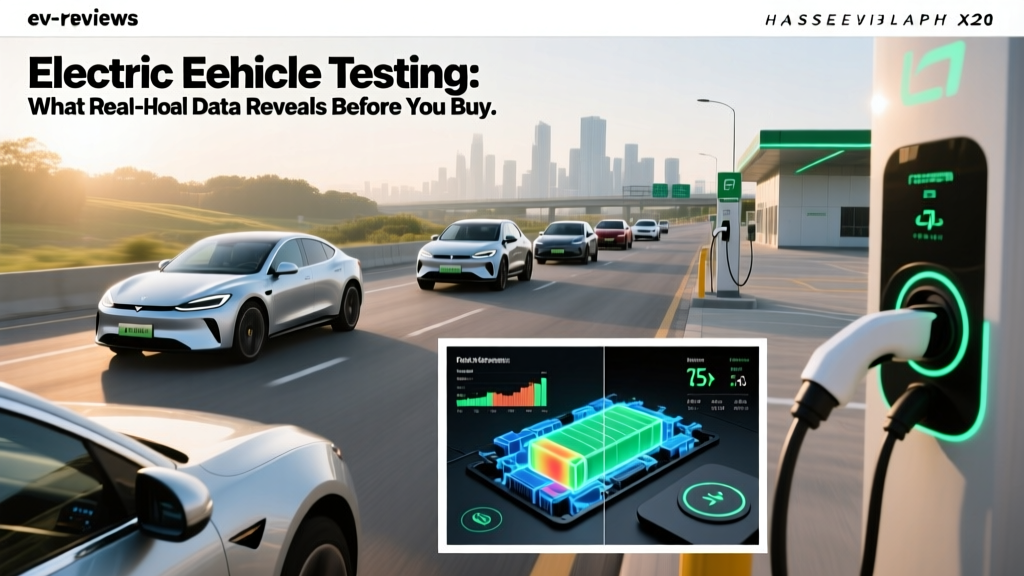
Independent electric vehicle testing consistently reveals a gap between manufacturer claims and real-world performance. The EPA range sticker on the window is a laboratory estimate — highway driving at 75 mph, cold-weather commutes, and DC fast-charging sessions all produce different numbers. For buyers, the most valuable testing data comes from controlled real-world evaluations that measure actual range under load, sustained charging speeds (not just peak kW), and five-year ownership costs versus gas and hybrid alternatives.
The Quick Answer
Electric vehicle testing by independent reviewers and owners shows that real-world highway range typically falls 10–20% below EPA estimates, DC fast charging rarely sustains peak kW beyond 20–30% of the session, and total five-year ownership costs for EVs average 5–15% lower than comparable gas cars when home charging is available — but can exceed gas costs for apartment dwellers relying on public networks.
What Electric Vehicle Testing Actually Measures
When engineers and reviewers conduct electric vehicle testing, they evaluate several performance dimensions that spec sheets flatten into single numbers:
- Range validation: Driving a standardized loop (often 70 mph highway or mixed city/highway) from 100% to near-zero State of Charge (SoC) to compare actual miles against the EPA estimate published on fueleconomy.gov.
- Charging curve analysis: Logging kW delivery from 10% to 80% SoC at a DC fast charger. A vehicle advertising 250 kW peak may only sustain that rate for 3–5 minutes before thermal management throttles the rate to 150 kW or below.
- Efficiency measurement: Calculating actual kWh consumed per 100 miles, which varies with speed, temperature, and terrain.
- Cold-weather impact: Testing at 20°F or below, where lithium-ion chemistry and cabin heating demands reduce range by 20–40%.
- Regenerative braking calibration: Measuring how effectively one-pedal driving recaptures energy in stop-and-go versus highway conditions.
The testing methodology matters. A 310-mile EPA range achieved in mild weather at 55 mph with no elevation change is not what a Colorado buyer will experience on I-70 in January. Testing that controls for these variables — and reports results in tables rather than superlatives — gives buyers the data needed to match a vehicle to their actual driving patterns.
Real-World Range vs. EPA Stickers: What Testing Shows
The EPA uses a standardized dynamometer test cycle to assign range estimates. These are useful for comparing vehicles against each other under identical conditions, but they don't replicate sustained highway driving or extreme temperatures. Here's what independent electric vehicle testing typically finds for popular 2025–2026 models:
| Vehicle | EPA Range | 70 mph Highway Test | Cold Weather (20°F) | Battery (kWh Usable) |
|---|---|---|---|---|
| Tesla Model Y Long Range AWD | 320 mi | ~270–285 mi | ~220–240 mi | 75 kWh (NMC) |
| Hyundai Ioniq 5 Long Range RWD | 303 mi | ~255–270 mi | ~200–225 mi | 77.4 kWh (NMC) |
| Chevrolet Equinox EV 3RS | 319 mi | ~270–290 mi | ~215–240 mi | 85 kWh (NMC) |
| Ford Mustang Mach-E Extended Range | 320 mi | ~265–280 mi | ~210–230 mi | 91 kWh (NMC) |
| BMW iX xDrive50 | 324 mi | ~285–305 mi | ~240–265 mi | 105.2 kWh (NMC) |
Key testing insight: Vehicles with heat pumps (standard on Hyundai/Kia E-GMP platforms, Tesla, and most European models) lose 20–25% range in cold weather. Those relying on resistive heating can lose 30–40%. Highway testing at 70+ mph consistently yields 10–15% below EPA, regardless of brand.
For buyers, the practical rule is: if your daily round-trip commute is 80 miles and your coldest-weather range drops to 220 miles, you have comfortable margin. If you regularly drive 250-mile highway stretches in winter, you need a vehicle with at least 320 miles of EPA range — or you need to plan a mid-route charging stop.
Charging Speed Reality: Peak kW vs. Sustained Delivery
Marketing materials emphasize peak DC fast-charge rates — "up to 350 kW" — but electric vehicle testing reveals that the charging curve is what actually determines your wait time. A charge curve plots kW delivery against battery State of Charge (SoC), and it almost always tapers as the battery fills.
| Vehicle | Peak DC Rate | Sustained Average (10–80%) | 10–80% Time | Connector |
|---|---|---|---|---|
| Hyundai Ioniq 5 | 240 kW | ~185 kW | ~18 min | NACS (2025+) |
| Tesla Model Y | 250 kW | ~175 kW | ~22 min | NACS |
| Chevrolet Equinox EV | 190 kW | ~140 kW | ~28 min | NACS (2025+) |
| Porsche Taycan (2025+) | 320 kW | ~250 kW | ~16 min | NACS adapter / CCS |
| Ford F-150 Lightning Ext. Range | 210 kW | ~150 kW | ~30 min | NACS (2025+) |
The distinction between kW (power — the rate of energy delivery) and kWh (energy — the battery's total capacity) is critical here. A 77 kWh battery charging at a sustained 185 kW average adds roughly 54 kWh in 18 minutes (10% to 80% of capacity), which translates to roughly 200–220 miles of range depending on efficiency.
Testing also reveals infrastructure variables. A charger rated for 350 kW may deliver less if the grid is constrained, if another vehicle is sharing the cabinet, or if ambient temperatures push the vehicle's battery thermal management to prioritize cooling over charging speed. Preconditioning your battery — navigating to a charger using the vehicle's built-in routing — is essential for achieving advertised speeds in NMC chemistry packs.
EV vs. Gas vs. Hybrid: Tested Cost Comparisons
Electric vehicle testing extends beyond driving dynamics into ownership economics. Here's a five-year cost comparison for a midsize crossover driven 15,000 miles annually, using national average electricity ($0.16/kWh) and gasoline ($3.40/gallon) prices as of early 2026:
| Cost Category | EV (e.g., Ioniq 5) | Hybrid (e.g., Toyota RAV4 Hybrid) | Gas (e.g., Honda CR-V AWD) |
|---|---|---|---|
| Purchase Price (MSRP) | $45,500 | $34,000 | $33,500 |
| Federal Tax Credit (§30D) | Up to $7,500* | $0 | $0 |
| Effective Purchase | ~$38,000 | $34,000 | $33,500 |
| Fuel/Energy (5 years) | $3,600 (home L2) | $6,545 | $9,430 |
| Maintenance (5 years) | $1,200 | $2,800 | $3,200 |
| Insurance (5 years) | $9,500 | $7,200 | $7,000 |
| 5-Year Depreciation (est.) | $16,000 | $11,000 | $12,500 |
| Total 5-Year Cost | $68,300 | $61,545 | $65,630 |
*§30D credit eligibility requires meeting income caps ($150K single / $300K joint), MSRP caps ($55K cars / $80K trucks/SUVs), and battery critical-mineral/sourcing rules per IRS guidelines. Point-of-sale transfer available at participating dealers.
Key testing-based takeaways from this comparison:
- Home charging is the economic linchpin. The $3,600 five-year energy cost assumes 85%+ home Level 2 charging at residential rates. Public DC fast charging at $0.40–$0.60/kWh pushes EV fuel costs to $5,500–$7,000 over five years — erasing much of the advantage.
- EV insurance premiums run 15–30% higher than gas equivalents due to repair cost data from IIHS and insurer claims experience with battery-pack replacements after collisions.
- Maintenance savings are real and measurable: No oil changes, no transmission fluid, fewer brake pad replacements (regen braking handles most deceleration). EV testing confirms brake pads often last 80,000+ miles.
- Hybrids occupy a rational middle ground for buyers without home charging access or who drive in extreme cold regularly. The RAV4 Hybrid's 39 MPG combined means ~$1,309/year in fuel — significantly less than a gas car, more than a home-charged EV.
Common EV Misconceptions: Testing Data vs. Myths
| Myth | What Electric Vehicle Testing Shows |
|---|---|
| "EV batteries need replacing every 5 years" | NMC and LFP packs in liquid-cooled systems show 8–12% degradation over 100,000 miles. Federal warranty mandate requires 8 years/100,000 miles minimum coverage at 70% capacity retention. Most tested packs retain 88–92% at 100K miles. |
| "All EVs can charge at 350 kW" | Only a handful of 800V-architecture vehicles (Porsche Taycan, Hyundai Ioniq 5, Kia EV6) can accept above 250 kW. Most mainstream EVs peak at 150–200 kW. Charger rating ≠ vehicle acceptance rate. |
| "EVs don't work in cold climates" | Norway — with harsher winters than most US states — had 82% new-car EV market share in 2025. Heat pumps and battery preconditioning mitigate range loss. Testing shows 20–30% winter range reduction, not failure. |
| "Charging takes hours on road trips" | 10–80% DC fast charges take 18–30 minutes for most modern EVs. Combined with rest stops, the real-world time penalty vs. gas is 10–15 minutes per 200-mile segment. |
| "EVs are worse for the environment due to battery mining" | Lifecycle analyses show EVs produce fewer total emissions than gas cars within 1–2 years of driving, even on coal-heavy grids. The break-even point depends on local electricity mix — cleaner grids accelerate it. |
First-Time EV Buyer: What Testing Says You Must Know
If electric vehicle testing data could be distilled into a checklist for first-time buyers, these are the non-negotiable items:
- Confirm home charging feasibility before choosing a vehicle. A Level 2 home charger (240V, 32–48 amps) delivers 25–40 miles of range per hour of charging and costs $800–$2,500 installed depending on panel capacity and conduit runs. If you need a 200-amp panel upgrade, add $1,500–$3,500. Without home charging, a PHEV or hybrid may be more practical.
- Match battery chemistry to your usage pattern. LFP (lithium iron phosphate) batteries tolerate daily 100% charging and have longer cycle life but offer 10–15% less energy density (shorter range per kWh). NMC batteries deliver more range but are best kept between 20–80% for daily use, reserving 100% for road trips. Tesla offers LFP in Standard Range models; most other brands use NMC.
- Calculate your real-world range need, not your fantasy road trip. If 95% of your driving is a 40-mile round-trip commute, a 250-mile EPA range vehicle is more than sufficient. Road-trip charging is a solvable planning exercise, not a daily burden.
- Test the infotainment and ADAS in person. SAE Level 2 systems like Tesla Autopilot, Ford BlueCruise, and GM Super Cruise all require driver supervision — they are not self-driving. Testing reveals massive variation in lane-centering smoothness, phantom braking frequency, and driver-monitoring camera sensitivity.
- Verify §30D tax credit eligibility for your specific VIN. Battery sourcing requirements change annually. A vehicle that qualified in 2025 may not in 2026 due to updated critical-mineral and foreign-entity-of-concern rules. Check the IRS qualified vehicle list before signing.
Your EV Decision Framework: If X, Then Y
| If Your Situation Is… | Testing Data Suggests… |
|---|---|
| You have a garage/driveway and can install Level 2 | A BEV (battery electric vehicle) maximizes fuel savings and convenience. Target 250+ EPA miles. Expect ~$3,000–$5,500 five-year fuel savings vs. gas. |
| You live in an apartment without charging access | A PHEV (plug-in hybrid) with 30–40 miles electric range lets you charge at public Level 2 stations opportunistically while the gas engine covers longer trips. Or choose a hybrid (HEV) — no plug needed, 35–45 MPG. |
| You drive 250+ miles highway in winter regularly | Choose an EV with 320+ EPA miles, heat pump standard, and NACS compatibility for Supercharger access. Or choose a PHEV for zero range-anxiety flexibility. |
| Your budget is under $35,000 effective price | Look at the Chevrolet Bolt EV/EUV (if available), used EVs qualifying for the §25E used-EV credit (up to $4,000), or a hybrid like the Toyota Corolla Hybrid ($24,000, 50 MPG). |
| You want the lowest total cost of ownership | Home-charged BEV with §30D eligibility, driven 12,000+ miles/year, in a state with low electricity rates. Five-year TCO can beat gas by $3,000–$8,000. |
| You tow or haul heavy loads frequently | Electric trucks (F-150 Lightning, Rivian R1T) lose 30–50% range when towing. If you tow more than twice a month, a diesel or hybrid truck remains more practical for range predictability. |
Frequently Asked Questions
How accurate are EPA range estimates for electric vehicles?
EPA estimates are reliable for comparing vehicles to each other under standardized conditions, but real-world highway driving at 70+ mph typically yields 10–15% fewer miles. Cold weather (below 30°F) reduces range an additional 20–30% due to battery chemistry limitations and cabin heating demands. The most accurate way to assess your personal range is to multiply the EPA figure by 0.75–0.80 for worst-case winter highway conditions.
Does DC fast charging degrade the battery faster than Level 2?
Testing data shows a measurable but modest difference. Frequent DC fast charging (3+ times per week exclusively) accelerates degradation by roughly 2–4% over 100,000 miles compared to Level 2-only charging. Modern thermal management systems mitigate most of the risk. For daily use, Level 2 home charging is optimal; DC fast charging is designed for road trips and occasional use without significant longevity concern.
Should I wait for solid-state batteries before buying an EV?
Solid-state batteries are in limited production for 2026 (Toyota has announced small-volume deployment in select models), but widespread commercial availability at mainstream prices is not expected before 2028–2030. Current NMC and LFP liquid-electrolyte batteries already demonstrate 88–92% capacity retention at 100,000 miles. If an EV meets your needs today, the battery technology is mature enough to purchase with confidence under existing warranty protections.
What does it cost to install a Level 2 charger at home?
A typical Level 2 installation (240V, 40-amp circuit, hardwired or NEMA 14-50 outlet) costs $800–$2,500 total, including the charger unit ($300–$700), electrician labor ($400–$1,500), and permits ($50–$200). If your electrical panel needs upgrading from 100A to 200A service, add $1,500–$3,500. Always get a quote from a licensed electrician before purchasing a charger.
How do I know if I qualify for the $7,500 federal EV tax credit?
Under current IRS §30D rules, eligibility requires: (1) modified adjusted gross income below $150,000 single / $225,000 head of household / $300,000 joint; (2) vehicle MSRP below $55,000 for cars or $80,000 for SUVs/trucks/vans; (3) the vehicle's battery meets critical-mineral and battery-component sourcing requirements that tighten annually; (4) final assembly in North America. The credit can be transferred to the dealer at point of sale as an immediate price reduction. Always verify the specific vehicle's eligibility on the IRS qualified vehicles list before purchasing, as sourcing compliance changes throughout the year.