The Quick Answer on Electric Vehicle Servicing
Electric vehicles require significantly less routine maintenance than gas cars — no oil changes, no spark plugs, no transmission fluid, no exhaust system repairs. Based on current ownership data, EV maintenance costs average $0.061 per mile versus $0.101 per mile for internal combustion vehicles, according to fueleconomy.gov. Over five years and 75,000 miles, that translates to roughly $4,575 in EV maintenance versus $7,575 for a comparable gas car — a savings of about $3,000.
What EV servicing actually involves: tire rotations every 5,000–7,500 miles, cabin air filter replacement every 15,000–20,000 miles, brake fluid checks every 2–3 years, coolant system flushes at 5-year intervals, and wiper/washer fluid as needed. The traction battery and electric motor require virtually zero scheduled maintenance.
What Electric Vehicle Servicing Actually Includes
When you pull an EV into a service center, the checklist looks radically shorter than what a gas car owner faces. Here's what a typical 2026 model-year EV maintenance schedule covers:
Routine Items (Every 5,000–7,500 Miles)
- Tire rotation and inspection — EVs wear tires 20–30% faster than gas cars due to instant torque and heavier curb weight (battery packs add 500–1,000 lbs). Expect tire replacement every 30,000–40,000 miles versus 50,000+ for a gas sedan.
- Brake inspection — Regenerative braking handles 80–90% of deceleration, so friction brake pads often last 100,000+ miles. However, calipers and rotors need periodic inspection for corrosion, especially in salt-belt states.
- Cabin air filter — Replace every 15,000–20,000 miles. Some models (Tesla Model Y, Hyundai Ioniq 5) use HEPA-grade filters that cost $30–$60.
Periodic Items (Every 2–5 Years)
- Brake fluid — Check and replace every 2–3 years. Moisture absorption degrades fluid regardless of mileage.
- Battery coolant — Most EVs use a liquid thermal management system. Coolant flush intervals vary: Tesla recommends every 4 years, Hyundai/Kia at 5 years or 60,000 miles.
- Reduction gear fluid — The single-speed reduction gear (EV equivalent of a transmission) needs a fluid check around 60,000 miles. Some manufacturers call it "lifetime" fluid.
- 12V auxiliary battery — The small 12V battery that runs electronics typically lasts 3–5 years. Replacement: $150–$300.
What You'll Never Pay For
- Oil changes ($40–$80 each, 2–3x/year on a gas car)
- Spark plugs ($100–$400 every 30,000–100,000 miles)
- Transmission fluid flush ($150–$300 every 30,000–60,000 miles)
- Timing belt/chain ($500–$2,000+ at 60,000–100,000 miles)
- Exhaust system / catalytic converter ($200–$2,500+)
- Emissions testing ($15–$50 annually in states that require it)
- Fuel filter, air intake filter, oxygen sensors
EV vs Gas: Maintenance Cost Comparison
The numbers below compare a representative 2026 EV (Hyundai Ioniq 5 SEL, $45,850 MSRP, 318-mile EPA range) against a comparable gas crossover (Toyota RAV4 XLE, $32,675 MSRP, 30 MPG combined) over 5 years / 75,000 miles.
| Service Item | EV Cost | Gas Car Cost |
|---|---|---|
| Oil changes | $0 | $900 (15 changes × $60) |
| Tire rotation/replacement | $2,200 (faster wear) | $1,600 |
| Brake pads/rotors | $0 (regen saves pads) | $800 |
| Cabin air filter | $250 | $250 |
| Brake fluid | $200 | $200 |
| Coolant flush | $150 | $150 |
| Transmission fluid | $0 | $300 |
| Spark plugs / ignition | $0 | $400 |
| Battery (12V aux) | $200 | $200 |
| Wipers / misc. | $150 | $150 |
| Total (5 yr / 75k mi) | $3,350 | $4,950 |
| Per-mile cost | $0.045 | $0.066 |
Key insight: EVs save roughly $1,600 in maintenance over five years, but that advantage narrows if you drive aggressively (accelerating tire wear) or live in a salt-belt state where corrosion can affect brake components that rarely get used.
Where Electric Vehicle Servicing Gets Tricky
EVs aren't maintenance-free — they're maintenance-different. Here are the real-world service scenarios that catch first-time EV owners off guard:
Tire Costs Are Higher Than You'd Expect
A Hyundai Ioniq 5 weighs 4,431 lbs. A Toyota RAV4 weighs 3,615 lbs. That 816-lb difference, combined with instant electric torque, accelerates tire wear noticeably. Budget for a set of four EV-rated tires (Michelin Pilot Sport EV, Hankook iON evo) every 30,000–40,000 miles at $800–$1,400 per set installed.
Dealer vs Independent Shop Availability
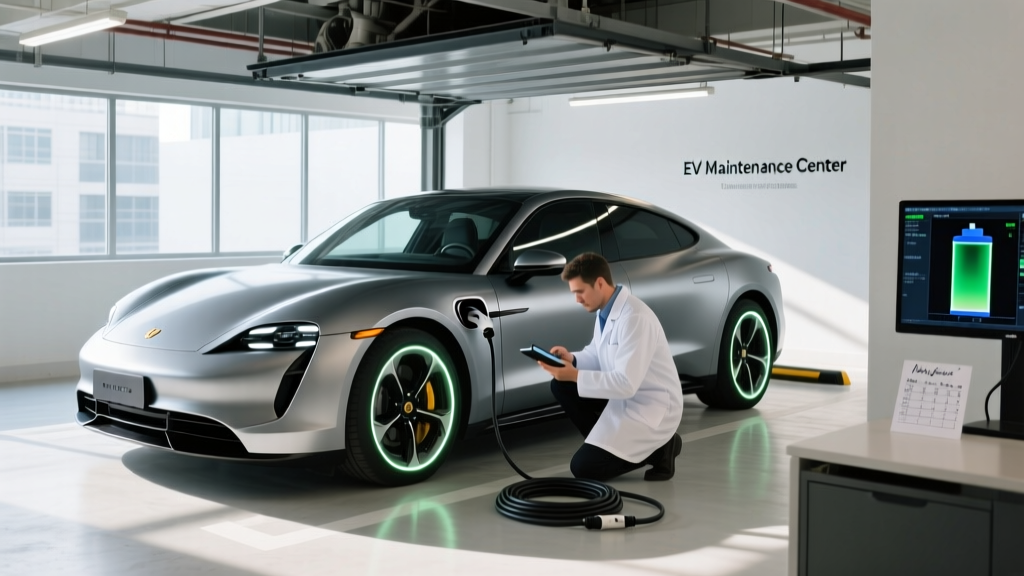
High-voltage system work (battery diagnostics, inverter service, onboard charger replacement) requires manufacturer-certified technicians and specialized safety equipment. Most independent shops cannot perform these services. For routine items (tires, brakes, cabin filters), any competent shop can handle an EV.
Battery Warranty vs Reality
Federal law mandates a minimum 8-year / 100,000-mile battery warranty for EVs sold in the US. California-emissions states (CA, CO, CT, ME, MA, NJ, NY, OR, RI, VT, WA) often require 10 years / 150,000 miles. The warranty typically guarantees the battery retains at least 70% of original capacity. Actual degradation data from Recurrent Auto shows most 2022–2025 EVs retain 90–95% capacity after 5 years / 60,000 miles — well above the warranty threshold.
Cold-Weather Considerations
EVs lose 20–40% of EPA-rated range in sub-freezing temperatures due to battery chemistry limitations and cabin heating demands. This doesn't cause damage, but it affects service planning: owners in Minnesota or Maine should precondition their battery (using the vehicle's app or scheduled departure feature) before DC fast charging to maintain charge speed and battery health.
Common EV Maintenance Myths vs Facts
| Myth | Fact |
|---|---|
| "EV batteries need replacing every 5 years like a phone" | Modern LFP and NMC packs are engineered for 1,500–3,000+ charge cycles. At 300 miles per cycle, that's 450,000–900,000 miles before significant degradation. Recurrent Auto data shows <5% of EVs have needed battery replacement. |
| "EVs are maintenance-free" | Tires, brakes, coolant, cabin filters, wipers, and the 12V battery all need attention. Tires wear faster. Budget $500–$700/year. |
| "You can't service an EV outside the dealer" | Tire shops, brake specialists, and general mechanics handle 80% of EV service. Only HV-system work requires dealer certification. |
| "Regen braking means you never need brake service" | Pads last longer, but calipers can seize and rotors can rust from underuse. Annual brake inspection is still recommended. |
| "EV coolant doesn't matter" | Battery thermal management relies on coolant. Neglecting flush intervals risks overheating the pack and voiding the warranty. |
| "EVs cost more to insure" | Partially true. Average EV insurance premiums run 10–25% higher than comparable gas cars due to higher repair costs after collisions and expensive battery replacement. Shop quotes from GEICO, Progressive, and EV-specialty insurers. |
Full Ownership Cost: Beyond Servicing
Maintenance is one line item. Here's the total 5-year cost picture for our EV vs gas comparison:
| Category | 2026 Hyundai Ioniq 5 SEL (EV) | 2026 Toyota RAV4 XLE (Gas) |
|---|---|---|
| Purchase price (MSRP) | $45,850 | $32,675 |
| Federal tax credit (§30D) | −$3,750* | $0 |
| Net purchase | $42,100 | $32,675 |
| Fuel / electricity (75k mi) | $3,375 (at $0.15/kWh, 3.5 mi/kWh) | $8,750 (at $3.50/gal, 30 MPG) |
| Maintenance | $3,350 | $4,950 |
| Insurance (avg) | $9,500 | $7,200 |
| Depreciation (est. 5-yr) | $18,900 | $14,700 |
| Total 5-Year Cost | $77,225 | $68,275 |
| Cost per mile | $1.03 | $0.91 |
*Federal §30D credit eligibility depends on MSRP caps ($55,000 for cars, $80,000 for SUVs/trucks), buyer income limits ($150k single / $300k joint), and battery sourcing requirements. The Ioniq 5 currently qualifies for $3,750 due to partial critical-mineral compliance. Verify current eligibility at IRS.gov.
The takeaway: The EV saves $5,375 in fuel and maintenance over five years, but the higher purchase price, insurance, and depreciation keep the total cost above the gas car in this comparison. The gap narrows with more miles driven, lower electricity rates (home solar), or a larger tax credit.
Decision Framework: Is an EV Right for Your Situation?
Choose an EV if:
- You have home charging access (garage, driveway, or landlord-approved outlet) — this eliminates 90% of charging friction and delivers $0.04–$0.06/mile "fuel" costs.
- Your daily commute is under 80 miles round-trip — even a 250-mile EPA range EV covers this easily with margin for detours and climate use.
- You drive 12,000+ miles per year — higher mileage amplifies the fuel and maintenance savings, closing the purchase-price gap faster.
- You want minimal scheduled servicing — no oil changes, no emissions tests, fewer dealer visits.
- Your state offers additional incentives — California, Colorado, New York, and others stack $1,000–$5,000 in rebates on top of the federal credit.
Consider a PHEV or gas car if:
- You lack reliable home or workplace charging — public-only charging costs $0.30–$0.50/kWh at DC fast chargers, erasing much of the fuel savings.
- You regularly drive 300+ miles in a single day — road-trip charging adds 20–40 minutes per stop, and cold-weather range loss can make this stressful.
- You're on a tight purchase budget under $30,000 — new EVs start around $30,000 (Chevrolet Equinox EV, Nissan Leaf) but the used-EV market and PHEVs offer more options in this range.
- You tow heavy loads frequently — towing 5,000+ lbs can cut EV range by 40–50%, making a hybrid truck (Ford F-150 PowerBoost, Toyota Tacoma Hybrid) more practical.
What First-Time EV Buyers Should Know About Service
Before you sign the purchase agreement, lock down these service-related details:
- Locate your nearest certified EV service center. If the closest dealer is 90 minutes away, factor that into your ownership experience. Some brands (Rivian, Tesla) offer mobile service vans for routine work.
- Read the battery warranty fine print. Confirm the capacity retention threshold (usually 70%), the time/mileage limit, and whether it's transferable to a second owner.
- Ask about loaner vehicles. HV battery diagnostics can take 1–3 days. Does the dealer provide a loaner EV, or will you be without a car?
- Check tire specifications. Many EVs ship with low-rolling-resistance, EV-specific tires. Replacing them with standard tires can reduce range by 5–10%.
- Set up the manufacturer app. Over-the-air (OTA) updates handle many software-related "service" issues remotely — recall fixes, battery management improvements, and infotainment patches arrive without a dealer visit.
- Budget for insurance before buying. Get quotes from at least three insurers. EV premiums vary wildly — one company may quote $180/month while another offers $110/month for the same vehicle and driver profile.
Electric Vehicle Servicing FAQ
How often does an EV need to be serviced?
Most manufacturers recommend a service visit every 12 months or 10,000–15,000 miles, whichever comes first. This is primarily for tire rotation, brake inspection, cabin filter replacement, and a general multi-point check. Some brands (Tesla) have moved to condition-based servicing with no fixed interval — the car alerts you when something needs attention.
Can any mechanic work on an electric vehicle?
Any qualified mechanic can handle tires, brakes, suspension, wipers, and 12V battery replacement. However, high-voltage system work — battery pack diagnostics, electric motor service, onboard charger repair, power electronics — requires manufacturer certification and HV safety training. For these items, you'll need a dealer or authorized service center.
What happens if the EV battery fails out of warranty?
Out-of-warranty battery replacement costs between $5,000 and $20,000 depending on the vehicle and pack size. However, this is rare. Data from Recurrent Auto shows that fewer than 5% of EV batteries have been replaced, and most failures occur early (within warranty) due to manufacturing defects rather than gradual wear. LFP chemistry batteries (used in base-model Tesla Model 3, Ford Mustang Mach-E Select) show even lower degradation rates than NMC packs.
Do EVs need state inspections?
Yes, in states that require annual safety inspections (Texas, Virginia, Massachusetts, etc.). However, EVs are exempt from emissions testing in all states, which saves $15–$50 per year and eliminates the risk of failing an emissions check. States like California require a brief EV-specific inspection covering brakes, tires, lights, and suspension.
Is it cheaper to maintain a Tesla than a Hyundai or Ford EV?
Tesla's maintenance costs are among the lowest in the industry because the company eliminated most scheduled service intervals in favor of condition-based alerts and OTA updates. However, Tesla's collision repair costs tend to be higher due to limited body shop networks and proprietary parts. Hyundai, Kia, and Ford EVs follow more traditional service schedules but benefit from wider dealer networks and more independent shop familiarity.
What's the single most expensive EV service event?
Outside the battery (which is rare and usually warrantied), the most expensive EV service events are: onboard charger replacement ($1,000–$2,500), electric drive unit / motor replacement ($3,000–$7,000), and heat pump replacement ($1,500–$3,000 on models that use one). These are uncommon but worth knowing about when evaluating a used EV outside its powertrain warranty.