The Quick Answer on Electric Vehicle Connectors
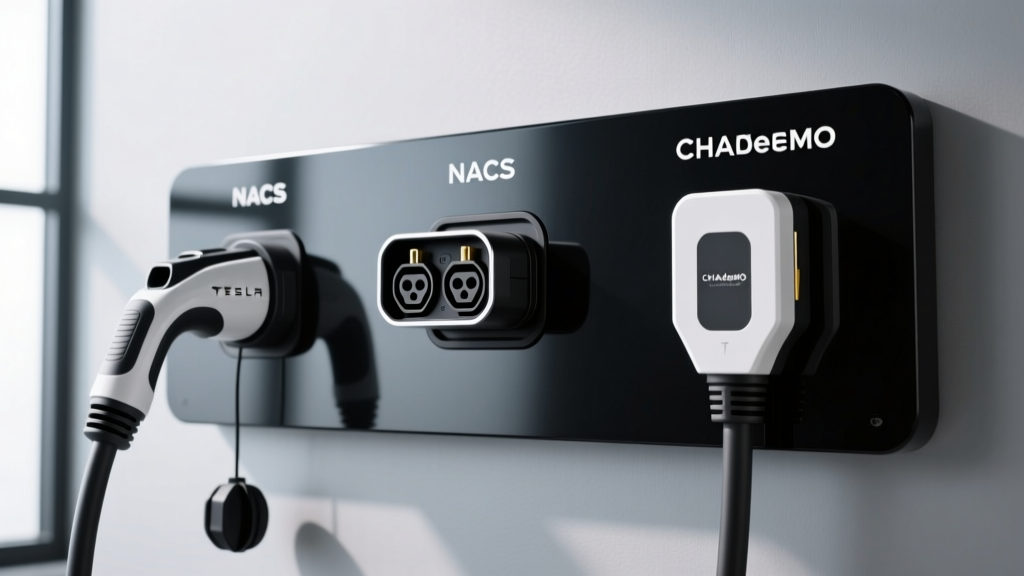
There are three main electric vehicle connectors in North America today: NACS (Tesla's North American Charging Standard, now the industry default), CCS1 (the previous standard used by most legacy automakers), and CHAdeMO (legacy Japanese standard, largely discontinued). For AC Level 2 home and destination charging, all modern EVs use either the native NACS plug or the J1772 connector with a simple adapter. As of 2026, nearly every new EV sold in the U.S. ships with a NACS port natively, giving you access to Tesla Superchargers and the growing NACS-equipped public network without an adapter.
If you're shopping for an EV or planning your charging setup, the plug on the car determines where you can charge, how fast you can charge, and whether you'll need to carry adapters. This isn't a minor detail — it directly affects road-trip convenience, daily charging costs, and long-term resale value. Let's break down each connector type with hard numbers, real-world compatibility, and what this means for your wallet.
Connector Types: Specs, Speeds, and Compatibility
Before we get into the weeds, here's the essential distinction: kW (kilowatts) measures the rate of power delivery — how fast electrons flow into your battery. kWh (kilowatt-hours) measures the total energy stored — your battery's tank size. A 250 kW charger doesn't deliver 250 kWh; it can theoretically add 250 kWh over one hour, though in practice charge curves taper well before that.
| Connector | Type | Max DC Rate | AC Level 2 | Network Access (2026) | Future Status |
|---|---|---|---|---|---|
| NACS | Combined AC/DC | Up to 350+ kW | Yes (native) | Tesla Supercharger, Electrify America, EVgo, ChargePoint, BP Pulse | Industry standard going forward |
| CCS1 | Combined AC/DC | Up to 350 kW | Via J1772 upper section | Electrify America, EVgo, ChargePoint (declining) | Being phased out; adapters available |
| CHAdeMO | DC only (separate AC plug) | Up to 400 kW (theoretical) | Requires J1772 for AC | Limited; mostly legacy stations | Discontinued for new vehicles |
| J1772 | AC only | N/A (AC) | Up to 19.2 kW | All Level 2 public & home chargers | Replaced by NACS for new EVs; adapters bridge the gap |
NACS: How Tesla's Plug Won the Connector War
Starting in 2024, Ford, GM, Rivian, Volvo, Polestar, Mercedes-Benz, BMW, Hyundai, Kia, and essentially every major automaker committed to adopting NACS on their vehicles. By the 2026 model year, the transition is largely complete. The new Ford Mustang Mach-E, Hyundai Ioniq 5, and GM's Ultium-based vehicles all ship with native NACS ports.
Why does this matter practically? NACS gives you native access to the Tesla Supercharger network — over 30,000 stalls in North America — without carrying an adapter. Superchargers consistently deliver 150–250 kW peak speeds, with V4 stalls capable of higher rates. More importantly, Tesla's network reliability consistently outpaces competitors; industry surveys show Supercharger uptime above 95%, compared to roughly 75–80% for other major networks.
For home Level 2 charging, NACS-equipped EVs use the same connector for both AC and DC, eliminating the need for a J1772-to-NACS adapter at destinations that still have J1772 cables. Most new home wall connectors now ship with NACS plugs as default.
CCS1 and CHAdeMO: What Legacy Connector Owners Need to Know
If you own a 2023 or earlier non-Tesla EV — say, a Volkswagen ID.4, Hyundai Ioniq 5 (pre-2025), or Chevrolet Bolt EV — your car has a CCS1 port. You're not stranded. Here's your adapter roadmap:
- CCS-to-NACS adapter: Priced between $150–$250 from reputable manufacturers. This unlocks Tesla Superchargers for CCS-equipped vehicles. Tesla sells an official adapter for ~$195.
- Charging speed caveat: When using an adapter on a Supercharger, expect peak rates around 150 kW for most CCS vehicles, limited by the vehicle's onboard charge controller, not the adapter itself.
- CCS public stations: Electrify America, EVgo, and ChargePoint still operate CCS-equipped stalls, but new installations increasingly favor NACS. Plan road trips with apps like PlugShare or A Better Routeplanner to confirm connector availability.
CHAdeMO is essentially a dead standard for new purchases. The Nissan Leaf and Mitsubishi Outlander PHEV were the last notable CHAdeMO vehicles. If you're considering a used Leaf, know that CHAdeMO DC fast-charging infrastructure is shrinking, and the Leaf's lack of active battery thermal management limits sustained charging speeds to roughly 50–70 kW in practice.
Real Costs: Connector Choice and Your Charging Budget
The connector on your EV affects not just where you charge, but what you pay. Here's a realistic ownership cost breakdown comparing a NACS-equipped 2026 EV against a comparable gas vehicle:
| Cost Factor | 2026 EV (NACS, 300 mi range) | 2026 Gas Sedan (30 MPG combined) |
|---|---|---|
| Home Level 2 charger install | $800–$2,000 (one-time, 240V/40A circuit) | $0 |
| Home charging cost (electricity) | ~$0.13/kWh avg → ~$4.30 per 100 miles (at 3.3 mi/kWh) | N/A |
| DC fast charging (road trips) | ~$0.35–$0.50/kWh → ~$11–$16 per 100 miles | N/A |
| Gasoline fuel cost | N/A | ~$3.40/gal → ~$11.30 per 100 miles |
| Annual fuel/energy (12,000 mi/yr, 85% home charging) | ~$600–$700 | ~$1,360 |
| Adapter costs (if needed) | $0–$250 | $0 |
| 5-year fuel/energy total | ~$3,000–$3,500 | ~$6,800 |
The connector matters here because NACS-native EVs can charge at Tesla Superchargers, which typically cost $0.25–$0.35/kWh for members — noticeably cheaper than Electrify America's $0.48–$0.64/kWh peak rates at many CCS stations. Over a few years of road trips, that's hundreds of dollars in savings.
EV vs. Gas vs. Hybrid: The Connector Factor in Your Decision
Connector availability should factor into whether you choose a full BEV, a PHEV, or stick with gas. Here's how the choice plays out based on real driving patterns:
| Scenario | BEV (NACS) | PHEV | Gas Vehicle |
|---|---|---|---|
| Daily commute (30 mi round trip) | Home charge overnight: ~$0.40/day | Electric-only: ~$0.45/day | ~$3.40/day |
| Weekly road trip (200 mi) | 1 DC fast charge: ~$25–$35 | Gas portion: ~$22 | ~$22 |
| Cold-weather range loss (20°F) | ~25–35% range reduction; more frequent charging stops | Gas engine compensates; minimal impact | No range loss (slightly lower MPG) |
| Apartment/no home charging | Reliant on public DC or workplace L2; higher cost ($0.35–$0.50/kWh) | Gas backup reduces charging urgency | Fuel anywhere in 5 minutes |
| Connector flexibility | NACS = widest network; CCS = adapter needed for Superchargers | J1772/NACS for AC; gas for distance | Universal fueling |
Common Misconceptions About EV Connectors
| Myth | Fact |
|---|---|
| "I can't charge a non-Tesla at a Supercharger." | Since 2024, Tesla has opened Superchargers to NACS-equipped non-Tesla EVs, and CCS vehicles can use an official adapter. As of 2026, most Supercharger stalls serve all NACS vehicles regardless of brand. |
| "Adapters are unreliable and slow charging." | Quality CCS-to-NACS adapters (Tesla, Lectron, A2Z) introduce negligible speed loss. The vehicle's onboard charge controller — not the adapter — determines peak kW. |
| "All Level 2 chargers use the same plug." | Older public L2 stations have J1772 cables. New installations increasingly use NACS. Carry a J1772-to-NACS adapter (~$40–$70) if your EV has a NACS port and you frequent older destinations. |
| "CHAdeMO charges faster than CCS or NACS." | While CHAdeMO theoretically supports 400 kW, no production vehicle uses that rate. In practice, the Nissan Leaf peaks around 50–70 kW due to passive battery cooling, far below the 200–350 kW achievable by CCS and NACS vehicles with active thermal management. |
| "I need a special connector for home charging." | Any Level 2 home charger (240V) works with your EV using the correct plug end. NACS-native EVs use NACS wall connectors; older EVs use J1772. The electrical circuit requirements are identical — a 40A/240V circuit delivers up to 9.6 kW regardless of plug shape. |
Your Decision Framework: Which Connector Setup Is Right for You?
Choose a NACS-native EV if:
- You want the widest DC fast-charging network access without adapters
- You road-trip more than 3,000 miles per year and value reliable, fast charging
- You're buying new in 2026 (it's the default for nearly every manufacturer)
- You want maximum resale value as the market consolidates around NACS
Choose a CCS-equipped EV (new or used) if:
- You're buying a 2023–2024 model at a steep discount and primarily charge at home
- You're willing to carry a $150–$250 CCS-to-NACS adapter for Supercharger access
- Your local public charging is predominantly Electrify America or EVgo with CCS stalls
Consider a PHEV instead of a BEV if:
- You lack reliable home or workplace Level 2 charging
- You regularly drive in extreme cold (below 10°F) where range loss exceeds 30%
- You frequently travel rural routes with sparse DC fast-charging coverage
- You want electric commuting (25–40 mi EV range) without any connector dependency for long trips
Stick with a gas vehicle if:
- You live in an apartment with zero charging access and no workplace chargers
- Your budget can't absorb the $5,000–$10,000 upfront EV premium even after the federal §30D tax credit (up to $7,500 with income, MSRP, and battery-sourcing requirements)
- You tow heavy loads regularly, where EV range drops 40–50% under load
Frequently Asked Questions
Can I charge a NACS car at a J1772 Level 2 station?
Yes. You'll need a J1772-to-NACS adapter, which costs $40–$70 and adds negligible bulk. Most NACS EV owners carry one for older destination chargers at hotels and shopping centers. The charging speed is identical — both deliver the same AC power from the station.
Will CCS charging stations disappear entirely?
Not overnight, but the trend is clear. New public charging installations in 2025–2026 overwhelmingly feature NACS connectors. Existing CCS stations will remain operational for years, but network operators are adding NACS cables to new and retrofitted stalls. CCS vehicle owners should plan to use adapters long-term.
Does the federal tax credit depend on which connector my EV has?
No. The IRS §30D clean vehicle credit eligibility depends on the vehicle's MSRP (≤$55,000 for sedans, ≤$80,000 for SUVs/trucks/vans), your adjusted gross income (≤$150K single / $300K joint), and battery critical-mineral and component sourcing requirements. Connector type has no bearing on credit qualification. The credit can be transferred to the dealer as a point-of-sale discount as of 2024.
What's the fastest-charging connector available today?
In practice, NACS and CCS1 are equivalent in maximum DC speed — both support vehicles capable of 350 kW peak charging. The actual speed depends on the vehicle's battery and thermal management. For example, the Hyundai Ioniq 5 with NACS peaks at ~240 kW (10–80% in ~18 minutes), while the Lucid Air with NACS can sustain over 300 kW under optimal conditions. The connector isn't the bottleneck; the vehicle is.
Do I need to upgrade my home electrical panel for a Level 2 charger?
Possibly. A standard Level 2 home charger draws 32–48A at 240V (7.7–11.5 kW). If your home has a 100A main panel that's already near capacity, you may need a panel upgrade to 200A, which costs $1,500–$3,000 from a licensed electrician. Homes with 200A service typically have sufficient headroom. Always get a professional load calculation before installation.
Is it worth buying a used CHAdeMO EV like the Nissan Leaf?
Only if the price is compelling and your needs are narrow. A used Leaf with 150–210 miles of EPA range can be had for $10,000–$15,000, making it one of the cheapest EVs available. However, CHAdeMO fast-charging stations are declining, the Leaf's passive battery cooling limits repeated fast-charging speeds, and battery degradation on older Leafs is more pronounced than on liquid-cooled EVs. It works as a second car or city commuter with home charging, but it's not a primary vehicle for most buyers.
The connector landscape has simplified dramatically. If you're buying new in 2026, NACS is your default and your best bet for long-term charging flexibility. If you're buying used or already own a CCS vehicle, a $200 adapter keeps you in the game. And if charging access remains a barrier, a PHEV gives you electric daily driving without betting your road trips on plug availability.